

Imagine buying cryptocurrency without giving your keys to anyone. No forms to fill out. No bank account linked. No middleman holding your money. That’s what a decentralized exchange (DEX) lets you do. Unlike traditional crypto platforms like Binance or Coinbase, DEXs don’t store your funds. You keep control. You trade directly with other people, using code instead of customer service reps. It’s not magic-it’s blockchain technology working the way it was meant to.
How DEXs Work: No Middlemen, Just Code
A decentralized exchange runs on smart contracts-self-executing programs on a blockchain. These contracts handle trades automatically. When you swap ETH for USDC, the contract checks if you have enough ETH, moves it to a pool, and sends you the USDC from that same pool. No one approves it. No one holds it. The code does everything. The most common type of DEX today uses something called an Automated Market Maker (AMM). Instead of matching buyers and sellers like a stock exchange, AMMs use math. Think of it like a vending machine: you put in one coin, you get another out based on a fixed formula. The most famous example is Uniswap, which launched in 2018 and now handles over 40% of all DEX trading volume. Here’s how it works: liquidity providers (people like you) deposit pairs of tokens-say, ETH and USDC-into a pool. The system keeps the ratio balanced using the formula x * y = k. If more people buy ETH, the ETH price rises slightly in the pool, and the system adjusts automatically. No order books. No brokers. Just math and money.DEX vs. Centralized Exchanges: The Real Differences
Most people start with centralized exchanges (CEXs) because they’re easy. You sign up, verify your ID, deposit cash, and trade. But there’s a catch: the exchange owns your crypto until you move it out. If they get hacked-or shut down-you could lose everything. That’s happened before. DEXs flip that model. You never give up control. Your wallet holds your keys. You sign each transaction yourself. That means:- You don’t need KYC (no ID checks)
- You can trade any token, even new ones no one’s heard of
- No one can freeze your account
- Every trade is public and verifiable on the blockchain
- Fiat on-ramps: You can buy crypto with USD, EUR, or GBP on Coinbase. On a DEX? You need crypto first.
- Speed and simplicity: CEX interfaces feel like Amazon. DEXs feel like building a PC from scratch.
- Liquidity for big trades: Bitcoin trades mostly on CEXs. DEXs are better for smaller, newer tokens.
Popular DEXs and How They’re Different
Not all DEXs are the same. Here are the big players and what makes them unique:- Uniswap (Ethereum): The original AMM giant. Handles $3+ billion in daily volume. V3 lets you set custom price ranges to earn more fees.
- PancakeSwap (BNB Chain): Faster and cheaper than Ethereum. Popular in Asia. Offers yield farming and lotteries.
- Curve Finance (Ethereum): Specializes in swapping stablecoins (like USDC, DAI, USDT) with near-zero slippage.
- dYdX (Ethereum Layer 2): Uses order books, not AMMs. Great for advanced traders doing margin or futures.
- 1inch: Not a DEX itself-it’s an aggregator. It searches 100+ DEXs to find the best price for your trade.

What You Need to Start
Using a DEX isn’t hard, but it’s not plug-and-play. Here’s what you need:- A crypto wallet: MetaMask (desktop/mobile) or Trust Wallet are the most common. Install it, create a password, and write down your 12-word recovery phrase. Never share it.
- Some crypto to trade: You’ll need ETH to pay for gas fees on Ethereum, or BNB for PancakeSwap. Buy it on a CEX first, then send it to your wallet.
- Network connection: Make sure your wallet is connected to the right blockchain. Don’t try to swap tokens on Ethereum if you’re on Solana.
- Understanding of slippage: This is the price change between when you click ‘swap’ and when the trade executes. Set it to 0.5% for stable pairs, 1-2% for volatile ones. Too low? Your trade fails. Too high? You get ripped off.
Big Risks: What Can Go Wrong
DEXs are powerful, but dangerous if you’re careless. Smart contract risk: Code can have bugs. In 2022, hackers stole $2.8 billion from DeFi protocols-65% of that came from DEXs. Uniswap’s code is audited and trusted. A new DEX with no reviews? Avoid it. Impermanent loss: If you provide liquidity, you’re not guaranteed profits. If the price of your tokens swings wildly, you could end up with less value than if you’d just held them. For stablecoin pairs, it’s usually 5-15% a year. For volatile tokens? Up to 35%. Front-running and sandwich attacks: Bots watch for big trades and jump in front of them, buying before you and selling after. This steals money from users. It’s estimated that $500 million to $700 million is lost this way every month. Scams: Fake tokens. Fake DEX sites. Phishing links. Always check the contract address. Uniswap’s official address is on their website. Don’t trust Google results.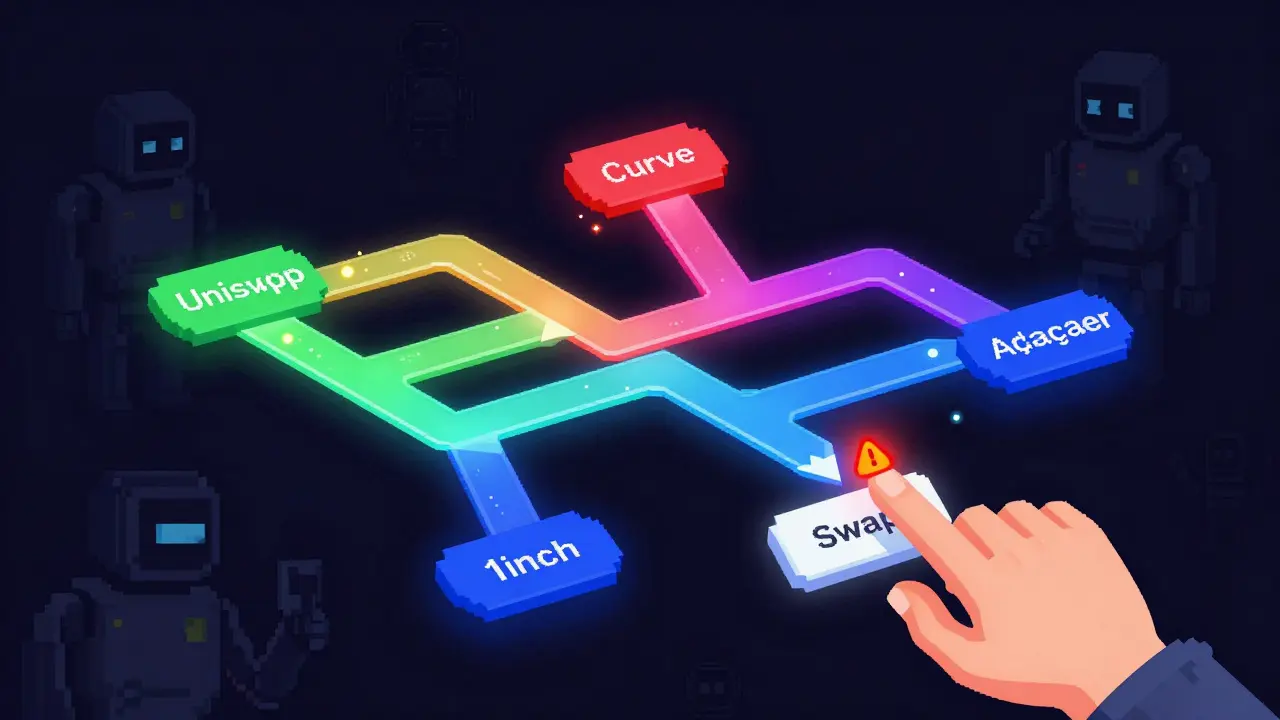
Who Uses DEXs-and Why
DEX users fall into two groups: Beginners: They struggle. They pay $50 in gas to swap $200 worth of tokens. They approve unlimited allowances and get hacked. They get frustrated and go back to Coinbase. Experienced users: They use DEXs because they can earn yield. By locking ETH and USDC into Uniswap’s v3 pool, some make 20-30% annual returns. Others use DEXs to buy new tokens before they list on CEXs. SHIB, DOGE, and thousands of others started on DEXs. The early buyers made millions. Reddit threads show both sides. One user lost $200 because they didn’t understand slippage. Another made $15,000 by providing liquidity to a new token pool and harvesting rewards with Yearn Finance.The Future: What’s Coming Next
DEXs aren’t standing still. Here’s what’s changing:- Layer 2 scaling: Ethereum’s Dencun upgrade (early 2024) will cut DEX fees by up to 100x. That’s huge.
- Uniswap v4: Launching in Q1 2024, it lets developers build custom trading logic-like auto-compounding pools or time-based trades.
- Regulation: The SEC fined Uniswap Labs $50 million in October 2023 for operating an unregistered exchange. More legal pressure is coming.
- Hybrid models: Coinbase and Binance now integrate DEX aggregators into their apps. You get the ease of a CEX with the liquidity of a DEX.
Final Thoughts: Are DEXs Right for You?
If you’re new to crypto, start with a CEX. Learn how wallets work. Understand gas fees. Learn what a transaction hash is. Then try a small trade on Uniswap with $50. If you’re experienced and care about control, privacy, and access to new assets? DEXs are the future. You’re not just trading-you’re helping build a financial system that doesn’t need banks. DEXs aren’t perfect. But they’re the closest thing we have to true financial freedom on the internet. And that’s worth learning.Are decentralized exchanges safe?
DEXs are safe if you know what you’re doing. Since you hold your own keys, there’s no risk of the exchange getting hacked. But smart contracts can have bugs, and scams are common. Always double-check contract addresses, avoid unlimited approvals, and never click links from unknown sources. Use trusted platforms like Uniswap or Curve, and start with small amounts.
Do I need to verify my identity to use a DEX?
No. One of the biggest advantages of DEXs is that they don’t require KYC. You don’t need to submit ID, proof of address, or any personal info. This makes them popular in countries with strict financial controls. However, some DEX aggregators or integrated services (like Coinbase’s DEX feature) may require KYC if they handle fiat on-ramps.
Can I trade fiat currency on a DEX?
Not directly. DEXs only support crypto-to-crypto trades. To trade USD, EUR, or other fiat, you need to buy crypto first on a centralized exchange like Coinbase or Kraken, then send it to your wallet. From there, you can swap it on a DEX. Some platforms are starting to bridge this gap-like Coinbase’s new DEX integration-but the actual swap still happens between crypto assets.
What’s the difference between AMM and order book DEXs?
AMM DEXs like Uniswap use math formulas to set prices based on token ratios in liquidity pools. Order book DEXs like dYdX work like traditional stock exchanges-you place buy and sell orders, and trades happen when they match. AMMs are simpler and better for most users. Order books are better for advanced traders doing large or leveraged trades.
Why do I need to pay gas fees on a DEX?
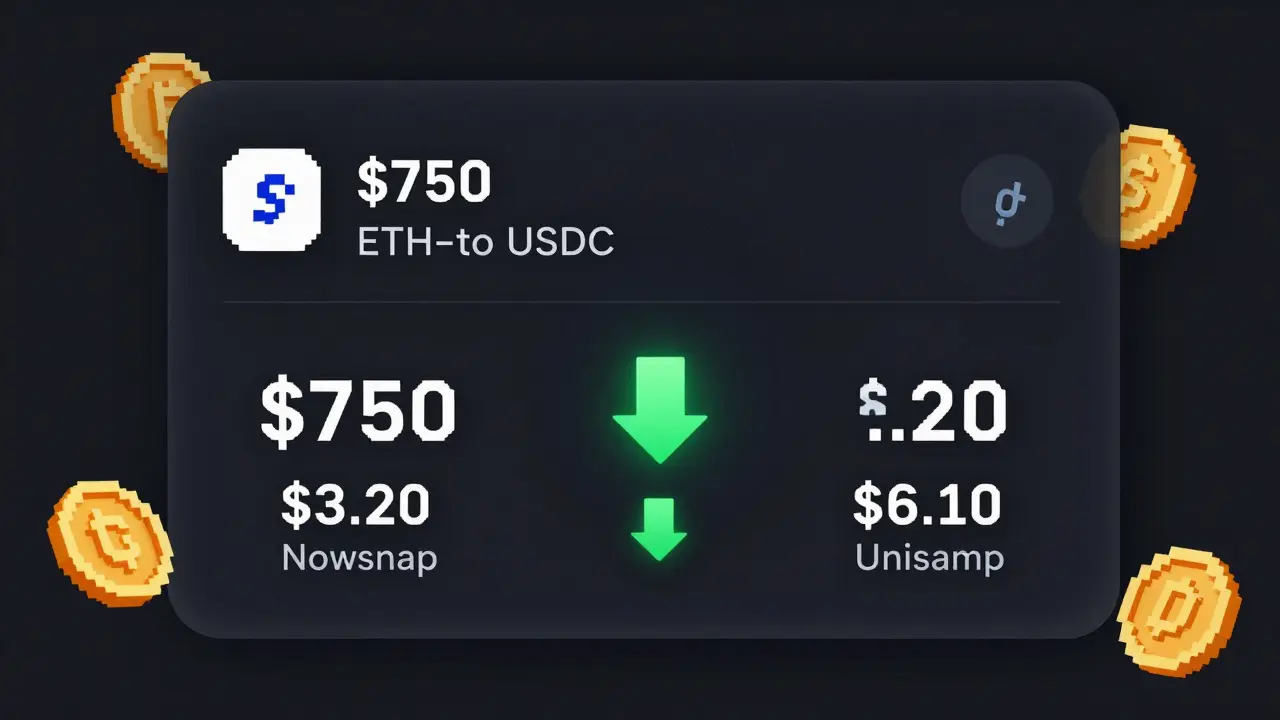
Gas fees pay miners or validators to include your transaction on the blockchain. Every swap, approval, or withdrawal costs gas because it changes the state of the network. On Ethereum, fees vary based on demand-usually $0.50 to $5. On faster chains like BNB Chain or Solana, fees are often under $0.10. You can reduce fees by trading during off-peak hours or using Layer 2 networks like Arbitrum or Base.
What is impermanent loss?
Impermanent loss happens when you provide liquidity to a DEX pool and the price of the two tokens changes. Even if the total value of your tokens goes up, you might end up with less than if you’d just held them. For example, if you put in 1 ETH and 200 USDC, and ETH doubles in price, the pool rebalances and you get back less ETH than you started with. It’s called ‘impermanent’ because if prices return to original levels, the loss disappears. But if they don’t, it becomes permanent. Stablecoin pairs have low impermanent loss; volatile pairs can lose you 15-35%.
Can I lose money just by using a DEX?
Yes, and it’s not always because of scams. You can lose money through high gas fees on small trades, slippage on volatile tokens, impermanent loss from liquidity provision, or accidentally approving a malicious contract. Most losses come from inexperience-not hacking. Always test with small amounts, read warnings, and never rush. Use tools like Revoke.cash to check and cancel token approvals you no longer need.
Valencia Adell
January 11, 2026 AT 10:36DEXs are just a glorified gambling den for people who think they’re smarter than the market. You don’t own anything. You’re just betting on code written by teenagers who’ve never seen a balance sheet. And don’t even get me started on ‘impermanent loss’-that’s just crypto-speak for ‘you lost money and now you’re crying about it.’
Sarbjit Nahl
January 13, 2026 AT 02:29The notion of decentralization as liberation is a romantic illusion. The blockchain is not a moral architecture. It is merely a distributed ledger governed by algorithmic determinism. The absence of intermediaries does not equate to freedom-it equates to responsibility without recourse. One must ask: is autonomy worth the cost of systemic fragility?
Paul Johnson
January 14, 2026 AT 07:36lol why do people even care about this dex stuff you just need to buy btc on coinbase and chill. i tried uniswap once and paid 40 bucks in gas to swap 20 bucks of eth. total waste. also never click approve unlimited. i lost 300 bucks that way. dumb
Meenakshi Singh
January 15, 2026 AT 12:18DEXs are where the real magic happens 🌟 I made 12k last month just by adding liquidity to a new memecoin pool. Yes, you read that right. 12k. But also yes, I lost 8k on a rug pull before that. It’s a rollercoaster. But hey, if you’re not taking risks, you’re not living. 💸🚀
Kelley Ramsey
January 17, 2026 AT 03:41This is such an important guide! I’m so glad someone finally broke this down clearly. I was terrified to try a DEX, but now I feel empowered. I just swapped my first 50 dollars on Uniswap yesterday-and I didn’t die! I even understood slippage! Thank you for making this feel accessible. 💙
Michael Richardson
January 18, 2026 AT 04:57DEXs? More like Dumb Exchanges. America runs on banks. If you want real finance, use a bank. If you want chaos, go play with your crypto toys in your basement.
Sabbra Ziro
January 19, 2026 AT 02:29Thank you for writing this with so much care. I’ve seen so many people get burned by DEXs because they’re rushed into it. But this guide? It’s balanced. It shows the risks without fearmongering, and the potential without hype. I’m sharing this with my niece who just started learning about crypto. She needs this.
Krista Hoefle
January 20, 2026 AT 03:48Uniswap v4? More like Uniswap v4: Now with 200% more complexity for people who still don’t know what a wallet is. I’m tired of crypto pretending it’s innovation when it’s just reinventing the wheel… poorly.
sathish kumar
January 21, 2026 AT 09:32The emergence of decentralized exchanges represents a paradigmatic shift in financial architecture. The absence of custodial intermediaries aligns with the foundational principles of blockchain as articulated in Nakamoto’s whitepaper. However, the regulatory vacuum in jurisdictions such as the United States presents a structural contradiction between technological possibility and legal legitimacy.
Surendra Chopde
January 21, 2026 AT 15:09I started with DEXs after losing money on a CEX hack. Now I only use MetaMask and always check contract addresses. The first time I swapped tokens, I thought I’d be hacked. But now? I feel safer than ever. The key is patience and double-checking everything. No rush.
Tiffani Frey
January 22, 2026 AT 18:04One thing that’s rarely discussed: DEXs enable financial inclusion for people in countries where banks are inaccessible or politically unreliable. In parts of Africa, Southeast Asia, and Latin America, DEXs are not a luxury-they’re a lifeline. This isn’t just about trading. It’s about sovereignty.
Mollie Williams
January 23, 2026 AT 16:00There’s something almost poetic about trading through code. No gatekeepers. No human bias. Just mathematics and mutual consent. It’s like the internet was meant to be: open, permissionless, and governed by logic rather than authority. Yet we still treat it like a casino. Maybe that’s the tragedy-not the tech, but how we use it.
Tre Smith
January 24, 2026 AT 14:27Let’s be real: 95% of DEX users are retail gamblers with no understanding of liquidity pools, slippage, or gas optimization. The remaining 5% are bots. The system is designed to extract value from the naive. The fact that people call this ‘financial freedom’ is the greatest con of the decade.
Ritu Singh
January 25, 2026 AT 09:24Did you know the SEC is working with big banks to kill DEXs? They’re scared. Because if people stop trusting banks and start using code, the whole system collapses. That’s why they fined Uniswap. It’s not about regulation-it’s about control. The banks don’t want you to have power. They want you to be dependent.
kris serafin
January 26, 2026 AT 21:31Just tried Curve for the first time to swap USDC to DAI. Zero slippage. 0.03 gas fee. Mind blown 🤯 If you’re holding stablecoins, this is your best friend. Also, always use Revoke.cash. Saved me from a shady approval. You’re welcome.
Jordan Leon
January 28, 2026 AT 19:15The true value of DEXs lies not in profit, but in the quiet dignity of self-sovereignty. To hold your keys is to hold your autonomy. This is not merely economic-it is existential. We are not trading tokens. We are reclaiming agency.
Rahul Sharma
January 29, 2026 AT 22:02DEX is very good for small traders. But you must know about gas fee and slippage. Always use 1inch to find best price. And never trust new token without audit. I lost money once, now I am careful. Good guide.
Calen Adams
January 30, 2026 AT 17:54DEXs are the future of finance. Period. Layer 2s are about to make gas fees irrelevant. Uniswap v4 is going to let you create custom pools that auto-compound your yield. This isn’t crypto hype-it’s the next evolution of capitalism. If you’re not building or participating, you’re getting left behind. Get in now or get erased.
Emily Hipps
January 30, 2026 AT 19:29Thank you for this. I’ve been trying to explain DEXs to my mom for months. She thought I was crazy. Now I’m sending her this. She actually said, ‘Wait, so I don’t need to give them my SSN?’ YES, MOM. YES.
Jessie X
January 30, 2026 AT 23:44I used to hate DEXs. Too confusing. Too many warnings. Then I spent a weekend learning. Now I make more from liquidity mining than my side hustle. It’s not magic. It’s math. And math doesn’t lie.
Kip Metcalf
January 31, 2026 AT 21:39Been using DEXs for 3 years. Lost money. Made money. Got scammed once. Learned. Still here. It’s not about winning. It’s about staying curious. And not being an idiot.
Frank Heili
February 2, 2026 AT 06:30One thing nobody talks about: DEXs are the only place where you can trade tokens before they’re listed on Binance. I bought PEPE at 0.0000001 ETH. Now it’s 0.000002. That’s 2000x. You won’t find that on Coinbase. Ever. DEXs are the wild west-but the gold is real.
Natalie Kershaw
February 3, 2026 AT 20:58Hey newbies-don’t panic when your trade fails. That’s normal. Gas spikes. Slippage hits. It’s not you, it’s the network. Just wait an hour, check Revoke.cash, and try again. You got this. And if you’re feeling overwhelmed? Take a walk. Crypto will still be there tomorrow.
Jacob Clark
February 5, 2026 AT 19:19Okay, but have you heard about the new MEV bot that front-runs every single DEX trade? I’ve been watching the blockchain for months. The average retail trader loses 7-12% per trade to bots. That’s not a feature. That’s a rigged game. And the devs? They’re laughing all the way to the bank. This isn’t decentralization. It’s algorithmic exploitation.
Valencia Adell
February 7, 2026 AT 13:21You think you’re clever with your ‘liquidity mining’? You’re just feeding the machine. The bots know your patterns. The devs know your wallet. You think you’re in control? You’re just another data point in their profit model. Wake up.