
When memecoins explode on Solana, they don’t just launch-they migrate. And until PumpSwap came along, that migration was a costly, frustrating mess. If you’ve ever lost over $1,000 in SOL fees just to move a new token from Pump.fun to Raydium, you know exactly what I’m talking about. PumpSwap, launched on March 19, 2024, didn’t just improve that process-it erased it. This isn’t another DEX trying to be Uniswap. It’s a laser-focused tool built for one thing: making memecoin trading seamless for the people actually trading them.
How PumpSwap Solves the Memecoin Migration Problem
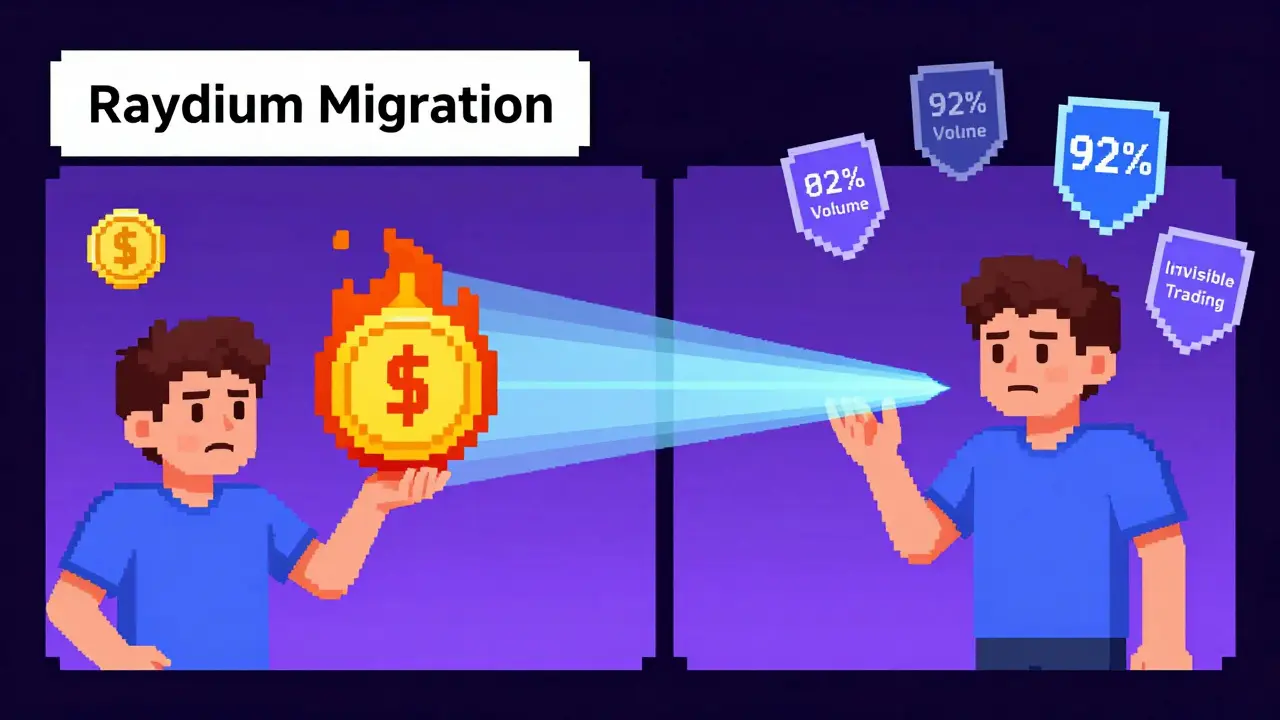
Before PumpSwap, launching a memecoin on Pump.fun meant one thing after the bonding curve ended: manual migration to Raydium. You had to sign multiple transactions, pay a 6 SOL fee (around $1,200 at the time), and wait for confirmation. For small-time creators and traders, that fee wasn’t just a cost-it was a barrier. PumpSwap changed all that. The moment a token finishes its Pump.fun bonding curve, it auto-migrates to PumpSwap. No wallet connects. No fee pays. No delay. It just happens. This single feature cut migration friction by 95% and turned PumpSwap into the default home for newly launched memecoins.By May 2024, PumpSwap had processed over $18 billion in total trading volume. That’s not a typo. In just 50 days, it hit $100 million in total value locked (TVL), making it Solana’s second-largest DEX by volume. Why? Because 92% of its trades still come from tokens that started on Pump.fun. It’s not competing with Raydium for general trading-it’s owning the onboarding pipeline.
Trading on PumpSwap: What You Actually Get
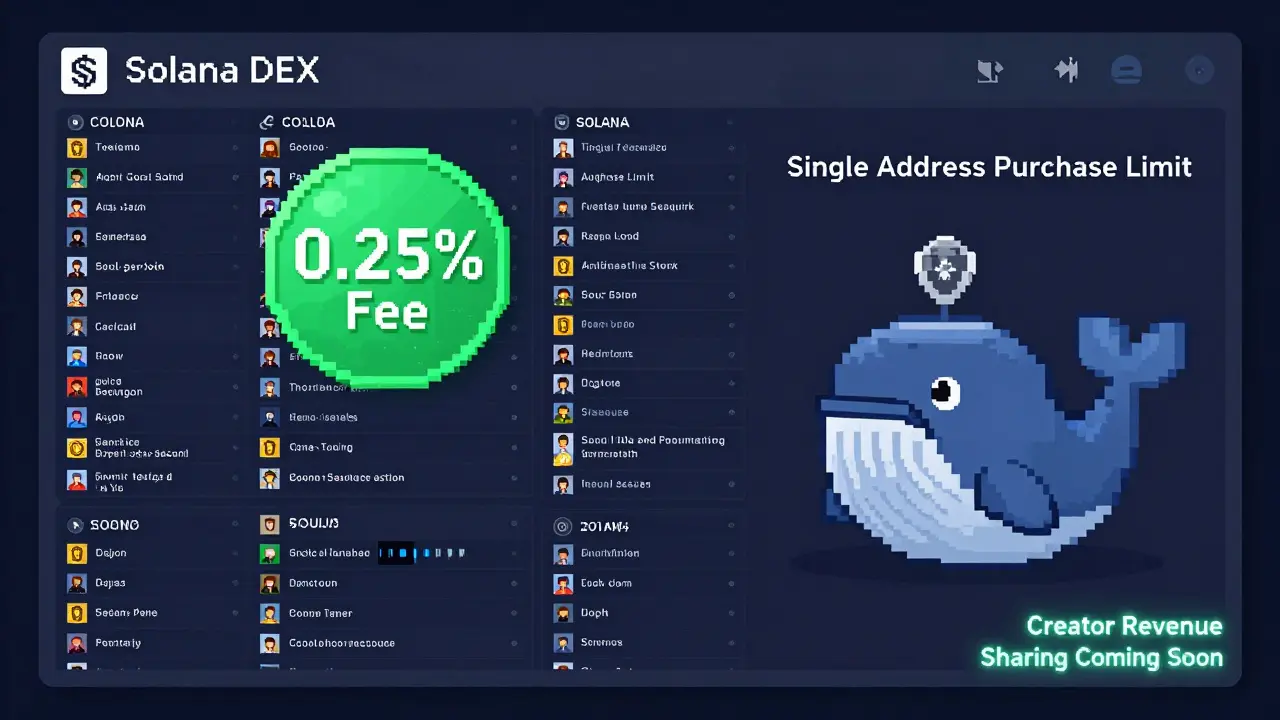
PumpSwap runs on Solana’s fast, low-cost network, so trades settle in under a second. The fee structure is simple: 0.25% per swap. Of that, 0.20% goes straight to liquidity providers. The remaining 0.05% feeds into the protocol treasury-no hidden cuts, no middlemen. You don’t need a special wallet. Just use Phantom, Solflare, or any Solana-compatible wallet. No KYC. No sign-up. Just connect and swap.One of its most underrated features is the Single Address Purchase Limit. You can set a maximum buy amount per wallet-down to as little as 0.5 SOL. This isn’t just a convenience; it’s a rug-pull shield. Many new memecoins get dumped by whales the second they launch. With this limit, pump-and-dumps become harder to execute. Users on Reddit and Solana Discord have repeatedly praised this feature. One trader said, “I’ve seen 10 tokens crash in the first hour. PumpSwap’s limit saved me from buying 100x my intended amount.”
Another standout is Invisible Trading. This isn’t marketing fluff. It’s a technical layer that randomly encrypts trade paths to prevent bots from front-running. Before this, bots would detect large buys on Pump.fun and snipe the token the second it went live on Raydium. PumpSwap’s system reduces front-running by an estimated 70%, according to internal data shared with CryptoSlate. That means more fair pricing for regular users.
PumpSwap vs. Raydium: The Real Comparison
Raydium is still Solana’s biggest DEX, handling nearly half of all trading volume. But here’s the catch: Raydium is a general-purpose AMM. PumpSwap is a memecoin express lane.| Feature | PumpSwap | Raydium |
|---|---|---|
| Primary Use Case | New memecoins from Pump.fun | General crypto trading |
| Migration Fee | $0 (automatic) | 6 SOL (~$1,200) |
| Trading Fee | 0.25% | 0.25% |
| Liquidity for New Tokens | Very high (92% of volume) | Low (requires manual liquidity addition) |
| Bot Protection | Invisible Trading (70% reduction) | None |
| Market Share (May 2024) | 14.5% | 46.1% |
| Creator Incentives | Planned revenue sharing (not yet live) | $RAY buyback (25% of fees) |
Raydium wins if you’re trading established tokens like $SOL, $JTO, or $SRM. It has deeper pools, better multi-quote support, and a buyback mechanism that rewards $RAY holders. But if you’re buying a new memecoin that just launched on Pump.fun? PumpSwap is the only option that makes sense. It’s faster, cheaper, and smarter for that exact use case.
What’s Coming Next: The Creator Revenue Sharing Model
PumpSwap’s biggest unanswered question is the Creator Revenue Sharing Model. Announced in March 2024 and still not live as of May 2024, this feature promises to distribute a portion of the 0.05% protocol fee directly to token creators. Think of it like this: if a memecoin you launched on Pump.fun trades $10 million on PumpSwap, you get a cut. Not a small cut-a meaningful one. Industry estimates suggest this could pay out millions to creators over time.Why does this matter? Right now, most memecoin creators walk away with nothing after launch. PumpSwap could change that. If implemented well, it turns creators into long-term stakeholders instead of one-time pumpers. Analysts at Panews Lab believe this could be the key to pushing PumpSwap past 25% market share by Q4 2024. But there’s skepticism. BeInCrypto pointed out that without clear rules and timelines, this feature could remain a marketing promise. The team has been quiet since March. No roadmap. No dates. That’s a red flag.
Real User Experiences: The Good, The Bad, The Ugly
User feedback is overwhelmingly positive-for the right use case. On Reddit, a user named MemeTrader89 wrote: “PumpSwap saved me 6 SOL on my last token migration-that’s over $1,000.” That sentiment repeats across dozens of posts. The interface is simple. The speed is unmatched. The fee savings are real.But there are downsides. Some users report high slippage on brand-new tokens with tiny liquidity pools. One trader on Solana Discord said, “PumpSwap’s great for established tokens, but sometimes slippage hits hard on brand new ones.” That’s not a bug-it’s a feature of the market. New tokens = low liquidity = wild price swings. PumpSwap doesn’t fix that. It just makes trading them possible.
Another issue: the platform lacks advanced trading tools. No limit orders. No charting. No stop-losses. It’s a swap-only interface. If you’re used to trading on Uniswap or dYdX, this will feel barebones. But if you’re just buying and selling memecoins? You don’t need those tools. You need speed and reliability. PumpSwap delivers that.
Who Is PumpSwap Really For?
PumpSwap isn’t for everyone. If you’re trading Bitcoin, Ethereum, or Solana-native blue chips, stick with Raydium or Jupiter. But if you’re into memecoins? This is the platform you’ve been waiting for.- Buyers of new memecoins: You get instant access, lower front-running risk, and no migration fees.
- Creators launching on Pump.fun: Your token goes live automatically. No extra work. No extra cost.
- Traders who want speed: 4.2 million swaps in one day? That’s not luck. That’s Solana’s speed, optimized.
It’s not for long-term investors. It’s not for stablecoin traders. It’s not for DeFi power users. It’s for the wild, fast, chaotic world of memecoins-and that’s exactly where it shines.
Final Verdict: Is PumpSwap Worth It?
PumpSwap isn’t perfect. It’s narrow. It’s dependent on Pump.fun. It lacks advanced features. But it doesn’t need to be perfect. It just needs to solve one problem better than anyone else-and it does. The elimination of the 6 SOL migration fee alone makes it revolutionary. The auto-migration, Invisible Trading, and purchase limits are thoughtful, user-first features that show real understanding of the problem.Its growth speaks for itself. From zero to $18 billion in volume in under two months. From 236 users to over 385,000 lifetime traders. That’s not hype. That’s adoption. If you’re trading memecoins on Solana, PumpSwap isn’t an option-it’s the default. Ignore it at your own risk.
Is PumpSwap safe to use?
Yes, but with context. PumpSwap underwent nine independent security audits before launch and plans to open-source its code. It runs on Solana, which is a secure and battle-tested blockchain. However, like all DEXs, it doesn’t protect you from bad tokens. If you trade a rug-pull memecoin, you lose money-not because PumpSwap is hacked, but because the token itself is worthless. Always do your own research on the project before trading.
Do I need to pay fees to use PumpSwap?
You pay a 0.25% trading fee on every swap, which is standard for DEXs. But you don’t pay any fees to migrate your token from Pump.fun to PumpSwap-that’s free and automatic. No SOL is taken from your wallet during migration. The only fees you’ll ever see are the 0.25% swap fee and Solana’s network gas (which is typically less than $0.01 per transaction).
Can I trade any token on PumpSwap?
Technically, yes-but practically, no. PumpSwap is optimized for tokens that launched on Pump.fun. Over 92% of its trading volume comes from those tokens. You can manually add liquidity for other tokens, but you’ll find very little trading activity for them. If you’re trying to trade a token that didn’t come from Pump.fun, you’re better off using Raydium or Jupiter.
How do I get started with PumpSwap?
First, set up a Solana wallet like Phantom or Solflare. Fund it with SOL. Go to pumpsolana.com (the official site). Connect your wallet. That’s it. You can start swapping immediately. If you’re buying a new memecoin that just finished its Pump.fun launch, you’ll see it listed automatically. No setup, no waiting.
Will PumpSwap replace Raydium?
No-and it doesn’t need to. PumpSwap and Raydium serve different purposes. Raydium is the Swiss Army knife for general crypto trading on Solana. PumpSwap is the specialized tool for memecoins that start on Pump.fun. They coexist. In fact, PumpSwap’s success has pressured Raydium to improve its own migration tools. The market is better off with both.




Brenda White
March 19, 2026 AT 05:44Lucy de Gruchy
March 19, 2026 AT 15:26Angelica Stovall
March 20, 2026 AT 06:15Konakuze Christopher
March 21, 2026 AT 12:22Ernestine La Baronne Orange
March 21, 2026 AT 21:03Manali Sovani
March 22, 2026 AT 15:42Tobias Wriedt
March 24, 2026 AT 12:48Taylor Holloman.
March 24, 2026 AT 23:39Bryan Roth
March 25, 2026 AT 13:15S F
March 26, 2026 AT 18:39Sahithi Reddy
March 27, 2026 AT 20:59sai nikhil
March 29, 2026 AT 08:48George Hutchings
March 30, 2026 AT 23:16