

You built a slick little tool on the weekend. It solves a problem you had. Now people want to pay for it. But you don't have an LLC. You aren't registered as a merchant with a bank. And frankly, you just want to code, not fill out compliance forms. Can you accept crypto payments without turning your hobby into a regulated financial institution?
The short answer is yes. In most major jurisdictions, including the US and the EU, simply accepting cryptocurrency like Bitcoin or Ethereum for goods or services does not automatically make you a money transmitter or a licensed exchange. However, it does trigger specific tax obligations that you need to handle correctly from day one.
The Legal Line: Merchant vs. Financial Institution
To understand where you stand, you have to look at what regulators actually target. Agencies like the FinCEN in the US or the AML authorities in Europe are primarily concerned with entities that move money *for others*. If you run an exchange where users trade coins, or if you hold funds in custody for clients, you are a Virtual Asset Service Provider (VASP). That requires licenses, audits, and mountains of paperwork.
If you are a solo developer selling a digital asset-say, a plugin, a course, or API access-and you receive payment directly into your own wallet, you are acting as a merchant. You are not transmitting value between third parties; you are exchanging your product for currency. According to guidance from legal firms like Vicox Legal and payment giants like Square, this activity generally does not require a special money-transmitter license. You are treated much like a freelancer who accepts a check or a wire transfer, except the currency happens to be digital.
This distinction is vital. It means you can keep your operation lean. You do not need to incorporate a company just to turn on a payment button. You can operate as a sole proprietor or self-employed individual, provided you stay within the boundaries of selling your own output rather than facilitating transactions for others.
Tax Reality: Crypto Is Property, Not Cash
While you might avoid regulatory licensing, you cannot escape the tax man. This is where many side-project owners trip up because they treat crypto like cash in their pocket. In the eyes of the IRS and most global tax authorities, cryptocurrency is classified as property.
Here is how that works in practice. Imagine someone buys your software for 0.01 BTC. On the day they pay, that 0.01 BTC is worth $600. You must report $600 of income on your taxes for that year. That is your gross receipt. But you now hold an asset valued at $600. If you hold onto that Bitcoin and its price doubles to $1,200 before you sell it, you have two taxable events:
- Income Tax: On the original $600 value when you received the payment.
- Capital Gains Tax: On the $600 profit ($1,200 sale price minus $600 cost basis) when you eventually convert it to fiat currency.
This creates a unique accounting burden. Unlike receiving a credit card payment where the dollar amount is fixed, every crypto transaction requires you to record the exact fair market value at the precise moment of receipt. If you ignore this and only report what you end up spending after converting months later, you risk underreporting income and facing penalties during an audit.
For small side projects, the solution is often simplicity: convert immediately. By using a processor that instantly swaps incoming crypto for your local currency, you eliminate the capital gains tracking headache. The income is clear, the volatility is gone, and your books look just like any other freelance invoice.
Choosing Your Payment Architecture
How you accept the money determines how much "business" work you have to do. There are three main ways to set this up, ranging from high-effort DIY to fully managed solutions.
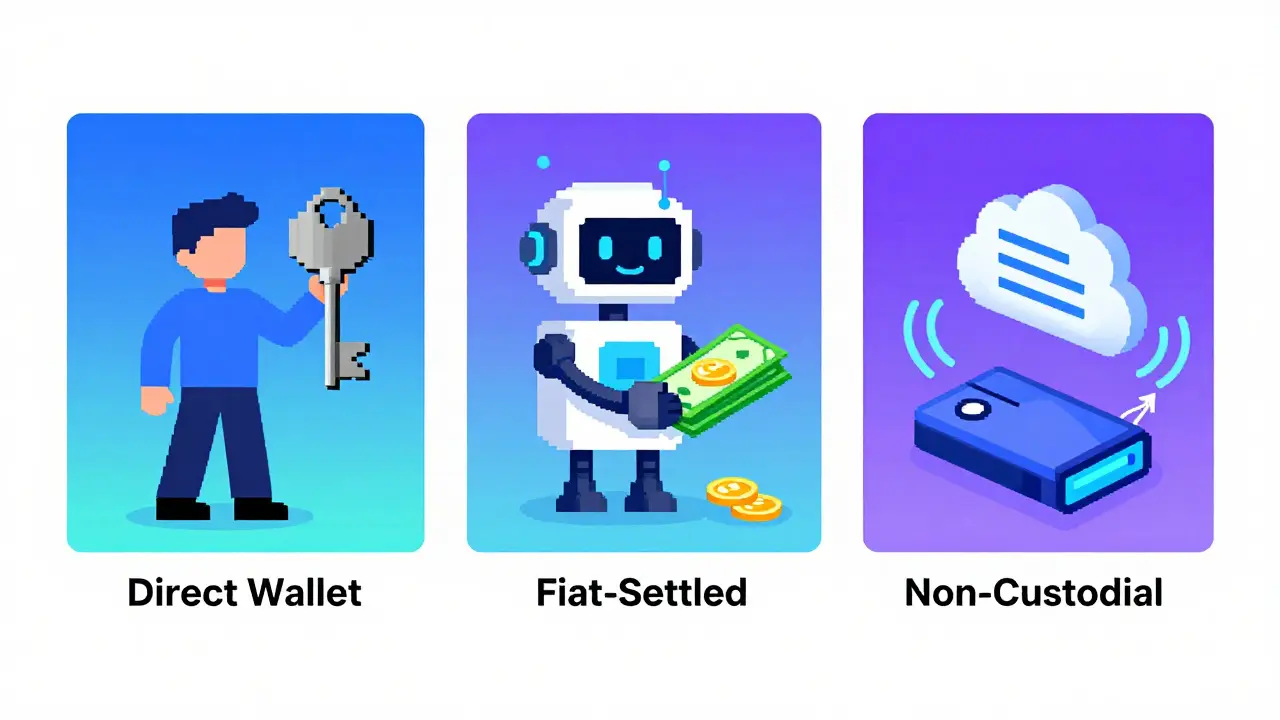
| Model | Custody Risk | Tax Complexity | Best For |
|---|---|---|---|
| Direct Wallet | High (You hold keys) | High (Track every tx) | Hobbyists, zero fees |
| Fiat-Settled Gateway | None (Platform holds) | Low (Fiat reports) | Sellers wanting simplicity |
| Non-Custodial Gateway | Low (Self-custody) | Medium (Automated logs) | Privacy-focused founders |
Direct Wallet Payments: You publish your public address, customers send funds, and you monitor the blockchain. This has zero processing fees, but it puts the entire burden of security and accounting on you. If you lose your seed phrase, the money is gone forever. Plus, you have to manually track every single transaction for tax purposes.
Fiat-Settled Gateways: Services like BitPay or Coinbase Commerce allow customers to pay in crypto, but the service provider converts it and deposits USD (or EUR) into your bank account. This is the closest experience to Stripe. You never touch the crypto. It simplifies taxes immensely because you are just reporting fiat income. However, these platforms often require KYC (Know Your Customer) checks and may freeze funds if they suspect irregular activity.
Non-Custodial Gateways: This is a newer model gaining traction among indie developers. Platforms like TxNod sit in the middle. They provide the invoicing interface and webhook notifications, but the funds settle directly to your personal hardware wallet (like a Ledger or Trezor). The platform never touches your private keys or the funds. This gives you the ease of a checkout page with the security of self-custody. Since there is no central balance holding your money, there is no risk of the platform freezing your assets or going bankrupt with your funds inside.
Volatility and Chargebacks: The Hidden Costs
One major advantage of crypto is the elimination of chargebacks. When a customer pays with a credit card, they can dispute the charge weeks later, potentially costing you the product and the revenue. Blockchain transactions are irreversible. Once the network confirms the payment, it is done. For digital goods, this is a massive relief.
However, volatility remains a threat. If you accept volatile assets like Bitcoin or Ether and hold them, your revenue could shrink by 20% overnight. Most serious operators mitigate this by either converting immediately to stablecoins (like USDC or USDT) or using a gateway that auto-converts to fiat. Stablecoins offer the speed and borderless nature of crypto with the price stability of traditional currency, making them ideal for pricing your side project's offerings.
When Does a Hobby Become a Business?
Tax authorities distinguish between a hobby and a business based on intent and regularity, not the payment method. If you are consistently trying to make a profit, keeping records, and operating with continuity, you are likely running a business-even if it's just you on a laptop.
Accepting crypto doesn't force this classification, but generating regular income does. Once you cross certain revenue thresholds in your country, you may need to register for VAT or sales tax. In the EU, for example, you must issue invoices in euros (or your local fiat), calculating the value of the crypto at the time of the transaction. Ignoring these requirements because "it's just a side project" is a common mistake that leads to significant fines down the road.
The key takeaway is that the technology of payment shouldn't dictate your legal structure, but your volume and consistency will. Start simple, keep meticulous records of every transaction hash and its fiat equivalent, and consider using tools that automate this data collection.
Next Steps for Solo Operators
If you are ready to enable crypto payments on your site today, start by deciding if you want to hold the assets or convert them. If you want simplicity, a fiat-settled processor is the easiest path. If you value sovereignty and want to avoid platform censorship or freezes, a non-custodial solution allows you to retain full control while still offering a professional checkout experience.
Regardless of the route, ensure your accounting system can handle crypto entries. Whether you use specialized software or a well-organized spreadsheet, capturing the date, amount, and fiat value at the time of receipt is non-negotiable for staying compliant.
Do I need to register a company to accept Bitcoin?
Generally, no. You can accept cryptocurrency as a sole proprietor or individual. Licensing requirements typically apply to exchanges and custodians, not merchants selling their own goods or services.
How do I calculate taxes on crypto payments?
You must report the fair market value of the crypto in your local currency at the exact time you received the payment as income. If you later sell the crypto for more or less than that value, you also owe capital gains or claim a loss on the difference.
Can my side project get frozen if I accept crypto?
If you use a centralized processor, yes, they can freeze funds if they suspect policy violations. If you use a non-custodial gateway where funds go straight to your hardware wallet, this is structurally impossible because the platform never holds your money.
Is it better to accept stablecoins or Bitcoin?
For predictable revenue, stablecoins like USDC are better because their value doesn't fluctuate wildly. Bitcoin is great for brand alignment and adoption but introduces volatility risk unless you convert it to fiat immediately upon receipt.
What is a non-custodial payment gateway?
It is a service that generates invoices and monitors the blockchain for payments, but sends the funds directly to your personal wallet. The service provider never accesses your private keys or holds your assets, eliminating counterparty risk.