
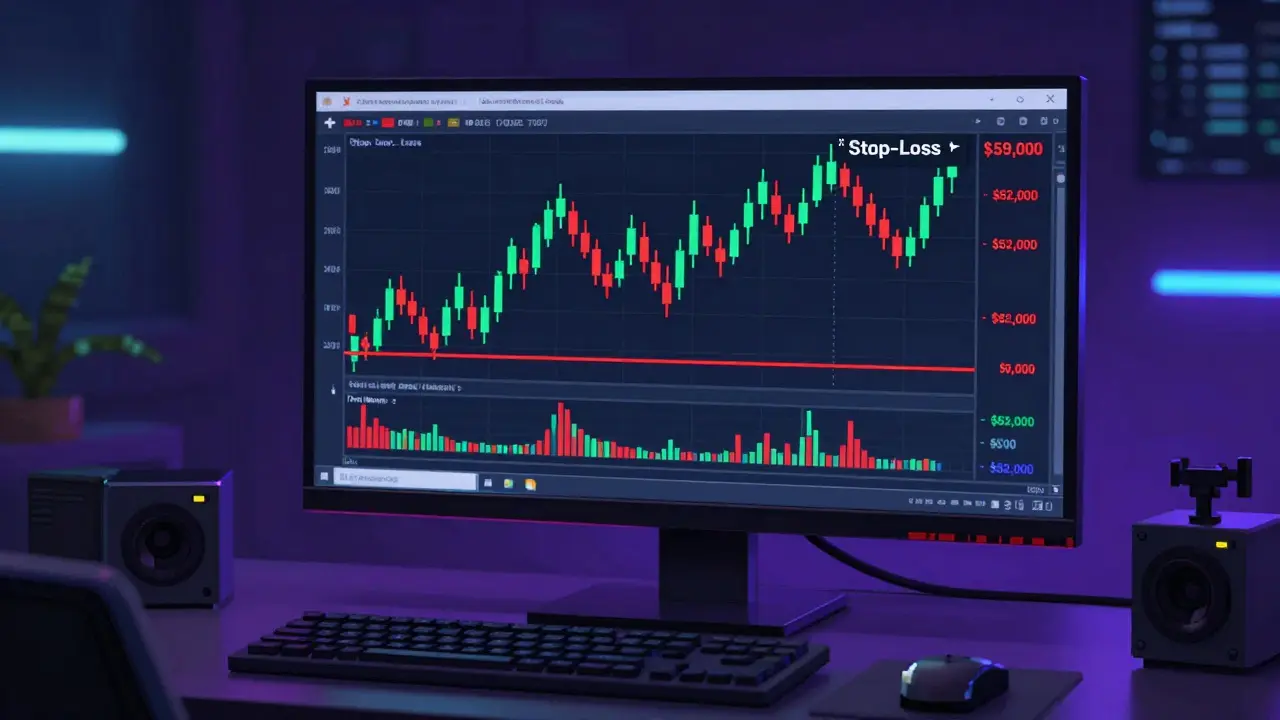
Imagine you buy Bitcoin at $60,000. It climbs to $75,000. You’re up big. But then the market turns, and it drops back to $62,000. If you had set a simple stop-loss at $59,000, you never got out because the price never hit that level. You watched your massive profit shrink into a tiny gain. This is the classic trap of static risk management in volatile markets like blockchain assets.
The solution isn't just about protecting against losses; it's about locking in gains. That’s where the debate between a standard stop-loss order and a trailing stop order becomes critical for every trader. One is a fixed safety net; the other is a dynamic profit protector. Understanding the difference can mean the difference between preserving capital and watching wealth evaporate during a sudden crash.
What Is a Stop-Loss Order?
A stop-loss order is an instruction to sell an asset when its price falls to a specific level. Think of it as a tripwire. You set the price, and if the market touches it, your position closes automatically. It doesn’t matter if you are asleep, on vacation, or staring at five different charts. The order executes.
In the world of cryptocurrency, where prices swing wildly around the clock, this simplicity is powerful. Let’s say you buy Ethereum (ETH) at $3,000. You decide you cannot afford to lose more than 10%. You set a stop-loss at $2,700. If ETH crashes to $2,699, your exchange sells your coins immediately. You limit your damage. You sleep well knowing your downside is capped.
The beauty of a standard stop-loss lies in its predictability. You know exactly where you will exit before you enter the trade. There is no ambiguity. For beginners or those with strict risk tolerance, this clarity reduces anxiety. However, it has a major flaw: it does not move with the market. If ETH rallies to $4,000, your stop-loss stays at $2,700. You are still risking a drop from $4,000 down to $2,700, which means giving back most of your unrealized profits.
How Does a Trailing Stop Work?
A trailing stop order is a dynamic order that adjusts its exit price as the asset’s value increases. Instead of a fixed number, you set a distance-either a percentage or a dollar amount-that trails behind the highest price the asset reaches.
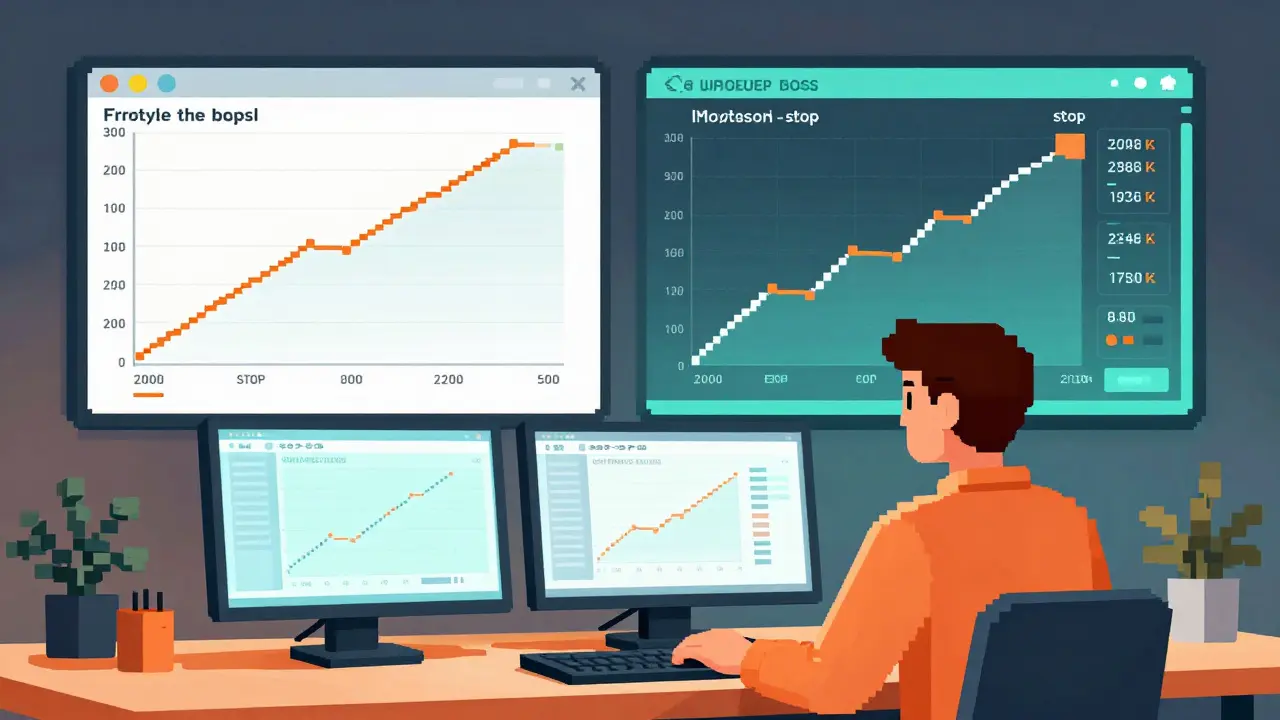
Let’s use the same Ethereum example. You buy ETH at $3,000 and set a 10% trailing stop. Initially, the stop sits at $2,700. But here is the magic: if ETH rises to $3,300, the stop moves up to $2,970 (10% below the new high). If it hits $4,000, the stop jumps to $3,600. The stop price only moves up; it never moves down. This creates a ratchet effect that locks in profits as the trend continues.
If the price then reverses and drops from $4,000 to $3,599, your order triggers. You exit with a significant profit, having captured the bulk of the rally. Without a trailing stop, you might have held on, hoping for $5,000, only to watch it crash back to $2,500. The trailing stop protects the upside while managing the downside dynamically.
| Feature | Stop-Loss Order | Trailing Stop Order |
|---|---|---|
| Price Behavior | Fixed trigger price | Adjusts upward with price gains |
| Primary Goal | Limit initial losses | Lock in profits & limit losses |
| Complexity | Low (simple setup) | Medium (requires parameter tuning) |
| Best Market Type | Volatile or sideways | Trending upwards |
| Risk of Early Exit | Low (unless stop is too tight) | High (can be shaken out by noise) |
When to Use Each Order Type
Choosing between these tools depends entirely on your strategy and the current market environment. They are not mutually exclusive; many professional traders use both at different stages of a trade.
Use a Standard Stop-Loss When:
- You are entering a highly speculative position with unclear direction.
- You want to define your maximum loss before taking the trade (risk-reward calculation).
- The market is choppy or ranging, meaning prices bounce up and down without a clear trend. A trailing stop might get triggered repeatedly in this scenario, leading to "death by a thousand cuts" through small losses.
- You are scalping short-term moves where precision matters more than capturing long trends.
Use a Trailing Stop When:
- You are in a strong uptrend and want to let your winners run.
- You have already moved past your initial break-even point and want to protect accumulated gains.
- You cannot monitor the market constantly but want to stay in the trade as long as momentum holds.
- You are swing trading cryptocurrencies over weeks or months, where large moves are common.

The Psychology of Automated Exits
Trading is less about math and more about psychology. Human beings are wired to fear loss and greedily hold onto hope. This leads to two fatal mistakes: holding losers too long and selling winners too early.
A stop-loss removes emotion from the equation regarding losses. You accept the pain upfront. But what about profits? Most traders manually close positions too early because they fear the market will reverse. A trailing stop solves this by enforcing discipline. It forces you to stay in the trade until the trend actually breaks, not just because you feel nervous.
However, trailing stops can be psychologically painful in their own way. Watching a trailing stop tighten as the price rises can create anxiety. You see the exit price creeping closer to the current price. When a temporary dip triggers the stop, you might feel angry, thinking, "If I had just waited..." This is known as "stop hunting" anxiety. Remember, you cannot predict the future. The trailing stop did its job: it protected the majority of your profit. Accepting partial profits is better than losing everything.
Setting the Right Parameters
The effectiveness of both orders hinges on how you set them. Setting a stop-loss too tight guarantees you will be stopped out by normal market noise. Setting a trailing stop too wide gives back too much profit during a reversal.
For cryptocurrencies, volatility is key. Bitcoin might drop 5% in an hour and recover quickly. If your stop is 2%, you are out. If it is 15%, you survive the noise but risk larger drawdowns. Many traders use technical indicators to set these levels.
- Support Levels: Place a stop-loss just below a recent support line. If price breaks support, the thesis is invalid.
- ATR (Average True Range): Use the ATR indicator to measure average volatility. Set your trailing stop at 1.5x or 2x the ATR value to account for normal fluctuations.
- Moving Averages: Some traders trail their stop along a moving average (like the 20-day EMA). As long as price stays above the average, they hold. Once it closes below, they sell.
Common Pitfalls and How to Avoid Them
Even with automated orders, things can go wrong. Here are three common issues traders face with stop-losses and trailing stops in crypto markets.
Slippage: In fast-moving markets, especially during news events or flash crashes, your stop order may not execute at the exact price you set. If you set a stop at $50,000, but liquidity dries up, you might fill at $48,500. This is called slippage. To mitigate this, consider using a "Stop-Limit" order instead of a "Stop-Market" order, though this carries the risk of not executing at all if the price gaps down.
Exchange Downtime: During extreme volatility, some centralized exchanges may freeze withdrawals or disable trading interfaces. While rare for major platforms like Binance or Coinbase, it happens. Always check your exchange’s reliability record. Decentralized exchanges (DEXs) offer alternatives but often have higher slippage due to lower liquidity pools.
Over-Optimization: Don’t tweak your trailing stop parameters after every trade based on hindsight. If you set a 10% trailing stop, stick with it unless your overall strategy changes. Changing rules mid-stream leads to inconsistent results and emotional decision-making.
Combining Both Strategies
Why choose one when you can use both? A sophisticated approach involves layering these orders. Start with a hard stop-loss to define your initial risk. Once the trade moves in your favor by a certain amount (e.g., 2x your risk), cancel the hard stop and replace it with a trailing stop.
This hybrid method ensures you never lose money on a trade (the initial stop protects you) while allowing unlimited upside potential (the trailing stop captures the trend). It requires active management initially but pays off in long-term portfolio growth. Many algorithmic trading bots automate this process, switching from static to dynamic protection seamlessly.
Can I use a trailing stop on any cryptocurrency exchange?
Most major centralized exchanges like Binance, Kraken, and Coinbase Pro support trailing stop orders. However, smaller or newer exchanges may only offer basic stop-loss functionality. Always check the order type options before placing a trade. On decentralized exchanges (DEXs), native trailing stops are less common, though some advanced wallets and aggregators now integrate this feature via smart contracts.
What is the best percentage for a trailing stop in crypto?
There is no single "best" percentage. It depends on the asset's volatility. For stablecoins or low-volatility altcoins, a 3-5% trailing stop might work. For highly volatile assets like Bitcoin or Meme coins, you may need a 10-20% trail to avoid being shaken out by normal price swings. Use historical data or the ATR indicator to determine an appropriate range for your specific trade.
Does a trailing stop guarantee I won't lose money?
No. A trailing stop limits losses relative to the highest price reached since the order was placed, but it does not prevent losses from your entry price if the market gaps down significantly. Additionally, slippage can cause execution at a worse price than expected. It is a risk management tool, not a profit guarantee.
Can I change my stop-loss level after setting it?
Yes, you can modify or cancel a stop-loss order at any time before it is triggered. With a trailing stop, you can adjust the trail distance, but note that most platforms do not allow you to move the stop price lower once it has trailed up. This prevents traders from manipulating the system to avoid exits.
Are stop-loss orders visible to other traders?
Generally, no. Stop-loss orders sit on the server side of the exchange and are not part of the public order book until they are triggered and become market orders. However, large clusters of stop-losses at obvious support levels can sometimes be inferred by market makers and institutional traders, potentially leading to "stop hunts" where price briefly dips to trigger these orders before reversing.