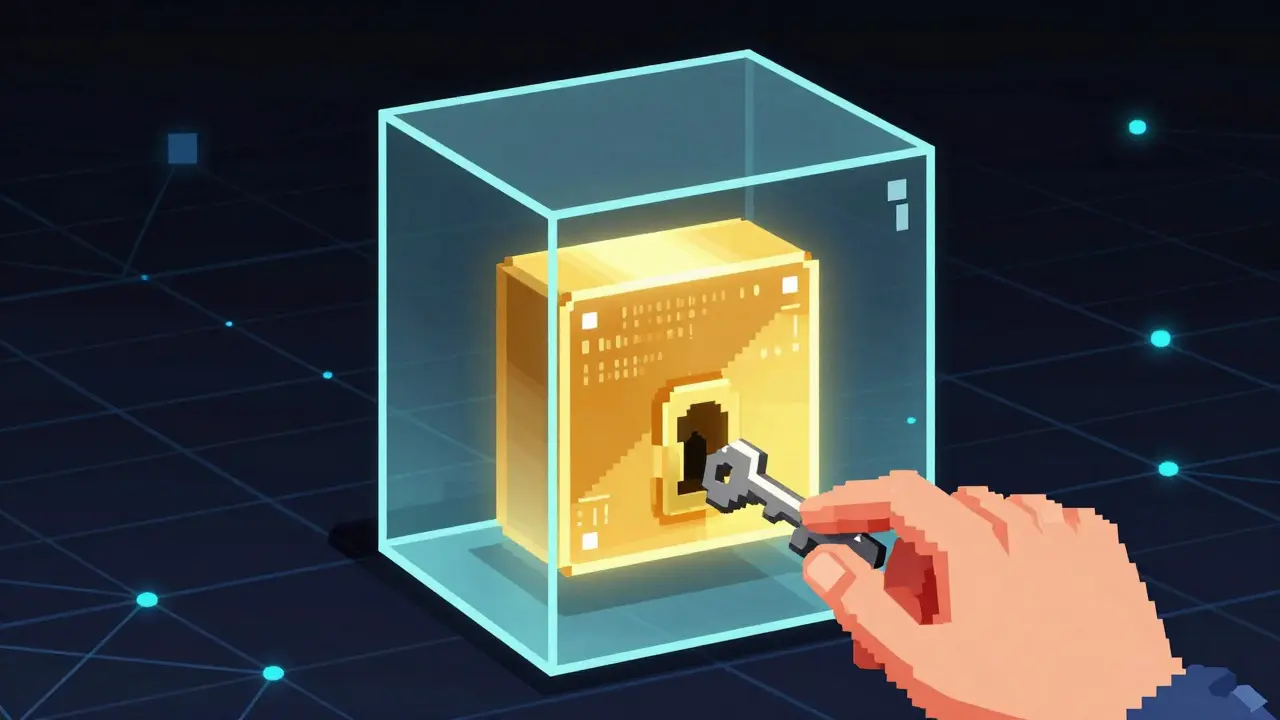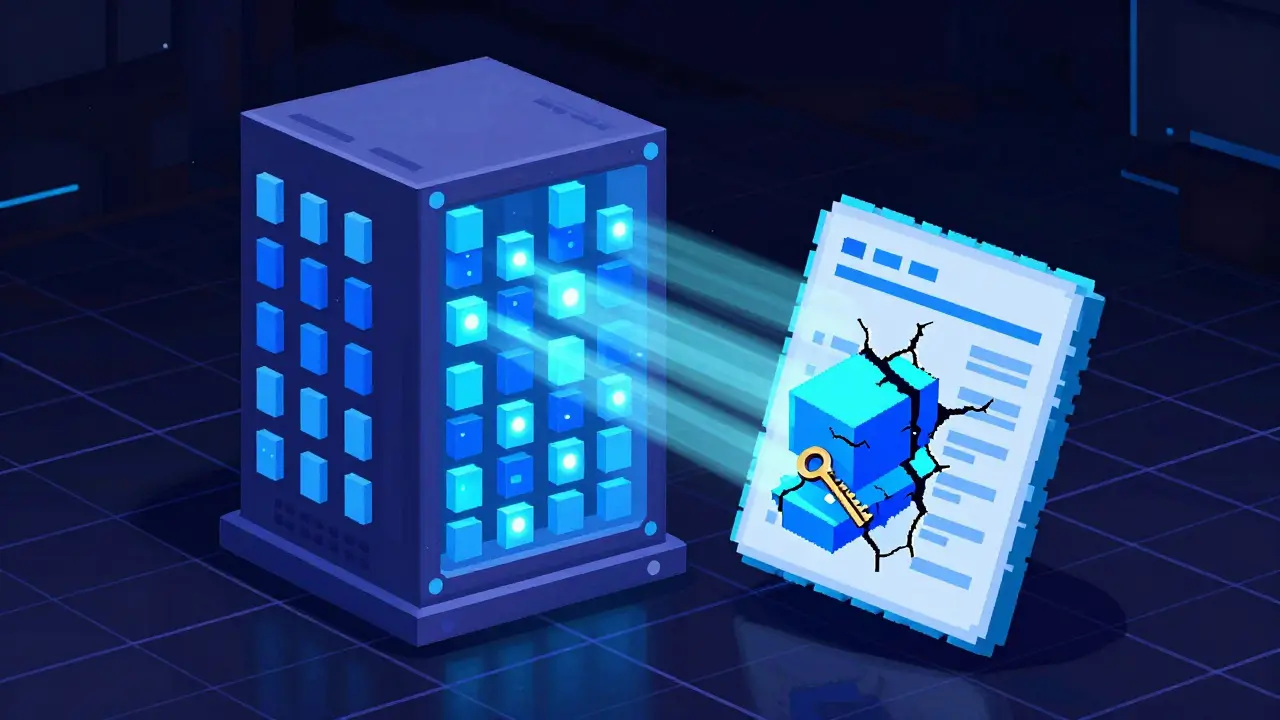
Blockchain was built on the idea that math makes it unbreakable. Your Bitcoin, Ethereum, or any other crypto asset is protected by complex equations that classical computers can’t solve in a lifetime. But what if a new kind of computer could crack those equations in minutes? That’s not science fiction anymore. Quantum computing is getting close to threatening the very foundation of blockchain security - and the clock is ticking.
How Blockchain Security Works Today
Every blockchain transaction relies on public-key cryptography. When you send Bitcoin, you sign it with your private key. Anyone can verify that signature using your public key, which is visible on the blockchain. But no one can reverse-engineer your private key from your public key - at least, not with today’s computers. This security comes from two math problems: factoring huge prime numbers (used in RSA) and solving elliptic curve discrete logarithms (used in ECC). Both are hard for classical computers. They’d take thousands of years to crack. That’s why blockchain feels safe. But quantum computers don’t play by the same rules.Shor’s Algorithm: The Quantum Wrecking Ball
In 1994, mathematician Peter Shor figured out how a quantum computer could solve those exact math problems - in seconds. Shor’s algorithm doesn’t brute force its way through numbers. It uses quantum superposition and entanglement to test millions of possibilities at once. That means it can factor massive primes or crack elliptic curves in polynomial time - not exponential. What takes a supercomputer millennia, a quantum computer might do in 30 minutes. That’s not theoretical. It’s mathematical. And it directly targets how blockchains verify ownership. If someone can derive your private key from your public key before a transaction confirms, they can steal your coins. No password. No hack. Just math.Why You’re Not Getting Hacked Today
Don’t panic yet. We’re not there. Google’s 105-qubit Willow chip, released in 2024, is one of the most advanced quantum processors today. But it’s still nowhere near what’s needed. According to a 2022 study by Universal Quantum, breaking a Bitcoin signature would require a quantum computer with 13 million qubits - and near-perfect error correction. Today’s best machines have under 1,000, and they’re noisy, unstable, and error-prone. The real window of vulnerability? When quantum computers can crack a private key in under 10 minutes - the average time it takes for a Bitcoin transaction to confirm. Right now, that’s still decades away. But that doesn’t mean we’re safe.The Real Danger: Harvest Now, Decrypt Later
The biggest threat isn’t what quantum computers can do today. It’s what they’ll do tomorrow with data collected today. Imagine someone quietly recording every Bitcoin transaction ever made. They don’t need to steal coins now. They just need to store the encrypted public keys. Once a powerful enough quantum computer arrives - maybe in 5, 10, or 15 years - they decrypt every single wallet that ever exposed its public key. That’s called a "harvest now, decrypt later" attack. And it’s already happening. Cybercriminals, nation-states, and even well-funded research labs are likely collecting blockchain data right now, waiting for quantum tech to catch up. This is especially dangerous for long-term holdings. If you sent Bitcoin in 2015 and never touched it again, your public key is out there. If you reused that address? You’re exposed.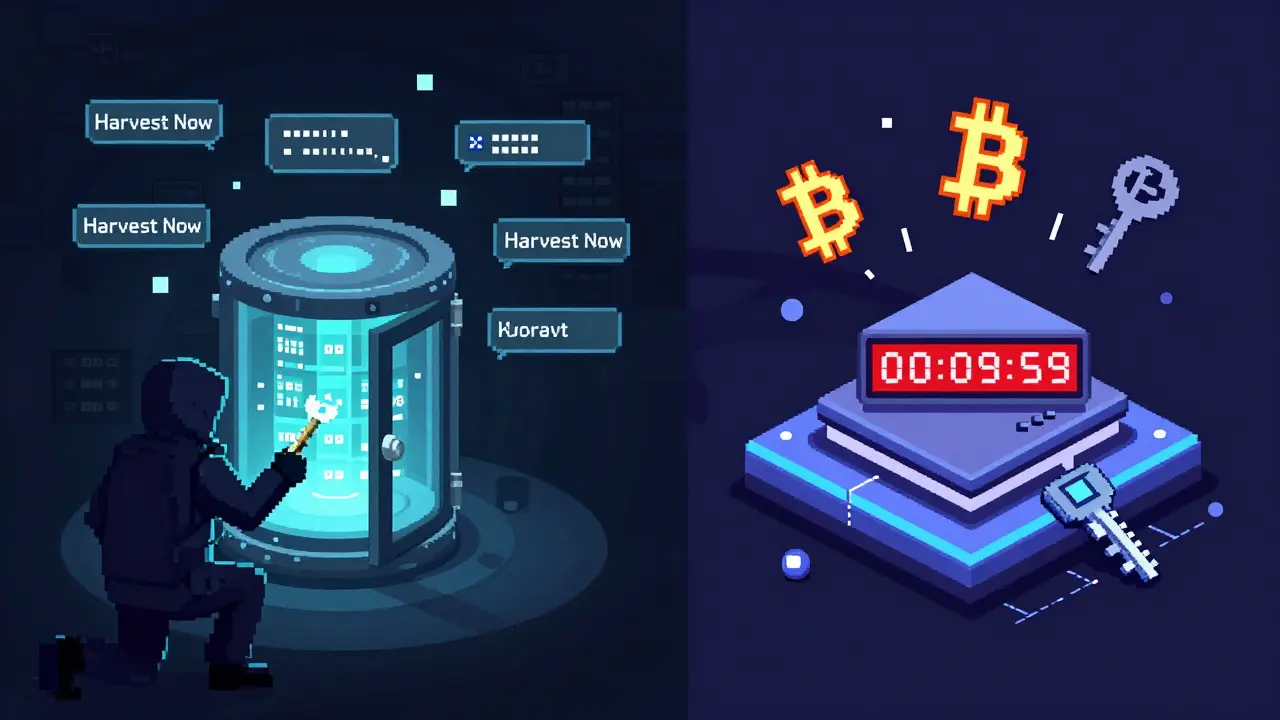
Address Reuse Is a Silent Killer
Most users don’t realize this: every time you reuse a Bitcoin address, you’re giving away your public key. And once that public key is known, a quantum computer can crack it. Modern wallets (like Ledger, Trezor, or Electrum) avoid this by generating a new address for every transaction. But older wallets, exchange deposits, and legacy users still reuse addresses. A 2024 analysis found over 30% of Bitcoin addresses in active circulation have been reused - meaning their public keys are public record. If you’re holding Bitcoin on an exchange, or you’ve sent funds to the same address multiple times, you’re at higher risk. The fix? Never reuse addresses. Use wallets that auto-generate new ones. Simple. Effective. Free.Who’s Building the Shield?
The blockchain world isn’t waiting for disaster. Major projects are already moving toward quantum-resistant cryptography. Ethereum’s developers are testing post-quantum signature schemes like CRYSTALS-Dilithium and SPHINCS+. These are new algorithms based on math problems that even quantum computers struggle with - like lattice-based cryptography or hash-based signatures. Hyperledger, the enterprise blockchain consortium, has launched a quantum-safe working group. They’re not just talking - they’re building test networks with quantum-resistant code. Even D-Wave, a quantum computing company, has run a live blockchain across four of its quantum machines. They used quantum annealing to validate transactions - not to break them. The point? Quantum tech can also be used to strengthen blockchain, not just break it.What Quantum-Resistant Means
Post-quantum cryptography (PQC) isn’t just "stronger encryption." It’s entirely different math. Instead of relying on prime factorization or elliptic curves, PQC uses problems like:- Lattice-based cryptography - solving complex geometric problems in high-dimensional spaces
- Hash-based signatures - using cryptographic hash functions to create unforgeable signatures
- Multivariate polynomial systems - solving systems of equations with many variables

It’s Not Just About Bitcoin
If quantum computers break blockchain, they break everything. TLS encryption that secures your bank login? Uses RSA. Digital certificates for websites? Based on ECC. Government records, military communications, medical data - all rely on the same math. Blockchain is just one part of a much bigger problem. The entire digital world is built on cryptographic trust. And quantum computing threatens to collapse it all. That’s why governments, banks, and tech giants are rushing to adopt PQC. The U.S. government has mandated federal agencies switch to quantum-safe systems by 2030. The EU, UK, and Japan are doing the same. Blockchain can’t be an island. Its fate is tied to the rest of the internet.What You Should Do Right Now
You don’t need to be a coder to protect yourself.- Stop reusing addresses. Use wallets that generate a new address for every transaction.
- Move old funds. If you have Bitcoin or crypto in an old wallet from 2015-2020, send it to a new address you control.
- Use hardware wallets. Ledger and Trezor support newer signature schemes and are less vulnerable to remote attacks.
- Watch for upgrades. Follow Ethereum, Bitcoin, and major wallets for announcements about quantum-resistant updates.
The Future Is Quantum - But Not Doomed
Quantum computing won’t kill blockchain. It will force it to evolve. The same way SSL gave way to TLS, and SHA-1 gave way to SHA-256, blockchain will upgrade its cryptography. The math will change. The code will update. The networks will hard fork if needed. The real risk isn’t quantum computers. It’s complacency. If the blockchain community waits until a quantum machine cracks a wallet, it’s too late. But if they act now - as Ethereum and Hyperledger are doing - the system can survive. Quantum computing isn’t the end of blockchain. It’s the next upgrade.Can quantum computers steal my Bitcoin right now?
No. Current quantum computers are nowhere near powerful enough to break Bitcoin’s encryption. Breaking a single signature would require a machine with millions of stable, error-corrected qubits - far beyond today’s best systems, which have fewer than 1,000. The threat is real, but not immediate.
What is the "harvest now, decrypt later" attack?
It’s when attackers collect encrypted data today - like public keys from blockchain transactions - and store it until quantum computers become powerful enough to decrypt it. This is especially dangerous for long-term crypto holders who reused addresses, since their public keys are permanently visible on the blockchain.
How long until quantum computers can break blockchain?
Experts estimate it could take 10 to 20 years to build a quantum computer with enough power and stability to crack Bitcoin’s ECC encryption. But some believe it could happen sooner due to rapid progress. The key is not when it happens - but whether we’re ready.
Are Ethereum and Bitcoin working on quantum-resistant solutions?
Yes. Ethereum is actively testing post-quantum signature algorithms like CRYSTALS-Dilithium. Bitcoin’s core developers are monitoring the threat and have discussed potential upgrades, though no formal plan exists yet. Both are aware of the risk and are preparing for future transitions.
Should I move my crypto because of quantum threats?
Only if you’re reusing addresses. If you’re using a modern wallet that generates a new address for every transaction, you’re already protected. But if you have old funds sitting on a reused address, move them now - it’s free, easy, and eliminates a major vulnerability.