
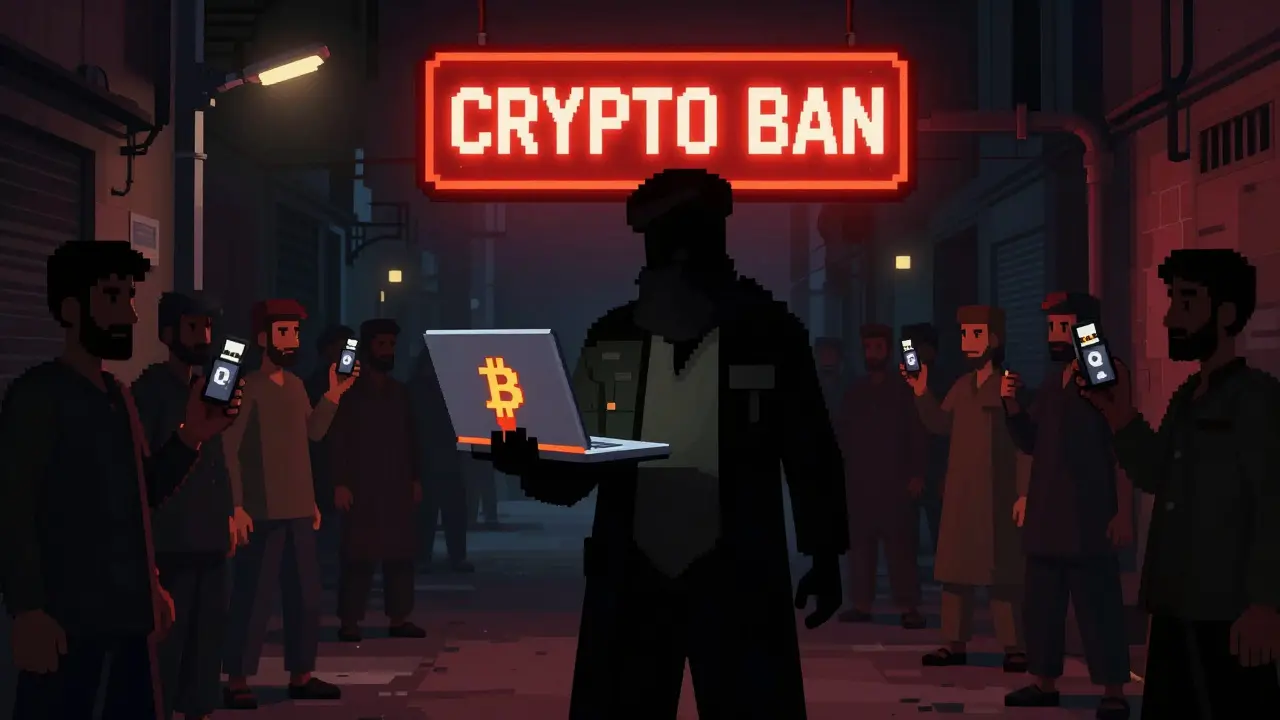
The Taliban’s ban on Bitcoin and all cryptocurrencies in Afghanistan isn’t just a policy-it’s a religious declaration. Since August 2022, the regime has declared any use, trade, or mining of digital assets haram-forbidden under Islamic law. This isn’t a vague warning. It’s enforced with arrests, asset seizures, and closed exchanges. And yet, despite the crackdown, crypto use has grown. Why? Because for millions of Afghans, especially women and families cut off from banks, Bitcoin isn’t a gamble. It’s survival.
Why the Taliban Says Crypto Is Haram
The Taliban’s reasoning is simple: Bitcoin has no intrinsic value. Unlike gold or land, it doesn’t exist in the physical world. In their view, that makes it gambling-maysir-which is clearly forbidden in the Quran. They argue that since crypto isn’t backed by any government or commodity, it’s unstable, unpredictable, and therefore dangerous. This interpretation comes straight from their version of Sharia law, which rejects anything not explicitly permitted. They also claim crypto threatens monetary sovereignty. Da Afghanistan Bank (DAB), the country’s central bank, says digital currencies undermine their control over the national currency. After the U.S. froze $9.5 billion in Afghan reserves in 2021, the Taliban took over. They didn’t want people using foreign-backed digital money to bypass their authority. So they banned it all: Bitcoin, Ethereum, USDT-you name it. No exceptions. But here’s the contradiction: the same regime that calls crypto haram is accused of accepting Bitcoin payments at border checkpoints, according to a December 2023 UN report. If it’s truly forbidden, why are officials using it? The answer? Control. The ban isn’t about purity-it’s about power.How the Ban Was Enforced
On August 15, 2022, the Taliban announced the ban with force. In Herat province alone, 16 crypto exchanges were shut down. Police raided offices, confiscated computers, and arrested traders. The Financial Transactions and Reports Analysis Center of Afghanistan (FinTRACA), the country’s anti-money laundering unit, started monitoring transactions under the 2013 Money Laundering Act-even though there’s no specific crypto law. People lost everything. One user on Reddit, @KabulTrader88, said they lost 1.2 Bitcoin-worth over $50,000 at the time-when police raided their home in November 2022. Others had their phones seized because they had crypto wallets installed. The message was clear: if you’re caught with crypto, you’re breaking the law. But enforcement isn’t perfect. Internet blackouts, like the 48-hour nationwide outage in October 2024, make surveillance harder. And when people can’t connect to banks, they turn to crypto anyway.The Underground Crypto Economy
Despite the ban, crypto use has exploded. Before 2021, only 3% of Afghans used digital assets. By 2024, that number jumped to 28%-nearly one in four adults. Why? Because the banking system collapsed. After the U.S. froze reserves, banks stopped processing international transfers. Remittances from abroad-money sent by Afghans working overseas to support families-plummeted from $7.1 billion in 2020 to just $1.8 billion in 2024. That’s where crypto stepped in. USDT, a stablecoin pegged to the U.S. dollar, became the unofficial currency. People used it to send money across borders without banks. Telegram groups like AfghanCryptoHelp grew to over 15,000 members. Users shared tips on how to set up non-custodial wallets like Trust Wallet, how to avoid detection, and how to trade via peer-to-peer (P2P) channels. Chainalysis data shows Afghanistan’s on-chain transaction volume grew 37% per year from 2022 to 2024. Even with crackdowns, monthly P2P trades hit $4.2 million in early 2025. Most of it? USDT. Because it’s stable. Because it’s digital. Because it works when banks don’t.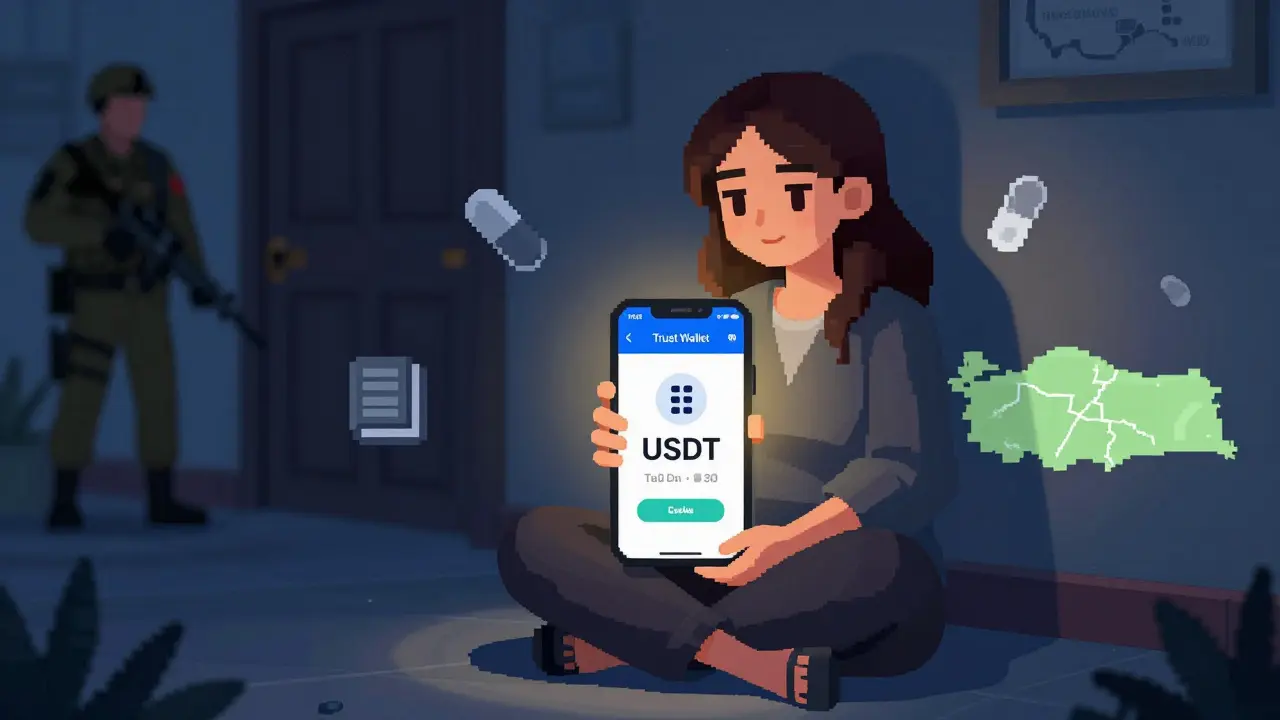
Women and Crypto: A Hidden Lifeline
For Afghan women, banned from working, traveling alone, or accessing bank accounts, crypto became a lifeline. The Digital Citizen Fund, a local nonprofit, trained 687 women in Bitcoin use between 2022 and 2024. Eighty-nine percent said it gave them financial independence. One woman used Bitcoin to receive money from her brother in Turkey to pay for her sister’s medical treatment. Another used it to pay for online education. But it came with risk. Forty-two percent of these women reported being harassed or questioned by Taliban officials when caught using crypto. Some were forced to delete their wallets. Others were fined. Still, they kept going. Because for them, crypto isn’t about speculation. It’s about dignity. Roya Mahboob, founder of the Digital Citizen Fund and named one of Forbes’ Most Powerful Women in 2023, put it plainly: “It’s much easier for them to get it because it gives them a hope of financial freedom.”How It Compares to Other Muslim Countries
Afghanistan is not the only Muslim-majority country with crypto restrictions-but it’s the only one with a total ban. - Saudi Arabia and the UAE have clear regulations. The UAE even created a Virtual Assets Regulatory Authority in 2022 to license exchanges. - Indonesia allows crypto trading under strict oversight. - Egypt permits licensed exchanges and has taxed crypto gains since 2023. - Iran allows mining (with government permits) but restricts trading. Afghanistan is alone in banning everything-no licenses, no rules, no exceptions. Even Iran, another theocratic state, doesn’t go this far. And scholars disagree. The OIC’s Fiqh Academy, a major Islamic legal body, said in 2022 that crypto “may be permissible if it achieves the objectives of Sharia.” That means if it’s used to transfer value fairly, it’s not inherently haram. The Taliban’s stance isn’t based on consensus. It’s based on control.
The Real Problem: Internet and Access
Using crypto in Afghanistan isn’t just illegal-it’s technically hard. The internet is unreliable. In 2024, users faced an average of 17.3 hours of outages per month. SIM card registration laws require real names, making anonymity impossible. Many users don’t speak English. Guides are in English. Wallets are in English. No official support exists. People spend weeks learning how to use Trust Wallet or MetaMask. They rely on Telegram groups for help. One user told a UNODC surveyor: “I had to ask my nephew in Pakistan to help me set up my wallet. He sent me a video. I watched it 12 times.” Some have turned to SMS-based blockchain solutions. In late 2024, 12,500 Afghans signed up for a service called CryptoSMS, which lets you send crypto via text message-no internet needed. It’s clunky. But it works.The Future: Can the Ban Last?
The Taliban says the ban is permanent. In February 2025, Deputy Prime Minister Mullah Abdul Ghani Baradar declared: “Digital currency has no place in an Islamic system.” But economics doesn’t care about declarations. The country’s GDP shrank by over 20% between 2021 and 2023. Unemployment is above 40%. Foreign aid has dried up. People need money. And if banks won’t deliver, they’ll find another way. Experts predict the ban will eventually weaken. Goldman Sachs estimates only a 30% chance it lasts beyond 2028. Iran’s path is the likely model: keep the ban on paper, but quietly allow P2P trading to continue. That’s already happening in Afghanistan. The regime raids traders-but can’t stop the flow. The real question isn’t whether crypto is halal or haram. It’s whether a government can stop people from using technology to survive.What This Means for the World
Afghanistan’s crypto ban is more than a local story. It’s a test case. Can a government ban a decentralized network? Can religious law override economic necessity? The answer so far? No. The ban is absolute on paper. But on the ground, Bitcoin is everywhere. It’s in women’s phones. It’s in remittances. It’s in the dark corners of Telegram. It’s the only thing keeping families fed. The Taliban may have the power to shut down exchanges. But they can’t shut down human need.Is Bitcoin illegal in Afghanistan?
Yes. Since August 2022, the Taliban has banned all cryptocurrency activities-including trading, mining, and holding-declaring them haram under Sharia law. The ban is enforced through arrests, asset seizures, and closed exchanges. There are no legal exceptions.
Why does the Taliban say Bitcoin is haram?
The Taliban claims Bitcoin has no intrinsic value, making it a form of gambling (maysir), which is forbidden in Islam. They also argue it undermines the state’s control over money and threatens financial sovereignty. This interpretation is strict and absolute, even though many Islamic scholars disagree.
Do people still use crypto in Afghanistan despite the ban?
Yes. Despite the ban, 28% of Afghan adults used cryptocurrency in 2024, up from just 3% in 2021. Most use USDT for remittances because traditional banks collapsed after 2021. Peer-to-peer trading happens daily through Telegram and SMS-based systems, even with risks of arrest.
How do Afghan women use Bitcoin?
Many Afghan women use Bitcoin to receive money from family abroad, pay for medical care, or fund online education-things they’re often barred from doing through banks. Organizations like the Digital Citizen Fund have trained over 600 women in crypto use. While 89% report increased financial freedom, 42% have faced harassment from authorities.
Is the Taliban’s crypto ban unique among Muslim countries?
Yes. While countries like Algeria and Egypt also ban crypto, Afghanistan is the only one with a total, no-exceptions ban enforced by a theocratic regime. Other Muslim nations-like the UAE, Indonesia, and Iran-have created regulatory frameworks, licenses, or limited permissions. Afghanistan has none.
Can the Taliban enforce the ban long-term?
Probably not. Economic collapse, internet blackouts, and rising reliance on crypto make enforcement unsustainable. Experts say the ban will likely become a paper rule while P2P trading continues underground-similar to Iran’s approach. Goldman Sachs gives it only a 30% chance of lasting past 2028.





Megan Lavery
February 21, 2026 AT 04:02Mae Young
February 21, 2026 AT 11:31Deborah Robinson
February 22, 2026 AT 10:52Ryan Burk
February 22, 2026 AT 16:51Don B.
February 23, 2026 AT 06:58Arya Dev
February 24, 2026 AT 15:27Leslie Cox
February 25, 2026 AT 04:34Sean Logue
February 26, 2026 AT 14:23precious Ncube
February 28, 2026 AT 04:40Tracy Peterson
February 28, 2026 AT 10:45aaron marp
March 1, 2026 AT 18:12Phillip Marson
March 2, 2026 AT 07:16Alyssa Herndon
March 4, 2026 AT 00:48Ifeanyi Uche
March 4, 2026 AT 18:24Jeff French
March 5, 2026 AT 04:36Elana Vorspan
March 6, 2026 AT 11:43Michael Rozputniy
March 6, 2026 AT 18:48Cathy Sunshine
March 8, 2026 AT 13:25Dee Resin
March 10, 2026 AT 12:22Kristi Emens
March 11, 2026 AT 12:14christopher luke
March 13, 2026 AT 06:24