

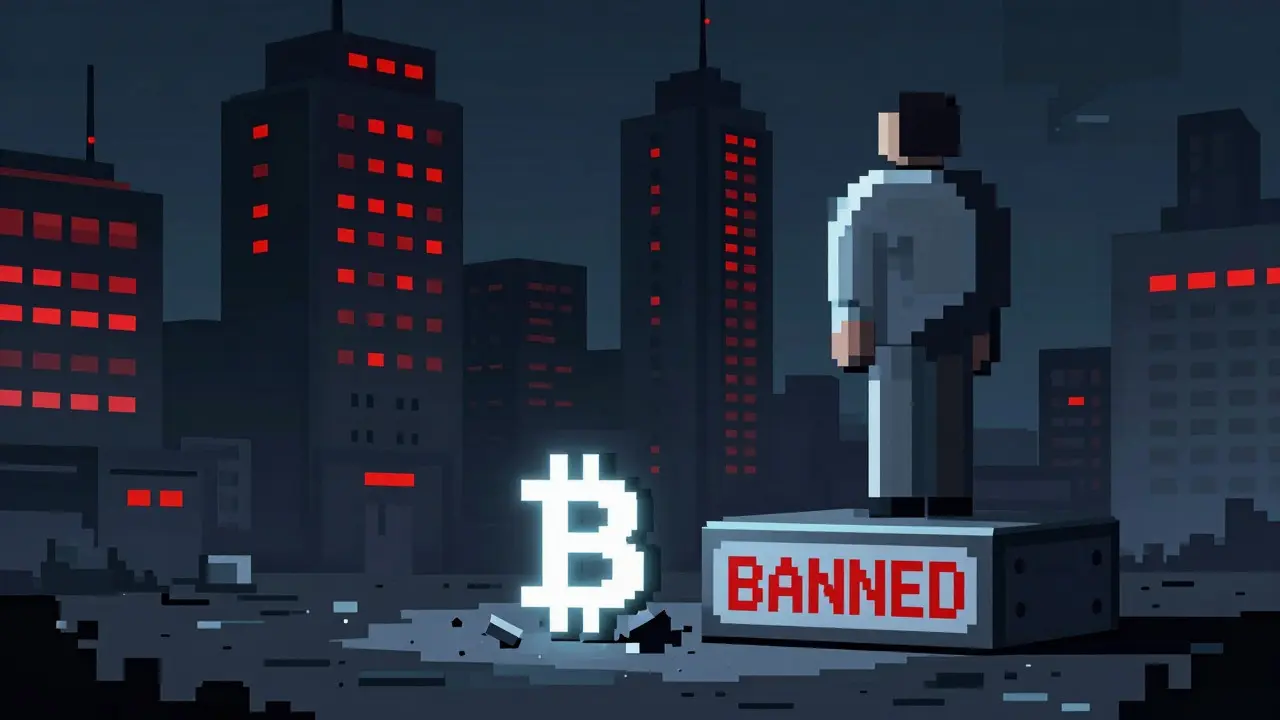
China hasn’t just restricted Bitcoin-it shut the door, locked it, and threw away the key. Since 2021, the country has enforced a total ban on all cryptocurrency trading, mining, and related services. If you hold Bitcoin in China, you’re not just operating in a gray area-you’re breaking the law. And yet, millions still do. Here’s what that really means for you, whether you’re inside China or just holding Bitcoin tied to it.
What China’s Ban Actually Covers
It’s not just about not being able to buy Bitcoin on a local app. China’s ban is comprehensive. Financial institutions-banks, payment processors, even fintech startups-are forbidden from offering any crypto-related service. That means no deposits, no withdrawals, no wallet integrations, no trading platforms. If you try to link your bank account to a crypto exchange, the transaction will be blocked before it even starts. Exchanges like Binance, OKX, or Huobi can’t legally serve Chinese residents. Even if you use a VPN to access them, you’re technically violating the law. The government requires internet companies to monitor and block crypto-related content. Websites, forums, Telegram groups-all of it gets flagged and taken down. Mining? Gone. In 2021, China shut down over 90% of the world’s Bitcoin mining operations. The government called it a waste of energy. Factories that once hummed with ASIC rigs were repurposed or shut. Some miners relocated to Kazakhstan or the U.S., but those left behind lost everything. And there’s no grace period anymore. If you’re still running mining hardware in China, you’re risking fines, equipment seizure, or worse.What Happens If You Already Own Bitcoin?
Owning Bitcoin isn’t explicitly illegal-but holding it is risky. The law doesn’t say “you can’t have Bitcoin.” It says you can’t trade it, mine it, or use it to pay for goods. So technically, you can keep it in a private wallet. But here’s the catch: you can’t convert it to yuan. You can’t cash out. You can’t use it to buy a car, a house, or even a coffee in Beijing. If you try to move Bitcoin to a bank account through a third party, you’ll trigger anti-money laundering (AML) alerts. The Ministry of Public Security monitors all financial flows for links to virtual currency. If your bank sees a sudden deposit from an unknown source, they’re required to report it. That could mean a visit from regulators, freezing your account, or even criminal investigation. There’s no legal recourse. If someone steals your Bitcoin, you can’t go to court and demand it back. If you get scammed on a peer-to-peer trade, there’s no consumer protection. The government doesn’t recognize Bitcoin as property. It’s not an asset. It’s a risk.How People Still Trade Bitcoin in China
Despite the ban, Bitcoin trading is still alive in China. How? Through underground networks. Peer-to-peer (P2P) platforms like LocalBitcoins or Paxful are used, but they’re risky. Sellers often demand cash in person. Buyers meet in parking lots or coffee shops. Some use gift cards, prepaid cards, or even gold bars to exchange value. There’s also a thriving black market for crypto-fiat conversion. You’ll find traders on WeChat or QQ groups offering to buy Bitcoin for yuan. Rates are worse than on global exchanges-sometimes 15-30% below market price. Why? Because they’re taking on legal risk. They need to make up for the chance of getting caught. And then there’s the offshore route. Many Chinese citizens hold Bitcoin through overseas exchanges, using foreign bank accounts or relatives abroad. But the government has cracked down on this too. In 2024, the People’s Bank of China ordered banks to freeze accounts linked to foreign crypto platforms. Thousands of accounts were shut down overnight.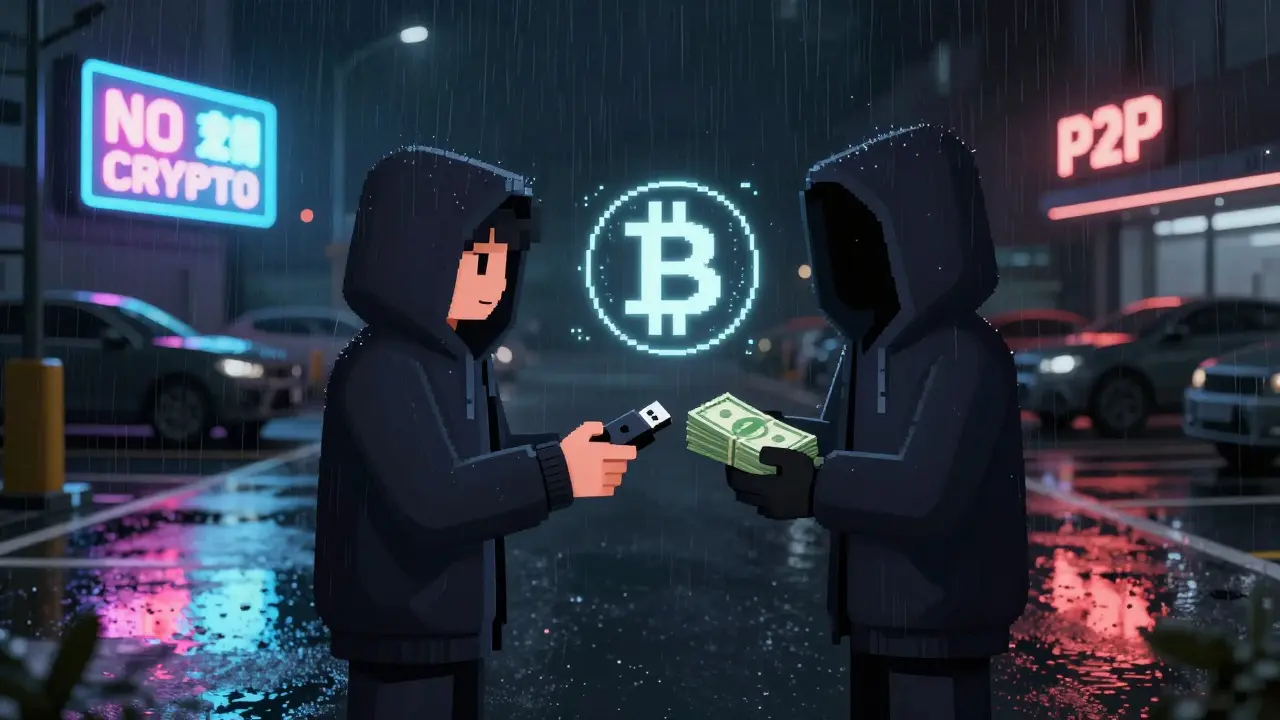
The CBDC: China’s Alternative to Bitcoin
While Bitcoin is banned, China is building its own digital currency: the Digital Yuan, or e-CNY. This isn’t a decentralized coin. It’s a state-controlled digital version of the yuan. The government tracks every transaction. It can freeze payments. It can set expiration dates. It can even restrict what you buy. The Digital Yuan is being rolled out across cities like Beijing, Shanghai, and Shenzhen. Over 260 million people have used it. It’s faster than WeChat Pay. It works offline. And it’s designed to replace cash and reduce reliance on private payment systems like Alipay. Why does this matter? Because the government doesn’t want competition. Bitcoin threatens its control over money. The Digital Yuan doesn’t. It reinforces it. China sees digital currency as a tool for surveillance, not freedom. And that’s why there’s zero chance they’ll legalize Bitcoin anytime soon.Global Ripple Effects
China’s ban didn’t just affect Chinese citizens. It reshaped the global crypto market. When mining shut down in 2021, Bitcoin’s network hash rate dropped by half in weeks. Miners scattered. New hubs formed in the U.S., Canada, and the Middle East. Prices dipped-but rebounded as demand shifted. Chinese investors used to make up 20-30% of global Bitcoin trading volume. Now, they’re largely out of the picture. But rumors still fly. Every time someone claims China is lifting the ban, Bitcoin spikes. Elon Musk once tweeted a fake rumor-causing a $12 billion surge in minutes. The market still reacts to noise, even if it’s false. The truth? China’s ban is locked in. There’s no indication it will change. The government’s focus is on control, not innovation. And while some analysts argue for a future where licensed exchanges are allowed, that’s pure speculation. No official policy, no draft law, no hint from Beijing.
What Bitcoin Holders Should Do
If you’re a Chinese citizen holding Bitcoin:- Don’t try to cash out through banks. You’ll trigger AML flags.
- Don’t use domestic exchanges. They’re all shut down.
- Don’t advertise your holdings. Even on WeChat or social media.
- Keep your private keys secure. No third-party wallets. No cloud backups.
- Consider moving assets offshore-if you can. But be aware: your bank may still monitor you.
- Avoid P2P trades with Chinese sellers. High risk of scams or fraud.
- Don’t assume Chinese buyers are legitimate. Many are using fake IDs or stolen accounts.
- Be cautious with KYC. Some exchanges require Chinese ID verification. That’s a red flag.
Will China Ever Reverse the Ban?
Almost certainly not. The government has spent years building infrastructure to replace Bitcoin, not coexist with it. The Digital Yuan is the future they want. Bitcoin is the past they’re trying to erase. There’s no political incentive to change. The ban helps control capital flight. It prevents financial instability. It keeps the yuan dominant. And with the AI-driven surveillance state now in place, enforcement is more efficient than ever. Even if China’s economy slows, or inflation rises, the government won’t turn to Bitcoin as a solution. It will print more yuan or expand the Digital Yuan. That’s the path they’ve chosen.Final Reality Check
China’s crypto ban isn’t a temporary policy. It’s a permanent stance. For Bitcoin holders inside China, it means living with an asset that can’t be spent, sold, or protected by law. For those outside, it means navigating a market shaped by silence, rumors, and shadow trading. The truth is simple: Bitcoin has no place in China’s financial system. And until that changes, holding it there is a high-risk gamble with no safety net.Is it illegal to own Bitcoin in China?
Owning Bitcoin isn’t explicitly illegal, but using it is. You can hold it in a private wallet, but you can’t trade it, mine it, or convert it to yuan through banks. The government doesn’t recognize it as property, so you have no legal protection if it’s stolen or lost.
Can I use a VPN to access crypto exchanges in China?
Technically, yes-but it’s against the law. The government blocks most major exchanges, and using a VPN to bypass those blocks violates China’s internet regulations. If caught, you could face fines, account freezes, or even criminal charges. Many users do it, but it’s not safe.
Why did China ban Bitcoin mining?
China banned Bitcoin mining in 2021 because it consumed massive amounts of electricity-often from coal-powered plants. The government labeled it as "high energy consumption and low efficiency." The move was also about reducing financial risk and asserting control over the monetary system. Over 90% of global mining operations were shut down within months.
Can I send Bitcoin to someone in China?
You can send Bitcoin to a wallet in China, but the recipient won’t be able to cash it out legally. Any attempt to convert it to yuan through banks or payment apps will trigger monitoring systems. The recipient risks having their accounts frozen or investigated by authorities.
Are there any legal ways to trade crypto in China?
No. All crypto exchanges, derivatives trading, and ICOs are banned. Even peer-to-peer trading is considered illegal under China’s financial regulations. The only legal digital currency is the Digital Yuan, which is fully controlled by the central bank.
What happens if I get caught trading Bitcoin in China?
There’s no standardized punishment, but consequences can include bank account freezes, fines, or criminal investigation under anti-money laundering laws. In rare cases, individuals have been detained for operating large-scale P2P trading networks. Most people avoid detection by keeping low profiles.
Will Bitcoin prices rise if China lifts the ban?
If China ever lifted the ban, Bitcoin prices would likely surge. China has over 1.4 billion people, and even a small percentage of new investors could create massive demand. But there’s no sign this will happen. China is investing in its own digital currency, not Bitcoin.
Can I inherit Bitcoin if someone dies in China?
There’s no legal framework for inheriting Bitcoin in China. Even if a will mentions it, courts won’t recognize it as an asset. Without access to private keys, the Bitcoin is effectively lost. Families often lose holdings because the deceased didn’t leave instructions-or because the legal system won’t help recover them.


Robert Mills
January 26, 2026 AT 16:23Sunil Srivastva
January 27, 2026 AT 07:51Ramona Langthaler
January 28, 2026 AT 19:37Andrea Demontis
January 30, 2026 AT 07:17Joseph Pietrasik
January 31, 2026 AT 16:33laurence watson
February 2, 2026 AT 10:41Rachel Stone
February 2, 2026 AT 12:30Elizabeth Jones
February 4, 2026 AT 10:43Jerry Ogah
February 6, 2026 AT 10:20Kevin Thomas
February 8, 2026 AT 09:01Raju Bhagat
February 10, 2026 AT 05:59Richard Kemp
February 12, 2026 AT 01:47Nickole Fennell
February 12, 2026 AT 03:59Edward Drawde
February 13, 2026 AT 18:28Pamela Mainama
February 14, 2026 AT 11:28Devyn Ranere-Carleton
February 15, 2026 AT 22:30