

Imagine you deposit $1,000 worth of Ethereum and USDC into a liquidity pool. A month later, the price of Ethereum spikes. You check your wallet, expecting a nice profit. Instead, you see that if you had just held those assets in your wallet, you would have made more money than by providing liquidity. That difference is impermanent loss, the opportunity cost liquidity providers face when asset prices change relative to each other while deposited in an Automated Market Maker (AMM) pool. It’s not a bug; it’s math. And it’s the silent killer of many DeFi portfolios.
You might think the term "impermanent" means the loss will go away on its own. That’s a dangerous assumption. The loss only disappears if the prices revert to their original ratio. If they don’t, that loss becomes permanent the moment you withdraw. This is why impermanent loss calculators are specialized financial tools designed to quantify the potential value difference between holding assets versus providing them to a liquidity pool are no longer optional gadgets for crypto nerds-they are essential survival tools for anyone earning trading fees in decentralized finance.
Why Impermanent Loss Happens (And Why You Need a Calculator)
To understand the tool, you need to understand the engine driving the risk. Most major platforms like Uniswap is a leading decentralized exchange protocol that uses the constant product formula (x * y = k) to facilitate trades without traditional order books use a constant product formula. When you provide liquidity, you’re essentially balancing two assets. As traders buy one asset and sell the other, the ratio in the pool shifts. If the price of one asset rises significantly, the pool sells off some of that rising asset to maintain balance. You end up with more of the cheaper asset and less of the expensive one.
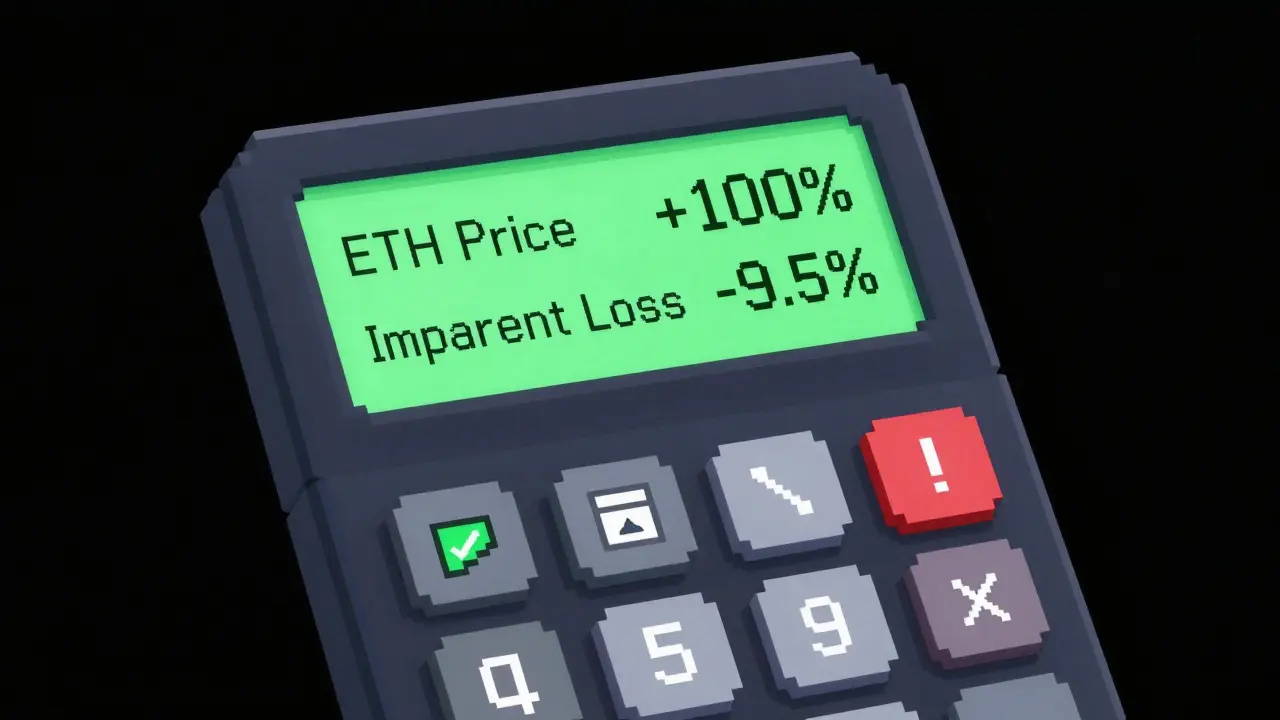
This rebalancing happens automatically. You can’t stop it. But you can predict it. Without a calculator, you are guessing whether the trading fees you earn will cover this hidden drag on your portfolio value. With a calculator, you can run the numbers before you commit a single dollar. For example, if ETH doubles in price against USDC, standard models show an impermanent loss of roughly 9.5%. If ETH triples, that loss jumps to nearly 18%. These aren't small margins. They eat directly into your returns.
Top Impermanent Loss Calculators Compared
Not all calculators are created equal. Some are simple widgets, while others are full-scale portfolio trackers. Here is how the industry leaders stack up based on features, accuracy, and user experience.
| Tool | Best For | Key Feature | Limitation |
|---|---|---|---|
| CoinGecko IL Calculator | Quick checks & fee offset analysis | Integrates APY to show net profit after IL | No historical portfolio tracking |
| Koinly | Tax reporting & real-time tracking | Connects to wallets for actual transaction data | Premium features require subscription |
| CryptoTaxPrep | Visualizing token quantity changes | Detailed charts showing exact token balances | Lacks integrated APY/ROI calculations |
| Coinbase Glossary Tool | Beginners learning the concept | Simple educational interface | No complex calculation capabilities |
CoinGecko's Impermanent Loss and APY Calculator is a widely used web-based tool launched in Q3 2020 that estimates impermanent loss and compares it against potential annual percentage yield from trading fees remains the gold standard for quick decision-making. Its strength lies in simplicity. You input the price change, and it tells you if the fees justify the risk. It supports variable weight pools, which is crucial as more protocols move beyond the standard 50:50 split. However, it doesn’t look back at what you’ve already done. It only helps you plan what’s next.
If you want to know what happened to your past positions, Koinly is a cryptocurrency tax accounting platform that offers an impermanent loss calculator integrated with wallet transaction history for precise compliance tracking is the heavyweight champion. By connecting your wallet, it pulls actual price data from APIs like CoinGecko to calculate the exact impermanent loss on specific time periods. This is vital for tax purposes, especially as authorities like the IRS scrutinize DeFi transactions. The downside? The advanced features sit behind a paywall, typically around $49/month for premium API access.
For visual learners, CryptoTaxPrep is a free online calculator released in March 2021 that provides detailed visual breakdowns of token quantities before and after price movements shines. It shows you exactly how many tokens you lost or gained during a price swing. It’s less about the dollar value and more about the mechanics of the rebalancing. It’s free, accurate, but lacks the fee-offsetting context that CoinGecko provides.
How to Use These Tools Effectively
Using these calculators isn’t just about plugging in numbers. It’s about understanding the inputs. Most tools require three main pieces of data:
- Initial Price Ratio: The starting relationship between the two assets (e.g., 1 ETH = 1,500 USDC).
- Price Change Percentage: How much you expect one asset to move relative to the other.
- Pool Weighting: Typically 50:50 for standard pools, but newer tools allow for custom ratios.
The magic formula behind most of these tools is derived from the constant product invariant. While you don’t need to be a mathematician, knowing that a 2x price increase leads to ~9.5% IL and a 10x increase leads to ~37% IL helps build intuition. The key insight from experts like Dr. Georgios Konstantopoulos is that you must always factor in fee revenue. A calculator showing -12% IL is misleading if the pool generates 15% APY in fees. The net result is +3%. Always subtract the IL from the expected fee income to get your true return.

Pitfalls and Common Mistakes
Even with the best tools, users make costly errors. The biggest mistake is treating impermanent loss as a temporary glitch rather than a structural feature of AMMs. Another common error is ignoring gas fees. In a high-volatility environment, you might try to withdraw and re-enter pools frequently to minimize IL. On networks like Ethereum, those gas fees can easily exceed the savings you were trying to achieve. One Reddit user reported losing 2.3 ETH in gas fees chasing reversals-a classic case of throwing good money after bad.
Also, beware of low-liquidity tokens. Calculators rely on price oracles. If a token has thin liquidity, the oracle price may lag the real market price by seconds or minutes. During flash crashes or pumps, this lag can make your calculated IL look different from your actual realized loss. Stick to large-cap pairs with reliable feeds for the most accurate predictions.
The Future of IL Calculation
The landscape is evolving. With the rise of Uniswap V3 is an updated version of the Uniswap protocol that introduces concentrated liquidity, allowing providers to allocate capital within specific price ranges for higher efficiency, the old 50:50 models are becoming obsolete. Concentrated liquidity changes the math entirely. Newer versions of CoinGecko’s tool and Koinly’s API now support these complex positions. Looking ahead, we expect machine learning models to forecast IL probabilities based on historical volatility, moving us from reactive calculation to predictive risk management. As DeFi matures, these calculators will likely become built-in UI elements of every major protocol, making risk assessment seamless.
Is impermanent loss really permanent?
It depends on price action. If the asset prices revert to their original ratio, the loss disappears. However, if you withdraw while prices are still divergent, the loss becomes permanent. The term "impermanent" refers to the fact that the loss is unrealized until withdrawal, not that it is guaranteed to vanish.
Which impermanent loss calculator is best for beginners?
CoinGecko’s calculator is ideal for beginners due to its simple interface and clear integration of APY data. It helps new users quickly understand if the trading fees outweigh the potential impermanent loss without requiring complex setup or wallet connections.
Do impermanent loss calculators account for gas fees?
Generally, no. Most calculators focus on the mathematical difference in asset value and trading fee revenue. Gas fees are external costs related to network congestion and must be estimated separately by the user, often using tools like Etherscan or gas trackers.
Can I avoid impermanent loss completely?
You can minimize it by providing liquidity for stablecoin pairs (e.g., USDC/USDT) where price divergence is minimal. However, in volatile pairs like ETH/USDC, some degree of impermanent loss is inevitable unless you hold the assets outside the pool.
Are impermanent loss calculators accurate for Uniswap V3?
Only the latest versions of advanced tools like CoinGecko v3.0 and Koinly support Uniswap V3’s concentrated liquidity. Older calculators based on the standard 50:50 model will provide inaccurate results for V3 positions because the risk profile is significantly different.