

There is a lot of noise online suggesting that crypto taxes in Pakistan are sliding down to 0%. If you've been waiting for that dream scenario to sell your bags, you might want to double-check your facts. In reality, Pakistan has moved away from its old days of regulatory confusion and has settled on a firm, flat tax structure. For most of you, that means a 15% hit on your profits when you cash out.
The shift happened through the Virtual Assets Ordinance in July 2025. It wasn't a random decision; the International Monetary Fund (IMF) and the Pakistan Crypto Council pushed for this to stop revenue leakage and bring digital assets into the formal economy. While a 0% rate isn't on the official books, the clarity provided by these laws is actually a win for those who were previously trading in the shadows.
How the 15% Capital Gains Tax Actually Works
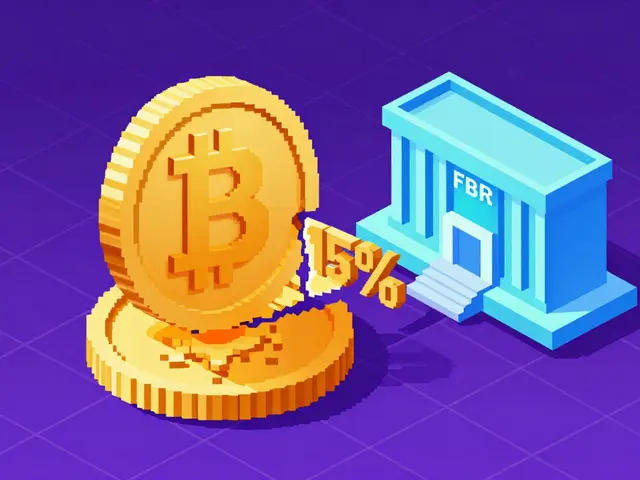
Let's get the basics straight. The Capital Gains Tax (CGT) is a flat 15% applied specifically when you sell your cryptocurrency for fiat currency (Pakistani Rupees) at a profit. Unlike some countries, Pakistan doesn't currently care if you held your Bitcoin for two days or two years-the rate remains the same.
However, there is a small silver lining for the casual trader. There are potential exemptions for small transactions under ₨50,000. If you're just swapping a few tokens for a coffee or a small gadget, you might not feel the pinch. But once you hit that threshold, the Federal Board of Revenue (FBR) expects its cut.
| Activity | Tax Rate | Tax Type |
|---|---|---|
| Selling Crypto for Profit | 15% | Flat CGT |
| Mining & Staking Rewards | 5% to 35% | Progressive Income Tax |
| Corporate Crypto Trading | 29% | Corporate Tax |
| Roshan Digital Account Conversion | 10% | Special Conversion Tax |
Mining, Staking, and Regular Income
It is a common mistake to think the 15% CGT covers everything. It doesn't. If you are running a mining rig or earning rewards from staking, the government views that as regular income, not a capital gain. This means your earnings fall into the standard progressive tax brackets. If you make up to ₨600,000 a year, you're looking at 5%, but if you're a high-earner making over ₨12 million, that rate jumps to 35%.
This distinction is crucial. A miner who earns monthly rewards is taxed differently than a holder who waits for a price surge to sell. For those using Roshan Digital Accounts, converting crypto to rupees can incur a 10% tax, which is a specific quirk of the repatriation rules for non-residents.

Who is Policing the Markets?
The game changed in May 2025 with the creation of the Pakistan Digital Assets Authority (PDAA). This body, led by Minister Bilal Bin Saqib, is the central entity responsible for making sure the crypto market doesn't turn into the Wild West. They aren't just there to collect taxes; they are trying to build a framework that attracts institutional investors.
The PDAA has started requiring cryptocurrency exchanges to share transaction data with the FBR. This means the days of "forgetting" to report a massive win are quickly disappearing. If you're using a local exchange or even a global one that complies with local laws, your data is likely already being flagged.
The Compliance Headache: How to File
Reporting your gains isn't as simple as clicking a button-at least not yet. You are required to use Form IT-1, with a deadline of September 30 every year. The real struggle for many is the valuation. Since there isn't a single "official" price for a token at any given second, users often struggle to convert their transactions to PKR using rates the FBR will actually accept.
Many traders are now turning to third-party tools like Koinly or CoinTracker to handle the heavy lifting. These tools help you track your cost basis-the price you paid for the asset-so you only pay tax on the actual profit, not the total sale amount. Without these, you might spend 20 hours a year just staring at spreadsheets.

Is Pakistan Competitive Globally?
When you compare 15% to the rest of the world, Pakistan is in a weird middle ground. It's far more attractive than India, where the government takes a massive 30% chunk of gains plus a 1% TDS. However, it can't compete with the "tax havens" like Dubai or Portugal, where the rate is effectively 0% for individuals.
The biggest complaint from the community is the lack of a "long-term holding' incentive. In Germany, if you hold a coin for over a year, you pay nothing. In Pakistan, you pay 15% whether you held for a year or a decade. This encourages short-term flipping rather than long-term investing, which some experts argue could hurt the country's overall market stability.
What's Next for Crypto Taxes in Pakistan?
While the "decline to 0%" rumor is unfounded, there is a chance for future relief. The PDAA hinted in October 2025 that they are drafting regulations for long-term holding incentives. This could mean that in 2026 or 2027, we might see a tiered system-perhaps 10% for holding over a year and 5% for two years. This is purely speculative, but it's where the conversation is moving.
For now, the 15% flat rate is the law of the land. If you're operating in this space, your best bet is to keep meticulous records and use automated reporting tools. Trying to dodge the FBR in the age of the PDAA is a gamble with very poor odds.
Is there really a 0% tax rate for crypto in Pakistan?
No. There is no official policy or scheduled decline to a 0% tax rate. The current law implements a flat 15% Capital Gains Tax on profits made from selling cryptocurrencies for fiat currency.
Do I have to pay tax on every single trade?
Taxes are generally triggered when you convert crypto back to fiat currency (PKR). There is a potential exemption for very small transactions under ₨50,000, but most profitable trades will be subject to the 15% CGT.
How is crypto mining taxed differently than trading?
While trading is taxed at a flat 15% CGT, mining rewards and staking income are treated as regular income. This means they are taxed according to your annual income bracket, ranging from 5% to 35%.
When is the deadline to file crypto taxes in Pakistan?
You must report your cryptocurrency gains using Form IT-1, and the annual filing deadline is September 30.
Will the FBR know if I don't report my crypto gains?
It is increasingly likely. Since mid-2025, the Pakistan Digital Assets Authority (PDAA) has mandated that cryptocurrency exchanges share transaction data with the Federal Board of Revenue (FBR).





Findlay Duncan Lyon
April 25, 2026 AT 02:08Actually a decent rate compared to some places. Cheers for the info.
Tara Aman
April 25, 2026 AT 07:03This is such a helpful breakdown! It is so important to stay on top of these changes so we can all keep growing our portfolios safely. Let's all get those records organized!
Yvette P
April 26, 2026 AT 07:18Oh honey, imagine thinking that 15% CGT is actually "competitive" in the global landscape of decentralized finance. While the author is trying to paint this as a win for transparency, let's be real about the systemic friction created when you implement a flat tax without accounting for the volatility of the underlying asset's cost basis over time. The lack of a long-term holding incentive is basically a middle finger to actual investors, effectively forcing a high-velocity churn of assets that benefits the exchanges far more than the retail holders who are just trying to avoid a tax nightmare. It's honestly adorable that anyone thinks the PDAA is here to "attract institutional investors" when the current framework is basically just a glorified revenue collection tool for the FBR. I've seen more sophisticated regulatory frameworks in a lemonade stand. Using tools like Koinly is a great start, but it's a band-aid on a bullet wound if the government doesn't stop penalizing long-term conviction. We're basically witnessing the birth of a regime that wants the prestige of being "crypto-friendly" without actually doing the hard work of creating an ecosystem that incentivizes growth over short-term extraction. Good luck to everyone trying to figure out their PKR conversion rates on a Tuesday afternoon while the FBR breathes down their necks.
Eric Raines
April 28, 2026 AT 00:51I already knew about the PDAA, obviously. Most people just don't realize that the 15% is basically just a placeholder until they find a way to tax the gas fees too.
Jennifer L
April 28, 2026 AT 18:51Oh my goodness, the stress of filling out Form IT-1 sounds laabsolutely terrifing!! I can't even imajine the panic of a missed deadline... it's just so heartbraking that the process is so confusing for everyone.
Ali Tate
April 29, 2026 AT 03:1115 percent is a joke compared to the absolute carnage in other markets but let's be real the FBR is just playing catchup with technology they don't understand just to grab some coins from the peasants
Jason M
April 30, 2026 AT 06:37Folks, don't let the complexity scare you! This is a huge learning opportunity for all of us to become more financially literate. Just take it one step at a time, use those tracking tools, and you'll conquer this tax season with flying colors! 🚀
Greg Reynolds
May 1, 2026 AT 09:29The assertion that this clarity is a "win" is logically flawed. Regulatory clarity that results in a tax burden without investment incentives is simply a more efficient method of wealth extraction.
Sarah Fisher
May 2, 2026 AT 01:13It's interesting how we view tax as a burden, but perhaps it's the price we pay for moving from the 'Wild West' to a structured society. It's a trade-off between absolute freedom and systemic stability.
Benjamin Forg
May 3, 2026 AT 15:27it is all a trap the pdaa is just a front for global surveillance and the fbr is probably sharing your data with agencies youve never even heard of stay away from local exchanges if you value your soul
Sara Ellis
May 4, 2026 AT 05:52taxes are just numbers and numbers are just ideas honestly why do we even care
Liz Ariza
May 4, 2026 AT 06:46Keeping a clean ledger is the best way to sleep at night! 🌟 Use those apps to stay organized and keep your stress levels low. You've got this! ✨
Charlie Queen
May 5, 2026 AT 18:57This is a great way to bring more people into the formal economy! Love seeing the progress 🌍😊
Keith Garcia
May 7, 2026 AT 07:27The sheer audacity of believing a 15% rate is an incentive is truly a marvel of cognitive dissonance. 🙄 Pure mediocrity at its finest.
Miranda Jamieson
May 7, 2026 AT 08:00If you're still trading in the shadows in 2025, you're not a 'rebel', you're just a liability. Get your taxes sorted or get out of the market.
Paige Raulerson
May 8, 2026 AT 16:04The mention of Koinly is so quaint. Real pros have custom scripts, but I suppose the masses need a handheld interface to avoid crying over a CSV file.
praveen subbiah
May 9, 2026 AT 04:31Actually, my home country's approach is even more intense but it's all for the glory of the nation's growth! 🇮🇳 It is wonderful to see other countries organizing their digital future!
Guy Bianco
May 10, 2026 AT 14:41I would suggest that newcomers focus on the ₨50,000 exemption. It provides a small but helpful cushion for those just starting their journey. (^_^)
Larry Yang
May 11, 2026 AT 21:05Imagine thinking the PDAA actually cares about "institutional investors" lol. They just want a bigger slice of the pie and they're using fancy terms to hide it.
jill huyo-a
May 13, 2026 AT 12:43I wonder if the 10% conversion tax for Roshan Digital Accounts applies to all coins or just specific ones? It would be great if the author could clarify that part.
Robert Mosolygo
May 13, 2026 AT 17:19The coordination between the PDAA and FBR is a textbook example of the Panopticon effect. They aren't just collecting taxes; they are building a database of every single financial movement to ensure total state control over individual wealth. If you think a "flat rate" is a fair deal, you're ignoring the fact that the infrastructure for a total freeze of assets is now fully operational. It's not about the 15%, it's about the metadata. They know exactly who is winning and who is losing, and that information will be weaponized the moment the political wind shifts. The ₨50,000 limit is a psychological trick to make you feel safe while you're actually just onboarding yourself into a surveillance system. This is exactly how the social credit systems start-by legitimizing the tracking of "alternative" assets under the guise of formalization. Wake up.