

Finding a new trading platform often feels like a gamble. You see the numbers, join a Discord server, and hope you aren't walking into a trap. If you've come across Meteora DBC is a cryptocurrency exchange platform that has recently caught the eye of traders due to its active trading volumes, you're probably wondering if it's a legitimate place to put your funds. The tricky part is that in the crypto world, names often overlap, and there is a massive difference between this platform and the well-known liquidity layer on Solana.
Before you deposit a single satoshi, you need to know exactly what you're dealing with. While the platform shows significant activity, there's a glaring lack of public documentation. This review breaks down what we know, what's missing, and how to avoid the most common mistakes when choosing between a centralized exchange and a decentralized protocol.
The Essentials: What is Meteora DBC?
At first glance, Meteora DBC looks like a standard trading hub. Based on current market data, it handles a 24-hour trading volume of roughly $11 million and attracts over 140,000 visitors a week. These are not small numbers; they suggest a platform that is actively being used by a sizable community. Their primary social touchpoint is a dedicated Discord channel, which is where most of the real-time chatter happens.
However, here is the red flag: there is almost no public information regarding who runs the platform, where they are based, or what security audits they've passed. In a world where "rug pulls" are common, a platform with high volume but low transparency is a risky bet. If you can't find a whitepaper or a legal entity behind the exchange, you are essentially trusting the platform with your keys and your capital without a safety net.
The Big Confusion: DBC vs. DEX
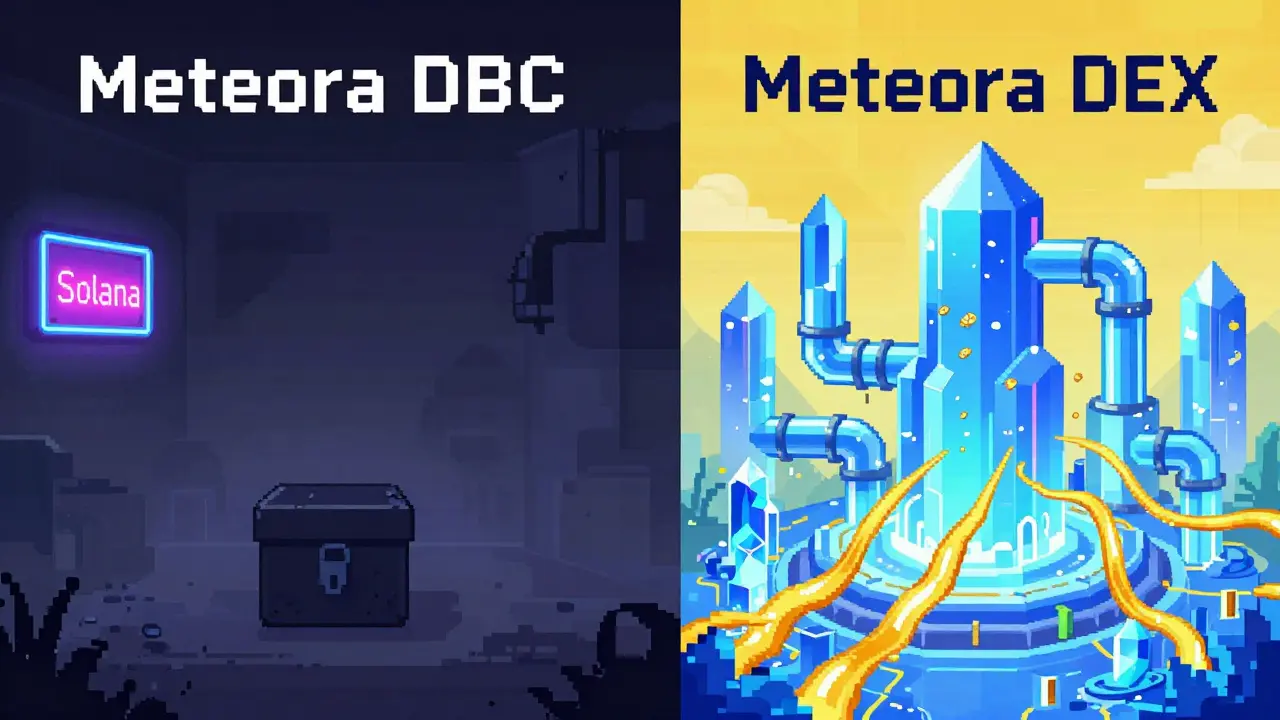
One of the biggest mistakes traders make is confusing Meteora DBC with Meteora DEX. They sound almost identical, but they operate in completely different ways. Meteora DEX is a Solana-based decentralized exchange protocol that focuses on liquidity infrastructure rather than being a simple trading site.
If you are looking for a high-tech, transparent, and audited environment, you are likely thinking of the DEX. The DEX version is a powerhouse in the Solana ecosystem, often working alongside Jupiter to provide deep liquidity. While the DBC version is a platform where you trade, the DEX version is a protocol that allows other platforms to function better.
| Feature | Meteora DBC | Meteora DEX |
|---|---|---|
| Type | Exchange Platform | Liquidity Protocol |
| Daily Volume | ~$11 Million | $200 Million+ |
| Primary Ecosystem | General Crypto | Solana |
| Transparency | Low (Limited Public Data) | High (On-chain/Audited) |
| Core Value | Trading Interface | DLMM & Dynamic Vaults |
Deep Dive into the Meteora DEX Ecosystem
Since the DBC side is so mysterious, it's worth explaining why the Meteora DEX is such a big deal. It doesn't just let you swap tokens; it changes how liquidity works. Most exchanges use a standard Automated Market Maker (AMM), which often leaves a lot of capital sitting idle. Meteora fixes this with several innovative tools.
- DLMM Pools: Unlike old-school pools, Dynamic Liquidity Market Making (DLMM) allows providers to set precise price bins. This means less slippage for the trader and higher efficiency for the person providing the money.
- Dynamic Vaults: These vaults act like a smart manager for your crypto. Instead of your assets just sitting there, the vault moves them to lending protocols to earn extra yield.
- Dynamic AMM: These combine traditional trading with lending, ensuring that the liquidity isn't just "dead weight" but is actively working to generate profit.
For a trader, this means that when you use a tool like Jupiter to find the best price, Meteora DEX is often the engine in the background providing that price. It's a highly technical approach that prioritizes capital efficiency over simple user interfaces.

Comparing Meteora to Other Solana Giants
If you're exploring the Solana space, you've probably heard of Raydium. While Raydium is the "old guard" of Solana DEXs-launched way back in 2021-Meteora is the "new challenger." Raydium has the advantage of a massive variety of trading pairs and a well-established governance token (RAY).
Meteora's edge lies in its math. By introducing concentrated liquidity and yield-optimizing vaults, it allows users to earn more from their assets without needing to manually move funds every few hours. It's the difference between a basic savings account and a managed investment portfolio. While Raydium is great for raw access to tokens, Meteora is designed for those who want to squeeze every drop of value out of their liquidity.

The Risks: What to Watch Out For
Trading crypto is already risky, but using an exchange with a "black box" operational model is even riskier. When using Meteora DBC, you have to ask: Where is the money stored? Who has the keys? Is there a KYC (Know Your Customer) process, or is it completely anonymous? If an exchange doesn't clearly state its security protocols, you are effectively gambling on the honesty of the developers.
A pro tip for anyone entering this space: Never keep more money on an exchange than you are willing to lose overnight. Use a hardware wallet for your long-term holdings and only move funds to a platform like this for active trading. If you decide to use a decentralized option like Meteora DEX, you keep control of your keys, which removes the risk of the exchange disappearing with your funds.
Is Meteora DBC Right for You?
If you are a high-risk trader who follows the crowd on Discord and doesn't mind a lack of official documentation, the high trading volume of Meteora DBC might be enticing. However, for the average person looking for a safe harbor for their investment, the lack of transparency is a major deterrent. You're essentially trading in a room where you don't know who owns the building.
On the other hand, if you're interested in the actual technology of DeFi, the Meteora DEX ecosystem is a goldmine. It's an excellent way to learn how concentrated liquidity works and how to earn yield on Solana. The choice depends on whether you want a simple (but mysterious) interface or a complex (but transparent) protocol.
Is Meteora DBC the same as Meteora DEX?
No. Meteora DBC appears to be a trading exchange platform with specific daily volumes and a Discord community. Meteora DEX is a decentralized liquidity protocol on the Solana blockchain designed to optimize how assets are pooled and traded.
Is Meteora DBC safe to use?
There is very little public information regarding the security audits, founding team, or legal status of Meteora DBC. While it has significant trading volume, the lack of transparency makes it a high-risk option compared to established, audited decentralized protocols.
What are DLMM pools in Meteora DEX?
Dynamic Liquidity Market Making (DLMM) pools allow liquidity providers to allocate their assets into specific price bins. This increases capital efficiency, reduces slippage for traders, and allows providers to earn higher fees by focusing their liquidity where the most trading happens.
How does Meteora DEX differ from Raydium?
Raydium is one of the oldest DEXs on Solana with a huge variety of tokens and a native governance token. Meteora focuses more on liquidity efficiency, offering tools like Dynamic Vaults and DLMM pools that generate higher yields for liquidity providers through better capital management.
Where can I find the community for Meteora DBC?
The primary community hub for Meteora DBC is their Discord server, which serves as the main point of communication between the platform and its users.






Samson Selleck
April 8, 2026 AT 22:29The systemic asymmetry between the DBC interface and the DEX protocol is a classic example of semantic ambiguity leveraged for retail capture. From a quantitative perspective, the lack of a transparent order book or an audited smart contract framework makes the DBC side an absolute volatility trap for anyone not versed in risk mitigation strategies. The liquidity provisioning models in the DEX are mathematically sound, utilizing concentrated liquidity to optimize capital efficiency, but that's irrelevant if the entry point is a black-box CEX.
Carroll Foster
April 9, 2026 AT 11:02Oh sure, because trusting a random Discord server is exactly how I like to manage my portfolio. Truly the pinnacle of financial innovation right there!
jennelle williams
April 10, 2026 AT 12:20be careful everyone. just keep your money safe
Hope Johnson
April 11, 2026 AT 17:42It is truly fascinating how the human psyche is drawn to the allure of high-volume activity even when the structural foundations are completely invisible to the observer. We must remember that in the digital age, transparency is not just a feature but a moral imperative for any entity handling the life savings of others, and the distinction between a protocol and a platform is where most people lose their way in the pursuit of quick gains.
ssjuul z
April 12, 2026 AT 06:54Great breakdown! Definitely sticking to the DEX side of things. Safety first! 🚀
Alan Seiden
April 14, 2026 AT 03:19This is utter rubbish. Only a complete fool would even consider a platform without a legal entity. The sheer incompetence of retail traders these days is staggering. Britain used to lead in financial standards, yet here we are watching people gamble on 'Discord-based' exchanges.
Prasanna Shembekar
April 14, 2026 AT 13:13omg its literally a scam lol
Jessie Tayaban
April 15, 2026 AT 04:05I almost fell for the DBC thing because I saw the numbers and got so hyped!! Like seriously why are there two things with the same name it's so confusinggg 😭
Omotola Balogun
April 16, 2026 AT 09:49The DLMM mechanism is actually quite sophisticated if you understand how price bins work in a concentrated liquidity model. Most people just see the APY and jump in without realizing that impermanent loss can still eat your margins if the price moves too far outside your selected range.
Rima Dinar
April 17, 2026 AT 07:58I really believe that if we all just take a moment to slow down and educate ourselves on the technical differences between a centralized exchange and a decentralized protocol, we can all navigate this volatile market together with much more confidence and avoid the pitfalls that so many beginners unfortunately fall into every single day because they are rushing into things.
Tracie and Matthew Hartley
April 18, 2026 AT 05:48idk why ppl care about audit’s anyway. just throw the money in and hope for the best lol its crypto not a bank
Amanda Faust
April 20, 2026 AT 04:21basically just use a hardware wallet if you actually care about your funds
Jason Davis
April 20, 2026 AT 15:27The DLMM pools are laegendary for effeciency but you gotta watch the slipage on smaller pairs. I've spent a lot of time with the Solana ecosystem and Meteora is definitely a top tier choice for liquidity providrs.
Chidinma Sandra okafor
April 21, 2026 AT 06:03Oh wow, thank you so much for this wonderful warning! It's just so heart-warming to see people actually trying to save others from losing money, even if the DBC people are probably just laughing at us from their private islands while they pretend to have 'volume'.
EDOZIEM MICHAEL
April 23, 2026 AT 03:28money is just energy flowing in different directions man if it goes to the DBC it just means the energy shifted
aletheia wittman
April 25, 2026 AT 01:17WAIT so u mean i mighta been scammed?? i litrally put like 500 bucks in there last week omg im actually gonna cry
Artavius Edmond
April 26, 2026 AT 08:21Just keep it chill everyone, we're all learning here. If anyone is stressed just stick to the audited stuff and breathe.
Lauren Abrams
April 27, 2026 AT 08:44The lack of a whitepaper for the DBC side is the biggest red flag here.
Akshay Gorad
April 27, 2026 AT 09:16I appreciate the detailed comparison table. It makes the distinction very clear for those who aren't as familiar with the Solana ecosystem.
Agnessa Dale
April 28, 2026 AT 02:47I'm sure there are people finding success with both, but staying safe is always the best way to go!