
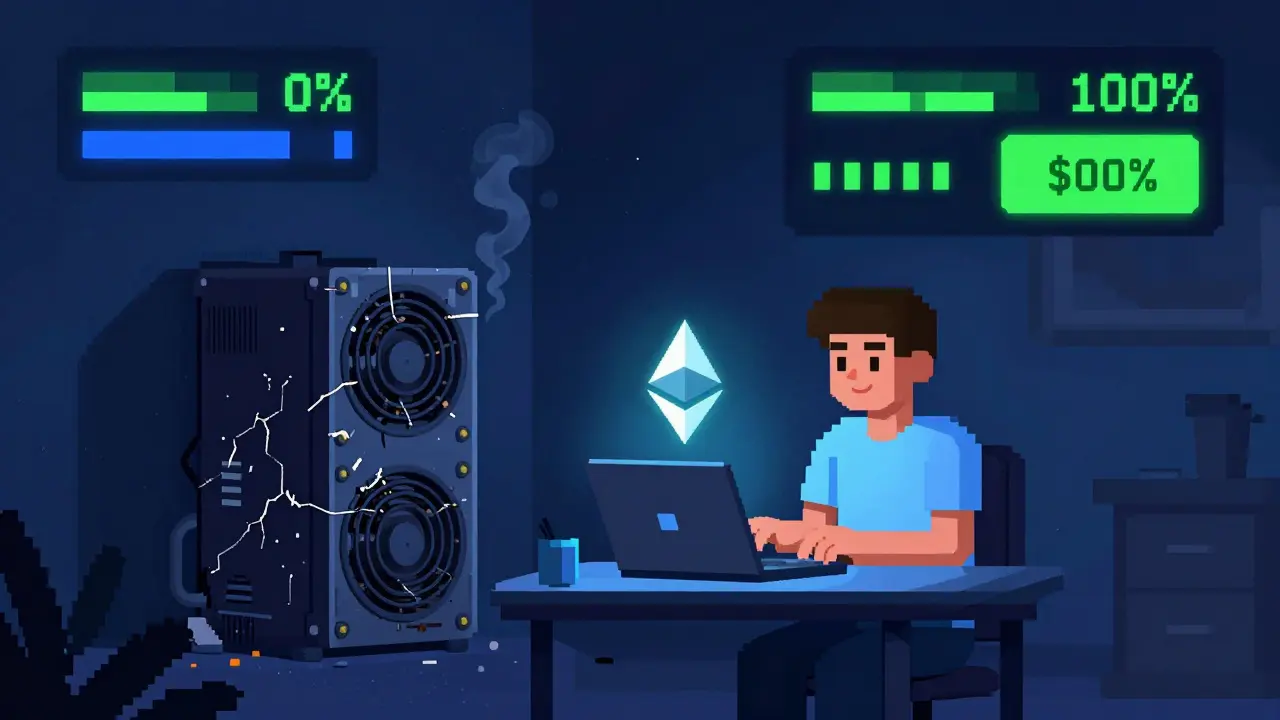
When you first hear about earning crypto just by holding it, it sounds too good to be true. No expensive machines. No loud fans. No electricity bills that make your jaw drop. That’s staking. And it’s completely different from mining-the old-school way of securing blockchains. The gap between them isn’t just technical. It’s financial, technical, and even psychological. If you’ve ever wondered why more people are choosing staking over mining, the answer isn’t about hype. It’s about who can actually get in the game.
What You Need to Start
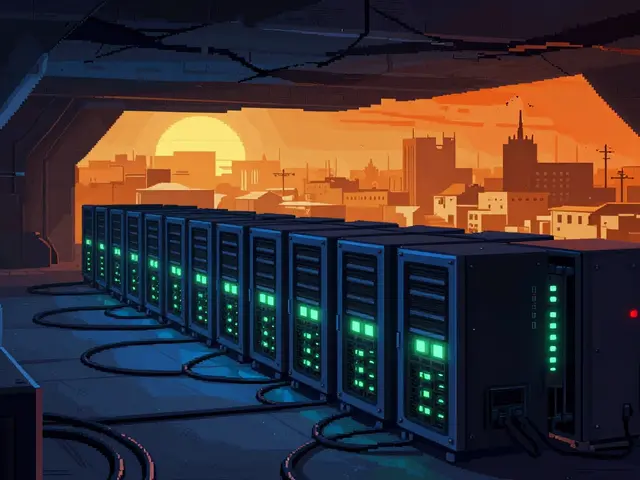
Mining used to be the only way to earn crypto by helping secure a network. You’d buy a rig, plug it in, and let it run 24/7. But it wasn’t just about having a computer. You needed serious hardware. An ASIC miner like the Bitmain Antminer S21 Hyd costs $12,500. Even GPU rigs aren’t cheap-eight NVIDIA RTX 4090s set you back around $12,800. And that’s just the start. You need a power supply that can handle 5,000 watts. Cooling systems. Dedicated space. Electricity that doesn’t cost $0.20 per kWh. If you live in a state like California or New York, mining is already a money-losing proposition unless you’re running a full-scale operation. Staking? You need one thing: crypto. That’s it. For Ethereum, you used to need 32 ETH-about $104,000 in December 2025. Sounds high? It is. But here’s the twist: you don’t have to stake alone. Most people use staking pools or exchanges like Coinbase, Lido, or Kraken. With Coinbase, you can stake with as little as $1. Lido lets you stake 0.01 ETH. You don’t need a server. You don’t need to learn Linux. You just log in, click a button, and wait for rewards.Costs That Actually Matter
Let’s compare real numbers. A typical mining setup uses 5,500 kWh per month. At $0.10 per kWh, that’s $550 a month. Add in hardware depreciation-ASICs lose value fast-and you’re looking at $10,000+ upfront with $6,600 in electricity per year. After six months, you’re still in the red. Coin Bureau’s 2025 analysis found mining takes 22 months to break even under current market conditions. Staking? Zero electricity cost. Zero cooling. Zero noise. You’re not running a machine-you’re locking up tokens. Even if you buy 10 ADA ($3.50) to stake on Cardano, your only cost is the price of the tokens themselves. There’s no depreciation. No wear and tear. Your stake doesn’t get hotter. It doesn’t break. It just earns. And if the price of ADA goes up? You’re up twice: on rewards and on value.Who Can Actually Participate?
Mining is geographically locked. The best places to mine are where electricity is cheap: Kazakhstan, Russia, Texas, and parts of China. That’s not because those places are crypto-friendly-it’s because they have surplus power. If you live in Germany, Japan, or Brazil, your electricity rates are too high to mine profitably. Even if you could afford the hardware, your monthly bill would eat your profits. Staking is global. You can stake from your phone in Nairobi, your dorm room in Manila, or your apartment in Berlin. ChainLabo’s 2025 data shows the top three staking countries are the U.S., Germany, and the U.K.-not because they’re cheap to power machines, but because they have internet access and crypto-savvy populations. You don’t need a warehouse. You don’t need a permit. You don’t need to convince your landlord you’re running a data center.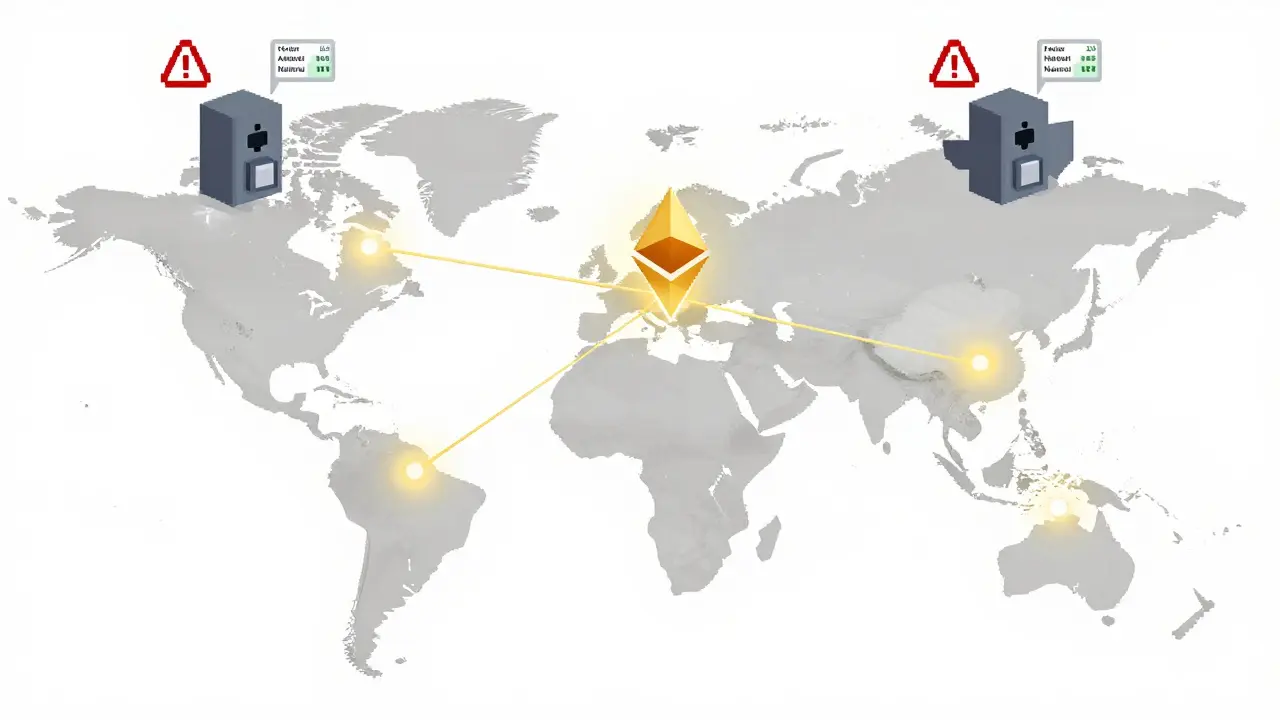
Technical Skills: A Night and Day Difference
Mining is a technical nightmare. Coin Bureau’s 2025 survey of 1,200 miners found 78% needed professional help to set up their rigs. You need to configure BIOS settings. Install mining software. Tune fan curves. Monitor temperatures. Adjust voltage. Deal with driver crashes. One wrong setting and your rig shuts down. And if it overheats? You’ve just burned through $1,600 in GPUs. Staking? Most people use exchanges. Coinbase’s onboarding takes four clicks and under two minutes. Even if you run your own validator, you don’t need to be a sysadmin. You install a simple client, sync your wallet, and let it run. The Ethereum staking launchpad has a 92% success rate. That’s higher than most software installations you’ve ever done.What Happens When Things Go Wrong?
Mining has one big risk: your machine breaks. You spend $10,000 on hardware. Six months later, it’s worth $3,000. The market shifts. The difficulty goes up. Your profit turns to loss. And there’s no way out. You’re stuck with a $7,000 paper loss. Staking has risks too-but they’re different. The biggest is slashing. If your validator goes offline for more than a few hours, you lose a small portion of your stake. One Reddit user lost 0.5 ETH ($1,625) because their Raspberry Pi lost power during a storm. That’s scary. But here’s the flip side: your staked tokens still have value. If Ethereum drops 30%, your 32 ETH is still worth $72,800. You didn’t lose hardware. You didn’t lose your investment. You just lost a small reward.The Big Shift: Ethereum’s Merge
Before September 15, 2022, Ethereum used Proof of Work. It consumed more electricity than Argentina. After The Merge? It dropped to 0.01 TWh per year. That’s a 99.95% reduction. Suddenly, staking wasn’t just an alternative-it became the default. And it changed everything. Mining companies scrambled. Miners sold their rigs. Some even switched to staking. Today, 29% of the top 100 cryptocurrencies use Proof of Stake. That’s up from 19% in 2020. Mining is shrinking. PoW networks now make up just 38% of the top 100. And it’s not slowing down. Gartner predicts 80% of new blockchains will use PoS by 2027. Ethereum’s upcoming Prague upgrade will cut the solo staking requirement from 32 ETH to 16 ETH. That’s $52,000. Still high? Yes. But it’s half. And with liquid staking, you can stake $100 and get a token that earns rewards and trades on exchanges.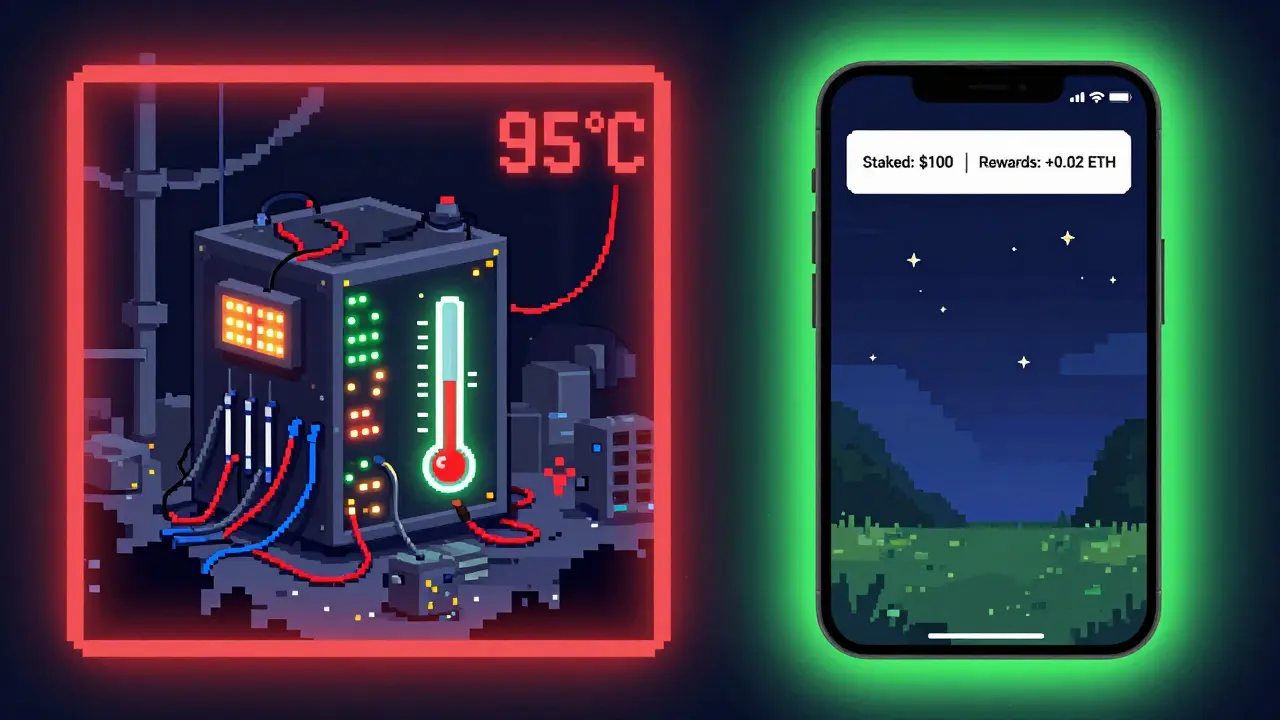
Who’s Winning? The Numbers Don’t Lie
The global staking market hit $42.7 billion in 2025. Mining? It’s declining at 3.2% per year. Coinbase, Lido, and Kraken now control over 50% of all staked assets. Mining pools? The top 10 control 83.7% of Bitcoin’s hashrate. That’s centralization. Staking? There are over 1,800 validator clients running independently. More diversity. More resilience. User reviews tell the story too. Mining services average 2.8/5 stars on Trustpilot. Staking platforms? 4.3/5. Why? Because 82% of miners cite high electricity costs as their biggest pain point. Meanwhile, 68% of stakers say ease of setup was their main reason for choosing it.Regulations Are Shifting Too
China banned mining in 2021. The EU made mining operations pay $50 per ton of carbon emissions. Nevada added a 0.025¢/kWh surcharge. Mining is becoming legally risky. Staking? The SEC’s Hester Peirce proposed a "Staking Safe Harbor" in November 2025. If it passes, staking rewards could be treated as non-securities in the U.S. That means no registration, no compliance headaches. It’s the first real sign regulators see staking as a legitimate financial tool-not a security loophole.Final Reality Check
If you’re thinking about getting into crypto consensus, ask yourself: Do I want to run a mini power plant? Or do I want to earn rewards like a dividend? Mining is for people with capital, space, and technical skills. It’s a business. A risky, expensive, energy-hungry business. Staking is for everyone else. Students. Retirees. People in developing countries. People who just want to hold crypto and earn a little extra. It’s not perfect. Slashing exists. Centralization through pools is real. But the barrier? It’s gone. The future of blockchain isn’t about who has the biggest ASIC. It’s about who can participate.Can I mine cryptocurrency with my regular laptop today?
No. Mining with a regular laptop or even a gaming PC is no longer profitable. The difficulty of Proof of Work networks like Bitcoin and Ethereum Classic is too high. Your electricity costs will exceed your rewards by a large margin. Even older ASIC miners from 2020 are now unprofitable in most regions. Mining today requires specialized hardware, cheap power, and industrial-scale operations.
Is staking safe? Can I lose my crypto?
You don’t lose your crypto just by staking-it’s locked, not spent. But there’s a risk called slashing. If your validator node goes offline for too long (usually over 4 hours), you can lose a small portion of your stake-typically 0.5% to 1%. This rarely happens with exchange-based staking because platforms manage the nodes for you. If you run your own validator, uptime matters. Always use a reliable power source and backup internet.
Do I need 32 ETH to stake Ethereum?
You need 32 ETH to run your own validator node. But almost no one does that anymore. Most people use staking pools or exchanges like Coinbase, Lido, or Kraken, which let you stake with as little as $1. These services combine small stakes into one validator, then distribute rewards proportionally. You’re still earning the same APY-just without the technical burden.
Which is more profitable: mining or staking?
For most people, staking is more profitable. Mining has high upfront costs, ongoing electricity bills, and hardware depreciation. Staking has near-zero operating costs and no depreciation. Even if you stake $100 in ETH, you’re likely to earn more net profit than someone who spent $10,000 on mining hardware and pays $500/month in electricity. Coin Bureau’s 2025 analysis showed mining takes 22 months to break even-staking breaks even in under 3 months.
Will staking replace mining entirely?
Not entirely, but it’s close. Bitcoin and a few other networks still rely on PoW, and they’ll likely keep it for security reasons. But for new blockchains, PoS is the standard. Gartner predicts 80% of new chains will use PoS by 2027. Ethereum’s success proved PoS can be secure, scalable, and sustainable. Mining’s days as the dominant consensus method are over.



Arya Dev
February 23, 2026 AT 07:55Leslie Cox
February 24, 2026 AT 23:46Andrew Hadder
February 25, 2026 AT 17:57Derek Sasser
February 26, 2026 AT 08:54Neeti Sharma
February 27, 2026 AT 03:56Nadia Shalaby
February 27, 2026 AT 20:09Fiona Monroe
March 1, 2026 AT 17:21Molley Spencer
March 2, 2026 AT 17:35John Fuller
March 3, 2026 AT 23:16Lucy Simmonds
March 4, 2026 AT 22:54maya keta
March 5, 2026 AT 00:42Curtis Dunnett-Jones
March 6, 2026 AT 12:45bella gonzales
March 7, 2026 AT 15:08Paul Reinhart
March 8, 2026 AT 06:56McKenna Becker
March 8, 2026 AT 17:31precious Ncube
March 9, 2026 AT 04:28Amita Pandey
March 10, 2026 AT 18:57Jan Czuchaj
March 11, 2026 AT 22:22Tracy Peterson
March 13, 2026 AT 02:24George Suggs
March 13, 2026 AT 06:47Dianna Bethea
March 14, 2026 AT 03:58Don B.
March 14, 2026 AT 05:15