

The European Union is about to make a move that will reshape how millions of people use cryptocurrency. Starting July 1, 2027, Monero and Zcash will be effectively banned from all EU-regulated crypto platforms. This isn’t a rumor. It’s law. And if you own these coins, you need to understand what’s coming - and what you can still do.
Why This Ban Is Happening
The EU didn’t wake up one day and decide to ban privacy coins out of nowhere. It was a deliberate, years-long effort to close loopholes in its anti-money laundering system. The new rule, called Regulation 2024/1624, was passed in May 2024 and is now part of the broader Markets in Crypto-Assets (MiCA) framework. Its goal? To make every crypto transaction traceable. The problem regulators see is simple: Monero and Zcash are designed to hide who sent money, who received it, and how much was sent. Monero uses ring signatures and stealth addresses to scramble transaction data. Zcash uses zero-knowledge proofs - a fancy term for math that proves a transaction is valid without revealing any details. To regulators, this isn’t privacy. It’s a weapon for criminals. According to the European Crypto Initiative, these coins make it "difficult to identify related transactions that might give rise to suspicion." That’s the official line. And for the EU, that’s enough to ban them outright.What Exactly Is Banned?
This isn’t just about not being able to trade Monero on Binance EU or Zcash on Kraken. The ban goes deeper. Article 79 of the new law says that any crypto service provider operating in the EU - exchanges, wallet providers, ATMs, even payment processors - is forbidden from handling any asset that allows anonymous transactions. That means:- You won’t be able to buy Monero or Zcash on any EU-based exchange after July 1, 2027.
- EU-based wallets will stop supporting these coins - no deposits, no withdrawals.
- Crypto ATMs in Germany, France, or Spain will no longer accept or dispense privacy coins.
- Any EU firm offering staking, lending, or earning on these coins must shut it down.
What About Holding Monero or Zcash?
Here’s the part people often get wrong: you won’t go to jail for owning Monero or Zcash. The law doesn’t criminalize possession. It only bans EU-regulated companies from dealing with them. That means if you already have Monero in a non-EU wallet - say, a hardware wallet stored in your home or a decentralized exchange like Uniswap - you can still hold it. You can even send it to someone outside the EU. The ban targets service providers, not individuals. But here’s the catch: if you try to move those coins into an EU-based exchange, they’ll refuse the deposit. If you try to cash out your Zcash through a German crypto ATM, it won’t work. The infrastructure is being cut off.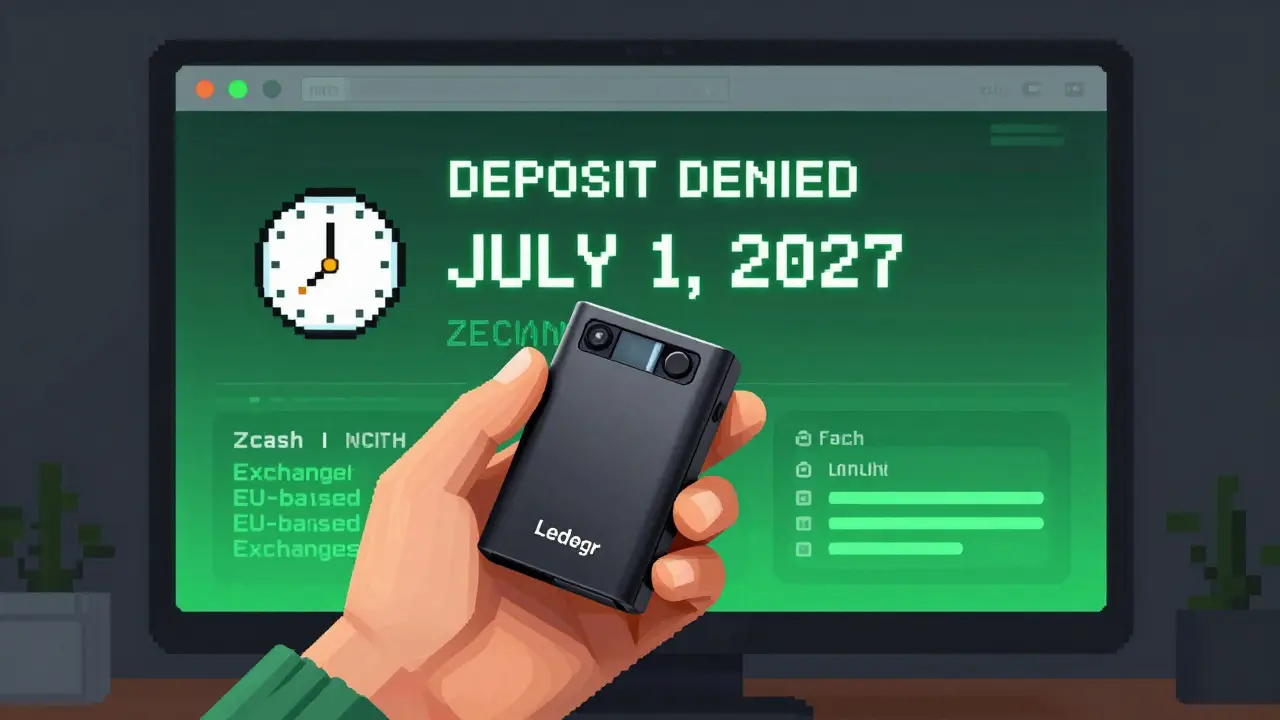
How Will This Affect the Market?
The EU is one of the biggest crypto markets in the world. Millions of people trade, hold, and use crypto here. Removing Monero and Zcash from this market means a massive drop in demand. Since the law was passed, trading volumes for both coins have dipped slightly on EU platforms. But the real impact won’t show until 2027. When exchanges are forced to delist these coins, liquidity will vanish. Prices could drop hard - not because the tech is broken, but because the market is shrinking. Some traders are already moving their holdings to non-EU exchanges like Bybit, KuCoin, or decentralized platforms. Others are converting to Bitcoin or Ethereum, which are fully compliant with EU rules. The EU’s move also sends a signal to other countries. If the EU - with its strict rules and global influence - bans privacy coins, countries like the UK, Canada, or Australia might follow suit. This isn’t just a local policy. It’s a global precedent.What Can Users Do Before 2027?
You have two years to prepare. Here’s what you can realistically do:- Check your current holdings. If you have Monero or Zcash on an EU exchange, withdraw them now to a wallet you control. Don’t wait until the last minute.
- Use non-EU platforms. If you want to keep trading privacy coins, use exchanges based outside the EU. Many are already preparing for this shift.
- Don’t panic-sell. The ban doesn’t make these coins worthless. It just removes one major market. Their technology still works. Their user base still exists.
- Learn about self-custody. If you’re not already using a hardware wallet (like Ledger or Trezor) or a non-custodial software wallet (like Monerujo or ZecWallet), now’s the time. The future of privacy coins may lie in personal control, not regulated platforms.
What Happens After 2027?
After July 1, 2027, EU-based companies will be legally required to block all transactions involving Monero, Zcash, and similar coins. The new supervisory body - called AMLA (Anti-Money Laundering Authority) - will monitor compliance. The first 40 major firms will be under direct watch. Some users may try to use peer-to-peer (P2P) trades or decentralized protocols to keep using privacy coins. But those methods are harder, slower, and riskier. No one is stopping you - but no one is helping you either. The EU’s goal isn’t to eliminate privacy coins forever. It’s to force them into the shadows. To make them harder to use, harder to access, and harder to trade. And in doing so, they hope to reduce their appeal.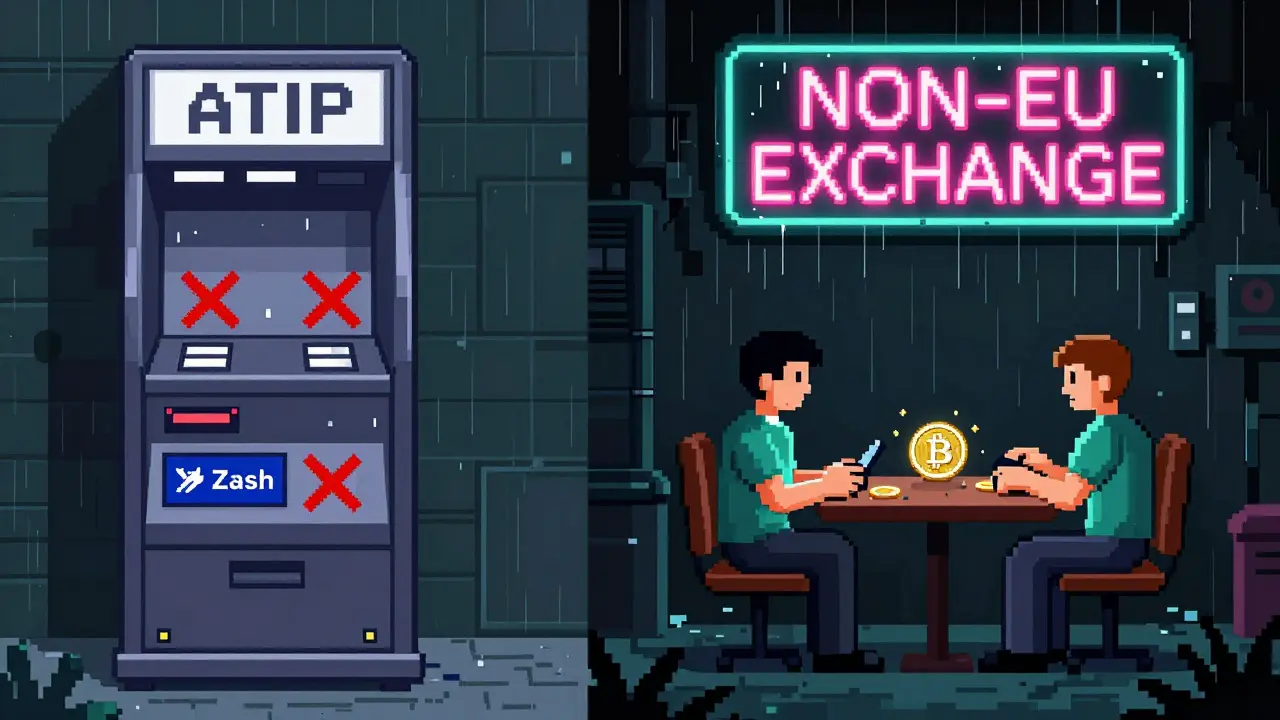



Taybah Jacobs
February 8, 2026 AT 19:29While I understand the EU's regulatory concerns, I find it deeply troubling that financial privacy is being treated as a liability rather than a fundamental right. The assumption that anonymity equals criminality is both reductive and dangerous. Privacy isn't a loophole-it's a feature of human autonomy. The technology behind Monero and Zcash has been peer-reviewed, audited, and used by journalists, activists, and ordinary citizens for legitimate reasons for over a decade. Banning them doesn't stop crime-it just pushes it further underground where oversight is nonexistent.
Moreover, the EU's approach ignores the global nature of crypto. If you ban privacy coins within your borders, you're not eliminating them-you're just making them harder to trace, while driving users to unregulated jurisdictions. That’s not security. That’s policy failure.
Alisha Arora
February 10, 2026 AT 05:39lol so now you can't even buy zcash in europe? what a joke. they're literally scared of math. if you're not hiding anything why do you care if someone sees your transaction? this is just control freaks with power.
Mrs. Miller
February 11, 2026 AT 11:52Oh, the EU. Always so elegant in their authoritarianism. "We're not banning privacy, we're banning the *idea* of privacy." Like they're running a museum exhibit titled: "How to Make Cryptocurrency as Boring as a Bank Statement."
Meanwhile, in the real world, people are using Monero to escape abusive partners, journalists are using Zcash to protect sources, and small business owners are avoiding predatory banking fees. But sure, let's assume everyone with a privacy coin is laundering drug money. Because that's clearly the only use case for encryption in history.
Also, I'm pretty sure the EU banned chocolate in 1998 because "it might cause obesity." This feels like deja vu with more blockchain.
Reda Adaou
February 11, 2026 AT 13:21It’s a tough balance, honestly. On one hand, I get why regulators want traceability-fraud and illicit activity are real problems. On the other, stripping away privacy entirely sets a precedent that could be abused later. What happens when governments decide your spending habits are "suspicious"? Who decides what’s legitimate privacy versus criminal behavior?
The solution isn’t to ban the tech. It’s to build better tools for detection without sacrificing anonymity. We can do better than this.
perry jody
February 12, 2026 AT 23:43Yessss! 🙌 Time to move all my XMR to a Ledger and laugh all the way to the bank. EU thinks they can stop innovation? Nah. They just made privacy coins more valuable. The real winners? People who already self-custody. The rest? They’ll be stuck in the system. 🚀
Danica Cheney
February 14, 2026 AT 18:59so like... if i have zcash in a wallet i dont even know if its real or not and now i cant cash out... so what do i do lol
David Bain
February 16, 2026 AT 05:59The regulatory framework under MiCA represents a necessary evolution in financial governance. The proliferation of untraceable assets introduces systemic risk to the integrity of the financial ecosystem. The EU's position is not anti-privacy per se, but rather pro-accountability. The burden of proof lies with the proponents of anonymity to demonstrate that such obfuscation does not facilitate illicit capital flows. Empirical evidence suggests otherwise.
Furthermore, the notion that "privacy equals human right" is a philosophical abstraction that fails to account for the material consequences of unmonitored financial channels. We are not discussing personal diaries-we are discussing monetary instruments subject to international AML/CFT regimes.
Deeksha Sharma
February 16, 2026 AT 20:39Actually this is a good thing. People are scared of privacy coins because they don't understand them. This ban will make people learn more. And when they do, they'll realize that privacy is not evil. It's empowerment. I believe in the future, we'll look back and say "wow, we were so naive to think we had to give up privacy to be safe."
Freddie Palmer
February 17, 2026 AT 18:59Wait-so if I hold Monero in a non-EU wallet, I’m technically fine? But if I try to send it to someone in France, and their exchange rejects it, does that mean I’m violating the law? Or is it just the service provider who’s breaking it? And what if I use a decentralized swap? Is that still "dealing with" the asset? I’m confused. The law is so vague on peer-to-peer interactions. This feels like a legal gray zone designed to scare people into compliance.
Jesse Pasichnyk
February 17, 2026 AT 20:35EU is just jealous. America built crypto. America doesn't need to spy on its citizens to know they're not criminals. This ban is weak. It's a surrender to fear. If you want to stop crime, go after the banks that launder money for dictators-not the people using tech to protect themselves. Freedom isn't optional. It's American.
Alex Garnett
February 17, 2026 AT 20:38Let’s be honest: privacy coins are a scam. They don’t provide "privacy"-they provide anonymity for criminals. The EU isn’t banning freedom; it’s banning criminal infrastructure. Anyone who defends these coins is either naive or complicit. Bitcoin is fine because it’s transparent. Monero? It’s designed to hide. That’s not innovation-that’s evasion. And evasion isn’t a right. It’s a crime waiting to happen.
Ryan Chandler
February 18, 2026 AT 17:40I remember when the U.S. banned gold ownership in 1933. "It’s for national security," they said. Then they lifted it 40 years later. This EU ban? Same energy. They’re not banning coins-they’re banning the future. And guess what? History always laughs at the people who tried to stop it.
Monero isn’t going anywhere. It’s just going underground. And when the next financial collapse hits? The people who held onto privacy coins will be the ones with real freedom. The rest? They’ll be begging for access to their own money.
Ajay Singh
February 20, 2026 AT 06:46Use non EU exchanges. Simple. No drama. The tech is still good. The market is global. EU is just one part. Move on. Stay strong.
Oliver James Scarth
February 22, 2026 AT 05:15The EU’s approach is, frankly, breathtaking in its hubris. To presume that all financial privacy is inherently suspect is not merely regulatory overreach-it is ideological dogma masquerading as policy. The very notion that a sovereign state may dictate the terms of private financial interaction betrays a fundamental misunderstanding of liberty. Bitcoin may be traceable, but it is not transparent by design-it is transparent by default. Privacy coins, conversely, are designed to protect the individual from institutional overreach. This is not a technical dispute. It is a civilizational one.
Kieren Hagan
February 22, 2026 AT 05:36For users holding privacy coins: your safest path forward is self-custody via hardware wallet, coupled with non-custodial wallet interfaces. Avoid centralized platforms entirely. If you must trade, use decentralized protocols with liquidity pools outside the EU jurisdiction. Document your holdings meticulously. In the event of future audits or regulatory inquiries, proof of non-EU custody may serve as a legal shield. This is not paranoia-it’s prudent risk management.
sachin bunny
February 23, 2026 AT 01:25they're lying. this is just the beginning. soon they'll ban bitcoin too. they're building the matrix. they want to control every dollar you spend. they already track your credit card, your phone, your social media. now they want your crypto. this is not about crime. this is about control. you think you're safe? wait until they see you bought a coffee with xmr. they'll come for you next. 🤫👁️👁️
Taybah Jacobs
February 23, 2026 AT 22:06It’s worth noting that the EU’s own internal audit of crypto-related crime found that less than 0.1% of all transactions involved privacy coins. Meanwhile, traditional banking systems laundered over $2 trillion last year. The real hypocrisy? They’re targeting the tool that makes illicit activity harder-not the institutions that enable it.
And let’s not forget: the EU mandates traceability for crypto, but still allows anonymous shell companies to operate across its borders. If transparency is the goal, why not start with the banks?