
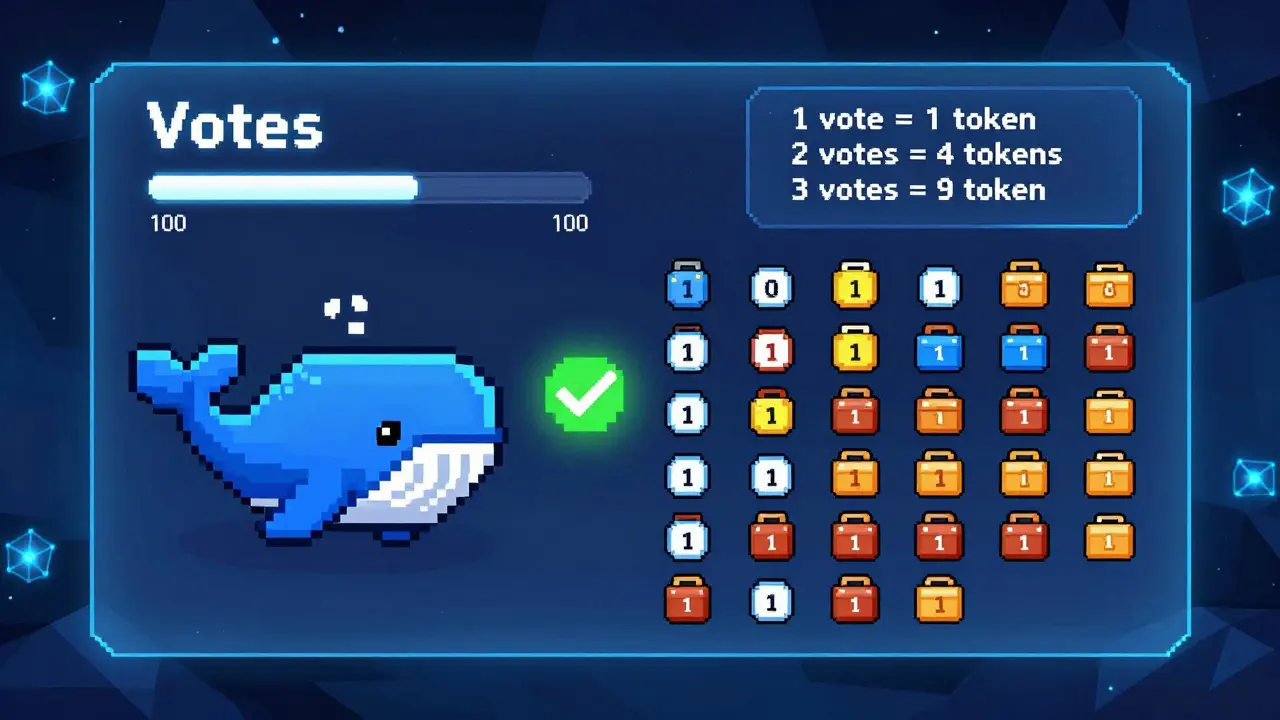
Imagine a DAO where one member holds 10% of all tokens, and another holds 0.1%. In a normal vote, the first person has 100 times more power. That’s not democracy. That’s plutocracy. Quadratic voting changes that. It’s not just another voting system - it’s a reset button for fairness in decentralized organizations.
Why Token Voting Fails in DAOs
Most DAOs use simple token-weighted voting. Each token equals one vote. Sounds fair, right? Not really. A few large holders - often called "whales" - can outvote hundreds of small participants. In 2023, a single wallet controlled over 40% of votes in a major DAO proposal. That’s not community governance. That’s a boardroom with a blockchain logo.Large holders don’t always act in the group’s best interest. They might push through risky upgrades to boost their own holdings, or block funding for community projects that don’t align with their strategy. The result? Low participation. Why bother voting if your one token is drowned out by a whale’s 100,000? Studies show that in token-weighted DAOs, fewer than 15% of members ever vote. Quadratic voting fixes this.
How Quadratic Voting Works
Quadratic voting (QV) doesn’t give you one vote per token. It gives you votes based on how much you’re willing to *spend*. The cost isn’t linear. It’s quadratic. That means:- 1 vote = 1 token
- 2 votes = 4 tokens
- 3 votes = 9 tokens
- 10 votes = 100 tokens
Each extra vote gets more expensive - fast. The math is simple: cost = n², where n is the number of votes you want to cast on a single issue. So if you have 100 tokens, you can’t just spend them all on one proposal. You’d get only 10 votes (because √100 = 10). Meanwhile, 100 people with 1 token each can each spend their 1 token to get 1 vote. Together, they have 100 votes - and they win.
This isn’t theoretical. Real-world tests show it works. In one DAO experiment, a whale with 100 tokens could only cast 10 votes. The other 99 members, each with 1 token, cast 99 votes total. The majority won. That’s the power of quadratic voting: it doesn’t eliminate big holders. It just stops them from dominating.
Real-World Examples
DAOs are already using this. Realms built a plugin that lets DAOs activate quadratic voting with a few clicks. Their system uses a "credit" model: each member gets a fixed number of voting credits per proposal. You spend credits to vote, and the cost rises quadratically. This keeps the system fair without forcing people to lock up their tokens.CityDAO tested quadratic voting to decide which land parcels to buy. Without it, a single whale could have bought 10 plots. With it, 200 small holders pooled their votes and spread ownership across 15 locations. The result? A more diverse, resilient asset portfolio.
Codeless Conduct used quadratic voting to pick hackathon winners. Instead of letting the biggest contributors win, they let the community vote on which projects had the most impact. The winning project had 1,200 votes - not because one person spent 1,200 tokens, but because 120 people each spent 10 tokens. That’s real consensus.
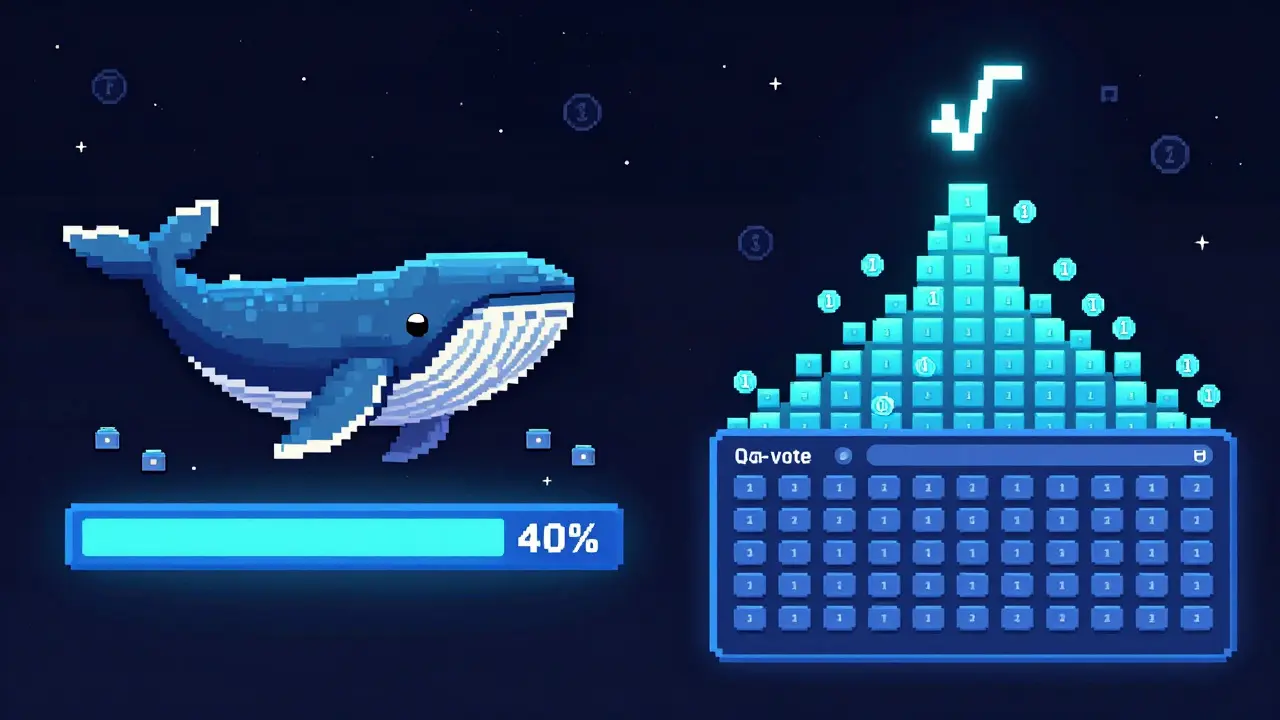
Why It’s Better Than Linear Voting
Linear voting (1 token = 1 vote) treats all votes the same. It doesn’t care if someone feels strongly. Quadratic voting does. It rewards intensity - but only if you’re willing to pay for it.Think of it like a market for opinions. If you really care about a proposal, you’ll spend more. But if you’re lukewarm? You’ll vote once and move on. This leads to:
- Higher participation - people feel their voice matters
- More nuanced outcomes - proposals with broad, deep support win
- Less collusion - whales can’t easily bribe or pressure others
Research from Frontiers in Blockchain found that quadratic voting "tends to reflect the will of a larger number of participants" - not just the richest. In 2024, a study of 12 DAOs showed that switching to quadratic voting increased voter turnout by 67%.
Challenges and Risks
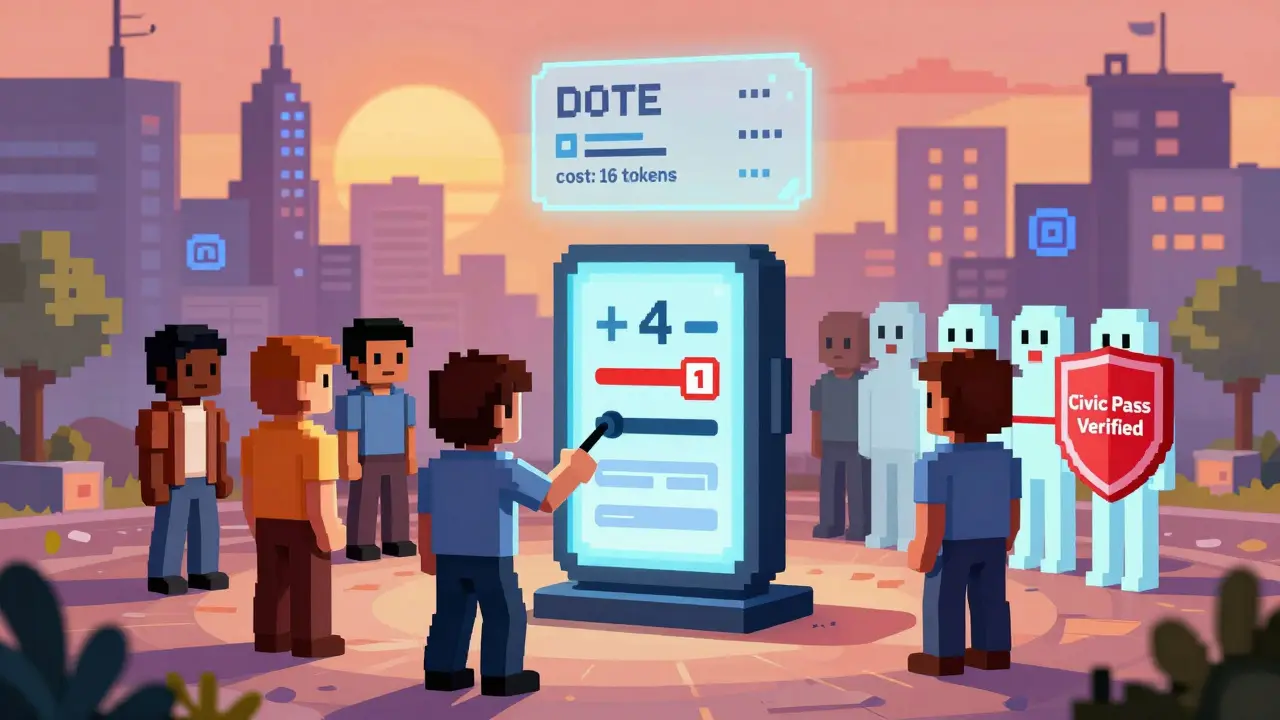
It’s not perfect. Quadratic voting has real hurdles.Complexity - Most people don’t understand n². If you ask a DAO member to "spend 16 tokens for 4 votes," they’ll glaze over. That’s why interfaces need to be dead simple. Realms shows voters a slider: drag to pick votes, and it auto-calculates cost. No math needed.
Sybil attacks - What if someone creates 100 fake accounts? They could each vote once, and overwhelm the system. That’s why identity verification is critical. Realms integrates with Civic Pass to ensure each vote comes from a real person. Other DAOs use Proof of Humanity or Worldcoin for the same purpose.
Vote budgeting - Should everyone get 100 credits? Or should it scale with token holdings? Too many credits, and whales still win. Too few, and participation drops. There’s no one-size-fits-all. DAOs must experiment.
Low engagement - Even with QV, some members still don’t vote. That’s why some DAOs combine it with delegated voting: you can assign your credits to someone you trust. It’s a safety net.
What You Need to Implement It
If you’re building or joining a DAO and want to use quadratic voting:- Choose a platform that supports it - Realms and Colony.io are the most mature.
- Set up identity verification - no Sybil resistance, no QV.
- Define your vote budget - start with 10-20 credits per member per proposal.
- Build clear UI - show voters cost per vote in real time.
- Educate your community - use short videos, not whitepapers.
Don’t try to build it from scratch. Smart contracts are hard. Use existing plugins. Most DAOs that tried to code their own QV system gave up after 3 months.
The Bigger Picture
Quadratic voting isn’t just about DAOs. It’s about rethinking how groups make decisions. Governments, cooperatives, even corporations are watching. The idea is simple: power should reflect intensity of preference, not wealth.As DAOs grow, they’ll face harder choices: funding development, managing treasury, hiring teams. Simple voting won’t cut it. Quadratic voting gives communities a way to say "I care a lot" without letting one person say "I own this."
The future of governance isn’t about who has the most tokens. It’s about who feels the most. And quadratic voting is the first system that actually makes that possible.
Is quadratic voting better than one-token-one-vote?
Yes, for most DAOs. One-token-one-vote gives all power to large holders. Quadratic voting gives more voice to the many, not just the few. It reduces whale dominance and increases participation. Studies show it leads to decisions that better reflect community sentiment.
Can I still vote if I have few tokens?
Absolutely. In quadratic voting, even one token lets you cast one vote - and that vote counts just as much as any other. Because each extra vote costs more, small holders can combine their votes to outvote large holders. In fact, small holders often win under QV because they outnumber whales.
Do I need to lock up my tokens to vote?
No. Most QV systems use voting credits, not token staking. You get a set number of credits per proposal, and you spend them to vote. Your tokens stay in your wallet. This avoids the liquidity trap of traditional staking systems.
What’s a Sybil attack, and how does QV stop it?
A Sybil attack is when someone creates hundreds of fake accounts to control votes. Quadratic voting doesn’t stop it by itself - but it’s useless without identity verification. DAOs using QV must link votes to real people, using tools like Civic Pass, Worldcoin, or Proof of Humanity. Without this, QV fails.
Is quadratic voting used outside DAOs?
Yes. It’s been tested in city councils, university boards, and even corporate shareholder votes. In 2023, a Swiss cooperative used it to choose its new board - and saw 80% voter turnout. The system works anywhere you need fair group decisions, not just blockchain.
Can whales still manipulate quadratic voting?
Not easily. A whale with 10,000 tokens can only cast 100 votes (because √10,000 = 100). But if 1,000 small holders each have 10 tokens, they can each cast 3 votes (since √10 ≈ 3), totaling 3,000 votes. The group wins. The math makes manipulation expensive and unlikely.





Mary Scott
February 21, 2026 AT 01:24Shannon Holliday
February 22, 2026 AT 11:14Jeremy buttoncollector
February 24, 2026 AT 02:40Michelle Xu
February 24, 2026 AT 04:49Ryan Burk
February 24, 2026 AT 17:51Amanda Markwick
February 24, 2026 AT 18:20Sriharsha Majety
February 25, 2026 AT 18:16Tabitha Davis
February 27, 2026 AT 15:09Vishakha Singh
February 28, 2026 AT 16:01Don B.
March 1, 2026 AT 13:21Arya Dev
March 2, 2026 AT 14:20Leslie Cox
March 3, 2026 AT 02:55Andrew Hadder
March 3, 2026 AT 13:04Derek Sasser
March 3, 2026 AT 16:39