
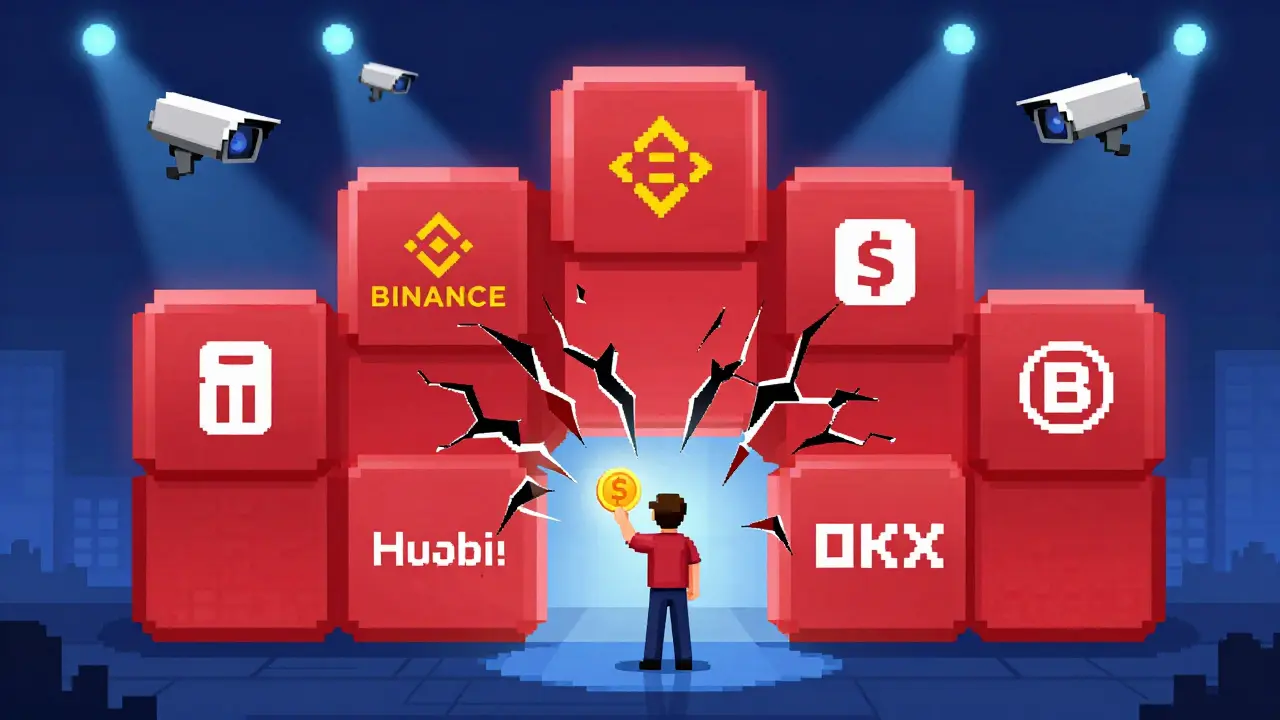
If you're a Chinese resident, any cryptocurrency exchange is off-limits. Not just some. Not just a few. All of them. Since June 1, 2025, the People's Bank of China has enforced a total ban on every form of cryptocurrency activity-trading, mining, holding, or even accessing a crypto wallet. This isn't a gray area. It's a clear, criminal offense under Chinese law. There are no exceptions. No loopholes. No safe platforms.
Why every exchange is banned
The Chinese government doesn't just regulate crypto. It erased it. The June 2025 decree didn't just restrict exchanges-it outlawed the entire ecosystem. That includes Binance, Coinbase, Kraken, OKX, Huobi, KuCoin, Gate.io, and every other platform you've ever heard of. Even decentralized exchanges (DEXs) and peer-to-peer apps aren't safe. Why? Because the ban isn't about security or scams. It's about control.The state wants to own the future of money. That's why it created the digital yuan, its own central bank digital currency (CBDC). The digital yuan lets the government track every transaction, freeze accounts, and control spending in ways Bitcoin or Ethereum never could. Crypto exchanges? They're untraceable, decentralized, and outside state control. That's why they had to go.
Financial institutions are now legally required to monitor every transaction for signs of crypto activity. If your bank account shows a payment to a known crypto platform-even once-you could be flagged. That means your account could be frozen. Your assets seized. And you could face criminal charges.
Exchanges you must avoid-no exceptions
You might think, "What if I use a VPN?" Or, "What if I only trade small amounts?" Those ideas don't work anymore. The ban covers every access point:- Binance-the world’s largest exchange-is blocked from serving Chinese users. Its apps are removed from Chinese app stores. Its website is filtered by national firewalls.
- OKX-once popular in China-is now illegal. Its founders are Chinese, but the platform is banned under the same rules as any foreign exchange.
- Huobi-founded in China-is also prohibited. Even though it moved its operations overseas years ago, Chinese law still treats it as a domestic threat.
- Coinbase and Kraken-U.S.-based and regulated-have zero legal standing in China. Accessing them is a violation.
- KuCoin and Gate.io-popular for their low barriers-are now actively monitored. Their mobile apps are flagged by Chinese cybersecurity tools.
Even OTC (over-the-counter) trading desks that used to help Chinese users buy crypto with bank transfers are now shut down. If you try to buy Bitcoin from someone in a WeChat group, you're breaking the law. The government doesn't care if you're trading $10 or $100,000. Any crypto transaction is illegal.
How enforcement works
The Chinese government didn’t just pass a law. It built a system to enforce it. Here’s how it works:- Internet monitoring: All major Chinese internet providers use AI-powered filters to block crypto-related websites and apps. If you try to visit Binance.com, you’ll get a connection error-even if you use a VPN, your traffic may be logged.
- Bank surveillance: Banks are required to scan all transactions for keywords like "crypto," "BTC," "ETH," or known exchange wallet addresses. Suspicious transfers trigger automatic reports to the Ministry of Public Security.
- Offline inspections: Authorities can show up at your home or business with warrants if they suspect crypto activity. They’ve seized computers, phones, and hard drives from individuals found with crypto wallets.
- Penalties: Fines can reach up to 10 times the value of the crypto involved. Repeat offenders face criminal prosecution. In 2025, over 3,000 people were charged under the new law.
There is no "gray zone." Even if you’re not actively trading, just holding crypto in a wallet-even if you never sent or received it-is considered illegal possession.

What happens if you ignore the ban
Some people think they can slip under the radar. They can’t. The system is designed to catch everyone.Imagine this: You use a friend’s overseas bank account to buy Ethereum. You store it on a hardware wallet. You never tell anyone. One day, your bank sends a notice: "Your account has been flagged for potential illegal financial activity." Within 72 hours, your account is frozen. You get a call from local police. They ask for your wallet recovery phrase. You refuse. You’re charged with violating financial regulations.
This isn’t hypothetical. It’s happened. In Guangdong, a 28-year-old man was sentenced to 18 months in prison for owning $20,000 worth of Bitcoin. In Shanghai, a small business owner was fined 500,000 RMB ($70,000) for accepting crypto payments from customers-even though he immediately converted it to yuan.
There is no appeal. No legal defense. The law is absolute.
What can you do instead
You don’t have to give up digital finance entirely. China gives you one legal alternative: the digital yuan.The digital yuan, issued by the People's Bank of China, works like a mobile wallet. You can send money, pay bills, and even earn interest through state-approved apps. It’s not decentralized. It’s not anonymous. But it’s safe, legal, and widely accepted across China. Over 700 million people already use it.
Other legal options include:
- Alipay and WeChat Pay for daily transactions
- State-backed mutual funds and bonds
- Gold-backed investment products approved by the China Banking and Insurance Regulatory Commission
These aren’t glamorous. They don’t promise 10x returns. But they won’t get you arrested.

The global contrast
Compare China’s approach to the rest of the world. In the U.S., crypto exchanges are licensed and regulated. In the EU, MiCA rules require KYC and reporting-but they don’t ban ownership. In Japan, crypto is legal tender for tax purposes. In Switzerland, crypto firms operate openly under clear rules.China is the only country that bans it all. No other major economy has gone this far. And China doesn’t plan to change. The government has invested billions into blockchain technology-but only for enterprise use, not public access. The goal isn’t innovation. It’s control.
Final warning
If you’re Chinese, and you’re thinking about using any crypto exchange-even just to try it-stop. The risk isn’t losing money. The risk is losing your freedom.There is no "safe" way to access crypto in China. No VPN, no offshore account, no anonymous wallet, no OTC deal. Every path leads to the same outcome: legal consequences.
The digital yuan is your only legal path forward. Everything else is a trap.
Can I use a VPN to access crypto exchanges like Binance or Coinbase?
No. Using a VPN to access crypto exchanges is still illegal in China. The government doesn’t just block websites-it monitors traffic patterns and flags users who attempt to bypass restrictions. Even if you can connect, your bank, internet provider, and local authorities can detect your activity. This can lead to account freezes, fines, or criminal charges. There is no safe way to use a VPN for crypto in China.
What if I bought crypto before the 2025 ban?
Owning crypto acquired before June 1, 2025, is still illegal under current law. The ban applies to possession, not just trading. Authorities have seized wallets and demanded users surrender private keys. Even if you didn’t trade after the ban, simply holding crypto can lead to legal action. There is no grandfather clause. The law treats all crypto holdings the same.
Is the digital yuan the same as Bitcoin or Ethereum?
No. The digital yuan is a central bank digital currency (CBDC) fully controlled by the Chinese government. Unlike Bitcoin or Ethereum, it’s not decentralized, not anonymous, and not traded on open markets. Every transaction is tracked by the state. It’s designed to replace cash and limit private financial autonomy-not to offer freedom like crypto does.
Can I be fined for using crypto on a foreign exchange while traveling abroad?
Yes. Chinese law applies to citizens regardless of location. If you’re a Chinese citizen and you trade crypto while overseas, you can still be prosecuted upon returning to China. Authorities have coordinated with international financial institutions to track Chinese nationals’ crypto activity abroad. Your bank account in China can be frozen based on overseas transactions.
Are decentralized exchanges (DEXs) like Uniswap legal in China?
No. Decentralized exchanges are banned just like centralized ones. Even though DEXs don’t have servers in China, the government still considers them illegal because they enable crypto transactions. Accessing Uniswap, PancakeSwap, or any DEX from within China violates the 2025 prohibition. The ban covers all forms of crypto trading, regardless of platform structure.




Taylor Holloman.
March 21, 2026 AT 02:46Steph Andrews
March 21, 2026 AT 18:38Prakash Patel
March 23, 2026 AT 03:41Zachary N
March 24, 2026 AT 08:37Elizabeth Kurtz
March 25, 2026 AT 13:51john peter
March 25, 2026 AT 17:58Marc Morgan
March 26, 2026 AT 06:52Anastasia Thyroff
March 27, 2026 AT 11:52Kira Dreamland
March 28, 2026 AT 01:20Bruce Doucette
March 28, 2026 AT 21:30Marie Vernon
March 30, 2026 AT 14:54Ross McLeod
April 1, 2026 AT 05:07Jessica Beadle
April 2, 2026 AT 21:08Brenda White
April 3, 2026 AT 19:20Tobias Wriedt
April 4, 2026 AT 16:52Ernestine La Baronne Orange
April 5, 2026 AT 07:15Manali Sovani
April 5, 2026 AT 16:16Konakuze Christopher
April 6, 2026 AT 21:42Sarah Hammon
April 8, 2026 AT 17:51iam jacob
April 9, 2026 AT 21:58Jesse Pals
April 11, 2026 AT 13:01Diane Overwise
April 13, 2026 AT 04:54