
When you hear that Bitcoin mines a new block every 10 minutes, it might sound like clockwork. But here’s the truth: mining difficulty is what makes that possible. Without it, Bitcoin’s block times would swing wildly-sometimes every few seconds, sometimes hours apart-depending on how many miners were online. That’s not just inconvenient; it breaks the whole system. Mining difficulty is the invisible hand that keeps Bitcoin running on schedule, no matter how much computing power floods the network.
What Mining Difficulty Actually Is
Think of mining difficulty as a moving target. Miners aren’t just guessing random numbers-they’re trying to find a specific hash, a long string of letters and numbers, that’s lower than a target value set by the network. The lower the target, the harder it is to find a valid hash. That’s where difficulty comes in. It’s not a number you can see on your miner, but it’s the scale that tells you how hard the network has made that target.
For Bitcoin, the difficulty is adjusted every 2,016 blocks-roughly every two weeks. If miners found those 2,016 blocks too fast (say, in 10 days instead of 14), the network increases the difficulty. If it took longer (18 days), it lowers the difficulty. The goal? Always hit that 10-minute average. It’s a feedback loop built into the code, and it’s been working since day one.
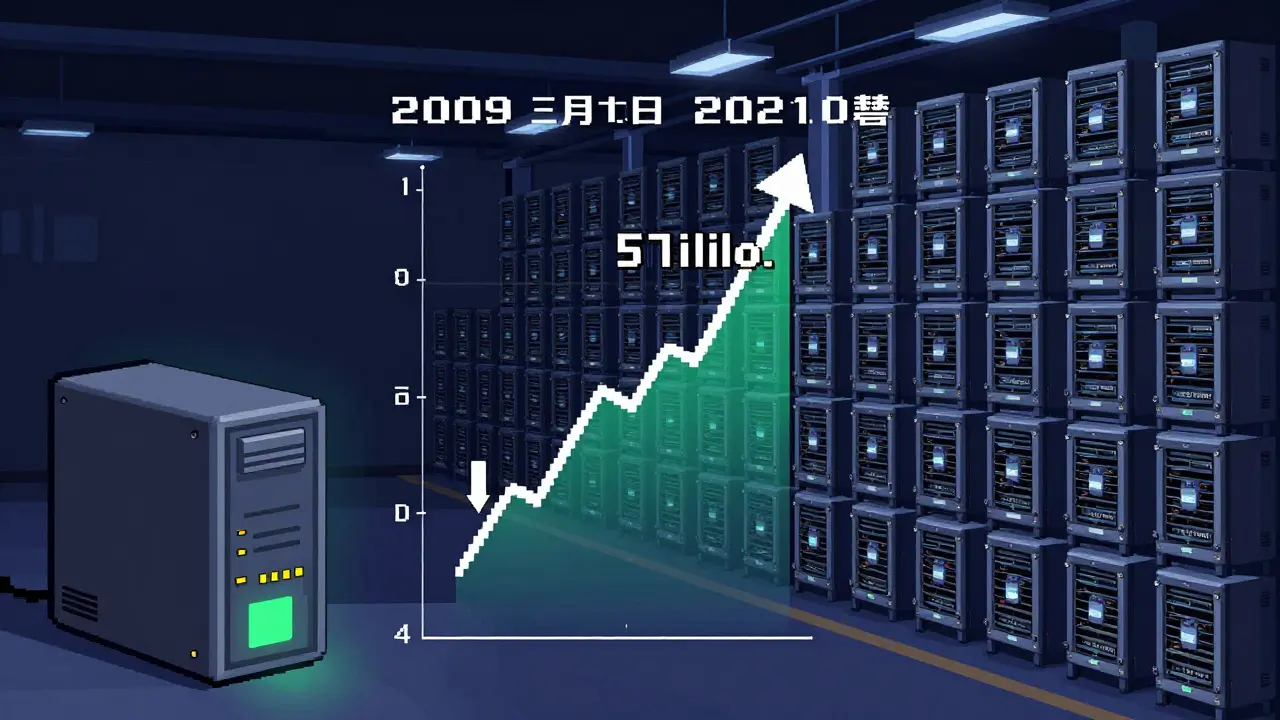
When Bitcoin launched in 2009, the difficulty was 1. Today, it’s over 57 trillion. That’s not because Bitcoin got harder to mine-it’s because the network’s computing power exploded. Back then, a regular PC could mine blocks. Now, you need a specialized machine called an ASIC, like the Bitmain Antminer S19 XP, which churns out 255 terahashes per second. That’s 255,000,000,000,000 guesses per second. And it’s still not enough to guarantee a win. The difficulty keeps rising because more miners join, and the system responds by making the puzzle harder.
How the Difficulty Adjustment Works
The math behind it is simple: Difficulty = Maximum Target / Current Target. The maximum target is a fixed number set in Bitcoin’s code: 0x00000000FFFF0000000000000000000000000000000000000000000000000000. The current target changes every adjustment period. If the network finds blocks faster than 10 minutes on average over the last 2,016 blocks, the current target gets smaller, which means difficulty goes up.
Here’s a real-world example. Let’s say miners found the last 2,016 blocks in 12 days instead of 14. That’s 20% faster than intended. The network multiplies the old difficulty by 1.2, and now every miner has to work 20% harder to find the next block. It’s automatic, decentralized, and doesn’t need anyone to press a button. The code does it all.
This system is why Bitcoin can survive massive swings in hash rate. In 2021, after China banned mining, Bitcoin’s hash rate dropped 50% overnight. Block times spiked to 15-20 minutes. But within two weeks, the difficulty dropped by 30%, and the network snapped back to 10-minute blocks. No one had to fix it. The protocol did.
Why It Matters for Security and Supply
Difficulty isn’t just about keeping time. It’s about security. Bitcoin’s security comes from the sheer amount of computing power working to validate transactions. The higher the difficulty, the more energy and hardware it takes to attack the network. To rewrite the blockchain, an attacker would need to control more than half of the total hash rate. At today’s difficulty level, that would cost billions of dollars in hardware and electricity-far more than the value of the coins you could steal.
It also controls how fast new bitcoins are released. Each block gives miners 6.25 BTC (until the April 2024 halving). If blocks came too fast, too many coins would flood the market. Too slow, and transaction confirmations would stall. Difficulty keeps both in balance. It’s the bridge between the technical rules of the blockchain and the economic reality of money.
How Miners React to Difficulty Changes
For miners, difficulty isn’t just a number-it’s profit or loss. When difficulty jumps suddenly, miners who run older or less efficient hardware suddenly lose money. A miner with an Antminer S19j Pro might have been making $15 a day before a difficulty spike. After a 15% increase, that drops to $9. If electricity costs $0.05 per kWh, they might shut down the machines until the next adjustment.
That’s why professional miners track difficulty like stock prices. Tools like Blockchain.com’s Difficulty Chart and HashRate.no’s predictive models help them anticipate the next adjustment. Some even automate their operations: if difficulty jumps more than 8% in one cycle, their systems turn off half the miners. Others buy hardware in advance, waiting for the dip after a difficulty surge. One miner on Reddit said, “I bought 10 new ASICs right after the June 2023 difficulty drop. By August, I was making 65% profit margins.”
There’s also a pattern between difficulty and price. Since 2016, Bitcoin’s difficulty and price have moved together 87% of the time. Difficulty usually peaks 28 to 42 days before a price peak. Why? Because when miners expect a price rise, they rush to buy hardware, increasing hash rate. That pushes difficulty up. When difficulty climbs too high, unprofitable miners drop out, and the price often follows.
Bitcoin vs. Ethereum Classic vs. Proof-of-Stake
Not all blockchains use difficulty the same way. Ethereum Classic, for example, adjusts difficulty every 100,000 blocks, which is less frequent than Bitcoin’s 2,016. That means its block times can fluctuate more between adjustments. But it still uses the same core idea: if blocks come too fast, make it harder.
Ethereum, however, ditched this whole system in 2022. It switched from proof-of-work to proof-of-stake. No more mining. No more difficulty. Validators are chosen based on how much ETH they lock up, not how much computing power they have. This cut Ethereum’s energy use by 99.95%. But it also removed the economic incentive structure that made PoW secure.
Bitcoin and Ethereum Classic still rely on miners paying for electricity, hardware, and cooling. That’s expensive. The Cambridge Bitcoin Electricity Consumption Index estimates Bitcoin uses as much power as Greece. But CoinShares found that 67% of that energy comes from renewables-mostly hydro in Canada and the U.S., or flared gas in Texas. For many miners, it’s not about waste; it’s about using energy that would otherwise go unused.
What’s Coming Next: The 2024 Halving
The next big event for Bitcoin mining is the halving in April 2024. Block rewards drop from 6.25 BTC to 3.125 BTC. That means miners earn half as much per block. If difficulty stays the same, profitability will crash. Many miners won’t survive. Analysts predict a 35-40% drop in hash rate over the next few months.
But here’s the twist: difficulty will adjust. Within two weeks after the halving, the network will sense fewer blocks being found and cut difficulty. The hash rate will stabilize again. It’s happened before-in 2016 and 2020-and it’ll happen again. The system is designed to absorb shocks.
Some miners are preparing. They’re locking in long-term power contracts. Others are moving to regions with cheaper electricity. A few are even betting on difficulty drops, buying new ASICs before the halving, expecting them to pay off after the adjustment.
Why This System Still Works
Proof-of-work mining difficulty isn’t perfect. It’s energy-heavy. It’s complex. It’s not fair to hobbyists anymore. But it works. It’s the reason Bitcoin has never been hacked. It’s why transactions settle reliably. It’s why people trust it as money.
Every time you hear that Bitcoin’s block time is 10 minutes, remember: that’s not magic. It’s math. It’s code. It’s a feedback loop that responds to real-world changes-miners joining, prices rising, energy costs shifting. It’s a living system, and mining difficulty is its heartbeat.
What happens if mining difficulty goes too high?
If difficulty rises too fast, miners with older or inefficient hardware can’t compete. They shut down, reducing the network’s total hash rate. That’s actually part of the system’s design. Fewer miners mean slower block discovery, which triggers the next difficulty adjustment-lowering the difficulty until profitability returns. It’s a self-correcting cycle.
Can mining difficulty go down?
Yes, and it happens regularly. If the network’s total hash rate drops-like after a regulatory crackdown or a price crash-blocks take longer to find. After 2,016 blocks, the algorithm detects this delay and lowers the difficulty. For example, after China’s 2021 mining ban, Bitcoin’s difficulty dropped by 30% in one adjustment to keep block times stable.
Is mining difficulty the same for all cryptocurrencies?
No. Bitcoin adjusts every 2,016 blocks. Ethereum Classic does it every 100,000 blocks. Litecoin uses a 2,016-block cycle but targets 2.5-minute blocks. Some altcoins adjust every block, while others don’t adjust at all. Each chain sets its own rules based on its goals-speed, security, or decentralization.
Do I need to understand mining difficulty to use Bitcoin?
No. As a regular user, you don’t need to know how difficulty works. Your wallet sends transactions, and they get confirmed in about 10 minutes. But if you’re mining, investing in mining hardware, or tracking Bitcoin’s economic health, understanding difficulty is essential. It affects profitability, network security, and even price trends.
Will mining difficulty disappear if Bitcoin switches to proof-of-stake?
Bitcoin won’t switch to proof-of-stake. It’s built on proof-of-work, and its community strongly supports keeping it. Ethereum switched because it wanted to cut energy use. Bitcoin’s design prioritizes security and decentralization through mining. Difficulty is core to that. Even if other chains move on, Bitcoin’s difficulty mechanism will stay as long as Bitcoin exists.
Final Thoughts
Proof-of-work mining difficulty isn’t just a technical detail. It’s the reason Bitcoin has lasted 15 years through crashes, bans, and skepticism. It’s the mechanism that turns electricity and hardware into trust. You don’t see it. You don’t feel it. But every time a Bitcoin transaction confirms, it’s because of this quiet, relentless adjustment-balancing power, profit, and time.





Robert Conmy
March 3, 2026 AT 05:30Let me be clear-this post is dangerously naive. Bitcoin's 'self-correcting' system is a lie. It doesn't adjust to reality; it adjusts to whoever has the biggest ASIC farm. The difficulty algorithm is just a smokescreen for centralized mining pools. You think this is decentralized? Wake up. The top 5 mining operations control over 60% of the hash rate. This isn't a protocol-it's a corporate monopoly disguised as ideology.
Lilly Markou
March 4, 2026 AT 08:16While I appreciate the technical rigor of this explanation, I find myself deeply unsettled by the environmental implications. The energy expenditure required to maintain this system-equivalent to a small nation's consumption-is not merely inefficient; it is ethically indefensible. We are trading planetary stability for a digital ledger that serves no tangible public good.
McKenna Becker
March 4, 2026 AT 14:10Difficulty isn't a number. It's a signal. A feedback loop written in code that says: 'You want to mine? Prove you're serious.' Every adjustment is a quiet vote from the network: who's still in? Who's out? It doesn't care about your hardware. It only cares about energy committed. That's the real innovation-not the blockchain, but the economic incentive baked into the math.
Amita Pandey
March 6, 2026 AT 13:01It is imperative to note that the assertion regarding renewable energy utilization in Bitcoin mining is statistically misleading. While it is true that certain jurisdictions utilize excess hydroelectric or flared gas, the global energy mix remains predominantly fossil-fuel-based. The Cambridge Bitcoin Electricity Consumption Index does not account for marginal emissions intensity, thereby rendering any claims of 'green mining' as fundamentally flawed.
Jeff French
March 6, 2026 AT 20:55ASICs are just the latest evolution. Back in '09, I mined with a GPU and thought I was a genius. Now? It's all about PUE, cooling, and power contracts. The real game isn't mining-it's energy arbitrage. The guys winning aren't the coders. They're the ones with deals on Texas wind farms and cheap hydropower in Quebec. Difficulty just tells you who's still playing.
Michael Rozputniy
March 8, 2026 AT 12:34They say difficulty adjusts automatically-but what if it doesn't? What if the algorithm is compromised? What if the next adjustment is manipulated by a cabal of mining conglomerates to wipe out small operators? The code is open, sure-but who audits the auditors? The 2021 China ban was suspiciously timed. Coincidence? Or a pre-planned consolidation?
Leslie Cox
March 10, 2026 AT 07:01It's fascinating how people romanticize Bitcoin's 'decentralization' while ignoring that mining difficulty is a tool of exclusion. The system doesn't reward innovation-it rewards capital. A kid in Ohio with a secondhand S19 can't compete with a warehouse full of S21s in Kazakhstan. This isn't a meritocracy. It's a wealth arms race disguised as technology. And we call this progress?
Dana Sikand
March 11, 2026 AT 13:42Okay but real talk-when difficulty drops after a halving, it's like the universe gives you a second chance. I watched my profitability jump 200% after the 2020 adjustment. I bought my first ASIC right before the halving, thought I was done for… then boom. The system works. It’s not magic, it’s math. And it’s beautiful. If you’re still mining with a GPU, you’re not a pioneer-you’re just stubborn.
Robert Kromberg
March 12, 2026 AT 04:05I get why people get emotional about this. But maybe we’re overthinking it. Difficulty isn’t about fairness. It’s about stability. If blocks took 30 minutes, nobody would trust Bitcoin as money. If they took 2 minutes, the chain would fracture. The system isn’t perfect, but it’s resilient. And that’s worth something.
Daisy Boliaan
March 12, 2026 AT 15:54Anyone else notice how every time difficulty spikes, crypto Twitter goes nuts? 'It's the end of mining!' 'The little guy is dead!' Then two weeks later, difficulty drops, and suddenly everyone’s back with their 10th ASIC. It’s a cycle. A drama cycle. The real miners? They’re not on Reddit. They’re in warehouses with silent fans and 10-year power deals. You’re just watching a soap opera with hash rates.
Nicki Casey
March 13, 2026 AT 03:00The entire premise of this article is a government psyop. Bitcoin was never meant to be mined by individuals. The 10-minute block time was engineered to create artificial scarcity while funneling profits into institutional hands. The difficulty algorithm? A controlled release valve. The halving? A staged event to inflate price before the next round of consolidation. You think you’re participating in decentralization? You’re a pawn in a game designed by the same elite that runs the Fed.
Jessica Carvajal montiel
March 13, 2026 AT 14:30Let’s be honest-the difficulty mechanism is just a way to keep the illusion of fairness alive. Miners aren’t competing on skill. They’re competing on who can afford to burn the most electricity. And let’s not forget: every time difficulty drops after a crash, it’s because the network is bleeding miners. That’s not resilience-that’s collapse with a delay. The system isn’t self-correcting. It’s self-destructing, slowly.
maya keta
March 13, 2026 AT 16:36Y’all act like difficulty is this mystical force. Nah. It’s just a multiplier. Think of it like a video game difficulty slider. Bitcoin’s default is 'Hardcore.' The network auto-tunes it based on who’s still online. If you’re not profitable, you’re not part of the consensus-you’re just a spectator. The system doesn’t care about your dreams. It cares about your watts.
Curtis Dunnett-Jones
March 14, 2026 AT 06:44Bitcoin’s difficulty adjustment is one of the most elegant pieces of economic engineering ever created. It transforms chaos into predictability. It turns an anarchic, volatile network into a reliable settlement layer. This isn’t just code. It’s a social contract written in mathematics. And it’s working-better than any central bank has in decades.
Sean Logue
March 15, 2026 AT 12:31Back in Nigeria, we used to joke that Bitcoin was the only thing that didn’t crash during power outages. But now? The miners here run on solar. We’ve got panels on every rooftop. The difficulty adjusts, we adjust. No banks. No middlemen. Just sun, silicon, and math. This isn’t about money. It’s about autonomy.