
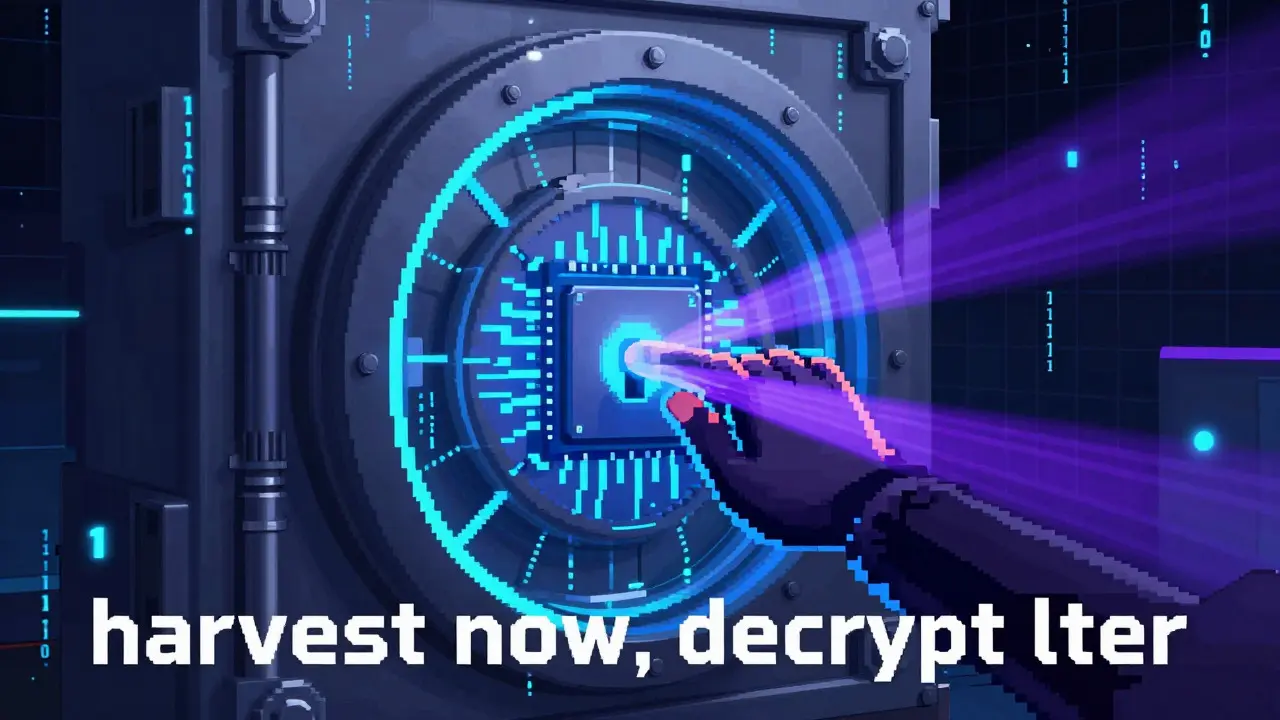
Imagine sending a locked box to your bank today. The lock is so strong that no one can pick it with current tools. But what if someone stole the box, kept it in their basement, and waited ten years? By then, they might have built a machine capable of snapping that lock open in seconds. This isn't science fiction. It’s the reality of Quantum-Resistant Cryptography, also known as Post-Quantum Cryptography (PQC).
If you’re involved in blockchain, finance, or any industry handling sensitive data, this shift is happening right now. In 2026, we are past the theoretical stage. Major tech giants and governments are actively migrating systems to protect against "harvest now, decrypt later" attacks. This guide cuts through the jargon to explain what quantum-resistant cryptography is, why it matters for your data, and how the transition is actually unfolding.
The Threat: Why Current Encryption is at Risk
To understand the solution, you first need to grasp the problem. Most of the internet’s security relies on public-key cryptography algorithms like RSA and Elliptic Curve Diffie-Hellman (ECDH). These systems work because factoring large numbers or solving discrete logarithms is incredibly difficult for classical computers. It would take thousands of years to break them.
However, in 1994, mathematician Peter Shor developed an algorithm that changes everything. Shor’s algorithm allows a sufficiently powerful quantum computer to solve these mathematical problems exponentially faster than classical supercomputers. While we don’t yet have quantum computers powerful enough to break RSA-2048, the threat is imminent. Experts at QuSecure estimate that practical quantum decryption capabilities could emerge by 2030.
This creates a dangerous window. Adversaries are already collecting encrypted data-trade secrets, medical records, blockchain private keys-and storing it. They plan to decrypt it once quantum hardware matures. This is the "harvest now, decrypt later" strategy. If your data has a long lifespan, its current encryption is effectively expired.
How Quantum-Resistant Algorithms Work
Quantum-resistant cryptography doesn’t use quantum mechanics itself. Instead, it uses new mathematical problems that are hard for both classical and quantum computers to solve. The National Institute of Standards and Technology (NIST) has been leading the global standardization effort since 2016. By mid-2024, NIST had finalized several core standards, moving from theory to practice.
There are four main families of PQC algorithms, each with distinct trade-offs:
- Lattice-Based Cryptography: This is the most popular approach. It relies on the complexity of lattice structures in multi-dimensional space. The standout algorithm here is CRYSTALS-Kyber, selected by NIST for key encapsulation. Kyber offers small key sizes (around 1-2 KB) and fast performance, making it ideal for widespread adoption. It runs only 2-3 times slower than classical RSA.
- Hash-Based Signatures: Algorithms like SPHINCS+ rely on the security of hash functions. They are considered extremely secure but come with larger signature sizes (8-49 KB) and slower signing speeds. They are often used as a backup or for high-security, low-frequency applications.
- Code-Based Cryptography: Represented by Classic McEliece, this method uses error-correcting codes. It is highly resistant to quantum attacks but suffers from massive public key sizes (up to 1 MB), which can strain bandwidth-constrained networks.
- Multivariate Polynomial Cryptography: While not selected in NIST’s initial round, these algorithms offer very fast verification speeds. However, they typically require larger public keys and have faced more cryptanalytic scrutiny regarding potential vulnerabilities.
PQC vs. QKD: Choosing the Right Path
You might hear about Quantum Key Distribution (QKD) as an alternative. QKD uses quantum physics principles to detect eavesdropping during key exchange. While theoretically unbreakable, it is impractical for most organizations. QKD requires specialized hardware, dedicated fiber optic lines, and works poorly over distances greater than 100 kilometers without trusted repeaters.
In contrast, PQC is software-based. It can run on existing servers, smartphones, and IoT devices. According to Ericsson’s 2023 analysis, deploying PQC costs significantly less than QKD and integrates seamlessly into current network protocols with only 15-20% computational overhead. For blockchain networks, where every node must verify transactions, the lightweight nature of lattice-based PQC makes it the clear winner over hardware-heavy QKD.
| Algorithm Family | Representative Algorithm | Key Size | Performance Impact | Best Use Case |
|---|---|---|---|---|
| Lattice-Based | CRYSTALS-Kyber | Small (~1-2 KB) | Low (2-3x slower than RSA) | General encryption, TLS, Blockchain |
| Hash-Based | SPHINCS+ | Medium (Signatures 8-49 KB) | High (Slower signing) | Digital signatures, Long-term archives |
| Code-Based | Classic McEliece | Large (~1 MB) | Medium (Decryption slow) | High-security niche applications |

The Hybrid Transition Strategy
No one is flipping a switch tomorrow. The industry standard for migration is the hybrid approach. This means combining a classical algorithm (like ECDH) with a post-quantum algorithm (like Kyber). If the new PQC algorithm has a hidden flaw, the classical layer still protects your data. If a quantum computer breaks the classical layer, the PQC layer holds the line.
NIST’s Special Publication 800-208 recommends this dual-layer security. In practice, this looks like updating TLS handshakes to include hybrid key exchanges. Microsoft Azure and Google Chrome have already begun integrating these hybrid models. For blockchain developers, this means upgrading consensus mechanisms and wallet signatures to support hybrid cryptographic suites, ensuring that transactions remain valid even as underlying security assumptions evolve.
Implementation Challenges in 2026
Despite the clear benefits, rolling out PQC is complex. The UK’s National Cyber Security Centre (NCSC) outlines a five-year migration timeline, starting with inventory and assessment. Many organizations struggle simply knowing what cryptographic assets they have. A 2024 Cloud Security Alliance survey found that 68% of IT professionals identified cryptographic inventory as their biggest hurdle.
Performance is another concern. Lattice-based keys are larger than elliptic curve keys. This increases bandwidth usage, which can be problematic for IoT devices or high-frequency trading platforms. Additionally, certificate management becomes harder when key sizes grow. You need to ensure that your PKI infrastructure can handle the increased load without degrading user experience.
Finally, there is the talent gap. Only 12% of security teams possess deep expertise in PQC implementation. However, vendor solutions like QuSecure and IBM’s z16 mainframes are automating much of this process, reducing deployment time from years to months. Open-source libraries like Open Quantum Safe provide critical reference implementations for developers building custom solutions.
Regulatory Pressure and Market Growth
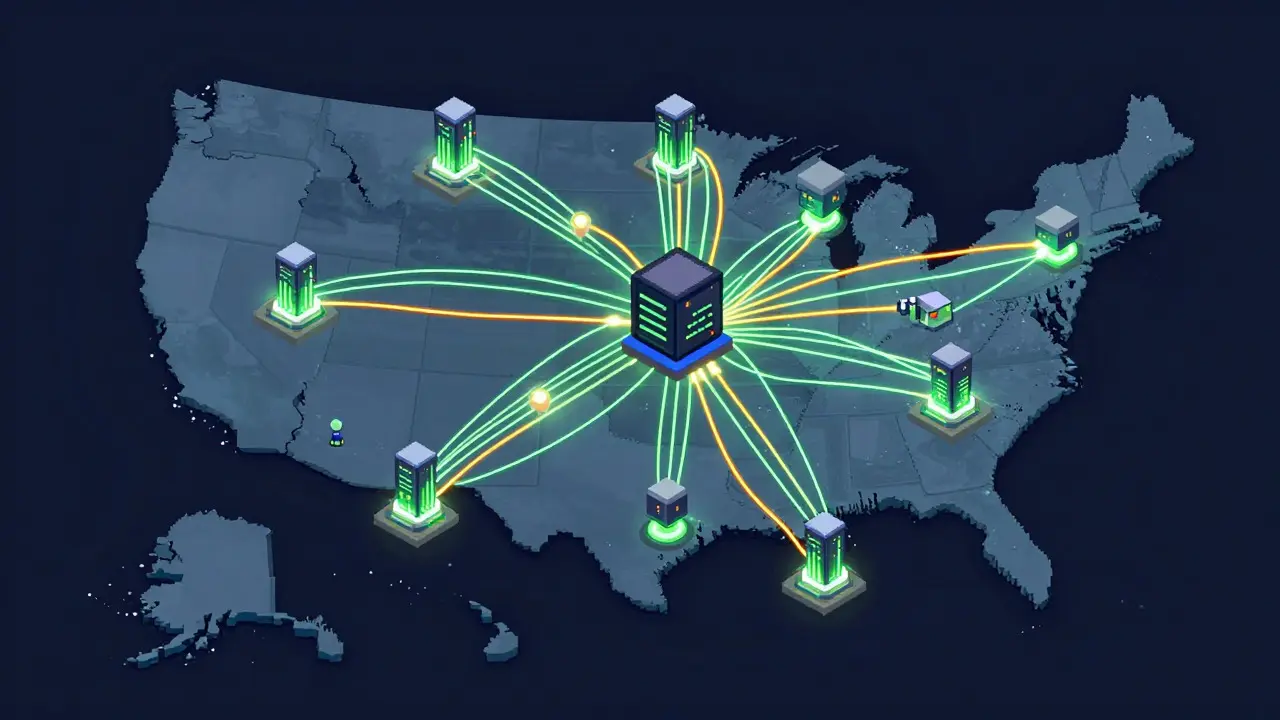
The push for PQC is no longer optional; it’s regulatory. The U.S. NSA mandated that all National Security Systems transition to CNSA 2.0 (which includes PQC) by 2035, with critical systems starting in 2025. In Europe, the Cyber Resilience Act requires critical infrastructure to be PQC-ready by 2027.
The market reflects this urgency. The global PQC market is projected to grow from $165.7 million in 2023 to $1.74 billion by 2028. Financial services lead adoption, with 78% of major institutions running PQC pilots. Healthcare and government sectors follow closely. For blockchain projects, ignoring PQC risks becoming obsolete as major enterprises demand quantum-safe compliance before integrating with decentralized ledgers.
Next Steps for Organizations
If you haven’t started, now is the time. Begin by auditing your cryptographic inventory. Identify where RSA or ECC is used for long-term data protection. Prioritize these assets for hybrid migration. Engage with vendors who offer automated PQC integration tools. Test lattice-based algorithms like CRYSTALS-Kyber in non-production environments to measure performance impact. Remember, the goal isn’t just to survive the quantum era-it’s to maintain trust in a world where data longevity is paramount.
Is my current blockchain wallet vulnerable to quantum attacks?
Most current wallets using ECDSA (like Bitcoin and Ethereum) are theoretically vulnerable to Shor's algorithm on a powerful quantum computer. However, practical quantum computers capable of breaking these keys do not exist yet. The risk is primarily "harvest now, decrypt later." Upgrading to quantum-resistant signature schemes like SPHINCS+ or Dilithium will mitigate this future risk.
When will NIST finalize the PQC standards?
NIST announced the final selection of CRYSTALS-Kyber as FIPS 203 in August 2023. Draft standards for signature algorithms like CRYSTALS-Dilithium and SPHINCS+ were expected for public comment in late 2024. Full finalization and widespread implementation are ongoing throughout 2025 and 2026.
Does PQC replace SSL/TLS?
No, PQC enhances SSL/TLS. The Internet Engineering Task Force (IETF) is updating TLS 1.3 to support hybrid key exchanges. This means your HTTPS connections will continue to work, but the underlying key exchange mechanism will include a quantum-resistant component alongside the traditional one.
Why is the hybrid approach recommended?
The hybrid approach combines classical and post-quantum algorithms. This provides defense-in-depth: if a vulnerability is found in the new PQC algorithm, the classical algorithm still secures the data. Conversely, if a quantum computer breaks the classical algorithm, the PQC layer remains secure. It balances innovation with proven reliability.
What is the cost of migrating to PQC?
Costs vary by organization size. Small businesses may incur minimal costs via software updates. Large enterprises face higher costs due to inventory audits, testing, and potential hardware upgrades for resource-constrained devices. However, compared to the cost of a major data breach or regulatory fines, early migration is cost-effective. Vendor tools are reducing deployment times from years to months.






Carl Michaud
August 7, 2026 AT 12:00the whole PQC narrative is a massive grift by the NSA and big tech to force hardware upgrades every five years. they claim 'harvest now decrypt later' but really they just want backdoors into your lattice structures. Kyber? more like spyber. wake up sheeple 🤡
Don Fizy
August 7, 2026 AT 17:11Hey there! :) Don't let the cynicism get you down. The hybrid approach mentioned in the post is actually super smart because it hedges your bets. If Kyber has a flaw, RSA still holds up for a bit. It's not about fear, it's about prudent engineering. Have you looked at Open Quantum Safe libraries yet? They make testing way easier than people think. :D
Rita Dutta
August 9, 2026 AT 04:38oh my gosh you guys are so boring with all this math talk. its like watching paint dry but with more zeros. i mean sure quantum computers are scary but lets not forget that most of us just want our wifi to work without resetting the router three times. why do we need 1MB keys when my phone battery dies before lunch? typical tech bro panic selling. also speling matters ppl.
Prudence Flemming
August 9, 2026 AT 18:25the epistemological shift here is profound. we are moving from computational hardness assumptions to algebraic geometry complexities. it is not just encryption it is ontology. if the key space becomes non-euclidean does privacy even exist anymore or is it just a social construct we agree to ignore until the qubits decohere?
Matt Kay
August 10, 2026 AT 12:08boring article. too long didnt read. just use bigger keys lol.
Rodmun Tarnowski
August 10, 2026 AT 18:25Excellent point, Matt!; indeed, the transition period is critical.; organizations must act NOW!; the window is closing rapidly!; do not wait for 2030!; start auditing today!; thank you for sharing this insight!;
Matthew Smith
August 12, 2026 AT 11:06morality demands we protect data. it is unethical to leave medical records vulnerable. the lazy IT departments who ignore this are complicit in future breaches. we must act with virtue and speed. no excuses.
Candice Cornett
August 14, 2026 AT 09:45actually you are all wrong. the real threat isnt quantum computers its the humans who implement them poorly. history shows us that complexity breeds failure. simpler is better. maybe we should just go back to paper ledgers and stop pretending code can solve human stupidity.
Lance Jantz
August 15, 2026 AT 11:32darling, you simply don't grasp the sublime beauty of lattice-based cryptography. it is like a symphony of high-dimensional vectors dancing in the void. while you worry about bandwidth, I am contemplating the existential dread of a universe where secrets are merely temporary illusions. how quaint your concerns are. 😘
Dominic Greco
August 16, 2026 AT 01:53they are lying about the timeline. NSA already has a working machine. look at the stock prices of quantum firms. insider trading on steroids. prepare for the collapse of the dollar system when all bank keys are broken overnight. buy gold now. 📉💀
Sean Rowland
August 17, 2026 AT 15:56Mr. Greco, your lack of technical literacy is showing. The CNSA 2.0 mandate is public record. Your conspiracy theories are statistically insignificant noise in the signal of legitimate cryptographic migration protocols. Please cite your sources or remain silent.
Sus Sawyer
August 18, 2026 AT 05:48yo sean chill out dude. dominic might be off base but he got passion. hey everyone lets keep it positive. the good news is tools like IBM z16 are making this way easier. dont stress just start small. test kyber in dev env. you got this! 🔥
Aryan MISHRA
August 18, 2026 AT 20:47Listen up!; Lattice-based is king!; Kyber is the standard!; Stop using hash-based for general purpose!; It is inefficient!; Read NIST docs!; Do your homework!;
Dave Kjendal
August 20, 2026 AT 06:49look man i tried reading the table but my eyes glazed over. seems like a lot of fuss for something we cant see yet. maybe ill upgrade when my current laptop explodes. till then im sticking to my password manager which i share with my brother anyway.
Kat Bennett
August 22, 2026 AT 01:51I have been thinking about this for days and it seems like such a huge undertaking for companies that are already struggling with basic cybersecurity hygiene. I wonder if smaller businesses will just give up and hope they are not targeted, or if the regulatory pressure will actually force them to comply despite the costs and the talent gap mentioned in the article. It feels like a perfect storm of complexity and urgency that might overwhelm many sectors.
Paul Smith
August 22, 2026 AT 05:18Hi Kat! 👋 You raise a valid concern about SMBs. But remember, cloud providers are handling a lot of this backend stuff. So many small biz just inherit the security from AWS or Azure. It’s a team effort! Let’s hope the vendors deliver easy updates. 🚀✨
Phil Babb
August 22, 2026 AT 10:15GET MOVING!!!; The market is growing to $1.74 BILLION!!!; Why are you hesitating???; Be aggressive in your adoption!!!; Lead the pack!!!; Do not be left behind!!!; Action now!!!;