Imagine sending a physical letter to a friend. You write it, sign your name at the bottom, and drop it in the mail. Your signature proves you wrote it. If someone else signs your name without permission, that is forgery. If someone opens the envelope and changes the message before it arrives, the content is compromised.
Now imagine doing this digitally, on a global network where anyone can see the transaction, but no one should be able to change it or pretend to be you. This is the core problem blockchain technology solves using digital signatures.
Digital signatures are not just electronic images of your handwritten scrawl. They are complex mathematical proofs that verify two critical things: authenticity (you sent it) and integrity (it wasn’t changed). Without them, cryptocurrencies like Bitcoin would collapse because there would be no way to prove who owns the funds or authorize their transfer.
How Digital Signatures Work in Crypto
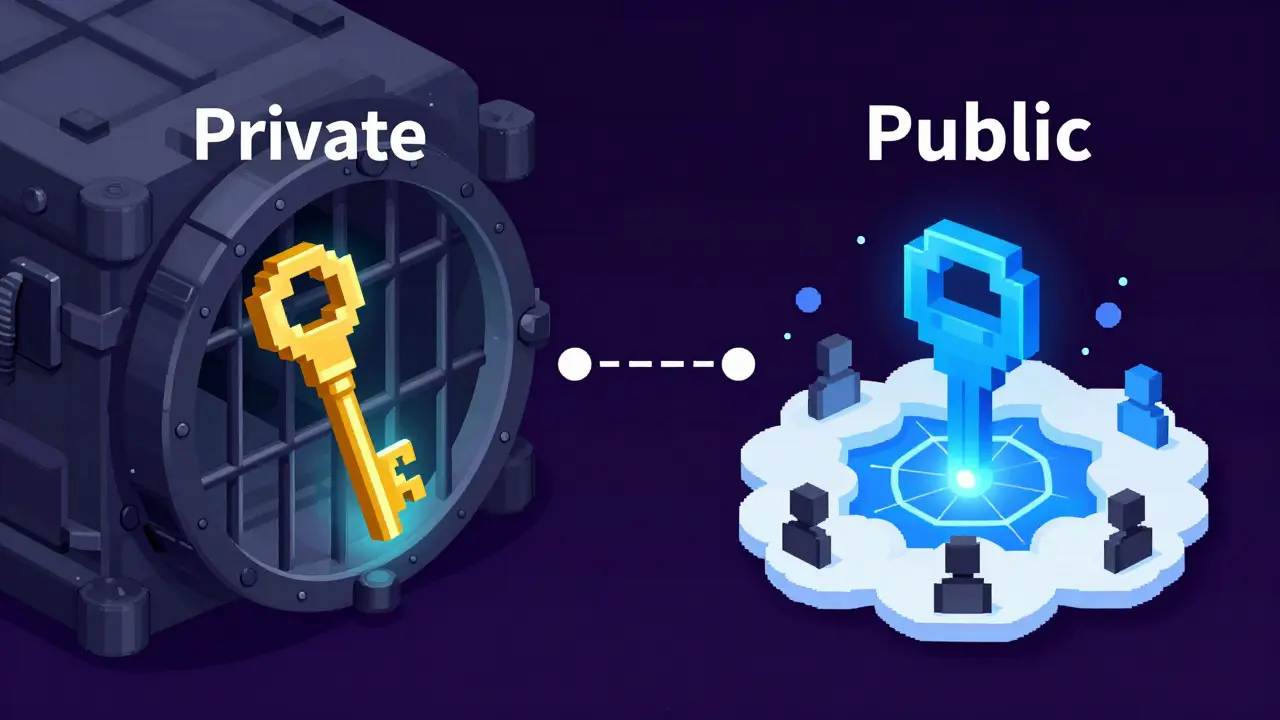
To understand digital signatures, you first need to grasp the concept of asymmetric cryptography. Unlike a house key, which is the same for locking and unlocking, asymmetric cryptography uses a pair of mathematically linked keys:
- Private Key: Think of this as your secret password or biological fingerprint. You keep this hidden. It is used to create the signature.
- Public Key: Think of this as your email address or phone number. You share this openly. It is used by others to verify your signature.
When you want to send cryptocurrency, your wallet uses your private key to sign the transaction data. This process creates a unique string of characters-the digital signature. Anyone with your public key can check this signature against the transaction details. If they match, the network knows you authorized it. If even a single character in the transaction amount or recipient address changes, the signature becomes invalid immediately.
This system relies on the fact that while the public key is derived from the private key, you cannot reverse-engineer the private key from the public key. It is a one-way mathematical street.
The Three Pillars of Security
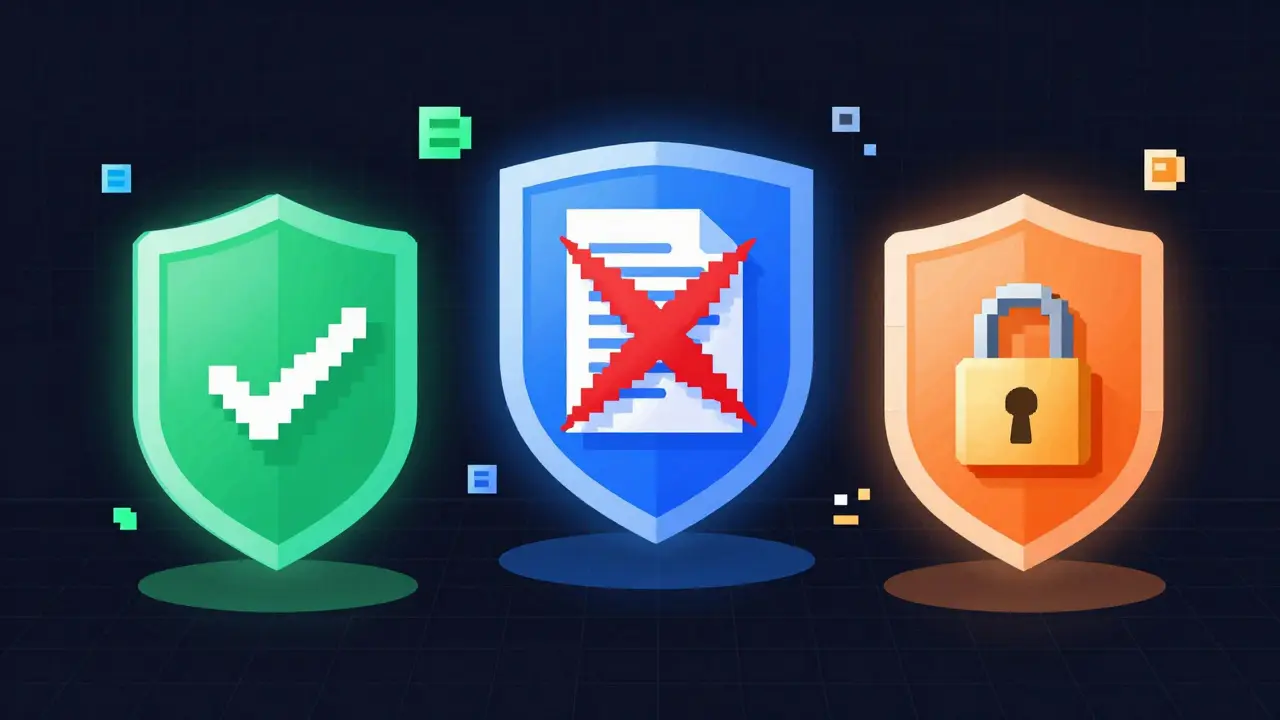
Digital signatures provide three specific security properties that make blockchain trustless systems possible. Let’s break them down into plain English.
- Authentication: The network confirms the message came from the claimed sender. Since only you have the private key, only you could have generated that specific signature.
- Integrity: The data has not been altered. If a hacker tries to change "Send 1 BTC" to "Send 10 BTC" after you signed it, the mathematical link breaks. The signature no longer matches the new data, and the transaction is rejected.
- Non-Repudiation: You cannot deny sending the transaction later. Because the signature is uniquely tied to your private key, you have cryptographic proof of authorization. There is no "I didn't mean to do that" defense in code.
These pillars replace the need for banks. In traditional finance, a bank verifies your identity and checks your balance. In crypto, the digital signature does the verifying, and the blockchain ledger tracks the balance.
A Real-World Example: Sending Bitcoin
Let’s look at what happens when you decide to send 0.05 Bitcoin to a friend. Here is the step-by-step workflow behind the scenes:
| Step | Action | Technical Detail |
|---|---|---|
| 1 | Create Transaction | Your wallet gathers inputs (your coins) and outputs (friend's address + amount). |
| 2 | Hashing | The transaction data is run through a hashing algorithm (like SHA-256) to create a unique fingerprint. |
| 3 | Signing | Your wallet uses your private key to sign this hash. This produces the digital signature. |
| 4 | Broadcasting | The transaction, along with the signature and your public key, is sent to the network. |
| 5 | Verification | Nodes use your public key to verify the signature matches the hash. If valid, it is added to the block. |
Notice that your private key never leaves your device. It is used locally to create the signature. What travels over the internet is the signature itself, which acts as a temporary, single-use proof of authority.
Why Can’t Hackers Forge These?
You might wonder why a sophisticated attacker can’t just copy your public key and generate a fake signature. The answer lies in computational difficulty.
Cryptographic algorithms like ECDSA (Elliptic Curve Digital Signature Algorithm), used by Bitcoin, rely on mathematical problems that are easy to solve in one direction but nearly impossible to reverse. To forge a signature, a hacker would need to guess your private key. With current computing power, trying every possible combination would take billions of years. It is statistically safer to win the lottery every day for a year than to crack a standard 256-bit private key.
However, the math is only as strong as your habits. If you store your private key on a computer infected with malware, or if you type it into a phishing website, the mathematics don’t matter. The key is stolen, and the thief can sign transactions as you. This is why hardware wallets exist-to keep the private key offline and isolated from potential attacks.
Digital Signatures vs. Traditional E-Signatures
It is important not to confuse blockchain digital signatures with services like DocuSign. While both involve signing documents electronically, their purposes differ significantly.
- DocuSign/E-Signatures: These primarily capture intent and identity. They often rely on third-party verification (IP addresses, email confirmation) and legal frameworks. They are designed for contracts and HR documents.
- Crypto Digital Signatures: These are purely mathematical. They do not care about your name or legal status. They only care that the holder of the private key authorized the data change. They are designed for asset transfer and data integrity in decentralized networks.
In crypto, your "identity" is your public key. You don’t need to prove you are Robert Stukes; you just need to prove you control the key associated with the address.
Common Pitfalls and Risks
Understanding the theory is one thing; applying it safely is another. Here are common mistakes users make regarding digital signatures:
- Sharing Private Keys: Never share your private key or seed phrase. No support agent, exchange, or developer will ever ask for it. If they do, it is a scam.
- Reusing Addresses: While not a direct signature failure, reusing addresses reduces privacy. Advanced analysis can sometimes link multiple transactions to a single user.
- Ignoring Transaction Details: Always double-check the recipient address and amount before signing. Once signed, the non-repudiation feature means you cannot undo it.
- Using Weak Wallets: Ensure your wallet software is up-to-date. Older versions may use deprecated cryptographic libraries that are less secure.
The Future of Digital Signatures
As quantum computing advances, current cryptographic standards face potential risks. Quantum computers could theoretically solve the mathematical problems underlying ECDSA much faster than classical computers. However, this is still theoretical for practical attacks. The crypto community is already researching post-quantum cryptography to ensure digital signatures remain secure in the coming decades.
For now, digital signatures remain the bedrock of cryptocurrency security. They allow strangers to transact value without trusting each other, relying instead on unbreakable math. Understanding how they work empowers you to use blockchain technology more securely and confidently.
Can I recover my cryptocurrency if I lose my private key?
No. Because digital signatures rely on the secrecy of the private key, there is no backdoor. If you lose the key, you lose access to the funds forever. The blockchain does not store your identity, so no one can verify you are the owner without the key.
Is my public key safe to share?
Yes. Your public key is meant to be shared. It functions like your bank account number or email address. People need it to send you funds or verify your signatures. Only your private key must remain secret.
What happens if someone steals my private key?
If someone steals your private key, they can create valid digital signatures on your behalf. They can move all your funds to their own address. This is why securing your private key with hardware wallets and strong passwords is critical.
Do all cryptocurrencies use the same digital signature algorithm?
Most major cryptocurrencies like Bitcoin and Ethereum use variations of ECDSA. However, some newer blockchains use different algorithms like Ed25519 for improved speed and security. The principle remains the same: private key signs, public key verifies.
Can a digital signature be forged?
Mathematically, forging a signature without the private key is computationally infeasible with current technology. It would require solving complex elliptic curve problems that would take thousands of years. Forgery usually happens due to human error, such as leaking the private key, not breaking the math.