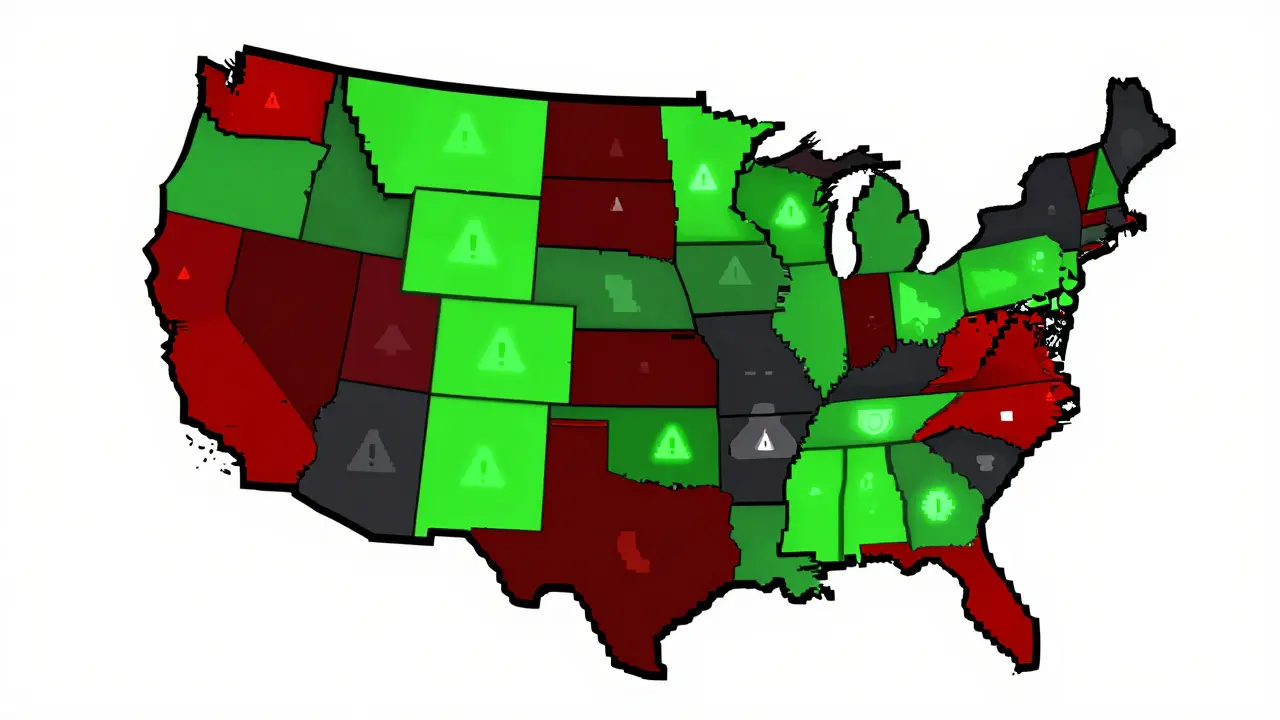
Imagine trying to buy a coffee with Bitcoin in New York City and then crossing the Hudson River to New Jersey. In one spot, you might be navigating a labyrinth of strict licensing rules. In the other, you’re operating under general financial guidelines that haven’t been updated since the smartphone era. This isn't a hypothetical scenario; it’s the daily reality for anyone dealing with digital assets in the United States. As of September 2026, there is still no single, unified federal law that governs every aspect of cryptocurrency trading, holding, or spending across all fifty states. Instead, we have a patchwork quilt of regulations stitched together by individual state legislatures, each pulling the thread in a different direction.
This fragmentation creates a headache for businesses and a puzzle for investors. If you’re wondering whether your favorite exchange can operate in your zip code, or if your self-custody wallet counts as a money transmitter service, the answer depends entirely on where you live. The landscape shifted dramatically in late 2025 when the federal government stepped up its game, but local laws remain stubbornly independent. Let’s break down what this actually means for you, cutting through the legal jargon to show you how these rules impact your wallet and your workflow.
The Federal Backdrop: Why States Still Matter
You might think that with the passage of the GENIUS Act in 2025, which created the first federal framework for stablecoins, the wild west days are over. It’s true that Washington has provided more clarity than ever before. The act set specific backing requirements for issuers, meaning stablecoins like USDC or Tether now have stricter audit trails. However, federal law sets the floor, not the ceiling. States retain the power to impose additional restrictions, particularly regarding consumer protection and business licensing.
Consider the CLARITY Act, which moved jurisdictional debates from the SEC to the CFTC. While this helped standardize how exchanges classify certain tokens, it didn’t erase state-level authority over money transmission. In fact, the Trump administration’s executive order on "Strengthening American Leadership in Digital Financial Technology" explicitly encouraged responsible growth, leaving room for states to innovate-or restrict-as they see fit. So, while you don’t need to worry about the SEC suing you for buying Ethereum anymore, you do need to know if your state requires a special license just to let you sell it.
New York: The Gold Standard of Restriction
If you want to understand how restrictive crypto regulation can get, look no further than New York. The Empire State was the first major jurisdiction to treat virtual currency as a regulated financial product rather than just property. At the heart of this regime is the BitLicense, issued by the New York Department of Financial Services (NYDFS). Unlike a simple registration, obtaining a BitLicense is a rigorous process involving detailed audits, anti-money laundering (AML) checks, and ongoing reporting obligations.
Why does this matter? Because many national exchanges choose to simply block New York users rather than navigate the compliance costs. If you live in NYC, you might find that certain altcoins aren’t available on your preferred platform, not because of technical issues, but because the exchange hasn’t secured the right approvals. The NYDFS also requires businesses to self-certify new virtual currencies before listing them, adding another layer of scrutiny. For residents, this means higher security and clearer recourse in disputes, but it also means fewer options and potentially slower access to new market trends.
| State | Primary Regulator | Key Framework | Business Impact |
|---|---|---|---|
| New York | NYDFS | BitLicense | High compliance cost; restricted asset availability |
| California | DFPI | Money Transmitter License (MTL) | Broad applicability; innovation-friendly interpretation |
| Texas | Texas Dept of Banking | General Money Transmission | Minimal specific crypto laws; relies on federal guidance |
| Wyoming | Wyoming Division of Banking | Special Purpose Trust Company | Crypto-specific legislation; favorable for startups |
California and Texas: The Innovation Hubs
On the opposite end of the spectrum sits California. The state’s Department of Financial Protection and Innovation (DFPI) has taken a pragmatic approach. They generally interpret existing money transmitter laws to cover crypto activities without creating a separate, burdensome crypto-specific license. This doesn’t mean California is unregulated-it’s actually quite active-but it focuses on broad consumer protection principles rather than niche technicalities. This balance has made California a magnet for crypto startups that want access to a massive market without the bureaucratic nightmare of New York.
Texas takes an even lighter touch. With no specific crypto statute on the books, businesses in Texas largely rely on federal guidelines and general banking laws. This lack of explicit restriction has allowed Texas to become a hub for crypto mining, thanks to its cheap energy and deregulated grid. While there are no special licenses required just for holding or trading Bitcoin, businesses moving large volumes of fiat currency into and out of crypto must still comply with standard anti-money laundering rules. It’s a hands-off approach that prioritizes economic freedom over preemptive regulation.

Wyoming: Writing the Rulebook
If you’re looking for a state that actively courted the industry, Wyoming is the standout example. Starting years ago, Wyoming legislators realized that generic banking laws didn’t fit blockchain technology. So, they wrote their own. They introduced the concept of the Special Purpose Trust Company, allowing banks to hold digital assets directly. This removed the intermediary risk that plagued early crypto custody solutions.
Wyoming also clarified that digital assets could be considered personal property for tax purposes and established clear rules for smart contracts. These moves weren’t just symbolic; they attracted real capital and talent. Companies like Kraken and various DeFi projects have cited Wyoming’s legal clarity as a reason for establishing operations there. For investors, this means a more predictable legal environment where ownership rights are clearly defined by state law, not just federal ambiguity.
The Role of State Attorneys General
Licensing is only half the battle. Even in states with friendly laws, enforcement actions can shut down a project overnight. State Attorneys General have become aggressive players in the crypto space. The New York Attorney General, for instance, has filed charges against multiple platforms for failing to disclose risks or engaging in misleading marketing. These cases often happen independently of formal regulatory bodies, meaning a company can be fully licensed yet still face lawsuits.
This enforcement-based regulation creates a chilling effect. Exchanges may delist tokens that appear risky or poorly explained, not because a regulator banned them, but because their legal team fears an investigation. For the average user, this translates to sudden changes in available assets. You might log in to find a token you bought last month is now unavailable for withdrawal until further notice. Keeping an eye on news from your state’s Attorney General office is just as important as checking the SEC website.

Practical Implications for Investors and Users
So, what does this patchwork mean for your daily life? First, location matters more than you think. If you move from California to New York, your investment strategy might need to change. Some platforms will automatically adjust your portfolio to comply with New York’s stricter listing standards. Second, record-keeping is critical. Because tax treatment can vary slightly based on how transactions are classified under state law, maintaining detailed logs of every trade, swap, and transfer is essential.
Third, consider the stability of your provider. In states with evolving regulations, smaller exchanges might struggle to keep up with compliance costs. Sticking with larger, well-capitalized platforms that have dedicated legal teams can reduce the risk of your funds getting frozen due to administrative errors. Finally, stay informed about pending legislation. The CBDC Anti-Surveillance State Act, currently moving through Congress, could further alter how central bank digital currencies interact with private crypto holdings. If passed, it would prohibit the Federal Reserve from issuing a CBDC without congressional approval, potentially preserving the current dual-system structure.
Navigating the Future Landscape
We are in a transition period. The federal government has signaled it wants to lead, but states are fiercely protective of their sovereign right to regulate commerce within their borders. Expect this tension to continue. We might see more states follow Wyoming’s lead, drafting bespoke laws that attract business. Conversely, we might see more states adopt New York-style frameworks as they react to high-profile scams or market crashes.
For now, the best strategy is vigilance. Don’t assume that what works in one state works in another. Check the specific terms of service for your exchange-they usually list which states they serve and why. Understand that "regulation" doesn’t always mean "restriction." Sometimes, it means legitimacy. As crypto integrates further into the traditional financial system, the friction between old laws and new tech will smooth out. But until then, knowing your local rules is your best defense.
Do I need a license to buy Bitcoin in my state?
Generally, no. Most states do not require individual consumers to obtain a license to buy, hold, or sell cryptocurrency. Licensing requirements typically apply to businesses that facilitate these transactions, such as exchanges or custodians. However, you should check if your state has specific reporting requirements for large transactions.
Why are some coins unavailable in New York?
New York's BitLicense framework requires exchanges to vet and approve specific cryptocurrencies before offering them to New York residents. Many newer or less-established tokens do not pass this review process, leading exchanges to restrict their availability to avoid compliance risks.
Does the GENIUS Act affect my personal crypto holdings?
The GENIUS Act primarily regulates stablecoin issuers, requiring them to maintain full reserves and undergo regular audits. It indirectly benefits you by increasing the trustworthiness of stablecoins you use for trading or savings, but it does not impose direct obligations on individual holders of non-stablecoin assets like Bitcoin or Ethereum.
Can state laws override federal crypto regulations?
Not exactly. Federal law sets the baseline, but states can impose stricter requirements unless federal law explicitly preempts state action. Currently, most federal crypto laws do not preempt state money transmission laws, allowing states to enforce their own licensing and consumer protection rules.
What happens if I move to a state with stricter crypto laws?
Your existing holdings usually remain yours, but your ability to trade or withdraw certain assets might change. Exchanges may restrict features or delist tokens for your account once your address updates to a stricter jurisdiction. It’s wise to review your portfolio’s compatibility with your new state’s rules before relocating.