
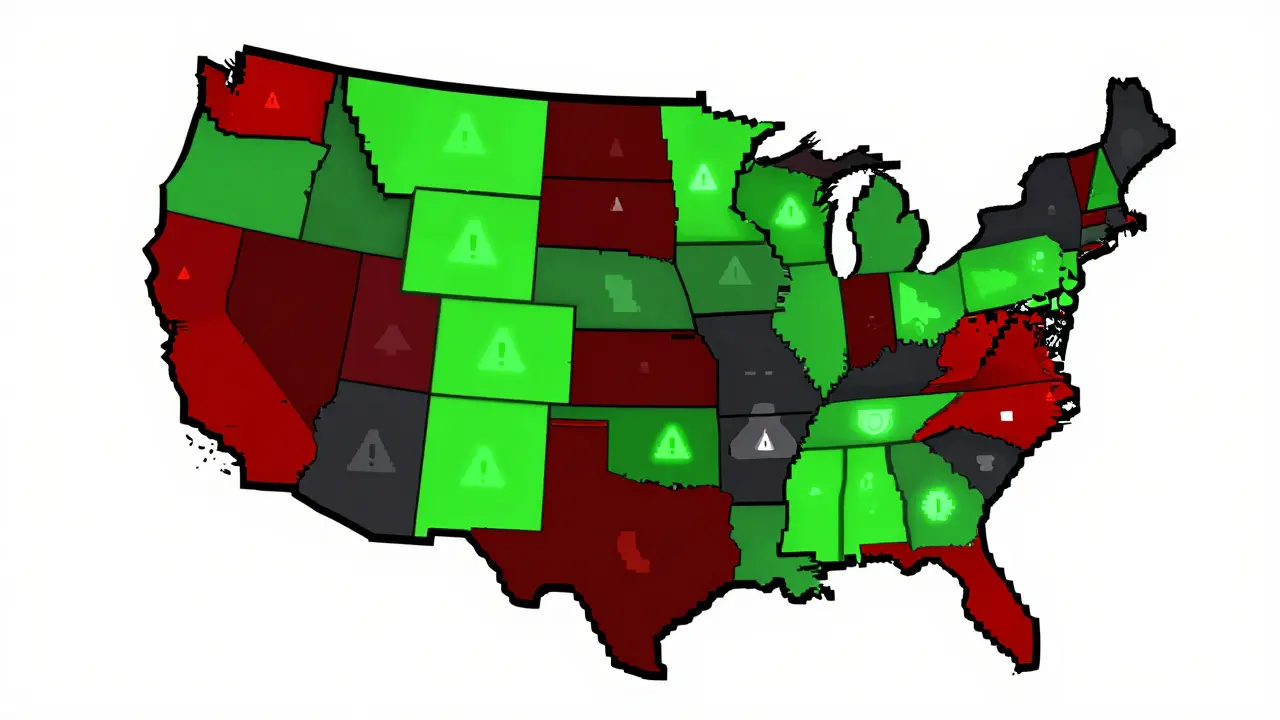
The United States does not have a single federal rulebook for cryptocurrency. Instead, you are navigating a patchwork of 50 different regulatory environments. As of mid-2026, this fragmentation means that what is legal and profitable in Wyoming might be illegal or prohibitively expensive in New York. For businesses, investors, and everyday users, understanding these state-level restrictions is no longer optional-it is the difference between compliance and catastrophe.
While federal legislation like the GENIUS Act (signed into law in September 2025) has begun to establish baseline standards for stablecoins, it explicitly preserves state authority over broader digital asset activities. This creates a complex landscape where states act as both gatekeepers and innovators. Some states, like California, focus on consumer protection with streamlined registration, while others, like New York, enforce strict licensing regimes that can cost hundreds of thousands of dollars annually. Understanding your specific jurisdiction is critical because penalties for non-compliance range from heavy fines to criminal charges.
Key Takeaways
- Federal Vacuum: The US lacks a comprehensive federal crypto framework, forcing reliance on divergent state laws despite recent steps like the GENIUS Act.
- New York’s Barrier: The BitLicense remains one of the most restrictive regimes globally, with high costs ($350k/year avg) and low approval rates (37 active licenses).
- Innovation Hubs: States like Wyoming and South Dakota offer favorable frameworks, such as Special Purpose Depository Institutions (SPDIs), attracting significant industry migration.
- Compliance Costs: Multi-state operators spend an average of $287,000 annually just on state regulatory fees, creating a barrier for smaller firms.
- Future Outlook: By 2027-2028, expect either federal preemption or formalized state-federal partnerships as current litigation resolves.
The Federal Context: Why States Rule
To understand state regulations, you must first grasp why they exist. As noted by the Stevens Center at Wharton in their 2025 report, "At the moment, the United States has no federal regulatory framework for digital assets." This vacuum forced states to step in starting around 2015. While President Trump signed the GENIUS Act in September 2025 to regulate stablecoins specifically-requiring 100% reserve backing with liquid assets-the law deliberately left the door open for states to regulate other crypto activities.
This division of labor means that while your stablecoin issuer must follow federal rules, your exchange, wallet provider, or mining operation is subject to the laws of the state where you operate. The SEC’s Spring 2025 Regulatory Agenda acknowledged that this "patchwork creates compliance challenges disproportionate to benefits," but until Congress passes broader legislation like the Responsible Financial Innovation Act, states hold the pen. For users, this means that customer protections, dispute resolution speeds, and even which coins you can trade depend heavily on your zip code.
New York: The Gold Standard of Restriction
If you are operating in New York, you are likely dealing with the BitLicense. Introduced in 2015 under Benjamin Lawsky, this framework is widely considered the most burdensome in the Western world. It requires entities engaged in any of 13 defined "virtual currency business activities"-including transmission, storage, and exchange-to obtain a license from the New York Department of Financial Services (NYDFS).
The barriers to entry are steep. You need a minimum net capital of $2 million, detailed business plans, and robust cybersecurity measures meeting NYDFS 500.00 standards, including cold storage for 80% of held assets. The application fee starts at $5,000, but total compliance costs average $350,000 annually per entity. As of September 2025, only 37 companies held active BitLicenses out of 104 applications. This exclusivity has driven major players like Coinbase and Circle to base their primary operations elsewhere. For consumers, the trade-off is mixed: while security is high, complaint resolution times average 217 days, significantly slower than in other states.

California: Volume Over Velocity
California takes a different approach through its Department of Financial Protection and Innovation (DFPI). Under amendments to the California Financing Law effective January 2023, entities transacting over $500,000 annually in virtual currency must register. Unlike New York’s license, this is a registration process with lower barriers to entry. The annual compliance cost averages $85,000, making it more accessible for mid-sized firms.
This accessibility has attracted 142 registered crypto businesses as of Q3 2025. However, the DFPI is aggressive in enforcement, initiating 17 actions against unregistered entities in the same period. The benefit for users is speed: California reports 38% faster dispute resolution compared to national averages. If you value quick access to support and a large market, California is attractive, but you must ensure your transaction monitoring systems can handle high volumes (10,000+ daily transactions) to stay compliant.
Wyoming and the Rise of Crypto-Native Banking
Wyoming has positioned itself as the friendliest state for crypto innovation. Its standout feature is the Special Purpose Depository Institution (SPDI) charter, established via Senate File 0019 in 2018. This allows crypto firms to operate as state-chartered banks with full FDIC deposit insurance. In 2024, Wyoming’s crypto-native banks processed approximately $12.7 billion in transactions.
The requirements are substantial but clear: $25 million minimum capital and a 6-8 month review process. However, once chartered, the operational flexibility is unmatched. Wyoming generated $427 million in state revenue from crypto operations in 2024, representing 7.3% of total state revenue. For comparison, New York generated only $189 million despite its larger economy. This economic incentive drives Wyoming’s pro-crypto stance. Other states like South Dakota and Tennessee are following suit, creating a cluster of innovation-friendly jurisdictions that account for 78% of new crypto banking jobs since 2020.
Comparing Regulatory Philosophies
| State | Regulatory Body | Licensing Type | Min. Capital / Threshold | Avg. Annual Compliance Cost | Key Feature |
|---|---|---|---|---|---|
| New York | NYDFS | BitLicense | $2 Million Net Capital | $350,000 | Strictest security; 80% cold storage required |
| California | DFPI | Registration | $500,000 Annual Transactions | $85,000 | Faster dispute resolution; high volume focus |
| Wyoming | Sunshine Division | SPDI Charter | $25 Million Capital | $42,000 | FDIC-insured crypto banks; innovation hub |
| Texas | PSC | Money Transmitter License | $25,000 Bond | Varies (Low) | Basic cybersecurity plans; no cold storage mandate |
| Louisiana | OBI | Virtual Currency License | Exempt if <$35,000 Activity | Moderate | Small business exemptions; clear scope |

Hidden Costs and Operational Pitfalls
Beyond the obvious licensing fees, hidden costs can derail a business. Multi-state operators face the nightmare of reconciling conflicting definitions. For example, 63% of multi-state operators struggle with defining whether an activity is "money transmission" or a "commodity" transaction, as noted in State Street’s March 2025 Digital Digest. This ambiguity affects 22-35% of operational budgets, funds that could otherwise go toward security enhancements.
Bonding requirements also vary wildly. Twenty-eight states require mandatory bonding, ranging from $25,000 in Texas to $500,000 in New York. Additionally, 19 states exempt entities processing under $1 million annually, offering a safe harbor for small startups. If you are scaling rapidly, monitor these thresholds closely. Crossing them without prior preparation can lead to immediate non-compliance status. The Blockchain Association’s 2025 survey found that 41% of businesses avoid certain states entirely due to this complexity.
What Users Need to Know
If you are not running a business, do regulations affect you? Yes. Your ability to recover lost funds, the speed of customer support, and the types of assets available to you depend on your state’s regulator. For instance, Reddit discussions in October 2025 showed 78% of users frustrated with New York’s slow complaint resolution. Conversely, users in sandbox states like Arizona reported 34% faster startup formation and better service responsiveness.
Be wary of platforms claiming to be "fully regulated" without specifying the jurisdiction. A platform licensed in Wyoming may not be able to serve customers in New York or Massachusetts. Always check the footer of crypto websites for their licensing disclosures. If a platform avoids this information, it is a red flag. With $2.1 billion recovered from crypto scams in Massachusetts alone between 2020-2025, vigilance is essential.
Future Trends: 2026 and Beyond
The landscape is shifting. The Atlantic Council predicts that by 2027, the US will see either comprehensive federal preemption or formal recognition of state-federal regulatory partnerships. Currently, 22 states are challenging aspects of the GENIUS Act in federal court, arguing it infringes on state sovereignty. Meanwhile, 14 states are introducing "model legislation" to align with federal frameworks.
Expect increased harmonization by 2028. States like Wyoming will likely retain their competitive edge in banking, while New York may relax some BitLicense requirements to stop talent outmigration. For now, treat state regulations as dynamic. What is compliant today may change tomorrow. Subscribe to updates from your state’s financial regulator and consider joining industry associations like the Blockchain Association for real-time alerts.
Do I need a license to trade crypto personally?
Generally, no. Personal trading for your own account does not require a license. Licenses are required for businesses that facilitate trades, store assets for others, or transmit value. However, if you are frequently moving large sums or acting as an agent for others, you may cross into "money transmission" territory, which varies by state.
How much does it cost to get a BitLicense in New York?
The initial application fee is $5,000, but total compliance costs average $350,000 annually. This includes legal fees, cybersecurity upgrades, capital reserves ($2 million minimum), and ongoing reporting. Only 37 licenses were active as of late 2025 due to these high barriers.
Can I operate a crypto business in multiple states?
Yes, but it is complex. You must comply with each state’s specific rules. Multi-state operators spend an average of $287,000 annually on state regulatory fees alone. Conflicting definitions of activities like "money transmission" create significant legal risks.
What is the GENIUS Act and how does it affect me?
Signed in September 2025, the GENIUS Act regulates stablecoins at the federal level, requiring 100% reserve backing. It does not replace state laws for other crypto activities. If you use stablecoins, this provides stronger federal consumer protection. For other assets, state laws still apply.
Which state is best for starting a crypto business?
Wyoming is often cited as the best for innovation due to its SPDI charters and low compliance costs ($42,000/year). California offers a large market with moderate barriers ($85,000/year). Avoid New York unless you have significant capital and patience for the BitLicense process.





Sylvia Mossman
June 4, 2026 AT 04:53Wyoming is basically the wild west now and everyone knows it. The SPDI charter is a joke if you think about the actual risk involved but sure let's pretend it's safe because of FDIC insurance.
Meanwhile New York is actually doing its job by keeping the scammers out even if it costs an arm and a leg. People complain about the BitLicense but have you seen what happens in unregulated states? You get rug pulled every five minutes.
Alexander DeVries
June 4, 2026 AT 20:07The fragmentation is exactly why we need to push for federal preemption immediately. It is inefficient and costly for businesses to navigate fifty different legal systems when dealing with a borderless asset class. We must streamline this process to foster genuine innovation rather than regulatory arbitrage.
Steven Jacobowitz
June 6, 2026 AT 02:17I am trying to understand how the GENIUS Act interacts with state laws regarding stablecoins specifically. If the federal law mandates 100% reserve backing does that override any state requirement for higher capital reserves or is it additive? The article says it preserves state authority but I feel like there is a conflict here that isn't being addressed clearly enough for small operators.
Yogendra Dwivedi
June 6, 2026 AT 16:46This is very helpful information for those of us operating across multiple jurisdictions. The cost difference between California and Wyoming is stark and it really dictates where companies choose to incorporate versus where they actually operate. It would be interesting to see data on how many firms are dual-registered to mitigate these risks.
verna kennedy
June 7, 2026 AT 20:34Let us be clear about the reality here. Most of these 'innovation hubs' are just tax havens with fancy names. Wyoming is not innovating; it is deregulating to attract fees from risky entities that cannot pass scrutiny in New York or California. Consumers deserve better protection than whatever loose standards these states are offering.
Brad Ranks
June 9, 2026 AT 01:37I moved my startup to South Dakota last year and honestly the whole process was smoother than I expected despite the hype around Wyoming. The key is having good legal counsel who understands the specific nuances of each state's money transmitter laws. Do not try to DIY this compliance stuff unless you want to lose everything.
Matthew Malone
June 10, 2026 AT 20:30It is pathetic that our country allows such a mess. Other nations have unified frameworks while we are stuck playing catch-up with fifty different rulebooks. This lack of federal leadership is embarrassing and it hurts American competitiveness in the global financial sector. We need strong centralized regulation not this patchwork nonsense.
aaliyah zahid
June 12, 2026 AT 12:23Oh look another post telling us how complicated things are. Can someone just tell me which exchange is safest for a regular person in Texas without reading a hundred pages of legal jargon? The sarcasm is thick today folks.
dan kaffeman
June 13, 2026 AT 03:32Only people who don't understand finance care about these silly regulations. Real investors know how to protect themselves. The government should stay out of it completely and let the market decide. These so-called protections are just barriers to entry for the elite to maintain their grip on power.
Greg Lewis
June 14, 2026 AT 07:36you think wyoming is safe but have you considered that the fdic insurance only covers up to 250k per account? so if your crypto bank fails and you have millions you are still screwed. it is all theater really designed to make retail investors feel warm and fuzzy while the big players move billions off balance sheet
Erik Kirana
June 14, 2026 AT 23:31The author clearly has no idea what they are talking about. The claim that New York generated only $189 million in revenue is misleading without context. New York provides far more value through consumer protection and stability which cannot be measured in simple revenue figures. This article is poorly researched and should be ignored by anyone serious about compliance.
JEVON HALL
June 16, 2026 AT 05:39Hey guys just wanted to add that if you are looking into Texas the PSC is pretty chill compared to NYDFS. They mostly just want to see your cybersecurity plan and maybe a bond. No need to overcomplicate it 😊 Just keep your records straight and you should be fine. Let me know if you need help with the forms!
Dr Lynea LaVoy
June 16, 2026 AT 10:36As a legal professional in this space I can confirm that the multi-state compliance burden is indeed the biggest headache for mid-sized firms. The average cost of $287,000 annually is accurate based on our client data. We are seeing a trend where smaller firms are partnering with larger licensed entities rather than seeking their own licenses due to these prohibitive costs.
Alexis Abster
June 16, 2026 AT 21:08I am so excited to see how this evolves! The potential for innovation in states like Wyoming is truly inspiring. Imagine the possibilities if we could streamline this further across all states. We are on the cusp of a financial revolution and it is beautiful to watch. Keep pushing forward everyone!
Narendra Kulkarni
June 17, 2026 AT 16:46its true that california is faster for dispute resolution but the enforcement actions are scary. i saw a friend get fined for not registering properly even though he thought he was under the threshold. always double check with a lawyer before assuming you are exempt. dont take chances with dfpi.
Kelly Tenney
June 19, 2026 AT 08:23This guide is incredibly useful for understanding the landscape. I appreciate the breakdown of costs and requirements. For those new to crypto business operations starting in a state with lower barriers like Texas might be wise before expanding to more regulated environments. Take your time and do your research thoroughly.
Caralee Robertson
June 20, 2026 AT 17:25i live in california and the dfpi seems pretty aggressive lately. i heard they are cracking down on unregistered exchanges especially. its good to know the registration cost is lower than ny but the volume requirements are tricky. hope this helps others navigating the same waters.
Mark Corpuz
June 21, 2026 AT 06:29The distinction between federal stablecoin regulation and state-level digital asset activity regulation is crucial. While the GENIUS Act provides a baseline for stablecoins it leaves a significant gap for other assets. This creates a complex environment where businesses must remain vigilant about state-specific updates. Clear communication from regulators would greatly assist industry participants.