

When you think of blockchain, you probably think of Bitcoin, Ethereum, or DeFi apps trading tokens on your phone. But there’s another side to crypto that’s quietly building real stuff-wireless networks, mapping systems, cloud storage, and GPU power-all powered by everyday people, not corporations. This is DePIN: Decentralized Physical Infrastructure Networks. And unlike most crypto projects that exist only online, DePIN is changing how physical infrastructure is built, owned, and paid for. If you’re looking for crypto investments with actual utility, not just speculation, DePIN might be the most under-the-radar opportunity right now.
What Exactly Is DePIN?
DePIN stands for Decentralized Physical Infrastructure Networks. It’s not a new coin. It’s a new way to build infrastructure. Instead of a company like AT&T or Amazon spending billions to lay fiber or build data centers, DePIN lets regular people contribute their own hardware-like a hotspot, a hard drive, or a GPU-and get paid in tokens for it. The blockchain tracks who did what, smart contracts pay out automatically, and users get access to cheaper, more reliable services.
Think of it like Airbnb for infrastructure. You don’t own the network, but you help build it-and you earn a share of its value. Helium, launched back in 2013, was the first real example. People bought $200 hotspots, plugged them into their homes, and started providing wireless coverage. In return, they earned HNT tokens. By 2023, Helium had over 1 million hotspots worldwide. That’s more coverage than some national telecoms in rural areas. Filecoin, launched in 2020, does the same thing but for storage: you rent out unused hard drive space and get FIL tokens. Render Network lets you rent out your GPU power for 3D rendering jobs. These aren’t theory projects. They’re live, scaling, and already serving real customers.
Two Types of DePIN Projects-And How They Affect Your Returns
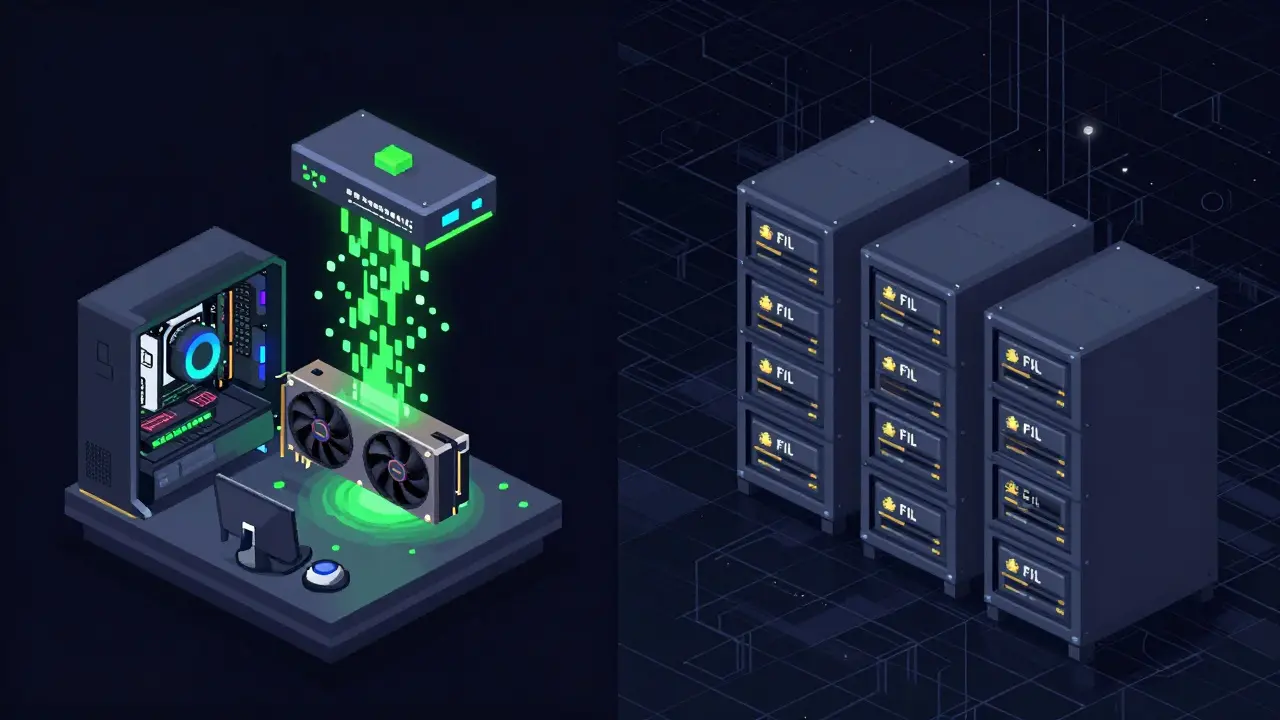
Not all DePIN projects are the same. They fall into two clear buckets: Physical Resource Networks (PRNs) and Digital Resource Networks (DRNs). Knowing the difference is key to understanding risk and reward.
PRNs require you to buy hardware. Helium, Hivemapper, and others ask you to invest $100-$1,000 upfront for a device. That’s a real cost. But it also means you’re tied to the network’s success. If the network grows, your earnings go up. Helium hotspots, for example, saw daily earnings drop from $1.50 in early 2022 to $0.35 by late 2023 as more people joined. But the network itself grew from 500,000 to 1 million hotspots. More users meant more demand, even if individual payouts fell. If you’re in it for the long term, this isn’t a failure-it’s scaling. You’re not just earning tokens; you’re helping build something bigger than yourself.
DRNs are different. Filecoin, Render Network, and others don’t need you to buy new gear. If you have spare storage or a gaming PC with a good GPU, you can join for free. Entry is low, but so is control. You’re competing with thousands of others. Render Network processed over 1.2 million GPU jobs in Q2 2023. That’s real demand. But if your GPU isn’t fast enough or your internet is slow, you won’t earn much. The barrier to entry is low, but the competition is high.
PRNs have higher upfront costs but stronger network effects. DRNs are easier to start but harder to stand out in. Your investment strategy should match your risk tolerance and resources.
Why DePIN Beats Traditional Infrastructure-And DeFi
Traditional infrastructure is broken. Telecoms charge $80 a month for spotty service. Cloud storage is expensive and centralized-one outage at AWS can take down half the internet. DePIN fixes that by using crowdsourced resources.
According to a16z Crypto, DePIN networks build infrastructure at 30-50% lower cost than traditional providers. Why? No corporate overhead. No shareholders to pay. No expensive data centers. Just people using what they already have. Helium Mobile now covers 1,800+ U.S. cities-including places Verizon ignores. Hivemapper’s street-level maps are used by Ford and Uber. Filecoin stores data for universities and startups. These aren’t side projects. They’re replacing parts of the old system.
Compare that to DeFi. DeFi’s total value locked (TVL) hit $82 billion in 2023. Sounds big, right? But what’s it actually doing? Lending, swapping, staking-mostly financial games. DePIN, on the other hand, is building real things. Helium’s network has 1 million hotspots. Hivemapper has collected 1.5 billion street images. That’s measurable, tangible growth. DeFi is about money moving. DePIN is about the world changing.
Who’s Winning-and Who’s Failing?
Not every DePIN project will survive. Messari found that 60% of early DePIN projects changed their token rewards within 18 months. That’s a red flag. If the team has to cut payouts because the model isn’t working, it’s a sign the tokenomics were flawed from the start.
Successful DePIN projects share three traits:
- Clear token utility: The token isn’t just a speculative asset-it’s needed to use the service. You need HNT to pay for network access. You need FIL to store data. You need RENDER to run jobs.
- Verifiable usage: You can check real metrics. How many hotspots? How many rendering jobs? How many miles mapped? If a project only talks about token price, walk away.
- Sustainable emissions: The token supply shouldn’t inflate too fast. Projects with annual inflation under 5% after launch are more likely to last. Helium’s shift to Solana in late 2023 cut transaction costs by 80%, making rewards more sustainable.
Failures usually come from one of two places: either they promised crazy returns without real demand (like early Filecoin miners who spent $5,000 on drives only to earn $20 a month), or they ignored regulation. Helium got hit with new FCC rules in July 2023 that cut hotspot earnings by 20%. Projects that didn’t plan for that are now struggling.
How to Get Started (Without Losing Your Money)
You don’t need to be a tech expert to invest in DePIN. But you do need to be smart.
Here’s how to start:
- Buy tokens first: Start with $50-$100 in HNT, FIL, or RENDER on Binance, Coinbase, or Kraken. Watch how the network grows. See if usage metrics rise. Don’t rush into hardware yet.
- Check real usage: Go to Helium’s explorer. Look at Hivemapper’s API stats. See how many jobs Render Network processes daily. If the numbers are flat or falling, the project might be dying.
- Only buy hardware if you’re ready: If you want to run a hotspot, make sure you have stable power and internet. Don’t buy a $600 Helium miner if you’re on a shaky WiFi connection. 30% of first-time users have setup problems.
- Diversify: Don’t put all your money into one PRN. Mix in a DRN like Render. If one sector cools, the other might heat up.
And watch your taxes. In 47 U.S. states, DePIN rewards are taxable income. PwC says you need to track every dollar earned. Keep records.

The Future: Will DePIN Take Over?
By 2026, Gartner predicts 20% of new infrastructure in connectivity, mapping, and storage will use decentralized models. That’s up from just 5% in 2023. That’s not a guess. That’s a forecast based on real adoption.
Big players are taking notice. Deutsche Telekom partnered with Helium in May 2023. Filecoin’s new Virtual Machine (FVM) in August 2023 let developers build apps directly on the network-developer activity jumped 170%. Polkadot just auctioned off three DePIN-specific parachain slots for $45 million total. This isn’t fringe anymore. It’s becoming infrastructure.
But here’s the hard truth: Delphi Digital predicts 70% of current DePIN projects will fail or merge by 2025. Only the top 5-10 will survive. That means timing matters. Early movers in Helium and Filecoin made big money. But now, you’re not buying into a startup. You’re buying into a proven system with real users.
The long-term potential? a16z Crypto says DePIN could be worth $500 billion to $1 trillion by 2030. That’s not fantasy. That’s based on replacing just a fraction of global telecom, storage, and mapping markets. Skeptics say it’s too optimistic. But look at what’s already here: 1 million hotspots. 1.5 billion mapped images. 1.2 million GPU jobs. This isn’t hype. It’s happening.
Final Thought: It’s Not About the Token Price
The biggest mistake people make is watching the token price like a stock ticker. That’s not how DePIN works. The value isn’t in how high HNT goes. It’s in how many people use the network. If Helium’s coverage keeps expanding, even if HNT drops 20%, the network is still winning. If Filecoin’s storage is cheaper and faster than AWS, then FIL has real value-even if the market is down.
DePIN is the first crypto sector where your investment is tied to real-world outcomes. You’re not betting on a coin. You’re betting on better infrastructure. And that’s something no other crypto category can claim.




Don Grissett
January 9, 2026 AT 09:42DePIN is the only crypto shit that actually does something. Helium hotspots? I got one. Made back my cash in 8 months. Now i just collect HNT like it's free candy. Meanwhile my buddy's in DeFi and his portfolio looks like a graveyard. Wake up people.
Katrina Recto
January 9, 2026 AT 11:46I started renting out my old GPU on Render Network last year. Made more than my side job. No hype. No drama. Just quiet, steady earnings. If you have spare hardware, just try it. No need to overthink it.
Veronica Mead
January 10, 2026 AT 01:21While I appreciate the enthusiasm surrounding DePIN, one must consider the regulatory risk inherent in decentralized infrastructure. The FCC's intervention in Helium's operations represents a precedent that may be replicated across jurisdictions. Moreover, the taxation of token rewards as ordinary income-per PwC's guidance-raises significant compliance burdens for the average participant. One must ask: is the marginal utility of decentralized storage worth the legal exposure?
Surendra Chopde
January 11, 2026 AT 00:46Interesting perspective. But I wonder-how many of these projects are truly decentralized, or just rebranded cloud services with token incentives? I’ve seen nodes in India with 500+ devices all owned by one company. Is this really community-driven, or just a new way to centralize control?
Tre Smith
January 12, 2026 AT 10:53Let’s be brutally honest: 80% of DePIN projects are vaporware. Helium’s earnings dropped because the tokenomics were broken from day one. They over-incentivized early adopters, then watched the network collapse under its own weight. And now you’re telling me to invest in another one? Filecoin miners lost millions. Render Network? You need a $2000 GPU just to break even. This isn’t investing-it’s gambling with better branding.
Ritu Singh
January 13, 2026 AT 19:19They’re using DePIN to build a surveillance grid under the guise of ‘community infrastructure’… and you’re all falling for it. The FCC didn’t regulate Helium because of ‘rules’-they were pressured by Verizon and AT&T. Big Telecom owns the regulators. This isn’t innovation-it’s a Trojan horse. And the tokens? Just digital breadcrumbs to keep you distracted while they harvest your data and your bandwidth.
kris serafin
January 15, 2026 AT 07:05For real though-if you're thinking about getting into DePIN, start small. Buy $50 worth of HNT or FIL. Watch the network usage on their explorers for a month. If active nodes are climbing, you’re golden. Don’t buy hardware until you’ve seen the numbers. And if you do get a hotspot? Put it near a window. WiFi through concrete is garbage. 🚀
Jordan Leon
January 15, 2026 AT 13:21There’s something poetic about this. We’re decentralizing infrastructure not because we trust the market, but because we’ve lost faith in institutions. The real value isn’t in the tokens-it’s in the quiet rebellion of a person in rural Ohio running a hotspot instead of paying $90 for Verizon. It’s not economics. It’s ethics.
Gideon Kavali
January 16, 2026 AT 03:23Let me be crystal clear: America leads in innovation-and DePIN is no exception. Helium? American. Filecoin? American. Render Network? American. Meanwhile, China is banning crypto and India is taxing it into oblivion. If you’re not investing in American-built decentralized infrastructure, you’re not just missing out-you’re betraying the future of free enterprise. 🇺🇸
Allen Dometita
January 16, 2026 AT 04:06Just got my first Render payout-$12 in a week. My old gaming rig was collecting dust. Now it’s earning. No stress. No drama. If you got a decent GPU, just plug it in. You don’t need to be a genius. Just don’t overthink it. 🤙
Brittany Slick
January 17, 2026 AT 23:30I love how DePIN turns闲置 hardware into magic. My grandma’s old laptop is now storing data for a university in Canada. She doesn’t get crypto-but she smiles every time she sees the little earnings pop up. It’s not just tech. It’s connection. 🌱
greg greg
January 18, 2026 AT 00:19It’s fascinating how the economic incentives of DePIN align with the physical constraints of real-world hardware deployment. The marginal utility of additional nodes in a PRN like Helium diminishes over time, yet the network effect increases non-linearly due to spatial coverage density-this creates a unique feedback loop where early adopters subsidize latecomers through token inflation, which in turn stabilizes as the protocol shifts to lower-emission chains like Solana, thereby recalibrating the incentive structure toward long-term sustainability rather than short-term arbitrage. This is not merely a financial innovation-it’s a sociotechnical reorganization of capital and labor in infrastructure provisioning.
Denise Paiva
January 19, 2026 AT 23:17Everyone’s acting like DePIN is the next big thing. But let’s not forget: the entire crypto market is a pyramid scheme with better branding. If you think decentralized storage is better than AWS, you’ve never tried uploading a 10GB file to Filecoin and waited 3 days for it to confirm. This isn’t innovation-it’s wishful thinking wrapped in blockchain buzzwords
Sarbjit Nahl
January 21, 2026 AT 09:25DePIN is just capitalism wearing a hoodie. You think people are doing this for the community? No. They’re doing it because they saw a 500% ROI in 2021. Now that the returns are normalizing, they’re pretending it’s about ‘building the future.’ The truth? It’s always been about extraction. The blockchain just made it prettier.
Meenakshi Singh
January 21, 2026 AT 17:52Filecoin’s been a disaster for small miners. I spent $4k on drives. Earned $18/month. Then they changed the reward algorithm. Now my setup’s a paperweight. And they wonder why people don’t trust these projects? 🤡
Frank Heili
January 22, 2026 AT 23:29If you're serious about DePIN, don't just look at token price. Look at the actual metrics. Helium's explorer shows 1.1M active hotspots. Render Network does 50k+ jobs daily. Filecoin has 12 exabytes stored. Real numbers. Real usage. That’s what matters. Tokens follow utility-not the other way around. And if you're thinking about hardware? Start with one. Test it. See if your internet can handle it. No need to go all-in. Just start small and learn.