
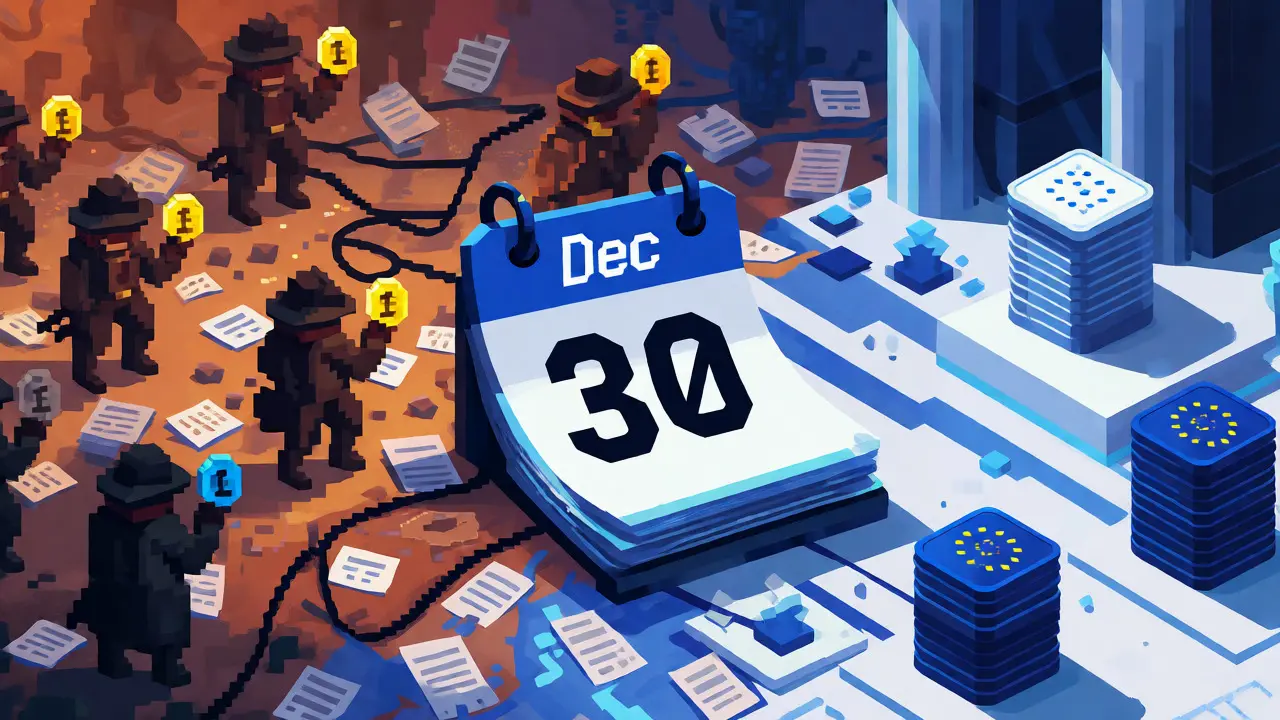
You might think the December 30, 2024 MiCA implementation deadline was just another bureaucratic date on a calendar. But if you hold Bitcoin in your wallet or trade on an exchange from Berlin to Barcelona, that date changed the ground beneath your feet. It wasn't about banning crypto; it was about forcing it into the same rigorous spotlight as traditional finance. For years, the European Union’s crypto market felt like the Wild West-fast, profitable, and dangerously unregulated. That era ended when the Markets in Crypto-Assets (MiCA) regulation fully took effect.
If you are still wondering whether this affects you, consider this: before MiCA, a platform could operate in France under one set of loose rules and in Germany under entirely different ones. Now, there is a single rulebook. This article breaks down exactly what happened on that critical date, why it matters for your portfolio, and how to navigate the new landscape without losing your mind-or your money.
The Phased Reality Behind the Single Date
It is tempting to view December 30, 2024, as a hard cliff edge where everything changed overnight. In reality, MiCA rolled out in stages. The first major hurdle came earlier, on June 30, 2024, when rules specifically targeting stablecoins went live. These included Asset-Referenced Tokens (ARTs) and E-Money Tokens (EMTs). If you have ever held USDC or EURC, you know these assets are pegged to fiat currencies. Regulators wanted proof that these digital dollars were actually backed by real cash or liquid assets, not just promises.
By late 2024, the focus shifted to the broader ecosystem. The remaining provisions targeted Crypto Asset Service Providers (CASPs)-the exchanges, custodians, and trading platforms you use daily. This phase required these companies to obtain formal licenses. Without a license, they couldn’t legally offer services across the EU. This distinction is crucial. Stablecoin issuers had their own strict requirements regarding reserves and audits, but service providers faced a comprehensive licensing regime that touched every aspect of their operation, from customer fund segregation to anti-money laundering checks.
Who Needs a License? Understanding CASPs
A Crypto Asset Service Provider (CASP) is any entity offering services such as custody, exchange, or advisory related to crypto-assets within the EU. Before MiCA, many platforms operated under national registrations that varied wildly in quality. Some countries had robust oversight; others were essentially open doors. The new framework harmonized this. To operate legally after December 30, 2024, a CASP needed authorization from a National Competent Authority (NCA) in one of the 27 member states.
This isn't just paperwork. Getting licensed means proving financial stability. You need minimum capital reserves. You must demonstrate operational resilience. And critically, you need a passport. Once licensed in one EU country, a provider can "passport" its services to all other member states. This creates a unified market, but it also raises the barrier to entry. Small startups that thrived in the regulatory gray areas now face significant legal and compliance costs. If they can't afford the license, they exit the market or restrict their services to non-EU clients.

Stablecoins Under the Microscope
While CASPs deal with the broad market, stablecoins got special treatment because they mimic money. The regulation treats them with the seriousness of bank deposits. Issuers must maintain 1:1 backing with high-quality liquid assets. They cannot lend out those reserves to chase yield. Transparency reports became mandatory, detailing exactly how the token is backed and what risks exist.
The enforcement here was swift. Following the full implementation, the European Securities and Markets Authority (ESMA) stepped in with clear directives. By early 2025, ESMA mandated that non-compliant stablecoins be restricted or delisted by March 31, 2025. This wasn't a suggestion. Platforms had to choose: keep a popular but non-compliant stablecoin and risk penalties, or remove it and force users to convert. Many users found themselves holding positions in tokens that suddenly became difficult to trade, highlighting the practical friction of regulatory transition.
| Feature | Pre-MiCA Era | Post-MiCA Era (Dec 2024+) |
|---|---|---|
| Licensing | National variations; some unregistered operations allowed | Unified EU-wide CASP license required for all major services |
| Stablecoin Backing | Varied; often opaque reserve structures | Mandatory 1:1 liquid asset backing with regular audits |
| Consumer Protection | Inconsistent; dependent on local jurisdiction | Standardized disclosure, liability rules, and complaint handling |
| Market Abuse | Harder to prosecute cross-border manipulation | Clear definitions of insider dealing and market manipulation |
The Transition Period Trap
Here is where things get tricky for existing businesses. Member states were allowed discretionary transition periods, ranging from 12 to 18 months. This meant that while the law was in force, some firms could continue operating under old rules for a bit longer. However, relying on this grandfathering provision comes with a massive catch: you don't get the EU passport.
If you rely on a transitional period in Germany, for example, you cannot automatically serve customers in France. You are locked into your home jurisdiction until you secure a full MiCA license. This created a fragmented experience for users. A trader might find that their favorite exchange works perfectly in one country but blocks sign-ups from another because the platform hasn't yet completed the full licensing process for that specific state. Legal experts warned against mistaking this phased approach for leniency. Non-compliance during the transition still carried risks, including potential shutdowns of specific services.

Why This Matters for Your Wallet
You might ask, "I'm just buying Bitcoin. Do I care about licensing?" Yes, you do. The ripple effects hit consumers directly. First, availability changes. If an exchange loses its license or decides the cost of compliance outweighs the profit from EU users, it may withdraw from the region. Second, fees may rise. Compliance costs money-legal teams, auditors, software upgrades-and those costs often trickle down to trading fees or withdrawal charges.
Third, security improves. The requirement for segregated client funds means your Bitcoin isn't mixed with the exchange's operational cash. If the exchange goes bust, your assets are theoretically safer. This mirrors protections you get with a regulated bank. For long-term holders, this reduction in counterparty risk is worth paying a little extra for. It transforms crypto from a speculative gamble into a more mature asset class, albeit one with higher barriers to entry for smaller players.
Global Impact and Future Outlook
The EU didn't act in a vacuum. By setting the world's first comprehensive standard, Europe forced global giants to adapt. Major international exchanges modified their global operations to meet MiCA standards rather than maintaining separate systems for Europe. This effectively exported EU regulations worldwide. If you trade on a global platform, you likely benefit from stricter controls even outside the EU, simply because it's cheaper for the company to run one high-standard system than two disparate ones.
Looking ahead, the regulation continues to evolve. Technical standards regarding stress testing and liquidity management are being refined. The initial shock of December 2024 has settled into a routine of ongoing supervision. For investors, the message is clear: check your provider's status. Look for the MiCA license badge. Understand which stablecoins are compliant. The wild west days are over, replaced by a structured, supervised, and surprisingly transparent market.
Does MiCA apply to Bitcoin and Ethereum?
Yes, but indirectly. While Bitcoin and Ethereum are not stablecoins, the platforms that allow you to buy, sell, or store them (Crypto Asset Service Providers) must comply with MiCA. This means the exchanges you use need licenses, and they must follow strict rules on how they handle your assets and disclose risks.
What happens if my exchange doesn't get a MiCA license?
If an exchange fails to obtain a license by the end of the transition period, it generally cannot offer services to new EU clients. Existing clients may be given a window to close their positions and withdraw funds. Eventually, the platform may cease operations in the EU entirely or restrict access to only pre-existing accounts without allowing new trades.
Are all stablecoins banned in the EU?
No, only non-compliant ones are restricted. Stablecoins issued by entities authorized by a National Competent Authority, which maintain proper reserves and transparency, remain legal. Popular tokens like USDC have adapted to meet these standards, while others that failed to prove sufficient backing faced delisting.
How does MiCA affect transaction fees?
There is no fixed fee increase mandated by law, but compliance costs are high. Exchanges spend significantly on legal counsel, audits, and technology upgrades. Many providers pass these costs to users through slightly higher trading spreads or withdrawal fees, though competition among licensed providers helps keep prices competitive.
Can I still use foreign exchanges in the EU?
Foreign exchanges can serve EU customers, but they must either establish a local subsidiary with a MiCA license or operate under strict restrictions. Many global platforms chose to obtain EU licenses to maintain seamless access to the European market, recognizing it as too large to ignore.




Christian Carneado
September 27, 2026 AT 09:49It is genuinely refreshing to see such a clear breakdown of the MiCA timeline. For those of us who have been navigating the crypto space from the US, it helps to understand how our European counterparts are stabilizing their markets. This kind of regulatory clarity often spills over into global best practices eventually.