

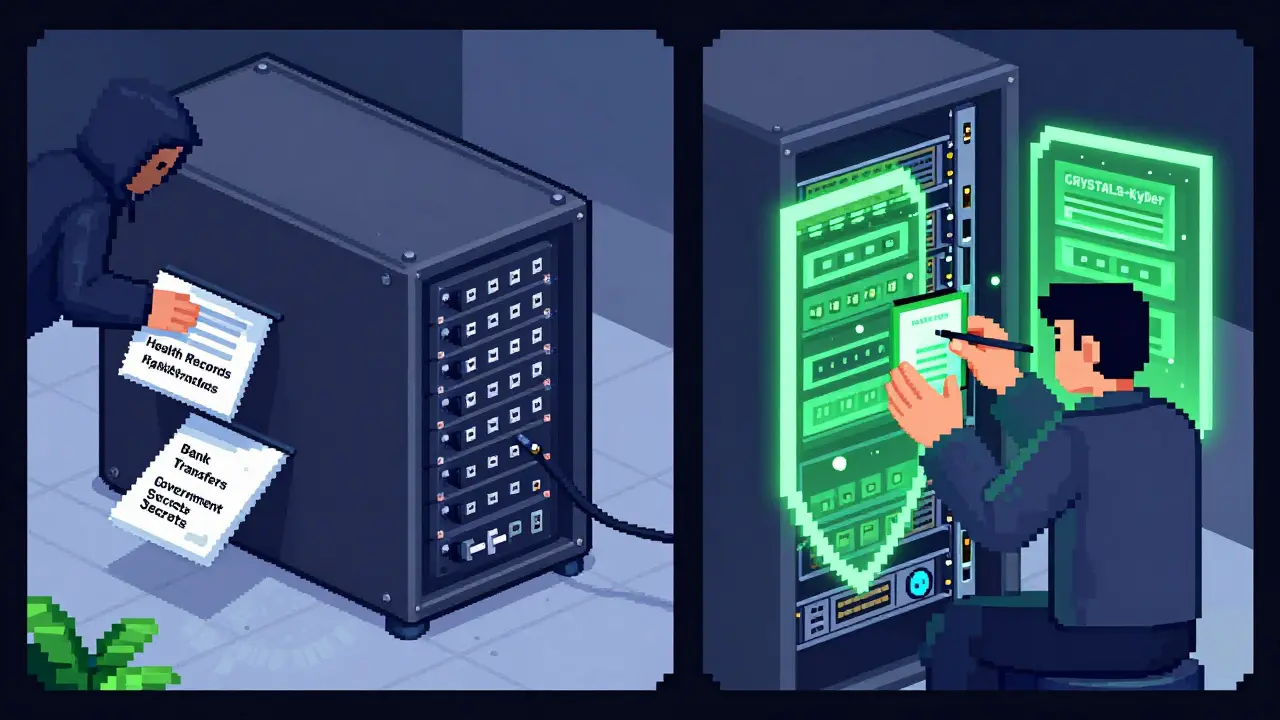
By 2026, your bank, your health records, and even your government’s secrets could be at risk-not from hackers with laptops, but from quantum computers you’ve never heard of. Right now, the encryption protecting all of it is built on math that quantum machines can break in months. What used to take 317 trillion years for a supercomputer to crack? A quantum computer could do it before lunch. This isn’t science fiction. It’s happening faster than most people realize.
Why Your Current Encryption Won’t Last
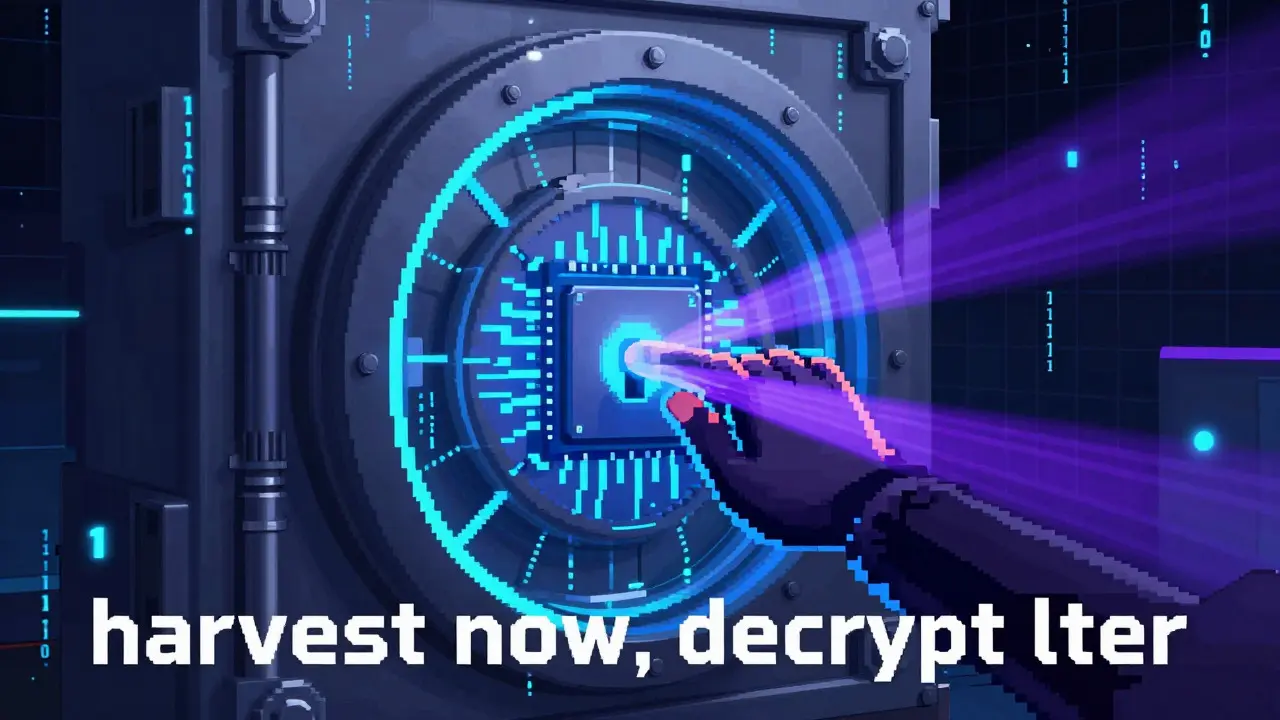
Today’s digital world runs on public-key cryptography. RSA, ECC, and similar systems keep your online banking, email, and messaging secure. They work because they rely on problems that are easy to do one way but nearly impossible to reverse-like factoring huge numbers or solving elliptic curve equations. Classical computers struggle with these. But quantum computers? They use qubits that can be 0 and 1 at the same time, letting them test millions of possibilities in parallel. Shor’s algorithm, developed in 1994, is the game-changer. It can break RSA and ECC in hours, not millennia. Grover’s algorithm weakens symmetric encryption like AES by cutting its strength in half. That means a 256-bit AES key, once considered unbreakable, would only have the security of a 128-bit key against a quantum attack. That’s not enough. The scary part? Attackers aren’t waiting. They’re already harvesting encrypted data-your past emails, medical files, financial transactions-and storing it. Once a powerful enough quantum computer arrives, they’ll decrypt everything. This is called “harvest now, decrypt later.” If you’re still using 2020-era encryption for data that needs to stay secret for 10+ years, you’re already compromised.What Is Quantum-Resistant Security?
Quantum-resistant security, also known as post-quantum cryptography (PQC), is the new set of algorithms designed to survive even when quantum computers are common. Instead of relying on factoring or discrete logs, these systems use math problems that even quantum machines struggle with. Think of it like switching from a lock that can be picked with a magnet to one that needs a 100-piece puzzle only the right person can solve. There are four main families of quantum-resistant algorithms:- Lattice-based cryptography-uses complex geometric structures in high-dimensional space. It’s fast, flexible, and the most promising for general use.
- Hash-based cryptography-relies on the security of cryptographic hash functions. Great for digital signatures, but not for encryption.
- Code-based cryptography-uses error-correcting codes from information theory. Proven secure for decades, but bulky.
- Multivariate polynomial cryptography-based on solving systems of nonlinear equations. Fast, but less tested.
NIST’s Standardization Push
The U.S. National Institute of Standards and Technology (NIST) has been running a global competition since 2016 to pick the best quantum-resistant algorithms. After years of testing, peer review, and real-world simulations, they announced the winners in 2022 and finalized them in 2024. The two most important standards now are:- CRYSTALS-Kyber-for encryption and key exchange. It’s efficient, scalable, and works well with existing protocols like TLS.
- CRYSTALS-Dilithium-for digital signatures. It’s faster and smaller than older signature methods like RSA.
It’s Not Just About Swapping Algorithms
Switching to quantum-resistant crypto isn’t like updating your antivirus. It’s a full system overhaul. Kyber keys are 10x larger than RSA keys. Dilithium signatures are 5x bigger than ECDSA. That means:- More bandwidth used in network traffic
- More storage needed for logs and certificates
- Slower performance on older devices
- Compatibility issues with legacy systems
Who’s Already Moving?
Big tech isn’t waiting. IBM has embedded quantum-safe encryption into its IBM Z mainframes, protecting financial transactions for banks worldwide. Google tested Kyber in Chrome. Microsoft added PQC support to Azure Key Vault. Fortanix and other cybersecurity firms now offer full quantum-resistant key management platforms. Even small businesses aren’t immune. If you use cloud services, your data is stored on servers that may already be upgrading. If you’re still using outdated encryption, you’re a liability-not just to yourself, but to your partners. The market is exploding. Analysts estimate the quantum-safe cryptography market will grow from $150 million in 2025 to over $3 billion by 2030. That’s not because of hype-it’s because the clock is ticking.What Should You Do Right Now?
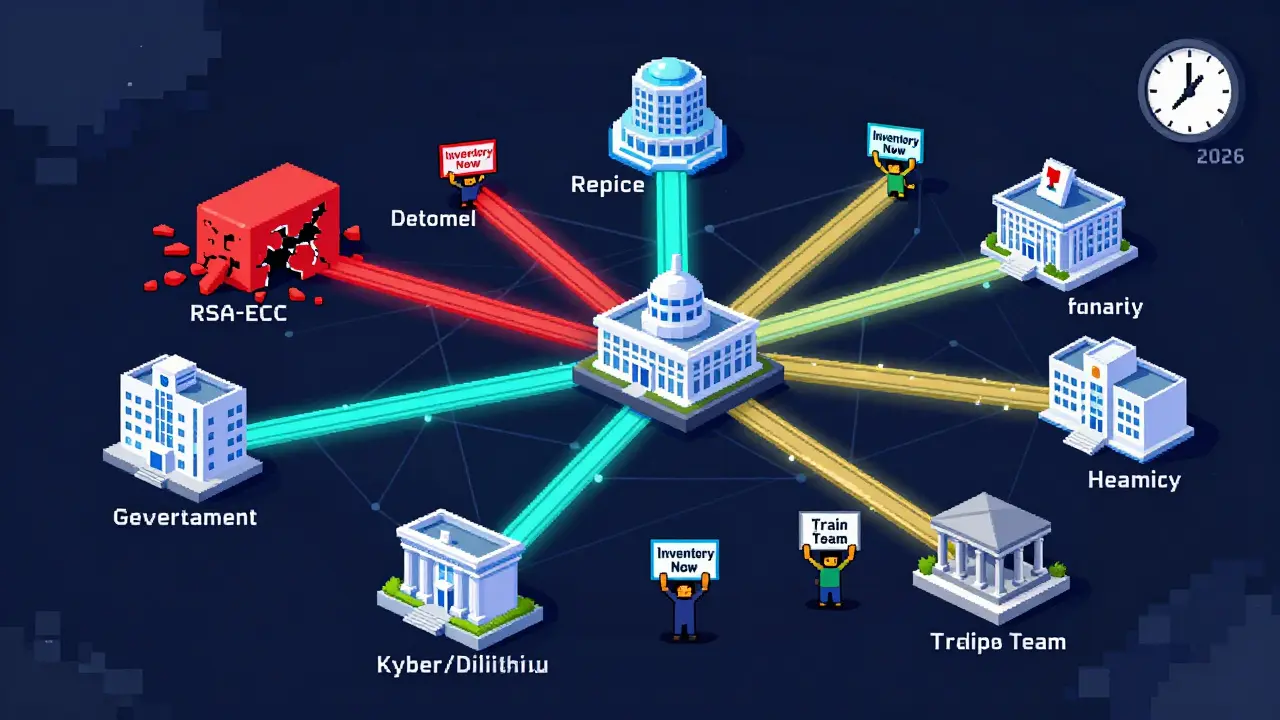
You don’t need to rebuild everything tomorrow. But you do need a plan. Here’s what to do in 2026:- Inventory your crypto assets-Find every system using RSA, ECC, or DSA. Look at certificates, APIs, databases, and blockchain wallets.
- Identify your high-risk data-What needs to stay secret for 10+ years? Government contracts, patient records, intellectual property? Prioritize those.
- Start testing Kyber and Dilithium-Use open-source libraries like liboqs or PQClean. Try them in a sandbox environment.
- Engage your vendors-Ask your cloud provider, ERP system, and cybersecurity vendor: “When will you support NIST PQC standards?”
- Train your team-Your IT staff needs to understand lattice-based math, key sizes, and hybrid setups. This isn’t something you outsource.




Kevin Gilchrist
January 2, 2026 AT 19:12So let me get this straight-we’re all just sitting here like it’s 2003 while quantum computers are already harvesting our baby pics and tax returns? 😈 I’ve got my crypto stored in a USB drive buried under my dog’s favorite spot. If Skynet comes for it, at least he’ll get a snack first. 🐶
Khaitlynn Ashworth
January 2, 2026 AT 21:15Oh wow, NIST picked winners? How revolutionary. I’m sure the same people who thought Y2K was a big deal and then forgot about it are now writing the rules for the apocalypse. 🙄 At least we can all pretend we’re prepared while our cloud provider quietly ignores it until someone gets sued.
NIKHIL CHHOKAR
January 3, 2026 AT 18:40Actually, this is a very responsible and timely piece. Many people still think quantum computing is decades away, but the reality is that the threat is already here in the form of data harvesting. The transition isn’t just technical-it’s cultural. Organizations need to stop treating security like an IT checkbox and start seeing it as a moral obligation to their users. I’ve seen too many small clinics ignore this because ‘we’re too small to matter.’ Spoiler: you’re not. Your patient data is valuable to attackers, regardless of your size.
And yes, Kyber and Dilithium aren’t perfect-but they’re the best we’ve got right now. Testing them in sandbox environments isn’t optional. It’s the bare minimum. If your CISO doesn’t understand lattice-based math, it’s time to hire someone who does-or at least send them to a workshop. This isn’t fearmongering. It’s math.
Mike Pontillo
January 5, 2026 AT 15:15So we’re gonna swap one broken system for another? Great. Next they’ll tell us to use QR codes to sign our wills. 😒
Joydeep Malati Das
January 7, 2026 AT 00:09This is one of the clearest overviews I’ve read on post-quantum cryptography. The distinction between symmetric and asymmetric encryption is particularly well-articulated. The emphasis on inventorying crypto assets is critical-most organizations don’t even know what systems they have running legacy crypto. I’d add that regulatory compliance should not be the only driver; ethical responsibility should lead the charge. The cost of delay is not just financial-it’s existential for individuals whose data may be exposed decades from now.
Mandy McDonald Hodge
January 8, 2026 AT 18:36ok so i just read this and my brain is kinda melting but also like… we HAVE to do something?? 🥺 i work at a small dental clinic and we still use like… 2015-era encryption for patient files?? i just emailed our IT guy and he said ‘we’ll get to it next fiscal year’… NOPE. nope nope nope. i’m printing this out and taping it to his monitor. 📄💥
Bruce Morrison
January 9, 2026 AT 08:21Don’t wait for permission. Start testing Kyber in your dev environment today. Use liboqs. It’s open source. It’s free. It’s not hard. The hardest part is admitting you need to change. The rest is just time and patience. Your future self will thank you.
nayan keshari
January 9, 2026 AT 16:55Everyone’s panicking about quantum computers but no one talks about how most of this ‘secure’ data is already leaked through phishing, insider threats, or just bad password hygiene. We’re fixing the wrong problem. The real threat isn’t Shor’s algorithm-it’s people clicking ‘Download Invoice.pdf.exe’
Johnny Delirious
January 10, 2026 AT 15:05It is with the utmost gravity and profound respect for the integrity of global digital infrastructure that I submit the following observation: the adoption of NIST PQC standards is not merely a technical upgrade-it is a civilizational imperative. The erosion of cryptographic trust constitutes a foundational vulnerability in the social contract of the digital age. To delay is to betray the future. The time for incrementalism has expired. We must act with urgency, precision, and unwavering resolve.
Bianca Martins
January 12, 2026 AT 11:27Actually, the AES-256 point is super important and gets overlooked. People think ‘quantum = everything broken’ but nope, symmetric encryption’s still good if you’re using it right. The real issue is key exchange. So if you’re still using RSA to send AES keys… yeah, that’s your problem. Fix that first. Also, if you’re on Windows 7 and think you’re safe? 😅
alvin mislang
January 13, 2026 AT 21:32They’re lying. Quantum computers aren’t real. This is just a government scam to sell you more expensive crypto gear. The NSA already has the keys. They’re just making us panic so we buy their upgrades. 💀
Monty Burn
January 14, 2026 AT 21:23What is security if not a story we tell ourselves to sleep at night? The math is elegant but the world is messy. We build locks because we fear the dark. But what if the dark was never outside? What if the thief was always inside the house… and we gave them the key?
Kenneth Mclaren
January 15, 2026 AT 03:42Did you know that the ‘quantum threat’ was invented by a secret cabal of tech CEOs and quantum physicists who are secretly running a simulation? They’re using our fear to control the global economy. The real quantum computers are in Area 51. They’ve already decrypted the Declaration of Independence. That’s why the original parchment is gone. They’re rewriting history. And they’re coming for your Netflix password next.