
You click a link to trade on Cybex DEX. The page spins. Nothing loads. You check Twitter. Silence. You check Reddit. Crickets. It’s not just your connection. Cybex DEX is a defunct decentralized cryptocurrency exchange that ceased operations and website access by December 2022. If you are looking for this platform today, you have likely stumbled into what industry trackers call the "Exchange Graveyard."
This isn’t a story about a hack or a rug pull where funds were stolen in a dramatic heist. It is a quieter, more common tragedy in the crypto world: slow death by neglect. For anyone researching old wallets, tracking historical data, or simply wondering why their favorite 2017 project vanished, here is the full breakdown of what happened to Cybex DEX and how to avoid its fate.
The Short Answer: Is Cybex DEX Still Working?
No. As of December 2022, Cybex DEX is confirmed dead. The website fails to load despite domain registration records still existing. Social media channels went silent by late 2019. Trading volume dropped to near-zero levels years before the lights went out completely. If you have tokens stuck there, recovery is unlikely without significant technical effort, and if you are looking to start trading, look elsewhere immediately.
Key Takeaways
- Status: Defunct since December 2022.
- Risk Level: High (for any remaining assets).
- Primary Cause: Insufficient liquidity and lack of development updates.
- Best Alternative: Uniswap or PancakeSwap depending on your blockchain preference.
What Was Cybex DEX? A Brief History
To understand why it failed, we first need to know what it was supposed to be. Launched in 2017, Cybex DEX positioned itself as a standard decentralized exchange (DEX). Unlike centralized platforms like Coinbase or Binance, which hold your money in their vaults, a DEX allows peer-to-peer trading directly from your wallet. You keep control of your private keys. No account creation. No KYC (Know Your Customer) checks.
The team behind it included names like James Gong, Yuri Milyutin, and Jianbo Wang, with consultants such as Budorin Dmytro, Ash Han, and David Lee. On paper, this looked like a typical early-stage crypto startup. The promise was freedom and security through decentralization. However, the execution lacked the critical ingredients needed to survive in a hyper-competitive market.
The Liquidity Trap: Why Low Volume Killed It
In the world of decentralized finance, liquidity is oxygen. Without enough buyers and sellers, you cannot trade efficiently. Slippage-the difference between the expected price of a trade and the price at which the trade is executed-becomes massive when volume is low.
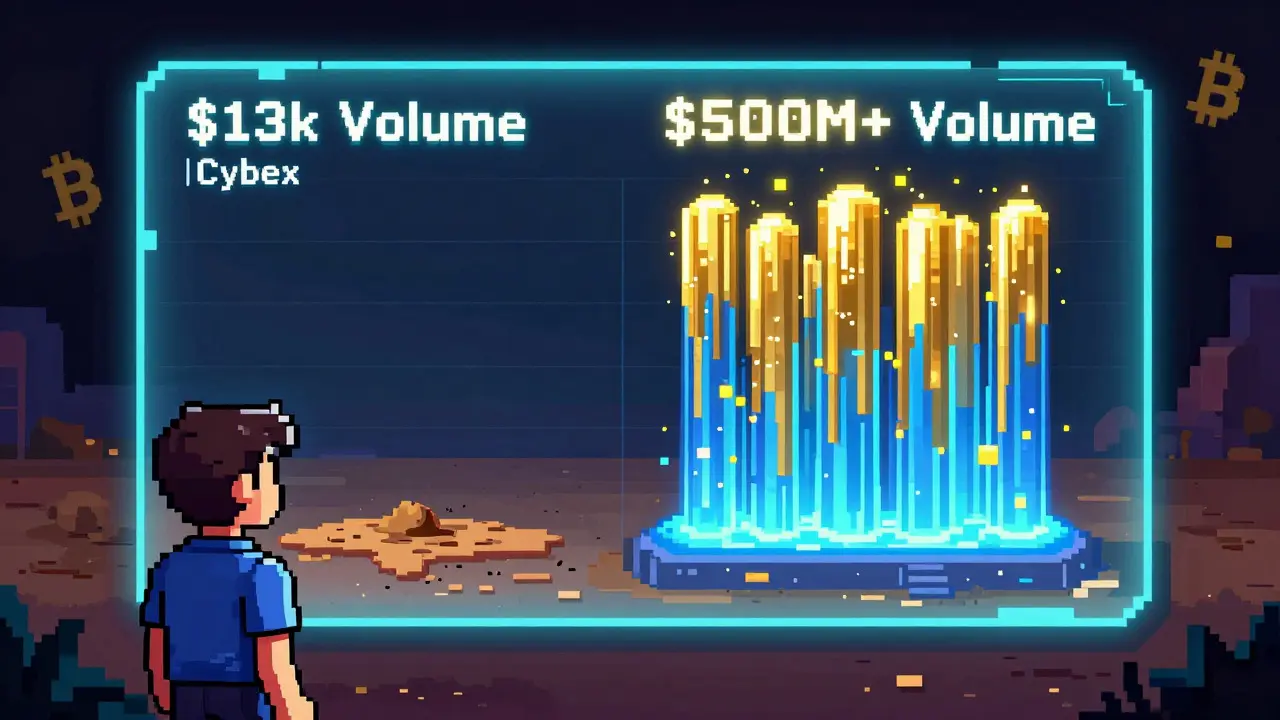
Let’s look at the numbers. By November 7, 2019, CoinGecko reported a 24-hour trading volume of just USD 10,926. That is less than the daily revenue of a small coffee shop. Two years later, in December 2021, during the height of the bull market when everyone was buying crypto, Cybex DEX’s volume had only crept up to USD 13,006. These figures are abysmal.
Why does this matter? Because low volume signals a lack of user trust. Traders flock to where other traders are. If you want to sell Ethereum quickly, you go to a platform with deep pools of cash ready to buy. On Cybex DEX, selling a large amount would have crashed the price against you. This created a vicious cycle: low volume scared away users, which kept volume low, until eventually, no one was left.
| Platform | Avg. Daily Volume (Est.) | Status |
|---|---|---|
| Cybex DEX | $10k - $13k | Defunct |
| Uniswap | $500M+ | Active Leader |
| PancakeSwap | $200M+ | Active Leader |
Technical Weaknesses and User Experience
Beyond the numbers, the user experience on Cybex DEX was lacking compared to modern standards. While it required connecting a compatible wallet like MetaMask-a standard practice for Ethereum-based DEXs-it failed to provide the support structures that make these tools usable for non-experts.
Successful DEXs invest heavily in documentation, active Discord communities, and regular interface updates. They guide new users through gas fees, slippage tolerance, and token approvals. Cybex DEX offered none of this. There were no active forums, no helpful tutorials, and no responsive support team. For a beginner trying to navigate their first decentralized trade, the learning curve was steep and lonely.
Furthermore, while being accessible to US residents was a theoretical advantage due to fewer regulatory hurdles than centralized exchanges, it didn't help if the platform itself was broken. The non-custodial nature meant users held their own risk, but without a functioning interface, that risk became impossible to manage.
How to Spot a Dead Exchange Before You Trade
Cybex DEX serves as a cautionary tale. How can you avoid putting your time or money into a platform that is already dying? Here are three red flags to watch for:
- Social Media Silence: Check the last tweet or Telegram message. If it’s been over six months since the last update, run. Active projects communicate constantly.
- Volume Discrepancy: Look at sites like CoinGecko or CoinMarketCap. If the daily volume is under $1 million, ask yourself why. Is it a niche stablecoin swap? Or is it just empty?
- Website Performance: Does the site load slowly? Are there broken links? Is the design outdated? Technical neglect often precedes total shutdown.
Expert analysis from Cryptowisser warned back in 2019 that "the trading volume is still so low that there is a risk that this exchange will have to shut down in the near future." That prediction proved accurate. Always listen to independent auditors and community sentiment.

Where Should You Trade Instead? (2026 Recommendations)
If you are looking for the benefits of decentralized trading-privacy, self-custody, and access to new tokens-you have far better options today. The DEX landscape has matured significantly since 2017.
- Uniswap: The gold standard for Ethereum-based trading. It offers deep liquidity, extensive token support, and a robust ecosystem. Fees vary by pool (0.05%, 0.30%), ensuring fair pricing for most trades.
- PancakeSwap: The top choice for Binance Smart Chain (BSC) users. Lower gas fees than Ethereum make it ideal for smaller transactions.
- Curve Finance: Specialized in stablecoin swaps. If you are moving between USDC, USDT, and DAI, Curve minimizes slippage better than almost any other platform.
- dYdX: For those interested in leveraged trading without giving up custody of their funds. It brings centralized-style features to a decentralized environment.
These platforms have active development teams, millions of daily users, and strong community backing. They represent the evolution of the technology that Cybex DEX failed to sustain.
What If You Have Assets Stuck on Cybex DEX?
This is the hardest question. If you have tokens in a wallet connected to Cybex DEX, they are likely still in your wallet, not on the exchange itself. Remember, DEXs are non-custodial. The exchange is just an interface.
However, because the interface is gone, you may need to interact with the smart contracts directly using a tool like Etherscan. This requires advanced technical knowledge. You must identify the specific contract addresses for the tokens you hold and attempt to transfer them to a new wallet address manually. Be cautious: interacting with old, unverified contracts carries risks. Consult with a crypto-savvy friend or a professional auditor before attempting any complex blockchain interactions.
The Broader Lesson: Sustainability Over Hype
The failure of Cybex DEX highlights a crucial truth about the crypto industry: technology alone is not enough. You need liquidity, community, and continuous improvement. The early days of 2017 saw hundreds of DEX launches. Most failed. Only those that built real utility and engaged users survived.
Today, the barrier to entry is higher. Users expect seamless experiences, mobile apps, and instant customer support-even on decentralized platforms. Projects that ignore these expectations, like Cybex DEX, get left behind. As you navigate the crypto space in 2026, prioritize platforms with proven track records and transparent activity. Don’t let nostalgia for old projects blind you to current realities.
Is Cybex DEX safe to use in 2026?
No. Cybex DEX is defunct. The website does not load, and there has been no activity since 2019. Using it poses unnecessary technical risks with no benefit.
Can I recover my funds from Cybex DEX?
If your funds were in a personal wallet (like MetaMask), they are still yours. You may need to use block explorers like Etherscan to manually transfer tokens via smart contract interaction. If you sent funds to a custodial address on Cybex, recovery is highly unlikely.
Why did Cybex DEX fail?
It suffered from extremely low trading volume (under $15k daily), lack of marketing, poor user experience, and absence of community engagement. Without liquidity, traders abandoned the platform.
What is the best alternative to Cybex DEX?
For Ethereum users, Uniswap is the leading alternative. For Binance Smart Chain users, PancakeSwap is recommended. Both offer high liquidity, active development, and secure interfaces.
Are all decentralized exchanges risky?
Not all, but many carry higher risks than centralized ones. Risk comes from smart contract bugs, low liquidity, or abandoned projects. Stick to well-established, audited platforms with high trading volumes to minimize risk.