
Imagine you are waiting for a bus. If the bus arrives every hour, you have plenty of time to grab coffee, but you might miss your appointment if you’re late. If it arrives every five minutes, you get there fast, but the bus is likely packed, chaotic, and prone to breaking down. This is exactly how block time works in the world of cryptocurrency.
Block time is simply the average interval between the creation of new blocks on a blockchain network. It dictates how quickly transactions are confirmed and recorded permanently. But here is the catch: faster isn’t always better. Shorter block times can lead to network instability, while longer ones make payments feel sluggish. Understanding this metric is crucial whether you are buying Bitcoin, trading on Ethereum, or building a decentralized application.
How Block Time Actually Works
To understand block time, you need to visualize the blockchain as a digital ledger made of pages. Each page is a "block." When a block is full of transactions, it gets sealed and added to the chain. The time it takes to fill that block and add it to the chain is the block time.
This process is not random; it is governed by the network’s consensus mechanism. In Proof-of-Work systems like Bitcoin, which uses mining to secure the network, miners compete to solve complex mathematical puzzles. The difficulty of these puzzles adjusts automatically to ensure blocks are produced at a steady pace. In Proof-of-Stake networks like Ethereum, where validators stake coins to propose blocks, the timing is more deterministic, relying on randomized selection rather than computational brute force.
The core value of block time lies in its direct impact on three things:
- Transaction Finality: How long until your payment is irreversible?
- Network Throughput: How many transactions per second (TPS) can the network handle?
- Security vs. Decentralization: Can small participants join the network, or is it dominated by powerful entities?
Major Networks Compared: Speed vs. Stability
Different blockchains choose different block times based on their design goals. There is no "one size fits all" because changing this parameter requires sacrificing something else. Let’s look at the big players.
| Blockchain | Average Block Time | Consensus Mechanism | Primary Use Case |
|---|---|---|---|
| Bitcoin | ~10 minutes | Proof-of-Work | Digital Gold / Store of Value |
| Ethereum | ~12 seconds | Proof-of-Stake | Smart Contracts / DeFi |
| Solana | 400-800 milliseconds | Proof-of-History + PoS | High-Frequency Trading / NFTs |
| Binance Smart Chain | ~3 seconds | Proof-of-Staked-Authority | Fast Transactions / Low Fees |
| Cardano | ~20 seconds | Proof-of-Stake (Ouroboros) | Academic Research / Sustainability |
Bitcoin’s 10-minute target was set by Satoshi Nakamoto in 2008 to balance security with global propagation delays. At that time, internet speeds were slower, and nodes were fewer. Today, it remains around 9.97 minutes. This slow pace ensures that the network is highly secure and decentralized, allowing even home users to run full nodes. However, it makes Bitcoin impractical for buying a cup of coffee unless you use Layer 2 solutions like the Lightning Network.
Ethereum, after its transition to Proof-of-Stake (The Merge), settled on a 12-second block time. This was a deliberate choice by co-founder Vitalik Buterin to find the "sweet spot" where confirmations are fast enough for most applications but slow enough to prevent excessive "orphan blocks" (blocks that get discarded because another block was found first). Under normal conditions, Ethereum processes 15-30 transactions per second.
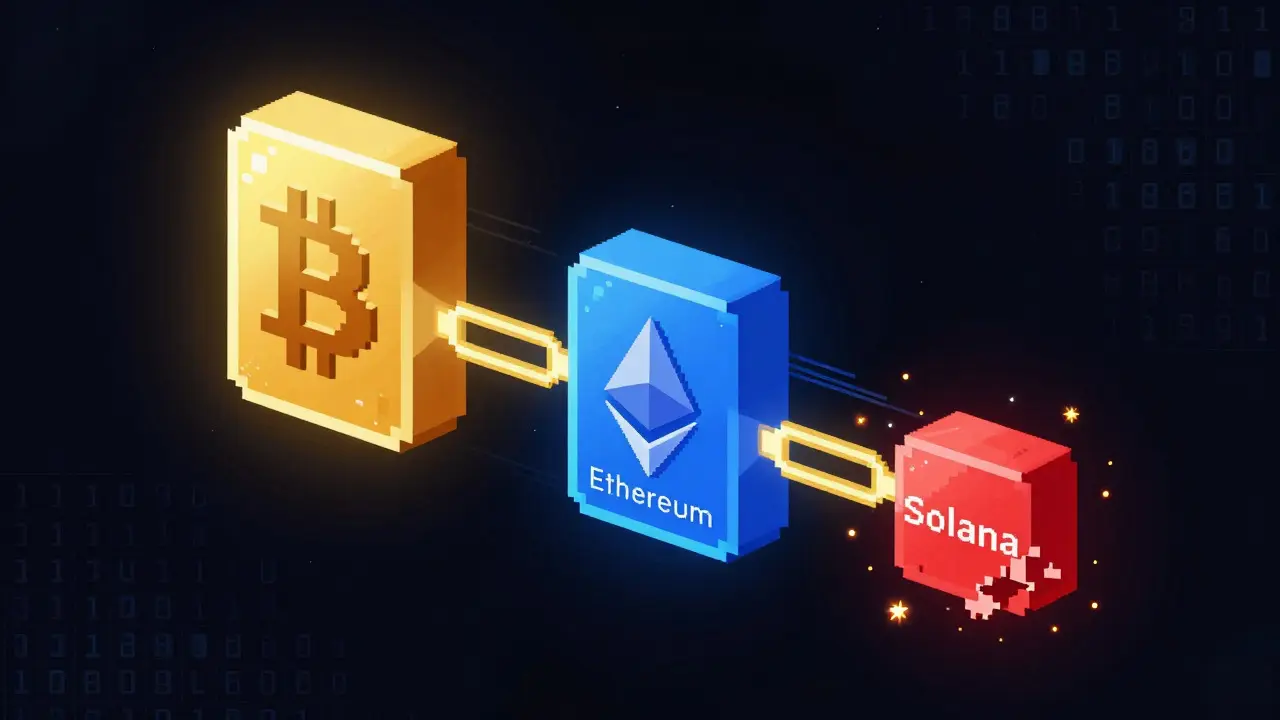
Then there is Solana, which boasts sub-second block times (400-800ms). This enables near-instant transactions, ideal for gaming and high-frequency trading. However, this speed comes with a cost. Solana has experienced several network outages, including a notable 12-hour halt in December 2023, due to the immense pressure of synchronizing thousands of nodes in milliseconds. As Chainspect noted in their 2023 technical report, sub-second block times require near-perfect network conditions to avoid consensus failures.
The Hidden Cost of Speed: Orphan Blocks and Centralization
You might wonder why we don’t just make every blockchain as fast as Solana. The answer lies in a concept called "orphan rate" or "stale blocks."
When a miner or validator creates a block, they broadcast it to the network. If two people create a block at nearly the same time, only one will be accepted by the majority. The other becomes an "orphan," and the work done on it is wasted. The shorter the block time, the higher the chance of this happening.
Here is why that matters:
- Centralization Risk: High orphan rates hurt small miners or validators because their blocks are more likely to be discarded. Only large, well-connected entities with premium internet infrastructure can consistently win. This pushes the network toward centralization.
- Bitcoin’s Advantage: With a 10-minute block time, Bitcoin’s orphan rate stays below 0.5%. This allows solo miners to participate fairly.
- Ethereum’s Balance: Ethereum’s 12-second target keeps the orphan rate around 2.5-3.5%, which is manageable but requires sophisticated software to handle reorganizations.
Dr. Yan X. Zhang from Nervos Network explained that reducing block time by 50% often requires a 300% increase in network bandwidth to maintain equivalent security. This is why enterprise blockchains like R3 Corda, which operate in controlled environments with known participants, can afford 1-2 second block times without the same decentralization risks.

What This Means for Your Transactions
If you are sending money, block time directly affects how long you wait for confirmation. But "confirmation" doesn’t mean the money is instantly yours. It means the network agrees the transaction happened.
For Bitcoin, merchants typically wait for 6 confirmations before considering a payment final. That’s roughly 60 minutes. For high-value transfers, this is essential security. For a $5 purchase, it’s frustrating. This is why many Bitcoin wallets now use instant payment channels or accept zero-confirmations for small amounts, accepting a slight risk of reversal.
On Ethereum, post-Merge, the standard for finality is 32 confirmations, which takes about 6.5 minutes. However, for most DeFi interactions, users consider a transaction "done" after 1-2 blocks (12-24 seconds). Developers must build their apps to handle this uncertainty, implementing strategies like optimistic UI updates that revert if a transaction fails.
In contrast, on Solana or Binance Smart Chain, you might see your balance update in under a second. This feels like using a credit card, which is great for user experience. But during peak congestion, as seen in early 2024, failed transaction rates on Solana jumped to 68% compared to 22% on Ethereum. Speed can sometimes mean fragility.
Future Trends: Adaptive Block Times
The industry is moving away from static block times. Researchers at MIT’s Digital Currency Initiative are exploring adaptive algorithms that adjust block production speed based on real-time network load. Imagine a highway that adds lanes when traffic is heavy and removes them when empty. Early tests show this could reduce orphan rates by 35% during congestion.
Solana’s upcoming Firedancer client aims to reduce average block time to 300ms while improving stability. Meanwhile, Ethereum’s Dencun upgrade focused on blob transactions to lower fees rather than speeding up block times, prioritizing security over raw speed. This suggests a future where Layer 1 networks remain stable and secure, while Layer 2 solutions handle the high-speed micro-transactions.
Is a shorter block time always better?
Not necessarily. While shorter block times provide faster transaction confirmations, they can increase the orphan rate, leading to network instability and centralization. Bitcoin’s 10-minute block time sacrifices speed for maximum security and decentralization, making it suitable for store-of-value purposes. Faster chains like Solana prioritize speed but may face more frequent outages or require more powerful hardware to validate blocks.
How does block time affect transaction fees?
Indirectly, yes. Shorter block times allow more blocks to be produced in a given timeframe, potentially increasing the total capacity of the network. However, if demand exceeds supply, fees still rise. Networks with very short block times, like Solana, often have lower base fees because they can process thousands of transactions per second, reducing competition for space in each block.
Why does Bitcoin take so long to confirm?
Bitcoin’s 10-minute block time is a design choice to ensure global node synchronization and maximize security. It allows sufficient time for the block to propagate across the entire network, minimizing the risk of forks. This makes Bitcoin highly resistant to attacks but less suitable for everyday retail payments without Layer 2 scaling solutions.
Can block time change dynamically?
Currently, most major blockchains have fixed target block times adjusted via difficulty algorithms (like Bitcoin) or slot mechanisms (like Ethereum). However, research into adaptive block times is ongoing. These systems would adjust the interval between blocks based on network congestion, aiming to optimize both speed and stability in real-time.
Which blockchain is best for fast payments?
For pure speed, networks like Solana (sub-second), Binance Smart Chain (3 seconds), and Polygon (2 seconds) are superior to Bitcoin and Ethereum. However, you must weigh speed against reliability. If you need absolute security for large sums, Bitcoin’s slower time is preferred. For daily micro-transactions, faster L1s or Layer 2 solutions on Ethereum (like Arbitrum or Optimism) offer a good balance.