
Imagine signing a legal contract that you cannot change, even if you find a typo or a fatal loophole. That is the reality of immutability in smart contracts, which refers to the permanent, unchangeable nature of code once it is deployed on a blockchain network. For years, this feature has been sold as the ultimate promise of blockchain technology: trustless, transparent, and secure. But as the industry matures, we are seeing a stark divide. On one side, you have protocols that refuse to change a single line of code, no matter what. On the other, you have systems that can be updated at any moment, often by a small group of developers. Which approach is safer? The answer isn't simple, and getting it wrong can cost millions.
The Core Promise: Why Immutability Matters
At its heart, immutability means exactly what it says: immutable. Once your code lives on the blockchain, it stays there forever. This concept was cemented when Ethereum launched in July 2015 with a decentralized platform designed to execute smart contracts without central authority. The logic is straightforward. If the code cannot be changed, then the rules of the game cannot be rigged after the players have bought in. This eliminates counterparty risk. You don’t need to trust the developer; you only need to trust the math.
This trust model is powerful. Take Uniswap V2, a leading decentralized exchange protocol that operates with fully immutable core contracts facilitating over $1.2 trillion in trading volume since May 2020 without any code modifications. Users know that the swap mechanics won't suddenly change to charge higher fees or steal funds. The code is public, verified, and fixed. This transparency is why finance and supply chain sectors, which account for over 70% of immutable contract usage, lean heavily on this model. They want finality. They want certainty.
The Hidden Danger: When Bugs Become Permanent
But here is the catch: developers make mistakes. In traditional software, if you find a bug, you patch it. In an immutable smart contract, if you find a bug, it stays there. Forever. This creates a terrifying scenario where a vulnerability is not just a technical issue but a permanent financial hole.
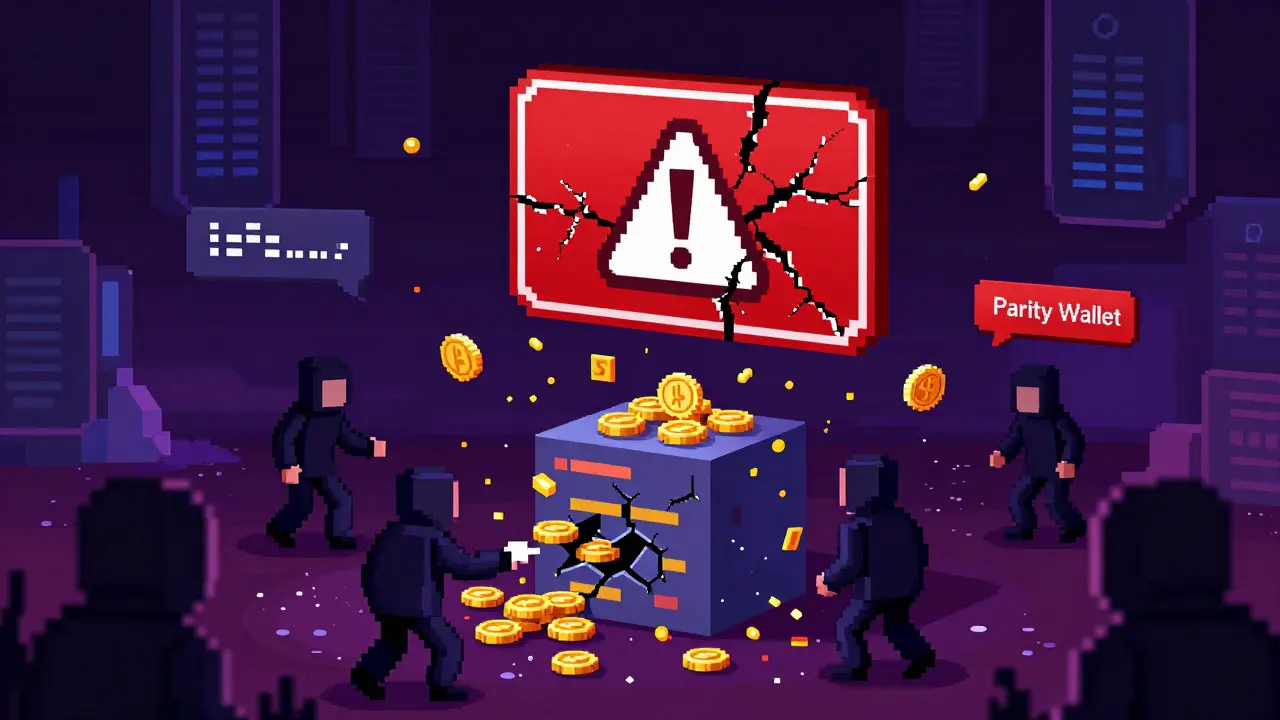
We saw this play out dramatically with the Parity Wallet hack in July 2017, where a critical vulnerability in immutable multi-sig wallet code resulted in the loss of approximately $60 million in Ethereum tokens that could never be recovered because the code could not be patched. Because the code was immutable, the community had to debate whether to perform a hard fork-a massive, controversial split of the blockchain-to fix the issue. It didn't work out well for everyone involved. According to research from the University of Cambridge's Centre for Alternative Finance, protocols using strictly immutable contracts experienced 37% fewer security incidents overall, but 100% of the vulnerabilities that were discovered remained permanently exploitable. That is a high-stakes gamble.
The Workaround: Proxy Patterns and Upgradeable Contracts
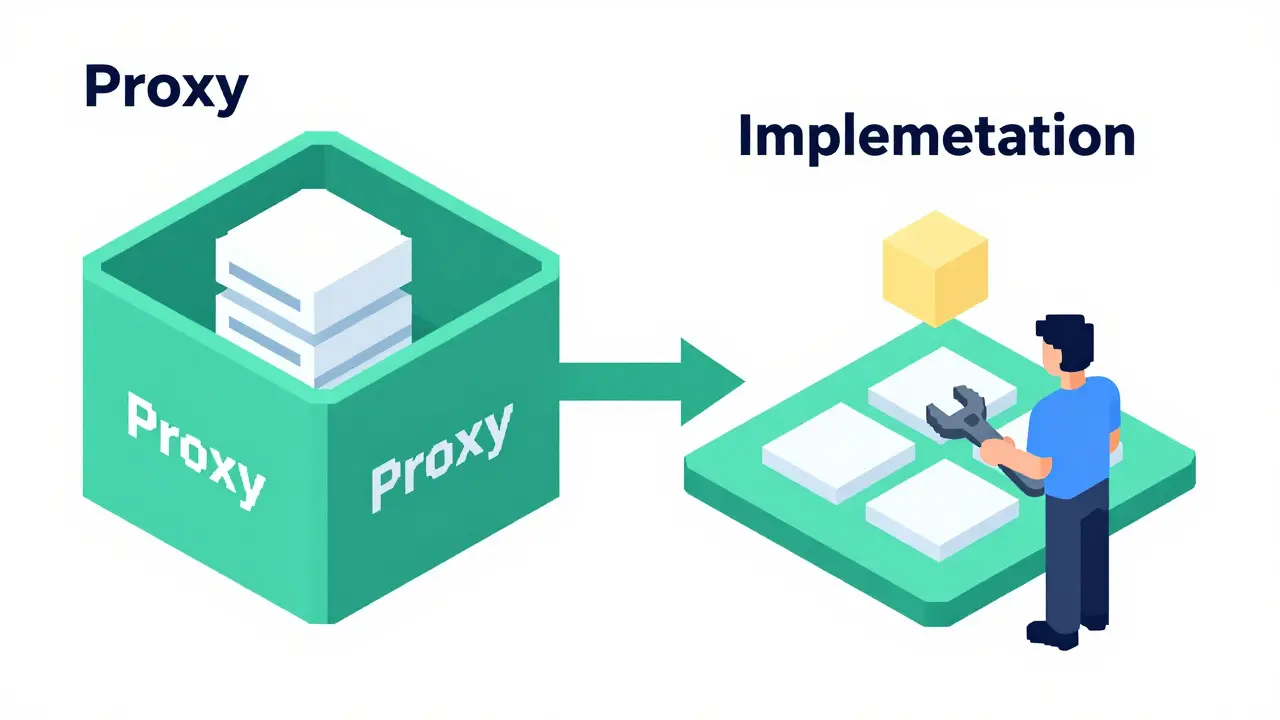
To solve the "no patches" problem, developers invented a workaround called the Proxy Pattern, an architectural design that separates the storage of data from the execution logic, allowing developers to update the code while keeping user data intact. Instead of putting all the logic directly on the blockchain, you create a "proxy" contract that holds the data and points to a separate "implementation" contract that holds the code. If you need to fix a bug, you simply point the proxy to a new implementation contract. To the user, it looks like the same contract, but under the hood, the engine has been swapped.
This approach is incredibly popular. Data from DappRadar in October 2023 showed that 92.7% of the top 100 DeFi protocols use some form of upgradeable framework, such as OpenZeppelin’s UUPS or Transparent Proxy standards. It gives developers a safety net. However, this convenience comes with significant trade-offs. First, it costs more gas. ConsenSys reported in Q3 2023 that proxy contracts incur 15-25% higher gas costs due to the extra computational steps required to route calls. Second, and more importantly, it introduces a new type of risk: who controls the upgrade key?
Security vs. Control: The Trust Paradox
When you use a proxy pattern, you are reintroducing trust into a trustless system. Someone-usually a multi-signature wallet controlled by the development team or a governance DAO-holds the keys to upgrade the contract. If those keys are stolen, or if the developers decide to act maliciously, they can change the rules instantly. This was the crux of the Van Loon v. US Treasury case decided in September 2023, where the Fifth Circuit Court of Appeals distinguished between truly immutable contracts and proxy-based systems, noting that proxy contracts act as routing layers that can subject developers to regulatory liability. The court essentially said that if a contract can be changed, it might not qualify as "immutable property" under certain legal definitions, opening up new regulatory headaches.
From a security standpoint, the data is mixed. While proxy contracts allow teams to patch 82% of critical vulnerabilities quickly, they also suffered 63% more security incidents than immutable counterparts. Why? Because the upgrade mechanism itself becomes a target. Hackers often try to hijack the admin keys rather than exploit the code logic. So, while you've solved the bug-fixing problem, you've created a centralization vector.
Comparing the Approaches
| Feature | Truly Immutable Contracts | Upgradeable (Proxy) Contracts |
|---|---|---|
| Code Changeability | None after deployment | Logic can be updated via proxy |
| Trust Model | Trustless (code is law) | Centralized (trust admins/governance) |
| Gas Cost | Lower (direct execution) | Higher (15-25% overhead) |
| Vulnerability Handling | Permanent risk unless hard forked | Can be patched quickly |
| Legal Status | Recognized as binding agreements (e.g., Wyoming SB0122) | Ambiguous regulatory treatment |
| Best Use Case | Settlement layers, stablecoins, voting | Complex DeFi apps, evolving products |
Practical Advice for Developers and Users
If you are building a smart contract, the decision isn't binary. You need to assess the risk profile of your application. For simple token transfers or voting mechanisms, immutability is superior. It proves integrity. For complex lending platforms or exchanges that need to adapt to market conditions, upgradeability offers necessary flexibility. But if you choose the latter, you must implement rigorous governance. Don't let a single person hold the upgrade key. Use multi-sig wallets with time delays so users have time to withdraw funds if an upgrade looks suspicious.
For users, the advice is equally clear. Check the contract architecture. Tools like Etherscan now label contracts as "Verified" and sometimes indicate if they are proxies. If a project claims to be "decentralized" but relies on a single admin key for upgrades, treat that claim with skepticism. Remember, immutability is a spectrum, not a switch. As Vitalik Buterin noted in early 2023, we are moving toward "social consensus mechanisms" where catastrophic failures might require community intervention, regardless of the code structure.
Future Trends: Parameterized Immutability
The industry is already evolving beyond this strict dichotomy. Gavin Wood, co-founder of Ethereum, proposed "parameterized immutability" in late 2023. This model allows creators to specify which parts of a contract are locked forever and which parameters can be adjusted. Imagine a loan contract where the interest rate formula is immutable, but the base rate can be updated by an oracle. This hybrid approach aims to capture the security of immutability with the flexibility of upgrades. By 2026, predictions suggest that 65% of enterprise blockchain implementations will use these hybrid models to balance security with regulatory compliance.
Can I recover funds lost to a bug in an immutable smart contract?
Generally, no. Because the code cannot be changed, there is no technical way to stop the exploit or return funds unless the entire blockchain network agrees to a hard fork, which is rare and controversial. This is why pre-deployment auditing is critical.
Are upgradeable smart contracts less secure?
They introduce different risks. While they allow fixing bugs, they rely on trusted administrators to perform upgrades. If admin keys are compromised, attackers can rewrite the contract logic to steal funds. Statistics show proxy contracts face more frequent incidents, though many are patchable.
What is a proxy pattern in blockchain?
A proxy pattern is a design where a "proxy" contract holds the data and delegates function calls to a separate "implementation" contract. This allows developers to update the code (implementation) without losing the data stored in the proxy, effectively making the contract upgradeable.
Why do some protocols prefer immutable contracts despite the risks?
Immutable contracts offer maximum trustlessness. Users know the rules cannot change behind their backs. This is crucial for high-value settlement layers and applications where predictability and legal enforceability are more important than flexibility.
How does immutability affect gas costs?
Immutable contracts generally have lower gas costs because they execute code directly. Upgradeable contracts using proxy patterns require additional steps (delegatecalls), which increases computational work and results in 15-25% higher gas fees per transaction.