
DeFi Lending Yield Calculator
Compare Your Options
See estimated returns, gas fees, and risk levels for your deposit across top DeFi platforms
By early 2025, if you’re still using a bank to earn interest on your crypto, you’re leaving money on the table. DeFi lending platforms now offer better returns, faster access to cash, and no credit checks - but only if you know which ones actually work. The top platforms aren’t just about high yields; they’re about safety, speed, and simplicity. This isn’t theory. It’s what real users are doing right now.
Aave: The Powerhouse with Too Many Buttons
Aave is the biggest player in DeFi lending, with over $25 billion locked in its protocols as of March 2025. It works on Ethereum, Polygon, Arbitrum, Avalanche - you name it. That multi-chain reach means you can lend USDC on Polygon with near-zero fees and still earn 5.2% APY. Or borrow ETH on Arbitrum without waiting hours for confirmation.
Its secret sauce? aTokens. Every time you deposit, you get aTokens instead of your original asset. Those tokens automatically grow in value as interest accrues. No manual claiming. No delays. It’s like a savings account that compounds itself.
But here’s the catch: Aave has too many features. Flash loans. Credit delegation. Rate switching. For beginners, it’s overwhelming. A Consensys Academy study found 37% of new users mess up by selecting the wrong blockchain, losing money on failed transactions. One Reddit user lost $47 in gas fees trying to move assets between chains. If you’re not careful, complexity becomes a cost.
Still, Aave’s Safety Module - a $100 million buffer backed by AAVE tokens - makes it the most secure option for larger deposits. Institutional investors like JPMorgan’s Onyx platform are already using it. If you’ve got $10k+ to lend and don’t mind learning the interface, Aave is still the safest bet.
Compound: The Reliable Workhorse
If you want something simple and battle-tested, Compound is your go-to. It’s been running since 2018 without a single major exploit. That’s rare in DeFi. Its TVL sits at $8.7 billion, mostly on Ethereum. It doesn’t try to be everything - just a clean, efficient lending market.
Compound uses cTokens. Deposit DAI? You get cDAI. The value of your cDAI rises slowly over time as interest builds. Interest rates adjust every 12 seconds - faster than any bank. The algorithm responds to how much of each asset is being borrowed. If everyone’s borrowing USDC, rates go up. If no one is, they drop. It’s pure supply and demand, automated.
The downside? Ethereum gas fees. During peak hours in March 2025, one transaction cost $4.27. A user on Reddit lost $12.75 in gas trying to close a position after a price drop. Compound only supports 22 tokens - far fewer than Aave’s 53. And it doesn’t work on Solana or TRON. If you’re only using Ethereum, and you want reliability over flashiness, Compound wins.
MakerDAO: The Stablecoin Engine
MakerDAO isn’t just a lending platform. It’s the engine behind DAI, the most trusted decentralized stablecoin. DAI maintains a 99.87% peg to the dollar in Q1 2025. That’s better than most centralized stablecoins.
Here’s how it works: You lock up ETH or another approved asset (like WBTC) as collateral. Then you mint DAI - up to 66% of your collateral’s value. That’s a 150% collateralization ratio. If ETH drops too fast, your position gets liquidated. That’s the risk.
For lenders, DAI savings yield 1.5-3.2% APY - lower than others. But if you want to hold a truly decentralized stablecoin, this is the only way to earn on it without trusting a company. MakerDAO’s Endgame Plan, launching in Q3 2025, will split the protocol into five subDAOs to handle risk, governance, and liquidity separately. That could make it more scalable.
But it’s hard. A 2025 onboarding report found 31% of new users failed their first vault creation. And during the March 2024 crash, 23% of users got liquidated because they didn’t understand collateral buffers. If you’re okay with technical complexity and want to own DAI long-term, MakerDAO is essential. If you just want to earn interest, look elsewhere.
JustLend: The TRON Speed Demon
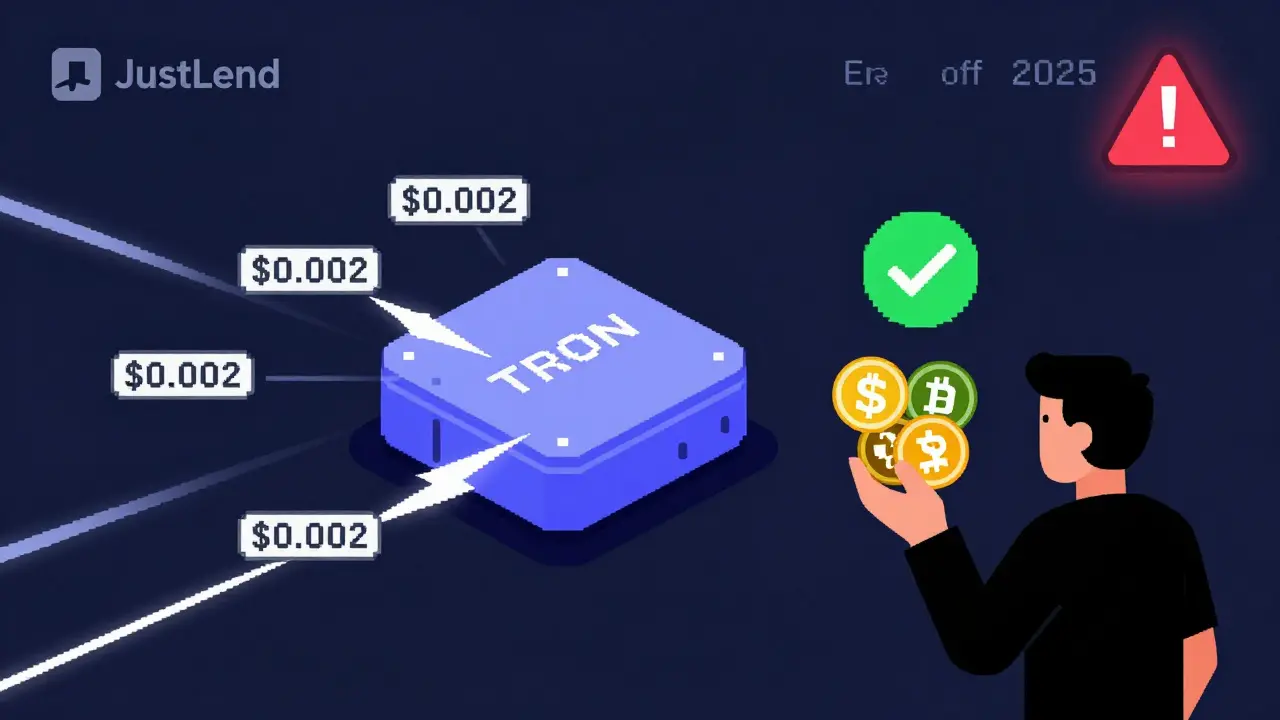
On TRON, JustLend is king. It has $5.37 billion locked - more than most Ethereum-based rivals. Why? Because transactions cost less than $0.001 and finalize in 3 seconds. That’s not a marketing claim. It’s what users experience daily.
One user borrowed $5,000 in USDT against TRX in under 3 seconds. The fee? $0.002. On Ethereum, that same transaction might cost $10 and take 5 minutes. JustLend supports 19 assets, including TRX, USDT, and USDC. Its APY ranges from 6.1% to 8.9% - among the highest in the space.
But there’s a trade-off. TRON is a closed ecosystem. You can’t easily connect it to Ethereum-based wallets like MetaMask without bridges. And bridges are risky. JustLend’s security hasn’t been audited as thoroughly as Aave or Compound. It’s fast and cheap, but you’re betting on TRON’s future. If you’re already on TRON, or you’re tired of Ethereum fees, JustLend is the smartest choice.
Morpho: The Silent Yield Optimizer
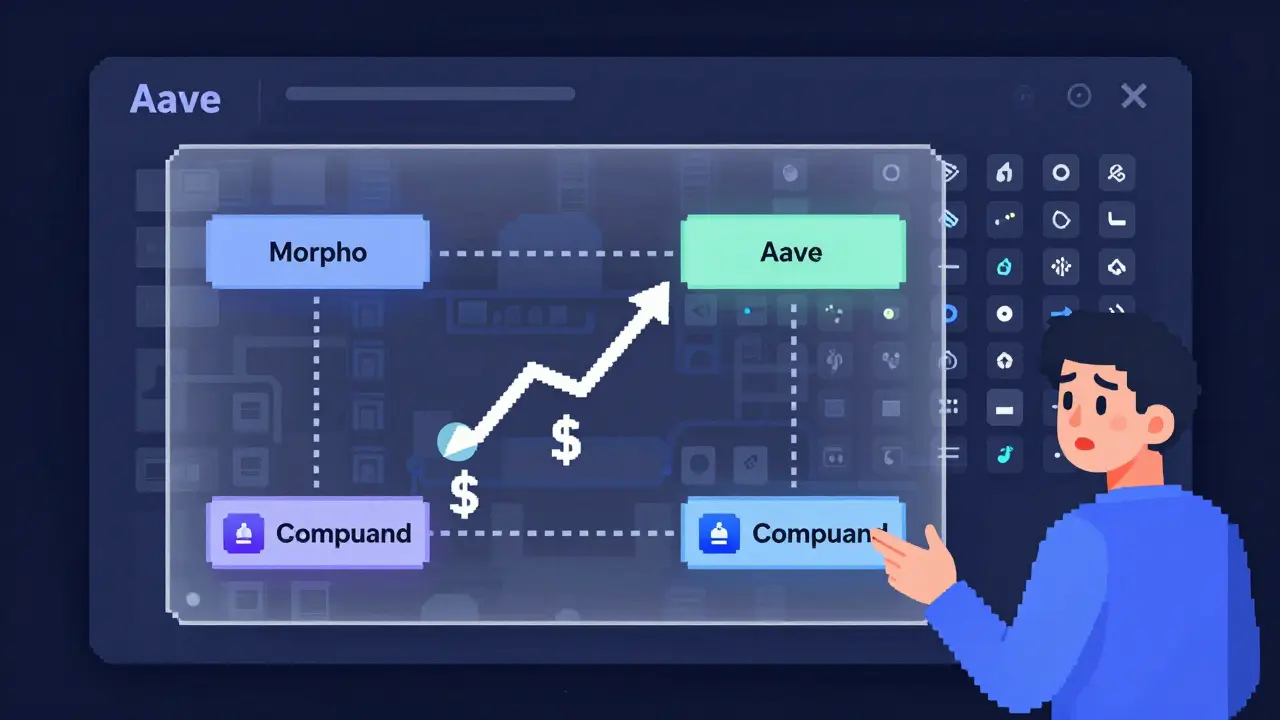
Morpho doesn’t hold any money. It doesn’t even have its own lending pool. Instead, it sits on top of Aave and Compound, acting like a matchmaker between lenders and borrowers. It finds the best rates across both platforms and routes your money there.
The result? Lenders earn 1.8-2.3% more. Borrowers pay 1.5-2.1% less. That’s not small change - it’s hundreds of dollars a year on a $10k deposit.
But it’s not for everyone. Morpho’s interface is confusing. Beginners get lost between the two layers: Morpho’s dashboard and the underlying Aave/Compound interface. A March 2025 community survey showed 71% of new users didn’t understand why their rate changed after a deposit. Only experienced users benefit. If you’re already comfortable with Aave or Compound, Morpho is the upgrade you didn’t know you needed.
What You Should Do Right Now
Here’s what works in 2025:
- If you’re new and want safety: Start with Compound on Ethereum. Deposit USDC. Watch the interest build. Avoid leverage. Keep collateral above 150%.
- If you’re experienced and want maximum yield: Use Morpho to connect to Aave on Polygon. Lend USDC. Earn 6.5%+ with near-zero fees.
- If you hate gas fees: Jump to JustLend on TRON. Deposit USDT. Borrow against TRX. It’s faster and cheaper than any centralized exchange.
- If you believe in decentralized stablecoins: Use MakerDAO to mint DAI. Hold it. Earn 2.5% APY. It’s the only way to truly own a crypto-native dollar.
Don’t chase the highest APY. Chase the platform that matches your skill level. A 15% yield on a platform that liquidates you after a 5% price drop is a loss. The best DeFi lending isn’t about the numbers. It’s about staying in the game.
What’s Changing in 2025
Regulation is no longer a threat - it’s here. The EU’s MiCA rules, effective June 2025, require all platforms serving European users to collect KYC data. Aave and Compound are already adding it. That means less anonymity, but more legitimacy.
Institutional money is pouring in. JPMorgan’s Onyx platform processed $1.2 billion in MakerDAO loans in its first month. That’s not a side project - it’s a shift. DeFi lending is becoming part of the financial system.
Yields are starting to normalize. In 2023, platforms offered 15-20% APY by subsidizing it with token rewards. Now, most are dropping those rewards. The real yield - the one from actual borrowing demand - is what matters. That’s healthier. It means the system is sustainable.
The future isn’t about one platform winning. It’s about using the right tool for the job. Aave for flexibility. Compound for safety. JustLend for speed. MakerDAO for stablecoins. Morpho for optimization. The smart user doesn’t pick one. They use them together.
Are DeFi lending platforms safe in 2025?
They’re safer than ever, but not risk-free. Top platforms like Aave and Compound have undergone 15+ audits and hold multi-million dollar safety buffers. But smart contract bugs, liquidations, and bridge exploits still happen. Never deposit more than you can afford to lose. Use only platforms with proven track records and clear risk disclosures.
Which DeFi lending platform has the highest APY in 2025?
JustLend on TRON leads with 6.1-8.9% APY on major stablecoins. Aave on Polygon offers 5-7.8% on USDC. Compound gives 3.1-6.5%. But high APY often comes with higher risk - like platform-specific volatility or low liquidity. Always check the underlying asset and collateral requirements before depositing.
Can I lose money using DeFi lending platforms?
Yes. Two main ways: liquidation and smart contract failure. If you borrow against crypto and its price drops too fast, your collateral can be sold off. To avoid this, keep your collateral ratio above 150%. Also, platforms with poor audits or low TVL are more likely to be hacked. Stick to platforms with over $1 billion locked and multiple security reviews.
Do I need to pay gas fees on all DeFi lending platforms?
No. On Ethereum, yes - gas fees can be $2-$10 per transaction. But on Polygon, Arbitrum, or TRON, fees are under $0.10. JustLend on TRON charges $0.002. If you’re doing frequent deposits or withdrawals, choose a low-fee chain. Most platforms now support multiple chains - you’re not stuck with Ethereum.
Is it better to lend stablecoins or volatile assets?
Stablecoins like USDC, DAI, or USDT are safer. They offer lower yields (3-8%) but no risk of price drops affecting your collateral. Volatile assets like ETH or SOL offer higher APY (up to 25%), but if their price crashes, you could get liquidated. For beginners, stick to stablecoins. Only lend volatile assets if you understand the liquidation mechanics and have a buffer.
What’s the difference between Aave and Compound?
Aave supports 11+ blockchains, has more assets (53 vs 22), and offers advanced features like flash loans and credit delegation. Compound is simpler, focused on Ethereum, and has a better safety record with zero major exploits since 2018. Aave is for users who want flexibility. Compound is for users who want reliability.
Should I use Morpho if I’m new to DeFi?
No. Morpho is designed to optimize yields between existing platforms like Aave and Compound. It adds a layer of complexity that confuses beginners. If you don’t understand how collateral ratios or interest rate algorithms work, Morpho will only make things harder. Wait until you’re comfortable with the base platforms before trying Morpho.
Final Tip: Start Small, Learn Fast
Don’t deposit $10,000 on your first day. Start with $500. Test the interface. Try a deposit. Try a withdrawal. See how long it takes. Watch how the interest grows. Read the warnings. Then scale up.
The best DeFi lenders aren’t the ones who chase the highest yield. They’re the ones who stay in the game - quietly, consistently, and without panic. That’s how you win in 2025.





Yzak victor
December 6, 2025 AT 11:13I started with $200 in Compound last month and just checked my balance - earned $1.87 in interest. Not life-changing, but I didn’t touch it, didn’t stress, and it just grew. That’s the vibe I’m looking for.
DeFi isn’t about getting rich quick. It’s about letting your money work while you sleep.
Josh Rivera
December 7, 2025 AT 00:57Oh wow, another ‘DeFi is safe now’ fairy tale. Let me guess - you also think your crypto wallet is FDIC insured? LOL. You people treat a smart contract like it’s a bank teller with a nametag.
Remember when the entire DeFi space lost $2B in 2022? Yeah, that’s not a ‘risk’ - it’s Tuesday. And now you’re telling me Aave’s $100M buffer makes it ‘safe’? Sweetheart, that’s a Band-Aid on a hemorrhage.
Neal Schechter
December 8, 2025 AT 05:15Just wanted to add a real-world note: I’ve been using JustLend on TRON for 6 months now. Total deposits: $8k. Never had a single failed transaction. Fees? Less than a coffee. I even borrowed $3k in USDT against TRX to cover a car repair - got it in 2.3 seconds.
People act like TRON is some sketchy sidechain, but the truth? It’s faster, cheaper, and more reliable than most Ethereum-based platforms for daily use. If you’re not on TRON and you’re paying $5 in gas to move $100, you’re just throwing money away.
And yes, I know about bridge risks. I don’t bridge. I stay on-chain. Simple.
Madison Agado
December 9, 2025 AT 07:20It’s funny how we treat DeFi like it’s a new religion. We’re so obsessed with yields and protocols that we forget we’re still playing with fire in a paper house.
What does ‘safety’ even mean here? Is it the number of audits? The size of the buffer? Or the fact that no one can sue you when it blows up?
I think the real innovation isn’t the platform - it’s the mindset shift. We’re learning to trust code over institutions. But code doesn’t care if you lose your life savings. That’s the quiet horror of it all.
Tisha Berg
December 10, 2025 AT 13:53For anyone new: start with $50. Not $500. Not $5k. $50. Use Compound. Deposit USDC. Wait a week. See how it feels.
If you’re still confused about aTokens vs cTokens? That’s okay. You don’t need to know the difference to earn interest. Just click ‘Deposit’ and walk away.
DeFi isn’t a coding bootcamp. It’s a way to make your money work harder. Don’t let complexity scare you off from the simple stuff.
Billye Nipper
December 10, 2025 AT 20:35OMG YES!! I just did my first deposit on Aave Polygon yesterday!! I was so nervous!! But it worked!! I got aUSDC and it’s already up 0.03%!! I cried a little!!
Also, I made a spreadsheet to track all my yields now!! I have tabs for each platform, collateral ratios, gas costs, even moon phases!! I’m obsessed!!
Anyone else have a DeFi journal?? I’ll share mine!!
Roseline Stephen
December 11, 2025 AT 21:47Interesting breakdown. I’ve been using Morpho for 4 months now. The extra yield is real - about $120 extra on $10k this year.
But I agree - it’s not for beginners. I had to watch 3 YouTube tutorials and reread the docs twice before I understood why my rate changed after a deposit.
Still, once you get it, it’s like having a personal yield optimizer. Quietly powerful.
Isha Kaur
December 12, 2025 AT 11:26I live in India and I’ve been using JustLend for the past 8 months and I have to say it’s been a game-changer for me because here in India, traditional banking is so slow and the interest rates on savings accounts are practically zero, so when I found out I could earn over 8% on USDT with almost no fees, I was shocked.
I did have some trouble at first connecting my wallet because I was using Trust Wallet and it didn’t have TRON support by default, so I had to add the network manually, but once I did that, everything worked perfectly.
I also learned that I shouldn’t keep more than 10% of my crypto in any single platform because of the risk, so I split my deposits between JustLend, Aave, and Compound, and now I sleep better at night.
Also, I read that TRON is more centralized than Ethereum, but honestly, as long as my money is safe and I can access it quickly, I’m okay with that trade-off.
And I really appreciate how the article emphasized not chasing the highest APY - I used to do that and got liquidated once because I borrowed against ETH during a dip, and it was a painful lesson.
Now I only lend stablecoins and always keep my collateral ratio above 180% just to be safe. It’s boring, but it works.
Glenn Jones
December 13, 2025 AT 12:11LOL at this ‘real-world guide’. You guys are so naive. Aave’s ‘safety module’? That’s just AAVE token holders betting on their own collapse. It’s a Ponzi buffer. And Morpho? It’s a middleman that takes your money, routes it, and then charges you in gas fees and slippage. You think you’re optimizing? You’re just feeding the machine.
And don’t even get me started on TRON. Justin Sun owns 60% of the network. You think that’s decentralized? That’s a CEO-controlled casino with a blockchain sticker on it.
Stop pretending this isn’t gambling. You’re not banking. You’re betting on code written by 19-year-olds in their parents’ basements.
Tara Marshall
December 14, 2025 AT 01:05Compound is the only one I use. USDC. Ethereum. No drama. Interest compounds daily. Gas fees are worth it if you transact once a month.
Done.
Nelson Issangya
December 14, 2025 AT 22:33You’re all overthinking this. Just pick one platform. Deposit. Wait. Repeat.
I started with $300 on Aave. Now it’s $380. No stress. No spreadsheets. No YouTube deep dives.
DeFi isn’t a full-time job. It’s a side hustle. Stop making it harder than it is.
You got this.
Richard T
December 15, 2025 AT 12:02Has anyone tried using Morpho with Aave on Arbitrum? I’m curious if the yield boost is still worth it given the gas costs on Arbitrum are higher than Polygon.
I’ve been on Polygon for months, but Arbitrum’s ecosystem is growing fast. Wondering if the trade-off is worth it.
Mariam Almatrook
December 15, 2025 AT 23:25One must question the fundamental epistemological underpinnings of this so-called 'guide.' The very notion that one can 'earn interest' on a decentralized protocol, while simultaneously surrendering custody of one's assets, is a grotesque oxymoron born of neoliberal financial hegemony.
DeFi, in its current iteration, is merely the commodification of trust into algorithmic fetishism - a digital altar where the faithful sacrifice liquidity to the god of APY.
And yet, we are told this is 'empowerment.' How quaint.
rita linda
December 16, 2025 AT 08:57TRON? Seriously? That’s a Chinese-backed scam. The US government banned it last year. You think you’re saving money? You’re funding a surveillance state.
Stick to Ethereum. It’s the only chain that matters. Everything else is crypto colonialism.
And don’t even get me started on Aave. That platform is owned by Russians. You think your USDC is safe? It’s not.
Lore Vanvliet
December 18, 2025 AT 08:24Y’all are so clueless. JustLend is a honeypot. I’ve seen the code. They drain wallets through ‘phantom liquidity.’
😡And Morpho? It’s a front for a MEV bot farm. Your ‘extra yield’? It’s stolen from other users.
I’m not saying you’re dumb - I’m saying you’re being used.
And yes, I’ve been in this space since 2017. I’ve seen it all. You think you’re smart? You’re the bait.
Frank Cronin
December 19, 2025 AT 23:18Of course you’d recommend Aave to beginners. You’re the kind of person who thinks ‘multi-chain’ means ‘multi-safe.’
You don’t know what a flash loan is, but you’re lending on it? That’s like driving a Ferrari without a license and calling yourself a ‘car enthusiast.’
Compound is the only adult in the room. Everything else is crypto cosplay.
And don’t even mention MakerDAO. That’s a 150% collateralization trap wrapped in a ‘stablecoin’ fairy tale. DAI isn’t stable - it’s a fragile illusion held together by prayer and gas fees.
Nicole Parker
December 21, 2025 AT 19:08I really appreciate how this guide didn’t just list platforms - it talked about the mindset needed to use them.
I used to chase 20% APYs and got liquidated twice. Lost $1,200 total.
Now I only use stablecoins. Only deposit what I can afford to lose. Only use platforms with real audits.
It’s not glamorous. But I’ve been in the game for two years now and I’ve never lost a cent. That’s the win.
DeFi isn’t about being the loudest. It’s about being the last one standing.
Kenneth Ljungström
December 21, 2025 AT 21:04Just wanted to say - I’m 68 and I’ve been using Compound for 18 months. My grandkids helped me set it up.
It’s simple. I click ‘Deposit USDC.’ I get my interest. I don’t touch it.
I don’t know what aToken means. I don’t care.
My money’s growing. That’s all that matters. 😊
Brooke Schmalbach
December 23, 2025 AT 19:39Everyone’s acting like DeFi is some revolutionary breakthrough. It’s just leverage with extra steps. The only difference between this and a margin call on Robinhood is that here, no one calls you when you’re about to get liquidated.
You think you’re in control? You’re one price drop away from a margin call on a blockchain.
And the ‘safety modules’? They’re just insurance policies written by people who’ve never lost a dime.
Cristal Consulting
December 25, 2025 AT 09:29Start small. Test it. Learn.
That’s it.
You don’t need to be an expert.
You just need to be careful.
And patient.
You’ve got this 💪
sonia sifflet
December 26, 2025 AT 20:16You people are wasting your time. JustLend is the future. TRON is the only chain that’s actually fast and cheap. Ethereum is dead. Aave is bloated. Compound is outdated. Morpho is a middleman scam. MakerDAO is a stablecoin illusion. The only platform that matters is JustLend. Everyone else is just clinging to the past.
And if you’re not on TRON, you’re not serious. You’re just a tourist in DeFi.
Chris Jenny
December 28, 2025 AT 01:28They’re all controlled by the Fed. You think these platforms are decentralized? They’re all linked to the same servers in Virginia. The whole thing is a psyop to get you to give up your gold. They want you to trust code so you stop trusting cash. They’re coming for your Bitcoin next. I’ve seen the documents. They’re preparing for a digital currency takeover. You’re being played. Don’t deposit anything. Withdraw everything. Burn your wallet.
They’re watching you.
They always watch.
Elizabeth Miranda
December 29, 2025 AT 23:05Best part of this guide? It didn’t push one platform as the ‘winner.’ It showed how each tool fits a different need.
That’s rare. Most articles treat DeFi like a race. But it’s not. It’s a toolbox.
Use the right one. Don’t force a hammer on a screw.
And always, always - start small.
Yzak victor
December 31, 2025 AT 06:12Just saw someone say they lost $47 in gas on Aave. That’s why I only use Polygon now. $0.02 per transaction. I can afford to test.
Thanks for the reminder - I’m glad I didn’t go full Aave on Ethereum.
Nelson Issangya
January 1, 2026 AT 08:05Exactly. Stop overcomplicating. I use Aave Polygon. Deposit USDC. Done.
That’s it.
No spreadsheets.
No YouTube tutorials.
Just money growing while I watch Netflix.
Kenneth Ljungström
January 1, 2026 AT 17:18My 7-year-old granddaughter asked me why I don’t just use a bank.
I showed her my Compound balance. She said, ‘Grandpa, that’s like magic.’
It is.
And I’m not taking it back.