

Before September 2025, Vietnam’s crypto market was a wild west. Millions of people traded Bitcoin, Ethereum, and stablecoins without any real oversight. Exchanges operated out of apartments, withdrawal times dragged on for days, and when a platform vanished - like BitViet in early 2024 - users lost millions without recourse. That changed with Directive 05/CT-TTg, the government’s first formal framework for cryptocurrency exchanges. It didn’t just add rules. It rewrote the entire game.
What Directive 05/CT-TTg Actually Does
Directive 05/CT-TTg isn’t a suggestion. It’s a mandate. Issued by the Prime Minister’s Office in September 2025, it turns crypto trading from a gray-area activity into a tightly controlled financial service. All exchanges operating in Vietnam must now be licensed by the Ministry of Finance. No exceptions. No loopholes. If you’re running a crypto platform in Vietnam and you’re not licensed, you’re breaking the law.
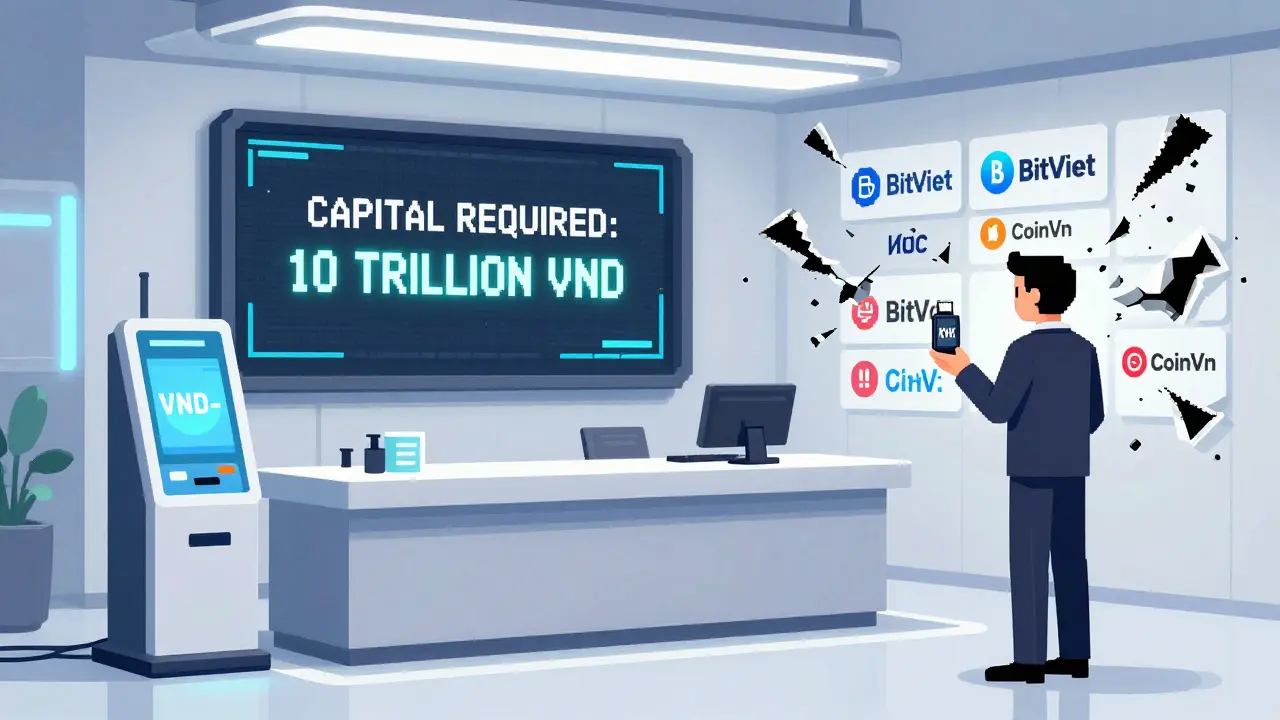
The law doesn’t just say "get a license." It sets impossible-sounding standards. To even apply, an exchange needs a minimum charter capital of 10 trillion VND - roughly $379 million USD. That’s not a typo. That’s more than the entire annual budget of some small countries. And here’s the catch: at least 65% of that capital - or 6.5 trillion VND - must come from institutional investors based in Vietnam. Foreign investors can own up to 49%, but no more. This isn’t about attracting global capital. It’s about keeping control firmly in Vietnamese hands.
The VND-Only Rule: Why It Matters
One of the most surprising parts of Directive 05/CT-TTg is the ban on foreign currency transactions. Every crypto trade must be settled in Vietnamese dong (VND). No USDT, no USD, no EUR. Even if you’re buying Bitcoin, the money you use to pay for it must be VND. This isn’t just about currency control. It’s about stopping capital flight.
Before this rule, an estimated $10.2 billion in crypto transactions flowed through Vietnam in 2024 - 87.4% of it unregulated. Many users were using crypto to move money out of the country, bypassing strict foreign exchange controls. By forcing all trades through VND, the government ties every transaction to its banking system. Every transfer, every order, every withdrawal now leaves a digital trail the State Bank of Vietnam can monitor in real time.
This also means stablecoins - the backbone of global crypto trading - are effectively banned. Stablecoins like USDT, USDC, and DAI make up over 70% of global crypto volume. In Vietnam, they accounted for 63.8% of all trades before the directive. Now, platforms can’t list them unless they’re backed by something other than fiat currency. That’s nearly impossible to do at scale. So while traders can still buy Bitcoin or Ethereum, they can’t easily convert their holdings into something stable. That’s a huge shift.
Who Can Even Apply?
The capital requirement isn’t just high - it’s designed to eliminate almost everyone. There were over 20 unlicensed exchanges operating in Vietnam before September 2025. Most had capital under 100 billion VND. One Reddit user, "HanoiTrader88," ran a profitable platform for two years with 5 billion VND in capital. He served 5,000 users. Under the new rules, he needs 2,000 times more money. He’s out.
Legal firms estimate that bringing a platform into compliance costs between 50 and 200 billion VND ($1.9 million to $7.6 million). That’s not just for capital. It’s for new blockchain infrastructure, KYC systems, audit trails, and integration with the State Bank’s real-time monitoring system. Only a handful of companies - likely state-linked or backed by major Vietnamese conglomerates - have the resources to even try.
And the timeline? The application window opens within 30 days of the directive’s release. The first licenses are expected in 90 to 120 days. But there’s a six-month grace period after the first license is issued before enforcement kicks in. That creates chaos. Exchanges don’t know if they’ll get approved. Users don’t know if their funds will be locked. And no one knows how many platforms will survive.
What This Means for Users
Most Vietnamese crypto users - around 21 million - will be affected. A CoinGeek survey found 68.3% support regulation for safety. But 79.6% think the capital requirement is too high. And 41.2% said they’d move to offshore platforms if local options shrink.
That’s the real risk. If only 3 to 5 exchanges get licenses - and they can only handle 5 million users total - the rest will be forced underground. Some will use peer-to-peer apps. Others will switch to foreign exchanges that don’t care about Vietnamese law. That’s exactly what happened in China after its 2021 ban. Regulation didn’t stop crypto. It just moved it offshore.
And what about the users who lost money in 2022 when 15 unregulated platforms collapsed? They’re not asking for more rules. They’re asking for protection. The new framework promises that. But it also promises fewer choices, slower withdrawals, and higher fees. Right now, unlicensed exchanges charged 0.15% per trade. Global averages are 0.25%. Licensed platforms will need to charge more to cover compliance costs. That’s the hidden tax.
How Vietnam Compares to the Region
Thailand licenses exchanges with a capital requirement of 500 million THB - about $13.7 million. Singapore’s requirements vary by business scope but rarely exceed $50 million. Vietnam’s $379 million is 27 times higher than Thailand’s. It’s not just strict - it’s extreme.
Indonesia also requires local currency settlements, but it bans retail trading entirely. Japan allows foreign-owned exchanges. Malaysia permits foreign currencies. Vietnam is doing something no other country has done: it’s trying to control crypto by making it so expensive and restrictive that only state-aligned players can survive.
That’s not innovation. That’s capture.

The Bigger Picture
Directive 05/CT-TTg isn’t just about crypto. It’s part of Vietnam’s broader Digital Technology Industry Law - a plan to grow the digital economy from 9.5% of GDP to 20% by 2030. The government wants blockchain, AI, and semiconductors to drive growth. But it doesn’t trust the market to get there on its own.
By forcing crypto into a tightly controlled box, Vietnam hopes to prevent financial instability, stop capital flight, and create a "safe" environment for institutional investors. The Ministry of Finance estimates regulated crypto could contribute 1.2% to 1.8% of GDP by 2030. But if users flee, if innovation dies, if offshore platforms thrive - that number could be zero.
The real question isn’t whether the framework works. It’s whether it’s worth the cost. Is a controlled, slow, limited crypto market better than a chaotic, fast, open one? The answer depends on who you ask.
For the 5,000 users of HanoiTrader88’s exchange? It’s a disaster.
For the institutional investor who lost $455,000 in a scam? It’s long overdue.
And for the government? It’s a bet - a huge, risky bet - that control beats freedom.
Is cryptocurrency legal in Vietnam now?
Yes - but only if you trade through a government-licensed exchange. Buying, selling, and holding crypto is legal under Directive 05/CT-TTg, but all trading must happen on platforms approved by the Ministry of Finance. Unlicensed exchanges are now illegal.
Can I still use USDT or other stablecoins in Vietnam?
No - not on licensed exchanges. Directive 05/CT-TTg bans crypto assets backed by fiat currencies like the US dollar. That means USDT, USDC, and similar stablecoins cannot be listed or traded on any Vietnamese-licensed platform. You can still hold them privately, but you can’t use them to trade on local exchanges.
Why does Vietnam require 10 trillion VND in capital?
The government says it’s to prevent fraud and market collapse - after 15 unregulated exchanges failed in 2022, wiping out half a million users’ savings. The high capital requirement forces out small operators and ensures only well-funded, stable companies can operate. Critics say it’s really designed to create a state-backed monopoly.
Can foreign companies run crypto exchanges in Vietnam?
Only as minority partners. Foreign ownership is capped at 49%. The majority (51%+) must be held by Vietnamese entities. This rule blocks global exchanges like Binance or Coinbase from launching local operations. Only Vietnamese firms - likely those with state ties - will be able to apply.
What happens to users of unlicensed exchanges?
They have six months after the first licensed exchange opens to move their funds. After that, unlicensed platforms must shut down. Users who don’t transfer their assets risk losing access. There’s no government guarantee for funds on unlicensed platforms - so if you’re on one now, you should move your assets as soon as possible.
Will crypto trading be taxed in Vietnam?
Yes. Tax regulations were finalized by November 2025. Crypto transactions under 100 million VND are taxed at 0.1%. Larger transactions are taxed at 0.3%. This applies only to trades on licensed exchanges. The tax is automatically collected by the exchange and sent to the government.
How many exchanges will get licensed in the first year?
Industry analysts estimate only 3 to 5 exchanges will qualify. The capital requirement, compliance costs, and ownership rules make it nearly impossible for startups or small players to compete. Most experts believe only state-affiliated or large Vietnamese conglomerates will succeed.
Can I still mine cryptocurrency in Vietnam?
Yes - mining isn’t banned. The directive only regulates exchanges that trade crypto. Individuals and businesses can still mine Bitcoin or other cryptocurrencies. But if you want to sell your mined coins, you must do so through a licensed exchange - and you’ll have to use VND.
What Comes Next?
The next 12 months will be critical. If only a handful of exchanges survive, Vietnam’s crypto market will shrink dramatically. If the government relaxes the rules - maybe lowers capital requirements or allows some stablecoins - users might return. But if nothing changes, the country risks becoming a crypto ghost town.
Right now, Vietnam has a choice: become a leader in controlled innovation, or become a cautionary tale of overregulation.
It’s not about banning crypto. It’s about who gets to control it.





Sharon Tuck
March 10, 2026 AT 02:09Honestly, I’m glad Vietnam is trying to protect people from scams. I’ve seen too many friends lose money in crypto because there was no safety net. This might be strict, but it’s better than watching people get burned again. I hope they also build good customer support systems - because if users get locked out, that’s just as bad as a scam.
Jennifer Pilot
March 10, 2026 AT 20:06It is, of course, profoundly regressive-this overreach-this fetishization of control, this pathological aversion to market autonomy. The state, in its infinite wisdom, has decided that citizens cannot be trusted with financial innovation. And yet-how quaint!-they still allow them to buy rice. What a paradox.
Sherry Kirkham
March 12, 2026 AT 13:16Control isn’t the enemy. Fear is. This law isn’t about suppressing crypto-it’s about stopping panic. People don’t need more freedom. They need stability. If you’re scared of losing everything, you don’t want a free market. You want a safety rail. And right now, Vietnam’s building one.
Nick Greening
March 13, 2026 AT 21:27So let me get this straight. You want to ban stablecoins because people use them to move money out of the country… but you’re fine with people using P2P apps to do the same thing? That’s not regulation. That’s just playing whack-a-mole with a sledgehammer.
Issack Vaid
March 15, 2026 AT 12:17Interesting how every country that tries to "control" crypto ends up just making it more expensive for everyone. Thailand: $13M. Singapore: $50M. Vietnam: $379M. Are they trying to create a crypto oligarchy? Or is this just state-sponsored FOMO? Either way, the market will adapt. Always does.
Shawn Warren
March 16, 2026 AT 09:40This is bold leadership. Visionary. The government is not just regulating-it is architecting the future of finance. Capital requirements are not barriers. They are filters. They ensure that only those with real commitment, real infrastructure, real responsibility get to play. This is how nations build durable economies. Not by chasing trends. By building foundations.
Jackson Dambz
March 18, 2026 AT 00:36Wow. 10 trillion VND. That’s insane. Who even has that kind of money? The only people who can afford this are the ones already connected to the government. This isn’t regulation. It’s a corporate coup disguised as policy. And the users? They’re just collateral damage.
Megan Lutz
March 20, 2026 AT 00:30They banned stablecoins because they’re used for capital flight? Then why not just tighten forex controls? Why punish every trader because some people use crypto to dodge the system? This isn’t fixing the problem. It’s punishing the symptom. And it’s going to backfire.
Jesse VanDerPol
March 20, 2026 AT 09:29I wonder if the people who wrote this law ever traded crypto themselves. Or if they’re just looking at spreadsheets and thinking "this looks risky." Real people lost money. Real people want protection. But this feels like locking the barn after the horses are already gone.
jonathan swift
March 22, 2026 AT 04:20🚨 CONSPIRACY ALERT 🚨
They banned USDT because they’re secretly printing VND to fund their own crypto empire. The "state-linked exchanges"? Totally owned by the central bank. The 65% institutional rule? A front for buying up Bitcoin with taxpayer money. They’re building a blockchain dictatorship. 💀
Datta Yadav
March 22, 2026 AT 17:48Let’s be brutally honest here. This isn’t about safety. It’s about power. Vietnam saw what happened in China-how crypto went underground and thrived-and now they’re trying to out-authoritarian China by making it so expensive to operate that only the state and its cronies can survive. The 10 trillion VND cap? That’s not a barrier to entry. That’s a death sentence for innovation. And the VND-only rule? That’s not financial sovereignty. That’s economic isolation. You don’t build a digital economy by forcing everyone into a cage. You build it by letting people fly. And right now, Vietnam is cutting off their wings.
Lydia Meier
March 23, 2026 AT 07:44The capital requirement is absurd. The stablecoin ban is counterproductive. The timeline is chaotic. The enforcement window is a mess. This policy is a mess. It’s not even coherent. It’s just a list of contradictions dressed up as a framework. I don’t even know where to begin.
jay baravkar
March 25, 2026 AT 00:11You know what? I get it. People got burned. A lot of people. And now the government wants to make sure it never happens again. That’s noble. But you can’t protect people by making things harder. You protect them by making them smarter. Education. Transparency. Real oversight. Not just a wall of cash. Let’s build bridges, not bunkers.
Ian Thomas
March 25, 2026 AT 09:21They call it "control." I call it surrender. If you’re so afraid of decentralized finance, why not just ban the internet? At least then you’d be consistent. This isn’t regulation. It’s a performance. A show for the masses. "Look, we’re in charge!" Meanwhile, everyone’s just going to use Telegram bots and Phantom wallets. The real market doesn’t care about licenses.
Austin King
March 26, 2026 AT 20:11It’s sad. The people who needed protection the most-small traders, students, workers-are the ones who’ll get squeezed out. Meanwhile, the big players? They’ll just wait for the licenses and charge 5x fees. This doesn’t protect users. It just shifts the power.
Rachel Rowland
March 28, 2026 AT 01:16Look, I’m not saying this is perfect. But if you’ve ever lost money because a platform vanished overnight, you know how terrifying that is. This isn’t about control. It’s about dignity. People deserve to trade without living in fear. Even if it’s slower. Even if it’s pricier. At least you know where your money is.
Bonnie Jenkins-Hodges
March 28, 2026 AT 16:11AMERICA WOULD NEVER DO THIS. Vietnam is finally doing what needs to be done. No more foreign crypto nonsense. No more USDT. No more chaos. Only VND. Only real Vietnamese companies. Only REAL patriotism. WE WIN. 🇻🇳💪