Remember when OpenSea was the only game in town? If you bought an NFT before 2022, that’s probably your first memory of the space. But the landscape has shifted dramatically. By January 2026, Blur had captured nearly half the market share among unique buyers, overtaking its older rival in raw volume while OpenSea clung to its reputation as the go-to spot for casual collectors. Choosing between them isn’t just about picking a website; it’s about deciding whether you’re here to flip assets quickly or build a long-term collection. If you’re a beginner trying to mint your first piece of digital art, Blur’s interface might feel like a cockpit with too many buttons. If you’re a pro trader hunting for underpriced Bored Apes, OpenSea might feel slow and expensive. This guide breaks down exactly where each platform wins, loses, and how they fit into your specific strategy.
Who Are These Platforms Built For?
The core difference lies in their DNA. OpenSea, founded in 2017 by Devin Finzer and Alex Atallah, started as a general-purpose bazaar. It’s designed for everyone-from someone buying a single pixel-art cat to a studio launching a new collection. Its strength is accessibility. You can connect your wallet, browse categories, and buy without knowing what "floor sweeping" means.
Blur, launched in October 2022 by CEO Pacman, was built specifically for power users. It doesn’t care if you’re new. It cares about speed, data density, and fee efficiency. Blur targets "whale traders" who execute dozens of transactions daily. If you treat NFTs like stocks-buying low and selling high based on real-time analytics-Blur is likely your home base.
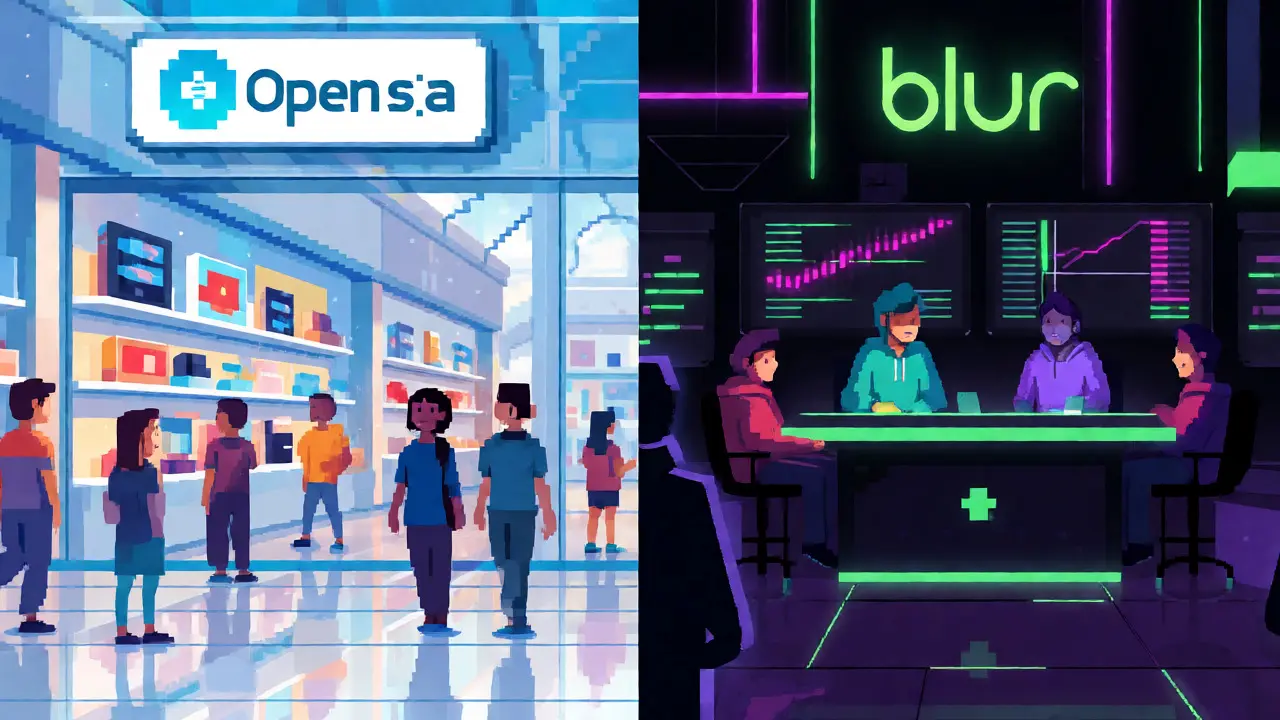
Think of it this way: OpenSea is the shopping mall. Blur is the stock exchange floor. One is for browsing and discovering; the other is for executing trades with precision.
Fees and Royalties: The Money Talk
This is usually the biggest deal-breaker for users. Fees eat directly into your profits, and the two platforms handle them very differently.
On OpenSea, you’ll typically pay a 2.5% seller fee. There are no buyer fees, which makes listing attractive, but creators still enforce royalties (usually 5-10%). In late 2024, OpenSea took a hard stance against platforms that ignored these royalties, blocking collections listed on non-compliant sites. This protects artists but keeps costs higher for traders.
Blur flipped the script. It offers zero trading fees for buyers and a variable seller fee of just 0.5-2%. More importantly, Blur eliminated mandatory royalty enforcement. This sparked a war. Artists argued it devalued their work, while traders loved the savings. As of early 2026, Blur’s model remains popular among high-volume traders who prioritize net profit over supporting individual creators directly through every transaction.
| Feature | OpenSea | Blur |
|---|---|---|
| Seller Fee | 2.5% | 0.5% - 2% |
| Buyer Fee | 0% | 0% |
| Royalty Enforcement | Mandatory (5-10%) | Optional / Enforceable by user choice |
| Primary Audience | Casual Collectors & Beginners | Professional Traders & Whales |

User Experience and Interface
If you’ve never used a crypto wallet before, start with OpenSea. Its interface is clean, intuitive, and forgiving. Mistakes are easy to correct, and help guides are everywhere. A Reddit user named u/NFT_Newbie99 noted in January 2026 that they went from zero to selling their first NFT in under an hour using OpenSea’s step-by-step tools. That kind of frictionless experience is rare in Web3.
Blur, on the other hand, assumes you know what you’re doing. The dashboard is dense with charts, order books, and bid histories. Features like "batch bidding" allow you to place offers on 50 different NFTs at once-a lifesaver for pros, but confusing for newcomers. Experienced users report spending 8-12 hours mastering Blur’s tools. If you hate learning curves, stay away. If you love data, you’ll feel right at home.
Customer support also differs sharply. OpenSea offers 24/7 live chat, which is crucial when your transaction hangs. Blur relies mostly on email support with an average response time of 72 hours. When you’re dealing with thousands of dollars in volatile assets, waiting three days for a reply can be painful.
Market Reach and Blockchain Support
OpenSea supports 19 blockchains, including Ethereum, Polygon, Solana, and Arbitrum. This multi-chain approach means you can find everything from cheap profile pictures on Polygon to high-end art on Ethereum without switching platforms. It’s a one-stop shop for diversity.
Blur operates primarily as an aggregator on Ethereum and Solana. It doesn’t host listings itself so much as it pulls them from other sources. This gives Blur access to deep liquidity on those specific chains but limits its reach elsewhere. If your favorite project is on Base or Avalanche, you won’t find it on Blur. You’ll need to stick with OpenSea or another specialized marketplace.
However, Blur’s aggregation model allows for faster execution. According to Bitquery benchmarks from January 2026, Blur processes transactions 37% faster than OpenSea due to optimized smart contracts and reduced gas overhead. For arbitrage traders who make money on milliseconds, this speed advantage is worth the limited chain support.

Token Incentives and Community Power
Both platforms have turned to tokenomics to lock in users. Blur launched its BLUR token in 2023 via a massive airdrop, distributing 1 billion tokens to early adopters. This created immediate network effects and gave traders a reason to stay even when fees were lower elsewhere. The token serves as governance and incentive currency within the Blur ecosystem.
OpenSea responded with its own $SEA token, planned for an airdrop in Q2 2026 targeting 1.2 million eligible users. While later to the party, OpenSea aims to use $SEA to subsidize creator royalties, potentially solving the tension between low fees and artist compensation. This move signals OpenSea’s intent to remain the "creator-first" platform, balancing trader needs with artist sustainability.
Community sentiment reflects this split. LunarCrush data shows 72% positive sentiment for Blur among professional traders, driven by cost savings and efficiency. Meanwhile, 58% of casual collectors prefer OpenSea, citing better education resources and trust. Neither platform is "better" universally; it depends entirely on your role in the ecosystem.
Which One Should You Choose?
Pick OpenSea if:
- You are new to NFTs and want a simple, guided experience.
- You collect across multiple blockchains (not just ETH/SOL).
- You value customer support and educational resources.
- You want to support creators through enforced royalties.
Pick Blur if:
- You trade frequently and care about minimizing fees.
- You focus exclusively on Ethereum and Solana projects.
- You need advanced analytics, batch tools, and fast execution.
- You are comfortable with self-custody risks and less hand-holding.
For most people, having both accounts open is wise. Use OpenSea to discover new projects and mint initial drops. Use Blur to trade secondary market assets when you spot an opportunity. They aren’t mutually exclusive-they’re complementary tools in a modern digital asset portfolio.
Is Blur safer than OpenSea?
Both platforms are reputable, but they carry different risks. OpenSea has a longer track record and robust security audits, making it generally perceived as safer for beginners. Blur is secure but lacks the same level of consumer protection infrastructure, such as instant customer support. Always verify contract addresses regardless of the platform.
Can I sell my NFT on Blur if I bought it on OpenSea?
Yes. Since NFTs are stored in your wallet, not on the marketplace, you can list any ERC-721 or ERC-1155 token on Blur regardless of where you purchased it. However, note that some collections may have restrictions or royalty preferences that affect visibility or pricing on Blur.
Why does Blur have lower fees than OpenSea?
Blur operates on a leaner business model focused on volume rather than per-transaction revenue. It eliminates mandatory royalty enforcement, reducing complexity and gas costs associated with splitting payments. Additionally, Blur’s architecture is optimized for high-frequency trading, allowing it to pass savings to users to attract market share from incumbents.
Does OpenSea support Bitcoin Ordinals?
As of early 2026, OpenSea has expanded support for various chains, but Bitcoin Ordinals are primarily handled through specialized platforms like Magic Eden or OKX. OpenSea’s main strength remains EVM-compatible chains (Ethereum, Polygon, etc.) and Solana. Check the current supported networks list on their site for the latest updates.
What happens if I miss a payment deadline on Blur?
Unlike traditional e-commerce, NFT purchases on Blur are atomic transactions on the blockchain. Once you confirm a purchase in your wallet, the funds are transferred immediately. There are no "payment deadlines" to miss post-purchase. However, if you place a bid, you must ensure your wallet has sufficient funds when the bid is accepted, or the transaction will fail.