Buying an NFT feels like owning a piece of digital history. You pay the price, you get the token, and you expect to keep it forever. But what happens when the server hosting your image goes offline? Or when you want to move that asset from Ethereum to another blockchain? The answer often lies in the fine print of NFT standards, which are technical specifications defining how unique digital assets are created, transferred, and managed on a blockchain. These rules determine whether your wallet can display your collection or if your marketplace will recognize your ownership.
While these protocols have enabled billions in transactions, they come with significant flaws. From sky-high gas fees to vague legal rights, the current landscape is fragmented. Understanding these limitations-and the emerging solutions-is critical for developers building new applications and collectors protecting their investments. Let’s look at why the old ways don’t scale and what is being done to fix them.
The Core Problem: Gas Fees and Scalability
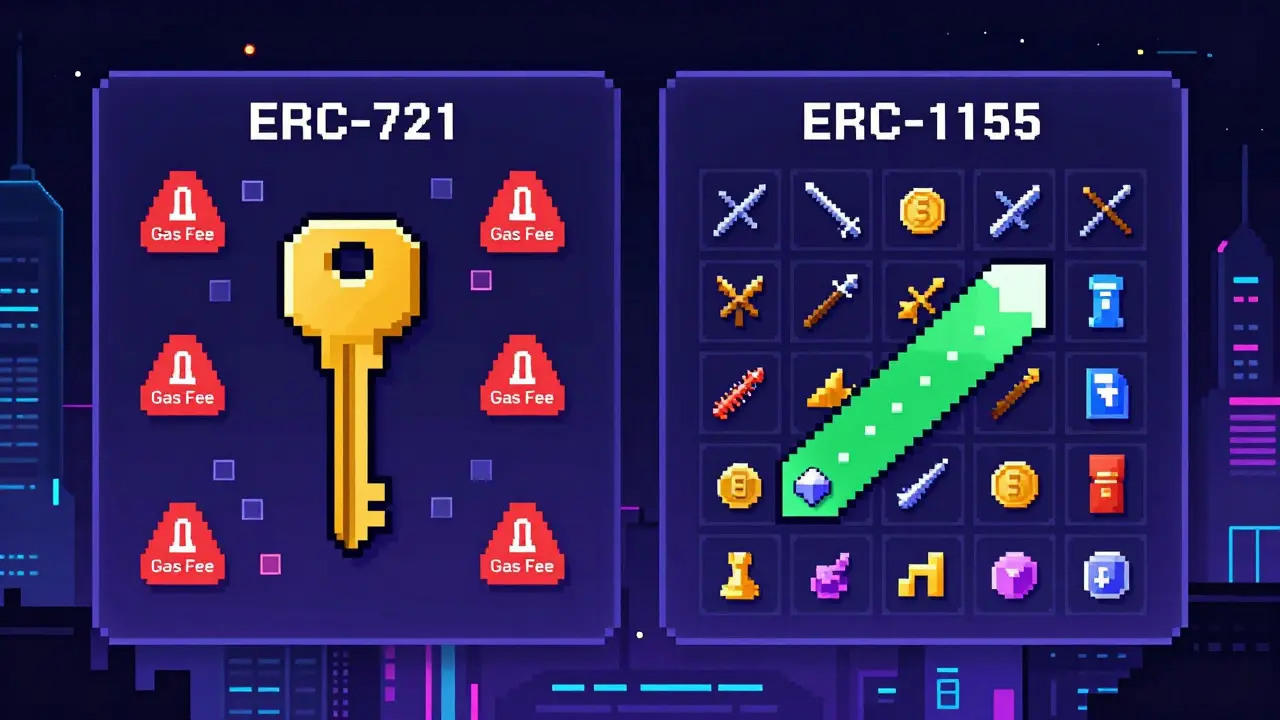
The most immediate pain point for anyone interacting with NFTs on Ethereum is cost. The foundational standard, ERC-721, introduced in January 2018 by William Entriken, Dieter Shirley, Jacob Evans, and Nastassia Sachs, treats every single NFT as a unique entity. This means each token has its own ID and requires its own transaction to transfer.
Imagine buying ten different items in a video game. Under ERC-721, you need ten separate transactions. Each one competes for block space on Ethereum, driving up the gas fee. If the network is congested, minting or trading even a small batch of tokens can cost more than the items themselves. This inefficiency prices out small creators and makes high-frequency use cases, like gaming micro-transactions, nearly impossible.
ERC-1155 was designed specifically to solve this. It allows multiple token types-both fungible (like currency) and non-fungible (like unique weapons)-to exist within a single smart contract. More importantly, it supports batch operations. You can send 100 different items in one transaction instead of 100 separate calls. This drastically reduces gas consumption and makes complex economies viable. However, because ERC-1155 is newer, not all wallets and marketplaces support it fully, leading to a fragmented user experience where some tools fail to display multi-token balances correctly.
| Feature | ERC-721 | ERC-1155 |
|---|---|---|
| Token Type | Non-fungible only | Fungible and Non-fungible |
| Batch Transfers | No (requires custom code) | Yes (native support) |
| Gas Efficiency | Low (high cost per token) | High (low cost per token) |
| Ecosystem Support | Universal (all major platforms) | Growing but inconsistent |
| Best For | Art, Collectibles, Real Estate | Gaming, In-app Economies |
Metadata Fragility and Long-Term Persistence
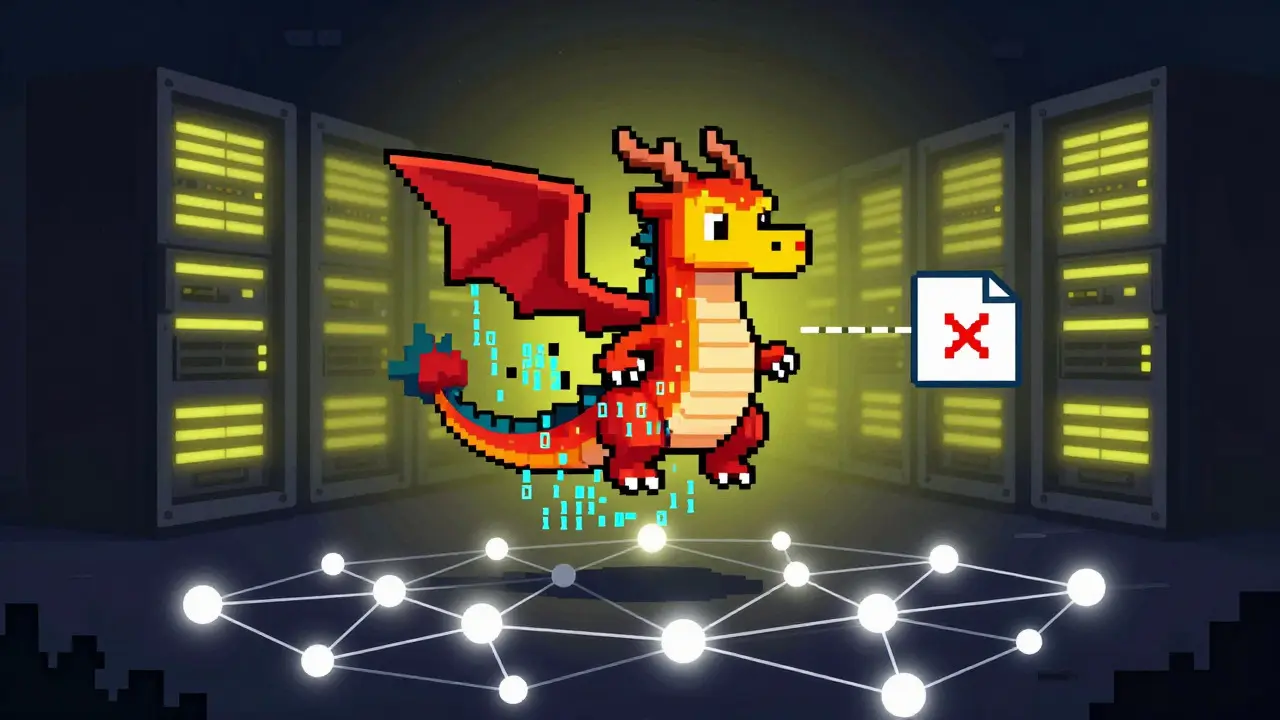
There is a dangerous misconception that storing an NFT on the blockchain means the artwork itself is safe there. It isn’t. Most NFT standards, including ERC-721, do not store the actual image or audio file on-chain. Instead, they store a pointer-a Uniform Resource Identifier (URI)-that links to where the data lives.
If that link points to a centralized server owned by the project creator, and that company goes bankrupt or deletes the files, your NFT becomes a broken link. You still own the token, but it points to nothing. Even using decentralized storage like IPFS doesn’t guarantee permanence unless the content is actively pinned by third parties. Without pinning, the data can disappear from the network just as easily.
This structural weakness creates a risk of "dead" collections. To address this, industry groups are pushing for better metadata standards. The Metaverse Standards Forum published a document in October 2025 proposing a structured template for NFT metadata. This template includes standardized fields for asset type, creator attribution, and usage rights. While this doesn’t force decentralized storage, it ensures that if the data exists, different platforms can interpret it consistently. It moves us away from proprietary, unstructured JSON files toward a universal language for digital assets.
Interoperability Across Blockchains
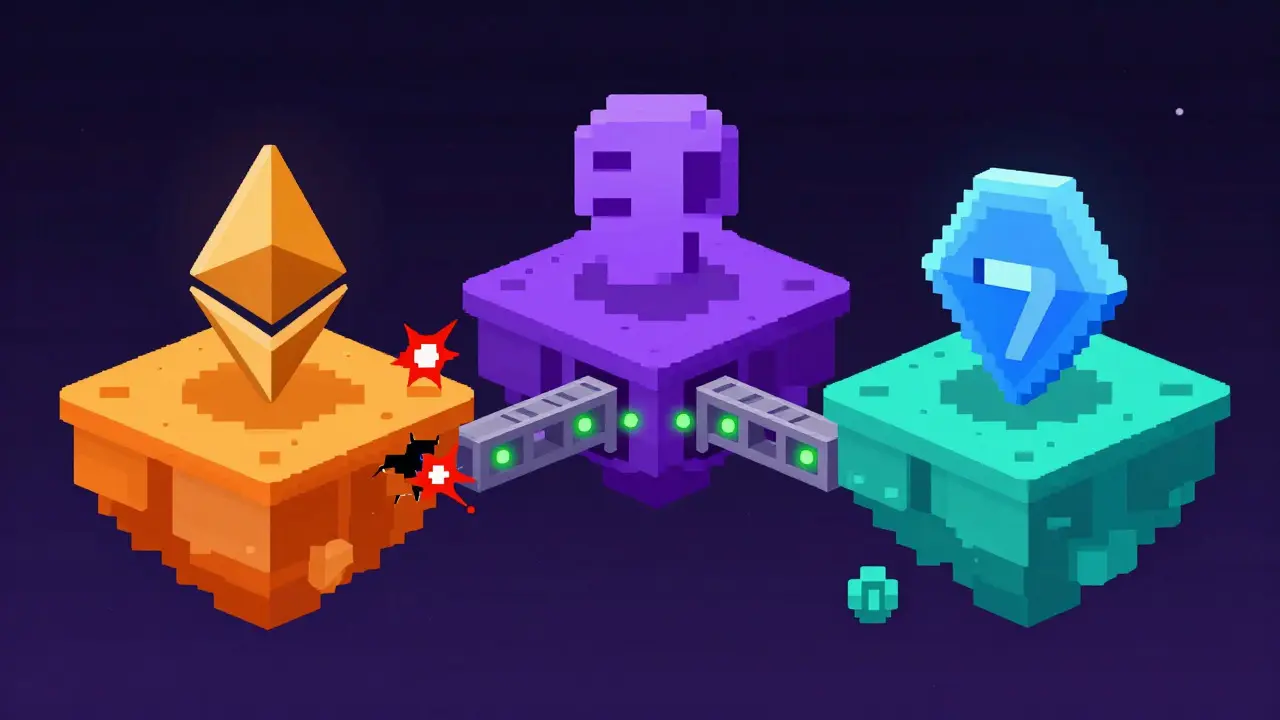
NFTs were supposed to be portable. You buy an avatar in one world, and you wear it in another. Currently, that dream is blocked by chain-specific standards. ERC-721 works on Ethereum and compatible networks like Polygon or Arbitrum. But if you try to move that token to Solana, Flow, or Tezos, it won’t work natively. Each blockchain has its own distinct technical specifications.
This fragmentation means that an application built for Ethereum cannot directly handle NFTs from other chains without complex bridging mechanisms. Bridges add security risks and complexity for users who just want to use their assets. The lack of a universal interface forces developers to write custom integration logic for every new chain they want to support, slowing down innovation.
Solutions are emerging through cross-platform schemas. Initiatives led by organizations like Copperpod IP are cataloging standards across ecosystems to find common denominators. The goal is to create middleware that can translate between these different languages, allowing an NFT minted on one chain to be recognized and utilized on another. Until then, true interoperability remains limited to specific partnerships rather than a general protocol feature.
Legal Ambiguity and Licensing Rights
Perhaps the biggest confusion for buyers is what they actually own. When you purchase an NFT, do you own the copyright? The right to sell prints? The right to use the image commercially? The short answer is usually no.
Research by Galaxy Digital highlights that most NFT projects grant only a limited license to display the work, defined in off-chain terms of service. There is no field in ERC-721 or ERC-1155 that explicitly states "Copyright Owner" or "Commercial Use Allowed." This gap leads to widespread misunderstanding. Buyers assume ownership of the intellectual property, while sellers retain it. Disputes arise when projects change their terms or when unauthorized minting occurs.
To fix this, experts advocate for standardized licensing frameworks. Projects are encouraged to adopt clear, pre-defined license categories-such as personal use only or commercial use up to a revenue threshold-and embed these details into the metadata. By linking machine-readable license descriptors to the token, wallets and marketplaces can automatically display rights summaries to users. This approach separates the technical ownership of the token from the legal rights to the content, providing clarity without overcomplicating the base protocol.
Security Risks and Implementation Complexity
Flexibility comes at a cost. Because NFT standards provide a minimal interface, developers have freedom to implement custom logic for minting, royalties, and access control. This flexibility opens the door to coding errors. Reentrancy vulnerabilities, incorrect transfer hooks, and flawed approval mechanisms are common issues in poorly audited contracts.
ERC-1155, while more efficient, introduces greater complexity by handling multiple token types in one contract. This enlarges the attack surface and makes formal verification harder compared to simpler single-asset contracts. Furthermore, the lack of standardized security extensions means practices vary wildly. One project might include robust checks against compromised tokens, while another omits them entirely. Users cannot rely solely on the standard to guarantee safety; they must trust the implementation.
The solution lies in stricter auditing standards and the adoption of secure, battle-tested libraries. Developers should avoid writing custom core logic from scratch whenever possible. Using established frameworks that enforce best practices, such as mandatory safe transfer checks, can significantly reduce the risk of exploits. As the ecosystem matures, we may see standardized security modules that become part of the broader NFT infrastructure.
Royalties and Composability Challenges
Creators rely on secondary sales royalties to earn ongoing income from their work. However, enforcing these royalties is difficult because the standards themselves do not mandate them. Royalty enforcement depends on individual marketplaces choosing to honor the data provided by the smart contract. Some platforms allow sellers to bypass royalties entirely, undermining the economic model for artists.
This ad hoc approach also hurts composability. Other decentralized applications (dApps) struggle to interpret what rights or economic flows are attached to a given NFT because there is no uniform way to encode this information. A game might want to check if a player owns a specific item to unlock a feature, but if the royalty and access-control mechanisms are implemented differently by each project, the integration becomes costly and error-prone.
Future iterations of NFT standards aim to address this by incorporating more semantic expressiveness. By encoding rights and economic relationships directly into the token’s structure, dApps can uniformly interpret and interact with NFTs. This shift from simple ownership records to rich, programmable assets is essential for building complex, cross-platform applications in the metaverse.
What is the main difference between ERC-721 and ERC-1155?
ERC-721 treats each NFT as a unique, indivisible token requiring separate transactions for transfers, which increases gas costs. ERC-1155 allows multiple token types (both fungible and non-fungible) to exist in a single contract and supports batch transfers, significantly reducing gas fees and improving efficiency for gaming and large collections.
Are NFTs stored on the blockchain?
No, typically only a pointer (URI) to the asset is stored on the blockchain. The actual image, video, or audio file is usually hosted off-chain on centralized servers or decentralized storage like IPFS. If the off-chain host fails or removes the file, the NFT may become inaccessible despite remaining on-chain.
Do I own the copyright when I buy an NFT?
In most cases, no. Buying an NFT generally grants you ownership of the token itself, not the underlying intellectual property. Rights are usually defined in off-chain terms of service, often granting only a limited license to display the work. Always check the specific project's license agreement.
Can I move an NFT from Ethereum to Solana?
Not natively. NFT standards are blockchain-specific. Moving an NFT between different chains requires using a bridge service, which wraps the original token and mints a corresponding version on the destination chain. This process adds complexity and potential security risks.
How are royalty payments enforced for NFTs?
Royalties are not enforced by the core NFT standards like ERC-721 or ERC-1155. Instead, they rely on marketplaces voluntarily honoring the royalty information embedded in the smart contract. Some platforms allow sellers to opt-out, meaning creators have no guaranteed way to collect secondary sales fees across all platforms.