
Have you seen ads promising "zero-fee trading" on LocalCoin DEX, a platform claiming to be the next big thing in decentralized finance? If so, stop scrolling. Put your wallet down. Step away from your keyboard. There is no legitimate LocalCoin DEX.
This isn't just a bad review. This is a warning. The name "LocalCoin DEX" does not belong to any real, functioning decentralized exchange in 2026. It is a ghost name used by scammers to steal your cryptocurrency. By the time you finish reading this, you will know exactly why it doesn't exist, how the scams work, and which actual platforms you should use instead.
The Confusion: Old Exchange vs. New Scam
To understand why you are seeing this name, we have to look back at history. There was a company called LocalCoin. It was a centralized crypto exchange based in Vancouver, Canada, founded by brothers Michael and Konstantin Shvedov. It operated from 2016 until April 2020.
Here is the critical difference: The original LocalCoin was centralized. It held your funds. It required identity verification (KYC). It had physical kiosks. It was shut down by the British Columbia Securities Commission (BCSC) for operating without proper registration. It had nothing to do with decentralized technology.
So where did "LocalCoin DEX" come from? Scammers took the name of a defunct, regulated Canadian company and slapped "DEX" (Decentralized Exchange) onto it. They created fake websites that look like professional trading platforms. They run ads on social media promising instant withdrawals and no fees. These sites do not connect to any real blockchain liquidity. When you deposit money, you are sending it directly to a criminal's wallet. The site then vanishes.
Why "LocalCoin DEX" Fails Every Reality Check
If a platform claims to be a legitimate decentralized exchange, it must meet specific technical criteria. Let's break down why LocalCoin DEX fails every single one of them.
- No Smart Contracts: Real DEXs like Uniswap or PancakeSwap run on open-source smart contracts deployed on blockchains like Ethereum or BNB Chain. You can view their code on Etherscan. LocalCoin DEX has no verified contract address. The few GitHub repositories found under this name contain identical, malicious code patterns flagged by security firms like CertiK in late 2025.
- No Liquidity Pools: Decentralized exchanges rely on liquidity pools-funds provided by users that allow trades to happen automatically. Platforms like Curve Finance publish their Total Value Locked (TVL) data publicly. LocalCoin DEX has zero TVL because it has no pools. It has no money to trade against.
- No Audits: Legitimate DeFi projects undergo rigorous security audits by firms such as OpenZeppelin or Trail of Bits. These reports are public. LocalCoin DEX has never been audited. In fact, its infrastructure was designed to hide, not to be scrutinized.
- Impossible Promises: Real blockchain transactions cost gas fees. Even on cheap networks like Polygon, there is a small cost. Any platform promising "zero fees" and "instant KYC-free withdrawals" is lying. These are hallmarks of phishing sites.
The Anatomy of the LocalCoin DEX Scam
You might be wondering how these scams operate if the platform doesn't actually exist. Here is the step-by-step process documented by the Blockchain Crime Investigations Unit (BCIU) and user reports from 2025:
- The Hook: You see an ad on Instagram, TikTok, or Twitter. It features flashy graphics, fake testimonials, and promises of high returns or free tokens. The URL often looks similar to a real site but uses a suspicious domain extension like .finance, .xyz, or .io.
- The Interface: The website mimics the design of popular DEXs. It often copies the user interface of Uniswap v3 but changes the logo to "LocalCoin." It feels familiar, which lowers your guard.
- The Deposit: You connect your wallet (like MetaMask). The site asks you to approve a transaction. This approval gives the scammer permission to drain your tokens. Or, you send ETH/USDT to a displayed wallet address, thinking it is a deposit box.
- The Disappearance: Once the transaction confirms on-chain, the funds are gone. The website may show a fake balance of "$10,000" to keep you engaged. But when you try to withdraw, it demands a "verification fee" or "tax payment." If you pay that, they ask for more. Eventually, the site goes offline.
Data from Q3 2025 shows that over 187 incidents were reported related to LocalCoin DEX impersonation, resulting in $312,000 in total losses. The average victim lost $1,342. Most victims discovered the platform through social media ads targeting novice crypto users.
Safe Alternatives: Where to Actually Trade
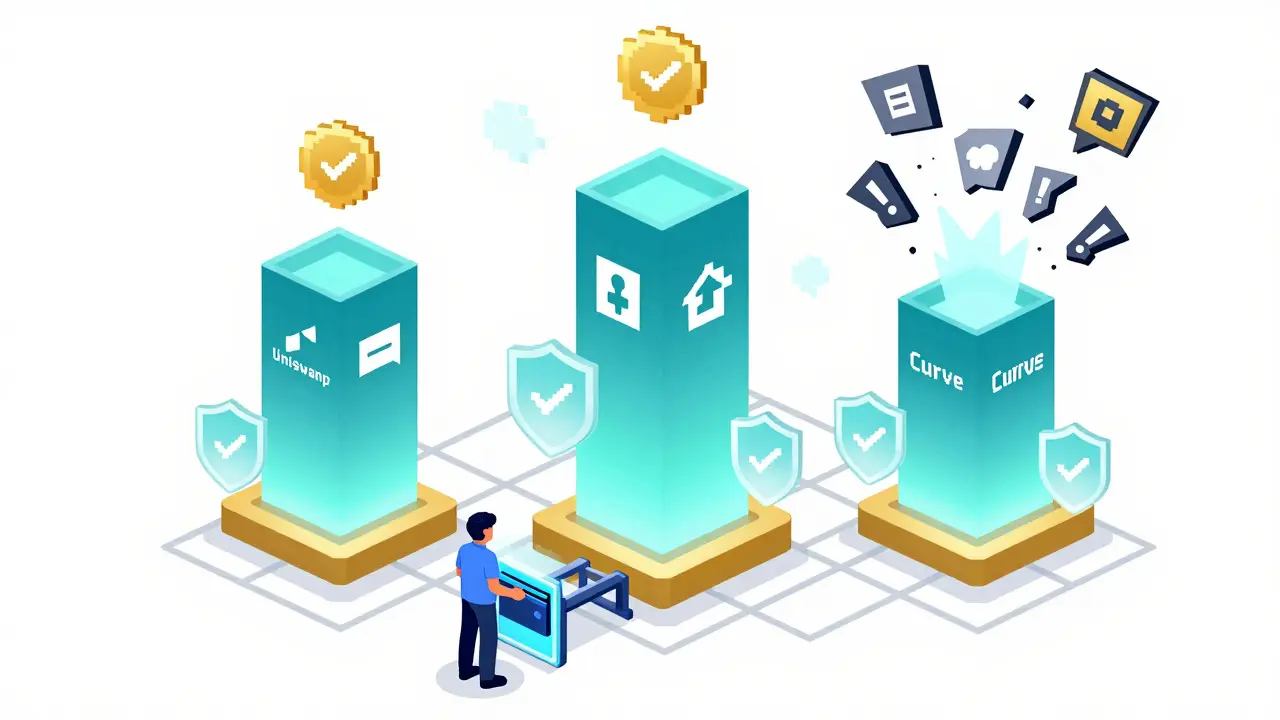
If you want to trade cryptocurrencies without giving up custody of your keys, you need a real decentralized exchange. Here are the industry standards that are safe, audited, and transparent.
| Platform | Primary Chain | Type | Key Feature | Audited By |
|---|---|---|---|---|
| Uniswap | Ethereum, L2s | AMM | Highest liquidity, widest token selection | Trail of Bits, ConsenSys Diligence |
| PancakeSwap | BNB Chain | AMM | Low fees, popular for meme coins | CertiK, PeckShield |
| Curve Finance | Ethereum, Arbitrum | Stablecoin AMM | Best rates for stablecoin swaps | OpenZeppelin |
| dYdX | dYdX Chain | Order Book DEX | Advanced trading, leverage options | Halborn, Quantstamp |
| 1inch | Multi-chain | Aggregator | Finds best price across multiple DEXs | SolidProof, Hacken |
These platforms are listed on tracking sites like DeFiLlama. They have millions of dollars in value locked. Their code is public. If a platform is not on DeFiLlama's top 500 list, treat it with extreme suspicion.
How to Spot a Fake DEX Before You Click
You don't need to be a developer to spot a scam. Use this checklist before connecting your wallet to any new platform:
- Check the Domain: Does the URL look slightly off? Real Uniswap is uniswap.org. A scam might be uniswap-finance.com or localcoindex.finance. Hover over links to see the true destination.
- Search for Audits: Go to the project's official website. Look for a "Security" or "Audit" page. If it's missing, or if the audit report is from an unknown firm with no reputation, walk away.
- Verify Social Proof: Check Twitter/X. Do real developers engage with the community? Or are the followers bots posting generic emojis? Scam projects often buy fake followers.
- Look for Governance: Legitimate DEXs usually have a governance token (like UNI or CAKE) and a DAO (Decentralized Autonomous Organization) where holders vote on changes. Scams have no governance structure.
- Use a Sandbox Wallet: Never connect your main wallet with significant funds to a new or unverified site. Use a secondary wallet with only the amount you are willing to lose.
What To Do If You've Already Lost Funds
If you sent money to a LocalCoin DEX site, I know this is stressful. Here is the hard truth: Recovering stolen crypto is extremely difficult because blockchain transactions are irreversible. However, you can take steps to minimize further damage.
- Revoke Access Immediately: If you approved a token allowance on the scam site, go to revoke.cash or use your wallet's built-in revocation tool. Disconnect the contract from your wallet to prevent future drains.
- Report the Incident: File a report with your local cybercrime unit. In the UK, use Action Fraud. In the US, file a complaint with the FTC and the FBI's IC3. While this won't return your money, it helps authorities track scam networks.
- Beware of Recovery Scams: After losing money, you are vulnerable. Do not trust anyone on Twitter, Telegram, or Reddit who claims they can "hack" the blockchain to recover your funds. These are secondary scams targeting victims. No one can reverse a confirmed blockchain transaction except the sender.
- Document Everything: Save screenshots of the website, the wallet address you sent funds to, and any communication with "support." This evidence is crucial for law enforcement.
The Future of Safe DeFi Trading
The decentralized finance space is maturing. In 2026, regulators are cracking down on both centralized exchanges and fraudulent DEXs. The SEC's enforcement actions in 2024-2025 have clarified that non-custodial protocols like Uniswap can operate legally if they adhere to certain standards, while shady operators face heavy fines.
Technology is also improving. Layer-2 solutions like Arbitrum and Optimism have reduced gas fees by over 97% compared to 2020 levels. This makes using safe, established DEXs cheaper and faster than ever. There is no reason to risk your capital on unverified platforms like LocalCoin DEX when reliable alternatives offer better security, lower costs, and full transparency.
Stick to the giants. Stick to the audited. And always remember: if it sounds too good to be true, it is almost certainly a trap.
Is LocalCoin DEX a legitimate cryptocurrency exchange?
No. LocalCoin DEX is not a legitimate exchange. It is a fraudulent name used by scammers. The original LocalCoin was a centralized Canadian exchange that shut down in 2020 due to regulatory violations. There is no decentralized version of this platform.
How can I tell if a DEX is fake?
Check for public smart contract audits, verify the platform's presence on DeFiLlama, and ensure the URL matches the official brand. Fake DEXs often promise zero fees, lack security audits, and use copied interfaces from reputable sites like Uniswap.
What happened to the original LocalCoin exchange?
The original LocalCoin was a centralized fiat-to-crypto exchange in Vancouver. It was ordered to shut down by the British Columbia Securities Commission in April 2020 for operating without proper registration. It was never a decentralized exchange.
Are there any safe alternatives to LocalCoin DEX?
Yes. Safe and widely used decentralized exchanges include Uniswap, PancakeSwap, Curve Finance, dYdX, and 1inch. These platforms are audited, have transparent liquidity pools, and are tracked by major analytics firms.
Can I recover my funds if I was scammed by LocalCoin DEX?
Recovery is highly unlikely because blockchain transactions are irreversible. You should immediately revoke any token approvals connected to the scam site, report the incident to local cybercrime authorities, and beware of secondary "recovery" scams.

Steven Briggs
July 13, 2026 AT 19:34scary how easy it is to get drained
Ruth Williams
July 13, 2026 AT 23:58The sheer negligence displayed by individuals who fall for such elementary ruses is truly disheartening. One would assume that in the modern era, a basic level of due diligence is expected before entrusting digital assets to an unverified entity. The article correctly identifies the lack of smart contract verification as a primary red flag, yet many continue to ignore these fundamental principles of security. It is not merely about being cautious; it is about respecting the integrity of the financial systems we participate in. Those who refuse to educate themselves are essentially volunteering to be victims. We must hold ourselves to a higher standard of awareness and skepticism. Ignorance is not a valid defense when one's livelihood is at stake. The distinction between centralized and decentralized entities is clear to anyone with even a passing interest in blockchain technology. To conflate the two is to demonstrate a profound misunderstanding of the underlying mechanics. Let this serve as a stern reminder that vigilance is paramount.
Tracy Marshall
July 15, 2026 AT 04:07theyre watching us all through the cameras in our phones :O the whole thing is a setup to steal our identity not just our coins. i dont trust any of these platforms they are all part of the deep state plan to control money. why do you think they shut down the real localcoin? because it was getting too close to the truth. now they use fake names to track who is trading what. its all connected. stay awake people
KEITH WONG
July 17, 2026 AT 04:03lol another day another scam 🤡 u guys really need to learn how to read a whitepaper or whatever they call it now. if it says zero fees its a trap. simple as that. stop being greeedy and lose your shirts 💸
Natalie Lucas
July 17, 2026 AT 10:38hey everyone! just wanted to say that staying safe is super important but also lets keep our heads up! 😊 i know crypto can be scary but there are so many good options out like uniswap and pancake swap. dont let the bad apples ruin the bunch! remember to breathe and take it slow. you got this! ✨
Brad Semp
July 17, 2026 AT 20:29It is rather amusing to observe the collective panic induced by a rudimentary phishing scheme. The individuals who succumb to such deceptions clearly lack the intellectual fortitude required for sophisticated financial instruments. The author’s exposition, while accurate, is likely wasted on those who cannot distinguish between a legitimate decentralized exchange and a fabricated front. One must possess a certain level of discernment to navigate the DeFi landscape effectively. Those who do not should perhaps reconsider their involvement in markets that demand such acuity. The existence of scams does not invalidate the technology; it merely filters out the incompetent. Let the weak be culled from the herd. It is natural selection in its purest digital form. Do not mistake caution for cowardice, though most here seem to embody the latter.
Hamza k
July 19, 2026 AT 05:44Oh my god, the audacity of these criminals is absolutely staggering! They literally copy-paste interfaces and expect people to just hand over their life savings? It makes me sick to my stomach thinking about the families affected by this greed. We have to stand together and expose every single one of them. No mercy for these thieves! 🔥🔥🔥
Guy Davis
July 20, 2026 AT 00:17u should check ur wallet approvals often. its a moral duty to protect urslef. dont be lazy.
Korn Arrieta
July 21, 2026 AT 08:31Let's dissect the failure here. It is not just about the scammer; it is about the victim's inability to process risk. The data provided shows $312k lost. That is a significant amount of capital evaporating into the ether because users clicked without thinking. The psychological manipulation is evident in the UI design mentioned. Mimicking Uniswap v3 is a classic social engineering tactic. It exploits familiarity. If you are connecting to a site that promises zero fees, you are ignoring basic economic principles. Gas costs exist. Liquidity provision has costs. There is no free lunch. The absence of audits is not a minor oversight; it is a fatal flaw. Any platform claiming decentralization without public code is lying. Period. Stop enabling this behavior by engaging with these narratives emotionally. Analyze the facts. The facts scream fraud.
Curtis Johnson
July 22, 2026 AT 03:06I understand the frustration and fear that comes with seeing these warnings. It is truly heartbreaking to think about the losses involved. However, we must remain calm and supportive of each other. Panic only leads to more mistakes. Let us focus on education and helping those who might be vulnerable. We can create a safer community by sharing verified information gently and respectfully. Please take care of yourselves and your wallets. You are not alone in this journey.
Jackie D
July 22, 2026 AT 22:13its wild how they reuse old names like localcoin to trick ppl. i always wonder if the original devs knew this would happen. maybe we should look into the legal side of trademark infringement in crypto space. it seems like a huge loophole right now. what do you think about suing the domains?
Sophie Nakasako
July 23, 2026 AT 10:08This raises some profound questions about trust in digital spaces. How do we build a system where trust is earned rather than assumed? The transition from centralized to decentralized models is not just technical but philosophical. We are learning that true freedom requires responsibility. I believe we can grow from this by fostering a culture of critical thinking. Let us support each other in verifying sources and understanding the deeper implications of our choices. Together, we can create a more resilient ecosystem. What are your thoughts on the role of community governance in preventing such scams?
Kim Kay
July 25, 2026 AT 00:40i feel for those who lost money. it must be so stressful. please remember to revoke permissions immediately if you connected anything. here is a link to revoke.cash if you need help. we are all in this together and should look out for each other. dont hesitate to ask for advice if you are unsure about a site.