
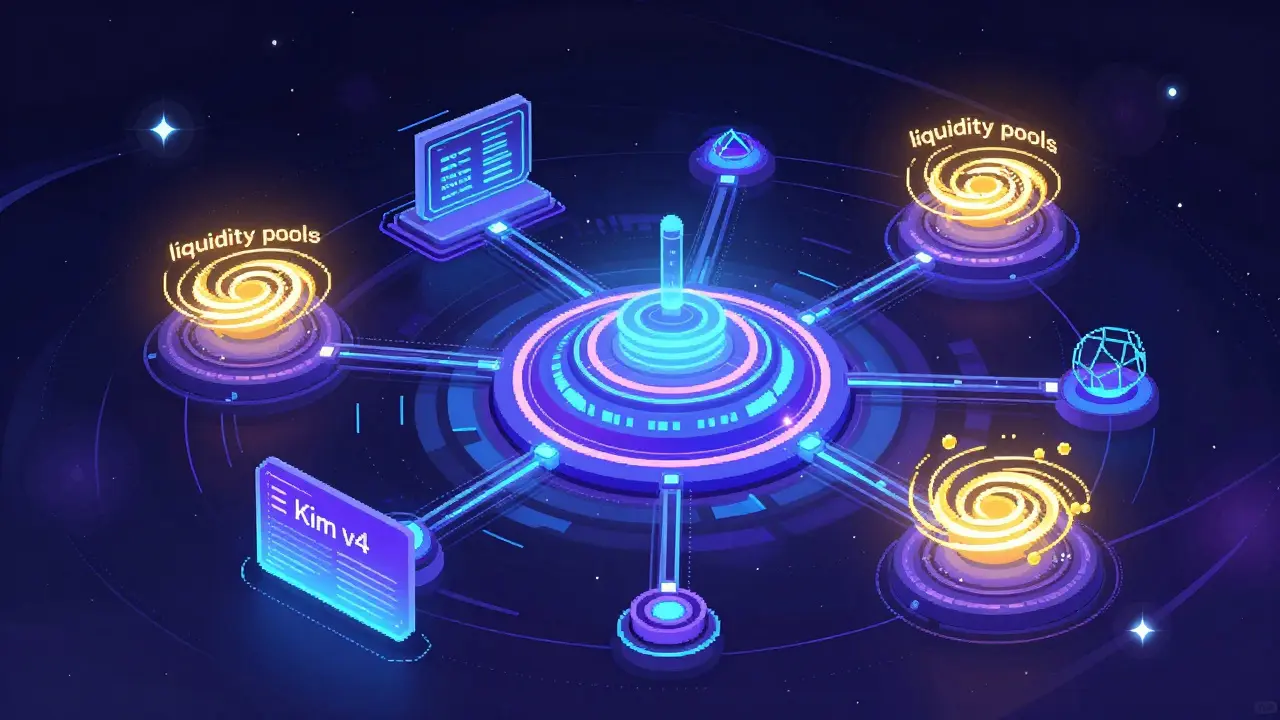
If you're tired of the rigid rules and security risks of centralized platforms, you've probably looked into decentralized exchanges. But with so many popping up, how do you know if a new version like Kim v4 crypto exchange is actually a goldmine or just another liquidity trap? Kim Exchange is a decentralized exchange (DEX) operating within the Mode platform that acts as a primary liquidity hub for the Optimism Superchain. Instead of the old-school order books you see on big exchanges, it uses a mathematical pricing model to move assets. If you're looking for a way to earn higher yields while keeping control of your keys, this might be your speed.
Quick Takeaways for Traders
- Core Tech: Uses Automated Market Maker (AMM) with concentrated liquidity to fight slippage.
- Security: Employs Multi-Party Computation (MPC) to protect assets without a single point of failure.
- Yield Boost: The kpNFT system can potentially push your returns up to 4x.
- Ecosystem: Built on the Mode platform, leveraging the Optimism Superchain for faster, cheaper transactions.
How the Trading Engine Actually Works
Most people are used to seeing a "buy" and "sell" wall of orders. Kim v4 ditches that. It uses an AMM protocol, which means you're trading against a pool of assets rather than another person. The secret sauce here is concentrated liquidity. In a standard pool, your assets are spread across every possible price point, which is inefficient. With concentrated liquidity, you can pick a specific price range where your assets are active. This means less slippage for the trader and higher potential fees for the liquidity provider.
Because it's built on the Mode network, you aren't paying the massive gas fees associated with the Ethereum mainnet. By tapping into the Optimism Superchain, the exchange ensures that the "v4" experience is snappy, which is critical when you're trying to catch a price swing in a volatile market.
The Token Economy: KIM vs xKIM
To understand if this exchange is a good bet, you have to look at the two-token system. It's not just about having a coin; it's about how those coins move the needle for the user.
$KIM is the primary utility token. If you're providing liquidity to the pools, this is where you start. You stake your KIM to earn a second, more powerful token called $xKIM. Think of $xKIM as your "VIP pass" to the governance side of the house. It's a non-transferable token, meaning you can't just buy it on a secondary market; you have to earn it through participation.
The real power of $xKIM comes from its ability to be allocated to various plugins, often called xKim plugins. These modular hooks allow the community to customize how liquidity is managed and how rewards are distributed. If a specific strategy is working well, the governance can shift focus there, making the platform feel more like a living organism than a static piece of software.
| Feature | $KIM Token | $xKIM Token |
|---|---|---|
| Primary Role | Liquidity Provision | Governance & Strategy |
| Transferability | Transferable | Non-transferable |
| How to Acquire | Trading/Mining | Staking $KIM |
| Main Benefit | Ecosystem Access | Yield Enhancement/Voting |
Boosting Yields with kpNFTs
For those into yield farming, the kpNFTs are the most interesting part of the v4 setup. These aren't just digital art pieces; they are yield-generating non-fungible tokens. When you stake your $xKIM, you can acquire these NFTs, which act as multipliers for your liquidity positions.
The platform claims that these kpNFTs can boost your yields by up to 4x. In the real world, this means if a standard pool is giving you a decent return, the NFT layer kicks it into high gear. However, you should be careful: higher yields usually come with higher risks, such as impermanent loss, which happens when the price of your deposited assets diverges significantly.
Security and the MPC Approach
Security in a DEX usually boils down to smart contract audits. While those are standard, Kim v4 implements Multi-Party Computation (MPC). Traditional wallets have a single private key; if that key is stolen, your funds are gone. MPC breaks the key into several "shards" distributed among different parties. To authorize a transaction, a threshold of these shards must collaborate.
This removes the single point of failure and makes it significantly harder for hackers to drain a wallet. When combined with the modular architecture of the exchange, it creates a environment where security isn't just a perimeter fence, but is baked into how the transactions are computed.
The Trade-offs: What's Missing?
No review is honest without looking at the gaps. While the tech behind Kim v4 is impressive, there are some red flags for the cautious investor. We don't have a transparent, real-time look at the Total Value Locked (TVL) or the daily trading volumes. In the DEX world, liquidity is king. If the TVL is too low, you'll experience high slippage regardless of the AMM model.
Additionally, we aren't seeing a wealth of third-party audits from firms like CertiK or OpenZeppelin. For a platform using complex MPC and modular hooks, an independent security stamp is non-negotiable. You're essentially trusting the internal architecture until a public, verified audit is released.
Is Kim v4 a centralized or decentralized exchange?
It is a decentralized exchange (DEX). It means you maintain control of your private keys and trade via smart contracts on the Mode platform, rather than depositing your funds into a corporate account.
What is the difference between KIM and xKIM?
$KIM is the liquid utility token used for providing liquidity. $xKIM is a non-transferable governance token earned by staking $KIM, which allows you to vote on plugins and boost your rewards.
How do kpNFTs increase my earnings?
kpNFTs are yield-generating assets acquired through $xKIM staking. They act as a multiplier for your liquidity positions, potentially increasing your yield by up to 4x compared to standard staking.
Which network does Kim Exchange run on?
It operates on the Mode platform, which is part of the Optimism Superchain, ensuring low transaction fees and fast execution speeds.
Is the Kim v4 exchange safe to use?
Technically, it uses advanced Multi-Party Computation (MPC) to enhance security. However, users should be aware that comprehensive third-party security audits are not widely publicized, so proceed with caution and only invest what you can afford to lose.
Next Steps for New Users
If you're ready to try it out, don't just dump your whole portfolio in. Start by bridging a small amount of assets to the Mode network. Once there, experiment with a small liquidity pool to see how the concentrated liquidity affects your returns. If you're aiming for the 4x yield, focus on accumulating $xKIM first to unlock the kpNFT benefits. Always double-check the current TVL on a DEX tracker before making large trades to ensure you aren't getting eaten alive by slippage.


Robert Smith
April 29, 2026 AT 18:25Looks interesting 🚀💰
Felix Eduardo Velasquez
April 30, 2026 AT 07:35Concentrated liquidity is the only way forward for DEXs if they want to compete with CEXs. By allowing LPs to specify a price range, the capital efficiency increases dramatically. Most users don't realize that providing liquidity across a full curve is basically just waiting to be diluted by volatility. The implementation here on Mode suggests a push for high-frequency agility, though the lack of a public audit is a massive theoretical risk. In a trustless system, the code is the law, and without a verified audit, you're essentially trusting the developers' word that the MPC implementation is sound.
Emily A
May 2, 2026 AT 03:59The absence of a CertiK or OpenZeppelin audit is an inexcusable oversight for any platform claiming to be "secure." It is simply naive to trust a proprietary MPC implementation without a rigorous, third-party verification process. Furthermore, the 4x yield claims are mathematically suspicious and likely lean heavily on unsustainable emission schedules. One should always analyze the inflation rate of the $KIM token before diving into such pools.
Rain Richardsson
May 2, 2026 AT 07:01Sounds risky but cool.
Rushell Perry
May 2, 2026 AT 15:17bridging to mode is pretty easy these days actually just use the official bridge and keep it small at first
Veronica Bago
May 3, 2026 AT 13:46I'm just hanging out watching the charts, hope this actually works out for everyone!
Arti Jain
May 4, 2026 AT 14:36Typical western hype. My country's tech is far superior.
Ralph Espinosa
May 5, 2026 AT 09:42I've used similar AMMs before!!! The concentrated liquidity really helps with the slippage!!! Just be careful with the range settings!!!
Harvey Alford
May 5, 2026 AT 21:54I'm losing money everywhere. Help.
VIVEK SINGH
May 7, 2026 AT 20:56Oh wow, another "revolutionary" DEX using a mathematical model. How groundbreaking. I'm sure the 4x yield is totally sustainable and not a total fantasy designed to attract exit liquidity for the early whales. It's almost as if the industry has a pattern of promising the moon and delivering a crater. But please, tell me more about the "VIP pass" tokens.
Lloyd I
May 9, 2026 AT 11:25Let's all dive in and learn together! It's a great time to explore the Superchain ecosystem!
Gabby Puche
May 9, 2026 AT 12:27Keep going everyone! Small steps are the way to go ✨💖
edie rosa
May 10, 2026 AT 12:54This whole setup feels like a desperate attempt to mask a lack of real utility with fancy acronyms like MPC. It's just another way to drain people's wallets under the guise of "innovation." The moral bankruptcy of these yield-farming schemes is honestly exhausting to even analyze.
Michael Repak
May 11, 2026 AT 00:19I totally agree with the caution here!!! Just start small!!! You've got this!!!
Livvy Cooper
May 12, 2026 AT 04:00Too complicated. Just buy and hold.
Iestyn Lloyd
May 13, 2026 AT 00:55The use of the Optimism Superchain is a sensible choice for reducing overhead. It provides a much more fluid experience than L1.
Kara Spadone
May 13, 2026 AT 04:03The duality of $KIM and $xKIM is just a mirror of our own fragmented digital identities 🌀. We chase the VIP status while ignoring the void of the underlying asset.
Kathleen Warren
May 13, 2026 AT 21:49If you are new, just remember to keep your keys safe and don't put in more than you can lose. It's okay to be cautious.
Barbara Jones
May 13, 2026 AT 23:44I triyed to bridge last night and it took a minit but it worked fine lol
Pramendra Singh
May 14, 2026 AT 13:22It is wonderful to see new projects bringing liquidity to the Mode platform. I hope this creates a very positive environment for all traders involved.