
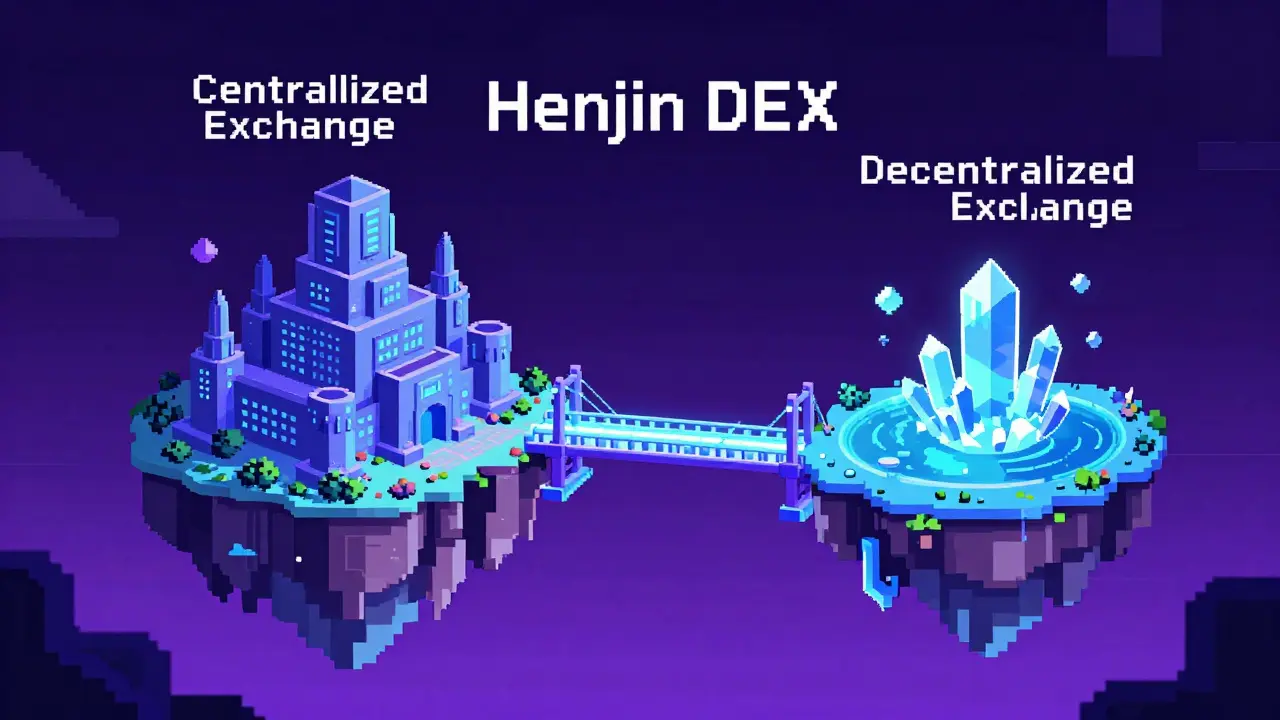
Most people think they have to choose between the speed of a centralized exchange like Binance and the security of a decentralized one like Uniswap. You either get a fast interface but trust a company with your keys, or you keep your keys but deal with slow transactions and high slippage. Henjin DEX is a decentralized cryptocurrency exchange that attempts to bridge this gap using a hybrid model combining a high-performance order book with concentrated liquidity pools. Launched to solve the scalability headaches of early DeFi, it claims to offer sub-500 millisecond transaction finality, which is nearly unheard of in the world of non-custodial trading. But does it actually hold up under pressure, or is it just another project with a flashy whitepaper?
The Hybrid Model: Order Books Meet Liquidity Pools
If you've used a standard DEX, you're probably used to Automated Market Makers (AMMs). AMMs are great for niche tokens, but they can be brutal on price impact for larger trades. Henjin DEX leverages a proprietary matching engine that works more like a traditional stock exchange. This means instead of just swapping against a pool, you can place limit orders.
According to data from the Blockchain Research Institute, the platform hits about 1,850 transactions per second (TPS) on its Ethereum Layer-2 setup. To put that in perspective, that's a massive jump over Uniswap, which typically handles around 45 TPS. While it won't beat the millions of TPS found on centralized servers, it's fast enough that you won't feel the "lag" typically associated with blockchain confirmations.
| Feature | Henjin DEX | Uniswap (V3/V4) | dYdX |
|---|---|---|---|
| Trading Model | Hybrid (Order Book + AMM) | Pure AMM | Order Book |
| TPS (L2 Implementation) | ~1,850 | ~45 | High (App-chain) |
| Transaction Finality | < 500ms | Block-dependent | Very Fast |
| Primary Asset Focus | Multi-chain/ETH L2 | Multi-chain | Derivatives |
The HENAI Token and the 'Super Node' System
You can't talk about this platform without mentioning HENAI, the native utility token. It isn't just a speculative asset; it's the fuel for the platform's governance and fee structure. If you hold HENAI, you can get up to a 30% discount on trading fees, which are set at 0.15% for takers and 0.05% for makers.
The most interesting part is the Super Node program. Think of this as a way to actually own a piece of the network's operational logic. To qualify, you need to stake 50,000 HENAI tokens. In return, you get a say in how the platform is run and a share of the trading fee revenue. It's a clever move to decentralize governance, though it does create a high barrier to entry for the average retail trader.

Real-World Trading: The Good and the Bad
When you actually start trading, the experience depends heavily on what you're swapping. If you're trading high-volume pairs like ETH/USDC, the order book model is a godsend. Users on Reddit have noted that 5x leverage trades execute smoothly with almost no slippage. However, if you're looking for obscure, low-liquidity "moon shots," you'll find that pure AMMs like Raydium are much better. Henjin simply doesn't have the depth in niche pools yet.
One major red flag? Bitcoin integration. If you're a BTC maximalist, you might want to look elsewhere. In a January 2025 SourceForge comparison, Henjin scored a measly 2.8/5 for Bitcoin asset support, trailing far behind platforms like Camelot DEX. Additionally, while the desktop site is powerful, the mobile experience is, frankly, a mess. Many users report crashes when switching between charts and the order book on iOS.
Security and Trust
In a world where "rug pulls" are common, security is everything. Henjin DEX has undergone audits by CertiK, with the most recent one wrapping up in late October 2024. So far, there haven't been any major exploits reported.
The platform uses a non-custodial architecture, meaning you keep your private keys in your own wallet (MetaMask, Trust Wallet, or Coinbase Wallet). This significantly lowers your risk because the exchange never actually "holds" your funds. That said, the Trustpilot rating sits at 3.7/5, with most of the complaints focusing on slow customer support rather than lost funds. If you have a technical issue, expect to wait up to 72 hours for a response, unless you head over to their Telegram group, where peer support is much faster.

Getting Started: A Practical Guide
If you're new to Henjin DEX review and want to try it out, the learning curve is moderate. You don't need to be a developer, but you should understand gas fees and slippage. Here is the quickest path to getting active:
- Connect Your Wallet: Use a Web3 wallet like MetaMask. Ensure you are on the correct network (Ethereum L2, BNB Chain, or Polygon).
- Fund Your Account: Deposit the assets you want to trade. If you're using the L2 implementation, make sure you have enough native tokens for gas.
- Optional Staking: If you plan on high-volume trading, acquire HENAI and stake it to unlock fee discounts.
- Set Your Parameters: Before hitting "Swap" or "Place Order," check your slippage settings. In volatile markets, 0.5% to 1% is standard, but for the order book, you can be more precise with limit orders.
Future Outlook and Roadmaps
The platform isn't standing still. They've already rolled out cross-chain settlements that dropped bridging times from 20 minutes to under 2 minutes. Looking ahead to late 2025, they are planning a "Liquidity Mesh" protocol. This is a big deal because it aims to aggregate liquidity from other DEXes, potentially fixing the fragmented order book problem that currently plagues the platform.
However, the road isn't easy. Analysts from Bernstein have questioned the platform's survival probability, arguing that the DEX market is reaching a saturation point. For Henjin to survive, they need to grow their Total Value Locked (TVL) from $127 million to over $500 million. Whether they can attract that much capital in a crowded market remains to be seen.
Is Henjin DEX safe to use?
Yes, it is generally considered safe as it is non-custodial, meaning you retain control of your private keys. It has been audited by CertiK, and no major security breaches have been reported as of late 2024. However, always remember that interacting with smart contracts carries inherent risks.
What is the difference between Henjin DEX and Uniswap?
The main difference is the trading engine. Uniswap is a pure Automated Market Maker (AMM), while Henjin DEX uses a hybrid model that includes an order book. This allows Henjin to offer faster transaction finality and the ability to set limit orders, whereas Uniswap focuses on simple swaps against liquidity pools.
How do I get fee discounts on the platform?
You can receive up to a 30% discount on trading fees by holding and using the native HENAI token to pay for your transactions.
Can I use Henjin DEX on my phone?
While there is a mobile interface and app, user reviews suggest it is currently unstable, especially on iOS. For serious trading and chart analysis, the desktop version is highly recommended.
What is a Super Node in the Henjin ecosystem?
A Super Node is a governance role granted to users who stake 50,000 HENAI tokens. Super Nodes participate in platform decision-making and earn a share of the exchange's fee revenue.






Matthew Wright
April 5, 2026 AT 21:10The sub-500ms finality is definitely the main draw here... but I wonder if that holds up during high volatility spikes. Usually, L2s struggle when the mempool gets clogged, even with high TPS ratings. It's a solid hybrid approach, though!
david head
April 6, 2026 AT 05:50looks legit 🚀 love the fee discounts with the token!!
Susan Wright
April 7, 2026 AT 03:34If you're planning to move a lot of volume, just be careful with the iOS app for now. Stick to a desktop browser with MetaMask for the best experience. The order book is way more reliable on Chrome than it is on mobile.
Earnest Mudzengi
April 8, 2026 AT 18:25CertiK audits are basically theater these days. Anyone who knows how the shadow-banking layer of DeFi works knows that a "clean" audit doesn't stop a backdoor in the smart contract logic. The Super Node system is just a fancy way to centralize power among a few whales who probably have ties to the offshore controllers. It's all a play to lure in retail liquidity before the big exit. The 1,850 TPS claim is likely just a theoretical maximum in a controlled environment, not real-world throughput. Total honeypot behavior.
Taylor Meadows
April 9, 2026 AT 10:15It's cute that people think 1,850 TPS is a game changer when most of you can't even manage your own seed phrases properly. This hybrid model is just a band-aid for a broken architecture. You're all just chasing the same ghost of "efficiency" while ignoring the obvious structural flaws in the HENAI tokenomics. It's predictable, really.
sekhar reddy
April 11, 2026 AT 04:31OMGG the mobile app crashing is literally a nightmare!! I tried to close a position and the screen just froze... I almost had a heart attack lol!! 😱
Trish Swanson
April 12, 2026 AT 01:43The Liquidity Mesh sounds promising... but we've seen "aggregators" fail before. It's an interesting goal!!!
Arwyn Keast
April 13, 2026 AT 09:23Typical over-engineered rubbish. Using a hybrid model to mask the inherent inefficiency of L2 settlement is just sloppy design. The order book is basically a vanity metric if the liquidity isn't there for anything other than USDC pairs. It's a disgrace to actual financial engineering.
Suzanne Robitaille
April 14, 2026 AT 06:12There is something truly poetic about the struggle between the speed of a machine and the security of a key. It's a delicate dance of trust and technology!
Siddharth Bhandari
April 15, 2026 AT 18:49The 0.05% maker fee is competitive. However, the 50,000 HENAI requirement for Super Nodes is prohibitively high for most independent traders, effectively limiting governance to venture capital firms.
akash temgire
April 17, 2026 AT 04:41The BTC support is unacceptable. Inefficient.
Evan Borisoff
April 17, 2026 AT 06:50The fundamental issue here is that the total value locked needs to skyrocket if this is even going to be a viable competitor to the established giants. When you look at the slippage on the low-cap pairs, it's blatantly obvious that the concentrated liquidity isn't actually concentrated enough to prevent massive price impact during moderate sells, which is a classic sign of a liquidity vacuum that only a massive influx of US-based capital can solve. This is just another attempt to recreate a CEX environment without the regulatory oversight of a proper jurisdictional framework.
Brooke Herold
April 18, 2026 AT 02:23I prefer using it on my laptop anyway. Much calmer.