
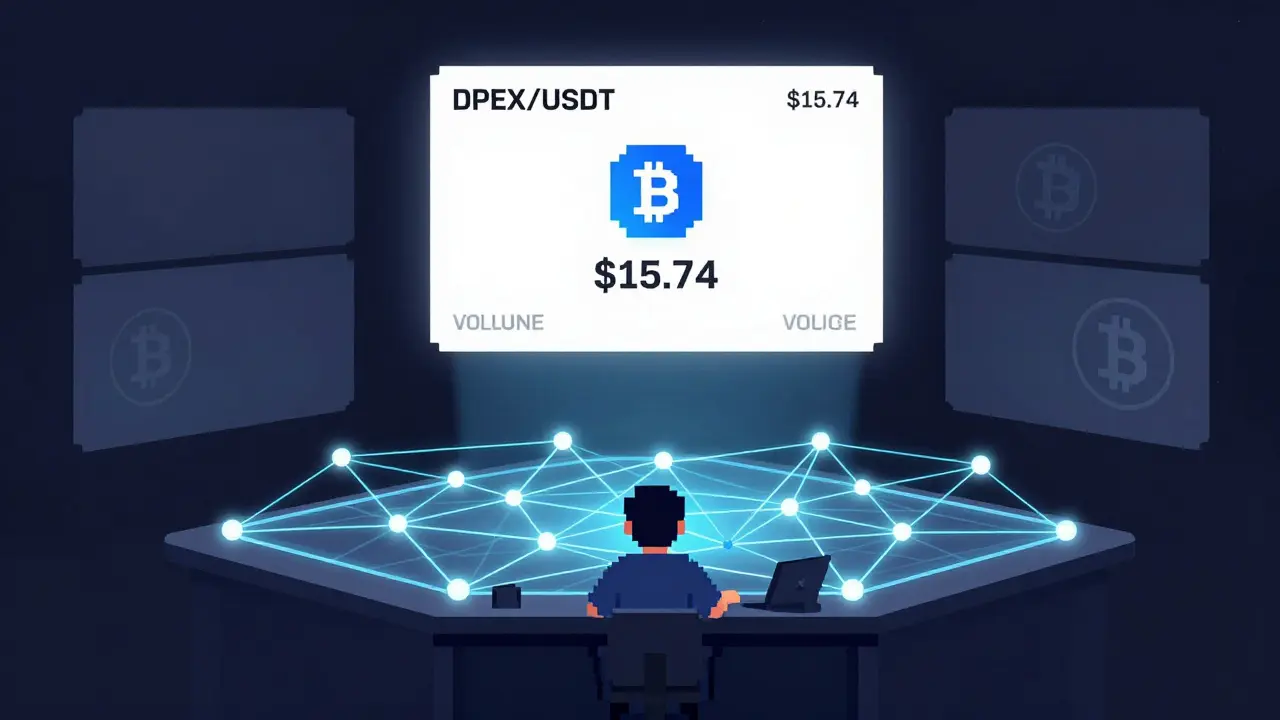
When you hear "crypto exchange," you probably think of Binance, Coinbase, or Kraken - platforms where you sign up, deposit cash, and start trading. But what if you don’t want to trust a company with your coins? What if you want to trade perpetual futures with 50x leverage - without a middleman holding your funds? That’s where DPEX.io comes in. It’s not another centralized exchange. It’s a decentralized perpetuals trading platform built on Polygon, promising zero price impact and full control over your assets. But does it actually work in practice? Or is it a shiny prototype stuck in a lab?
What Exactly Is DPEX.io?
DPEX.io, short for Decentralized Perpetuals Exchange, launched in 2023 as a direct response to the FTX collapse. Its whole reason for existing is to let traders do what centralized exchanges do - but without the counterparty risk. No KYC. No account freezes. No sudden disappearances. You connect your wallet, fund it with USDT or another stablecoin, and start trading perpetual futures directly on-chain.
Unlike Uniswap or SushiSwap, which focus on spot trading, DPEX specializes in one thing: perpetual contracts. These are derivative contracts that never expire, letting you go long or short on crypto without owning the underlying asset. You can trade BTC, ETH, SOL, and others with up to 50x leverage. That’s not a typo. Fifty times your deposit. High risk? Absolutely. But for experienced traders, it’s a powerful tool.
The platform runs on Polygon’s Layer 2 network. That means faster trades and fees under $0.10 - a big deal compared to Ethereum’s $5-$20 gas spikes. DPEX pulls price data from five major exchanges: Binance, OKX, KuCoin, Bitfinex, and Gate.io. It uses the median price from those sources to calculate trades and liquidations. To keep things accurate, it also leans on Chainlink oracles for real-time price updates, keeping liquidation triggers within 2.5% of actual market prices.
How Trading Works on DPEX.io
Here’s the step-by-step reality of using DPEX:
- Get a web3 wallet (MetaMask, WalletConnect, or Rabby are recommended).
- Fund it with USDT or another supported stablecoin on the Polygon network.
- Go to dpex.io and connect your wallet.
- Select your trading pair - right now, it’s only DPEX/USDT.
- Choose leverage (up to 50x), set your position size, and hit "Open Position."
No order book. No matching engine. No slippage from traditional limit orders. Instead, DPEX uses a “zero price impact swap” model. That means your trade doesn’t move the market. Even if you open a $10,000 position, the price stays stable. This is a major technical advantage over GMX or Gains Network, where large trades can cause noticeable price swings.
When you close your position, profits or losses are settled in USDT. All fees are paid in USDT. Liquidity providers earn 70% of all trading fees - a strong incentive to keep the market deep. But here’s the catch: there’s almost no liquidity.
The Reality of Trading Volume and Liquidity
DPEX.io’s biggest problem isn’t its tech. It’s its lack of users.
As of October 2025, DPEX’s 24-hour trading volume was $15.74. That’s not a typo. Fifteen dollars and seventy-four cents. For comparison, GMX does over $150 million per day. Uniswap does $1.7 billion. Even small DEXs like PancakeSwap handle over $500 million daily.
On CoinGecko, DPEX is listed with a circulating supply that’s “not reported.” Its price has swung wildly since launch - from an all-time high of $0.00204634 in July 2023 to a low of $0.00001305 in July 2025. As of late 2025, it trades around $0.00001392. That’s a 99.3% drop from its peak.
There’s only one trading pair on the entire platform: DPEX/USDT. No BTC, no ETH, no altcoins. You can’t even trade ETH perpetuals on DPEX. That’s a huge red flag. If you’re a trader looking to hedge your portfolio or speculate on Bitcoin, this platform doesn’t serve you.
CoinMarketCap labels DPEX as an “Untracked Listing.” That means it doesn’t meet minimum thresholds for liquidity, volume, or transparency to be properly monitored. In other words, the data is too thin to trust.
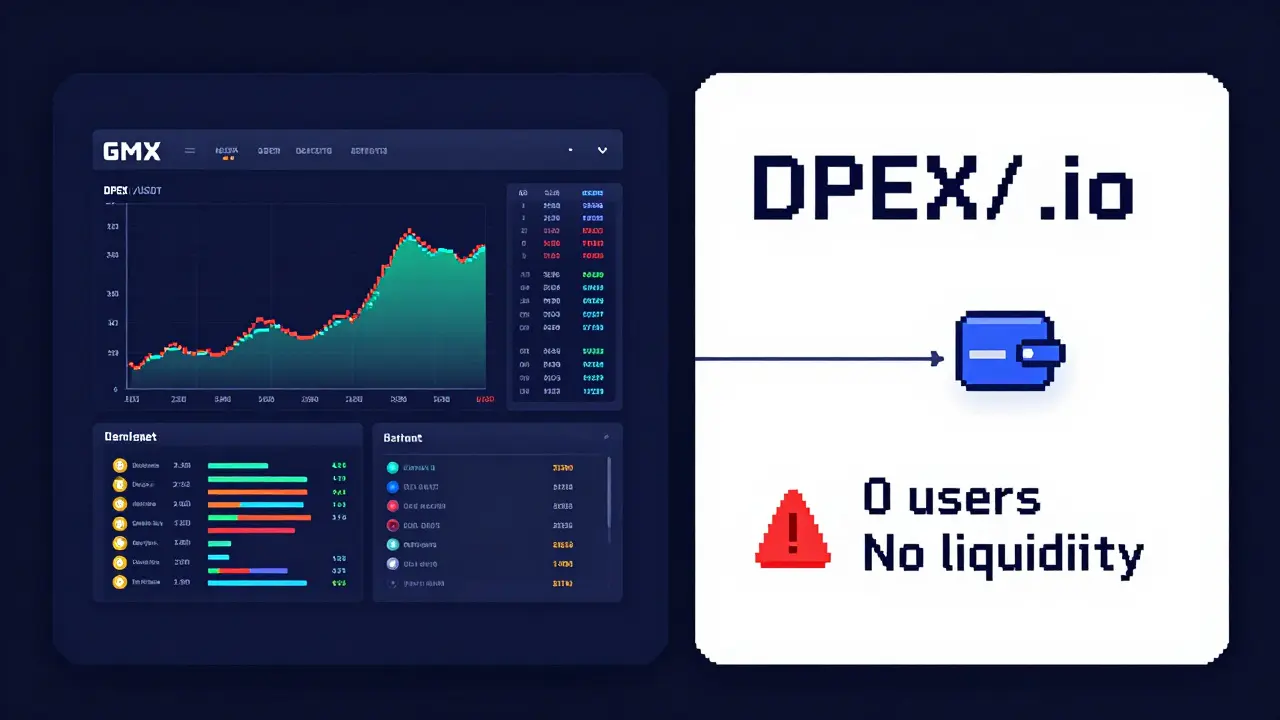
Security and Non-Custodial Design
DPEX’s biggest strength is also its biggest selling point: you never give up control of your funds. Your wallet holds your collateral. Your trades are executed on-chain. No one can freeze your account. No one can hack your balance - unless you lose your private key.
The platform uses smart contracts audited by reputable firms. The price oracle system - combining five centralized exchanges with Chainlink - reduces the chance of manipulation. Liquidations are triggered only when prices stay outside the 2.5% band for a sustained period. That’s smarter than many centralized exchanges that liquidate based on a single data point.
But security isn’t just about code. It’s about community. And DPEX has almost none. There are zero reviews on Trustpilot. No Reddit threads. No Twitter threads from real users. No YouTube tutorials. No Discord community with thousands of members. Just a website and a whitepaper.
Who Is DPEX.io Really For?
DPEX isn’t for beginners. It’s not for casual traders. It’s not even for most DeFi users.
This platform is built for one niche group: experienced perpetual traders who:
- Already understand leverage, liquidation risks, and funding rates
- Use Polygon regularly and are comfortable with web3 wallets
- Want to avoid centralized exchange risks
- Are willing to trade in near-zero liquidity for the principle of decentralization
If you’re looking to trade Bitcoin with 50x leverage on a platform with real depth, DPEX won’t help you. You’ll get filled faster, with tighter spreads, and better pricing on GMX or Bybit.
But if you’re a DeFi purist who believes in the ideology of non-custodial trading - and you’re okay with almost no volume - then DPEX is a technical experiment worth watching. It’s a proof of concept. Not a product.
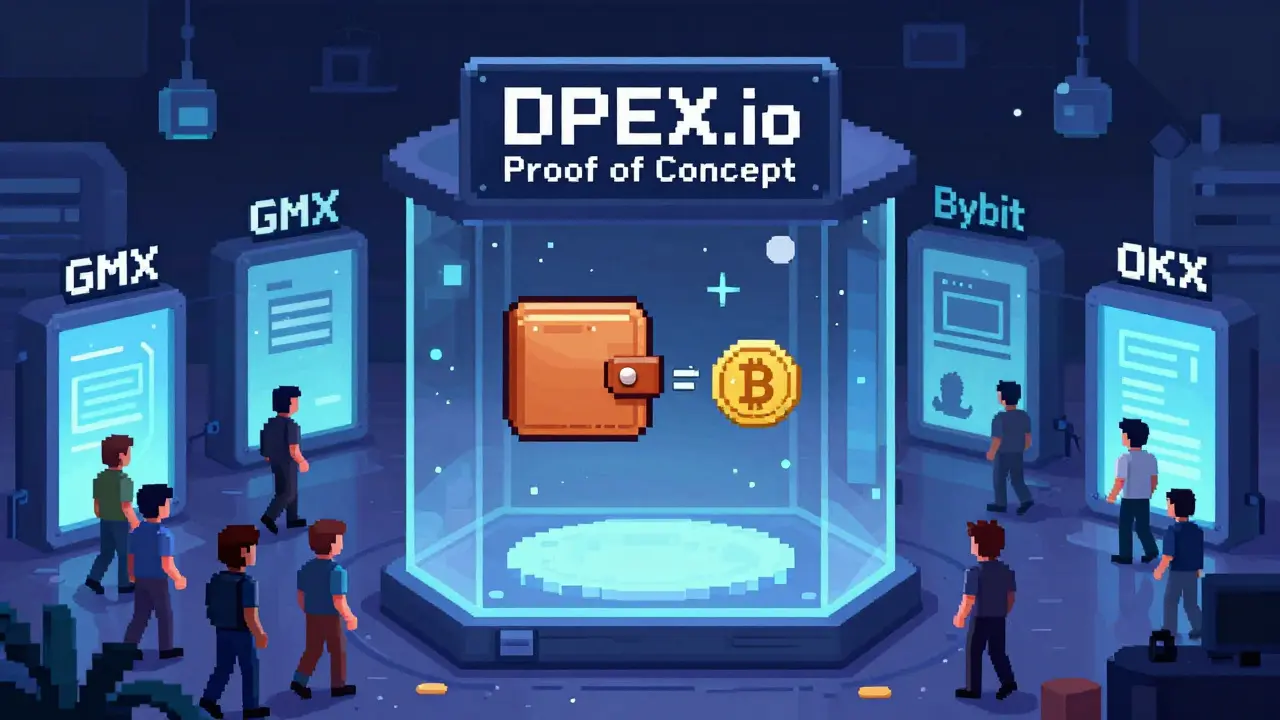
SmartOTC and Institutional Ambitions
In December 2023, DPEX launched SmartOTC - a peer-to-peer decentralized over-the-counter platform aimed at crypto funds, DAOs, and family offices. The idea was to let institutions trade large volumes without moving the market. Sounds smart. But there’s no evidence anyone is using it.
No press releases. No case studies. No public announcements from institutions. The feature exists on paper, but not in practice. That’s the pattern with DPEX: big promises, tiny results.
What’s Missing?
DPEX has the tech. But it’s missing everything else:
- Trading pairs - Only DPEX/USDT. No BTC, ETH, SOL, or any major asset.
- Liquidity - $15.74 in 24-hour volume is not a market. It’s a glitch.
- User base - No reviews, no community, no engagement.
- Documentation - No detailed guides, no video tutorials, no FAQ.
- Support - No live chat, no email, no help center.
- Roadmap - No announced updates since SmartOTC.
Compare that to GMX, which offers 10+ trading pairs, $150M+ daily volume, a thriving Discord, regular updates, and integrations with major wallets like Phantom and Rabby. DPEX doesn’t just lag behind - it’s barely on the map.
The Bottom Line
DPEX.io is a technically interesting idea. It solves real problems: counterparty risk, high fees, and slippage. Its architecture is clean. Its price feed is robust. Its fee distribution model is fair.
But none of that matters if no one uses it.
As of March 2026, DPEX.io remains a ghost town. You can connect your wallet. You can open a position. You can even make a profit. But if you need to exit, you’ll be waiting. If you want to trade anything other than DPEX/USDT, you can’t. If you need help, you’re on your own.
This isn’t a crypto exchange you should use. It’s a lab experiment. A test case. A warning.
For now, stick with GMX, Bybit, or OKX if you want to trade perpetuals. DPEX.io? It’s not ready. And it might never be.
Is DPEX.io safe to use?
Technically, yes - your funds stay in your wallet, and the smart contracts are audited. But safety isn’t just about code. With almost zero trading volume and no community, you’re taking on extreme liquidity risk. If you need to close a position, you might not find a counterparty. There’s also no customer support. You’re entirely on your own.
Can I trade Bitcoin or Ethereum on DPEX.io?
No. As of March 2026, DPEX.io only supports one trading pair: DPEX/USDT. You cannot trade BTC, ETH, SOL, or any other major cryptocurrency. This severely limits its usefulness for anyone looking to hedge or speculate on mainstream assets.
How do I get started with DPEX.io?
You need a web3 wallet like MetaMask or WalletConnect, funded with USDT on the Polygon network. Go to dpex.io, connect your wallet, select DPEX/USDT, choose your leverage (up to 50x), and open your position. There’s no onboarding, no tutorial, and no support - just a bare interface. If you’re not already familiar with DeFi trading, this will be confusing.
Why is DPEX.io’s trading volume so low?
Because almost no one uses it. The platform launched with little marketing, no community building, and no integrations with major wallets or DeFi dashboards. It lacks liquidity providers, lacks visibility, and lacks trust. Without users, there’s no volume. Without volume, there’s no reason for users to come.
Is DPEX.io listed on major exchanges like Binance or Coinbase?
No. The DPEX token is only listed on Uniswap V2 (Polygon) as an untracked asset. It’s not available on any centralized exchange. This makes it nearly impossible for new users to buy the token, and it further isolates the platform from mainstream adoption.


Patty Atima
March 17, 2026 AT 18:03Billy Karna
March 18, 2026 AT 01:21rajan gupta
March 19, 2026 AT 08:03they build castles in the sky and forget to lay the foundation 🏰💀
i miss when we just traded for fun, not for "decentralized ideology" 🤡
DPEX is like a Ferrari with no gas 🚗⛽️
the code works, the concept is holy, but no one has a credit card 💸
i cried when i saw $15.74 volume 🥲😭
this isn't DeFi - it's performance art 🎭
we're all just waiting for the rug pull now... or the "surprise airdrop" 🎁
i'm so emotionally drained from watching this unfold 😔
why do we keep doing this to ourselves?? 💔
Cheri Farnsworth
March 19, 2026 AT 09:06Gene Inoue
March 20, 2026 AT 06:05Ricky Fairlamb
March 20, 2026 AT 21:56Arlene Miles
March 21, 2026 AT 15:50Jessica Beadle
March 23, 2026 AT 08:21Lucy de Gruchy
March 24, 2026 AT 13:55Lauren J. Walter
March 25, 2026 AT 23:46i mean... congrats?
i guess?
i'm just here for the drama 😐
S F
March 26, 2026 AT 06:21Anastasia Danavath
March 26, 2026 AT 18:02anshika garg
March 28, 2026 AT 02:41Bruce Doucette
March 28, 2026 AT 23:20Marie Vernon
March 29, 2026 AT 03:29Ross McLeod
March 29, 2026 AT 22:21Tony Weaver
March 30, 2026 AT 19:44Brenda White
April 1, 2026 AT 06:05