
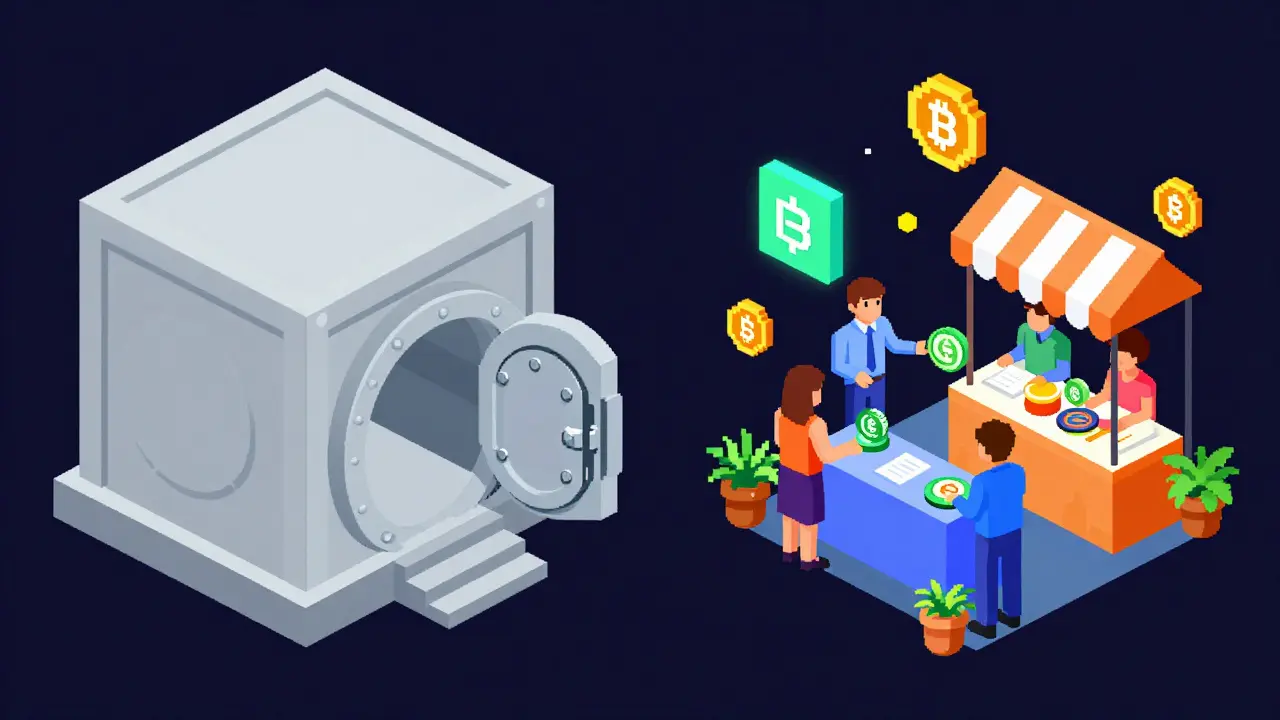
Ever felt like you're handing over your house keys every time you deposit money into a big exchange? That's exactly how centralized exchanges work. You give them your funds, they hold the keys, and you just hope they don't go bust or freeze your account. But there's a different way. A DEX is a decentralized exchange, a peer-to-peer marketplace where you trade cryptocurrencies directly from your own wallet without any middleman. Also known as Decentralized Exchange, it flips the script on traditional finance by using smart contracts instead of corporate boardrooms. If you're tired of KYC forms and want total control over your assets, a DEX might be your best bet, but it comes with a learning curve that can be brutal if you're not prepared.
The Core Difference: Who Holds the Keys?
The biggest divide in the crypto world is between CEXs (Centralized Exchanges) and DEXs. Think of a CEX like a traditional bank; they verify your ID, hold your money, and can stop you from withdrawing if they suspect something. A DEX is more like a farmer's market. You bring your goods, find a trade, and swap right there on the spot. Because it's non-custodial, your private keys never leave your wallet.
This setup removes "counterparty risk." You aren't trusting a CEO or a company to keep your coins safe; you're trusting the code. However, this means there is no "forgot password" button. If you lose your seed phrase, your funds are gone forever. It's total freedom, but with total responsibility.
How DEXs Actually Work: The Three Main Types
You can't just put a traditional order book on a blockchain without it becoming incredibly slow and expensive. To solve this, developers created different architectures. Depending on which DEX you use, the backend looks very different.
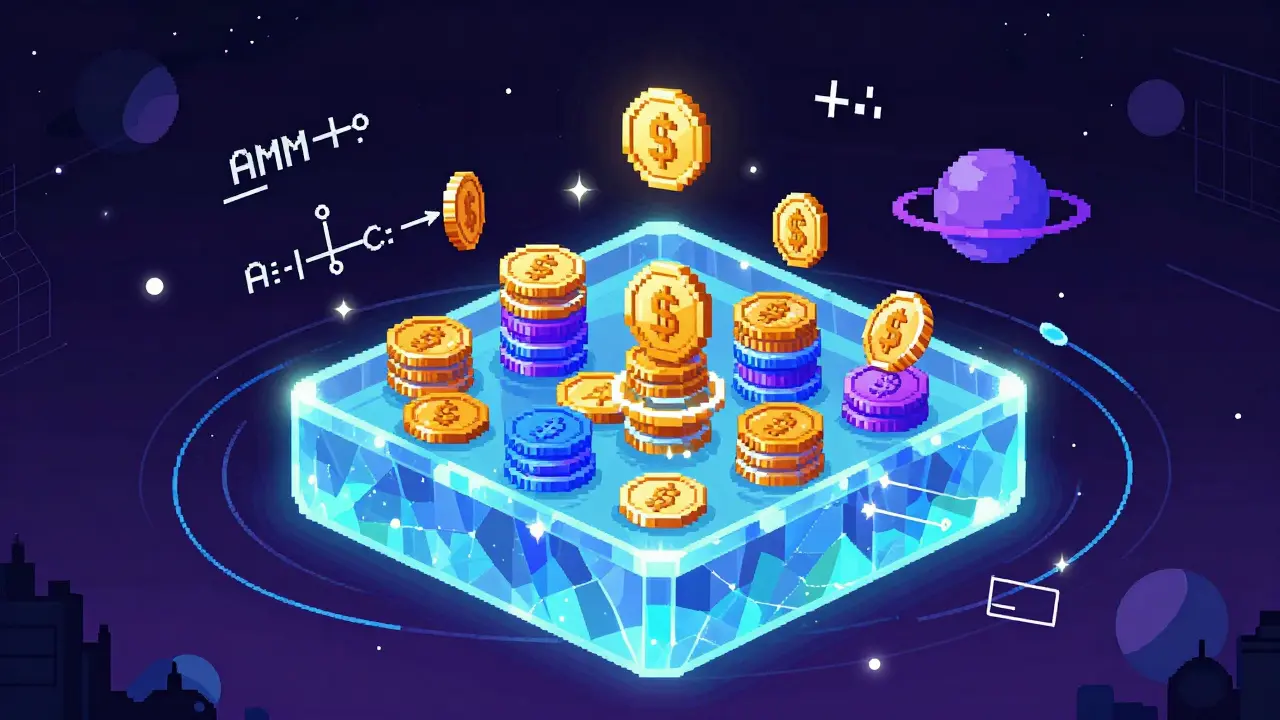
- Automated Market Makers (AMMs): These are the most common. Instead of matching a buyer with a seller, you trade against a pool of assets. Platforms like Uniswap use a mathematical formula to set the price based on how much of each coin is in the pool. If people buy a lot of one token, the price goes up automatically.
- Order Book DEXs: These feel like a professional trading platform. They match specific buy and sell orders in real-time. dYdX is a prime example, offering a more traditional trading experience but without the central authority.
- DEX Aggregators: Imagine a search engine for trades. An aggregator like 1inch scans multiple DEXs to find you the best price and lowest slippage, then routes your trade through the most efficient path.
| Feature | DEX (Decentralized) | CEX (Centralized) |
|---|---|---|
| Custody | Non-custodial (You hold keys) | Custodial (Exchange holds keys) |
| KYC/Identity | None (Permissionless) | Required (ID Verification) |
| Asset Range | Massive (Including new tokens) | Curated (Vetted tokens) |
| Fiat On-ramp | No (Crypto-to-Crypto only) | Yes (Bank transfer/Card) |
| Control | Full control over assets | Dependent on exchange terms |
The Hidden Costs: Gas Fees and Slippage
Trading on a DEX isn't free, and the costs can be unpredictable. Since every trade is a transaction on a blockchain, you have to pay a "gas fee" to the network validators. On the Ethereum network, these fees can skyrocket during busy periods. Imagine trying to swap $20 worth of tokens but finding out the network fee is $50. It's a common shock for beginners. This is why many traders are moving toward faster, cheaper chains like Solana or Layer 2 solutions like Arbitrum.
Then there's slippage. This is the difference between the price you expect and the price you actually get. If you're trading a coin with low liquidity, a large order can push the price up or down significantly during the transaction. If you set your slippage tolerance too low, your trade might fail repeatedly. If you set it too high, you might get ripped off by a bot. A good rule of thumb is 0.5% to 1% for stablecoins and maybe 3% for volatile "moonshot" tokens.
Getting Started: Your Technical Checklist
You can't just sign up for a DEX with an email and password. You need a gateway to the blockchain. Most people start with a non-custodial wallet like MetaMask or Trust Wallet. This is where your funds actually live.
- Set up your wallet: Download a reputable wallet and write down your seed phrase on paper. Never store this digitally.
- Fund your account: You'll need the native token of the network you're using to pay for gas (e.g., ETH for Ethereum, SOL for Solana).
- Connect to the DEX: Navigate to the official site of the DEX and click "Connect Wallet."
- Select your pair: Choose the token you have and the token you want.
- Adjust Slippage: Check the liquidity of the pool and set your tolerance accordingly.
- Approve and Swap: You'll usually have to "approve" the token spend first, then confirm the actual swap transaction in your wallet.

The Risks: Smart Contracts and Scams
DEXs are generally safer from "bank runs," but they are vulnerable to code failures. Smart contract bugs can lead to exploits. In 2022, millions were lost to flash loan attacks and bridge exploits. While a CEX might have an insurance fund, a DEX has no one to call if the code has a hole in it. You are essentially betting on the quality of the audit performed on the protocol.
Phishing is another massive danger. You might encounter a fake DEX site that asks you to "sign a transaction" to unlock a reward. In reality, that signature gives the attacker permission to drain every single token in your wallet. Always double-check the URL and never share your private keys with anyone, regardless of how official they seem.
Is the DEX Life for You?
If you're a casual investor who just wants to buy some Bitcoin and hold it for five years, a CEX is probably easier. The interface is cleaner, and the onboarding is faster. But if you're interested in the world of DeFi (Decentralized Finance), want to trade tokens before they hit the big exchanges, or simply refuse to give your ID to a corporation, the DEX is your playground.
The future is leaning toward DEX aggregators and cross-chain protocols. We're seeing a shift where users no longer care which specific pool they are using; they just want the best price across the entire ecosystem. As network fees drop due to upgrades like Ethereum's Dencun, the barrier to entry is disappearing, making decentralized trading accessible to everyone, not just the tech-savvy.
Can I buy crypto with a credit card on a DEX?
Generally, no. DEXs only facilitate crypto-to-crypto swaps. To get started, you usually need to buy crypto on a centralized exchange (like Coinbase) or via a third-party on-ramp and then send those funds to your non-custodial wallet.
What happens if I set my slippage too low?
If the price moves against you by more than your set percentage before the transaction is confirmed on the blockchain, the trade will fail. You will still pay the gas fee for the attempted transaction, but no tokens will be swapped.
Are DEXs legal?
Most DEX protocols are permissionless code running on a blockchain, which makes them hard to regulate. However, governments are starting to target the interfaces (the websites you use to access the DEX). Depending on your region, some interfaces may require KYC for certain features.
Why are some DEX trades so expensive?
The cost isn't actually the DEX's fee, but the network's gas fee. When many people use the blockchain at once, the cost to prioritize your transaction goes up. This is especially common on Ethereum during high-traffic events.
How do I avoid scams on a DEX?
Only use official links, never share your seed phrase, and be wary of tokens that promise impossible returns. Use a "burner wallet" (a secondary wallet with only a small amount of funds) when interacting with brand new or unverified projects.


Suvoranjan Mukherjee
April 7, 2026 AT 16:26Great breakdown of the ecosystem! For anyone diving into AMMs, keep an eye on impermanent loss if you decide to provide liquidity. It's a critical concept where the divergence in price between the paired assets can eat into your profits compared to just HODLing. Also, checking the TVL (Total Value Locked) on DeFiLlama before swapping can give you a better idea of the pool's health and stability. Always double-check the contract address on Etherscan to avoid those nasty honeypot tokens! 🚀
Adriana Gurau
April 9, 2026 AT 05:26Imagine actually thinking that using a DEX makes you a "tech genius" 🙄. It's basically just a glorified vending machine for digital tokens. Most of these "moonshots" mentioned are just pump-and-dump schemes for people who can't read a whitepaper 💅.
JERRY ORTEGA
April 9, 2026 AT 15:08just a heads up for the newbies... use a hardware wallet if you're moving serious money. metamask is fine for a few bucks but cold storage is where the real peace of mind is. dont let the hype rush you into a mistake
Emily 2231
April 11, 2026 AT 12:46The implementation of non-custodial systems is the only logical defense against the inevitable surveillance state. These corporate entities seek total dominion over our financial autonomy. I shall remain vigilant and keep my assets far from their reach.
Sonya Bowen
April 12, 2026 AT 03:13Self-sovereignty is the ultimate goal here. Trust the math, not the man.
June Coleman
April 12, 2026 AT 19:49Oh sure, because losing your life savings because you misplaced a piece of paper is just a fantastic feature of total freedom. Truly a masterpiece of design. 🙄
Carol Prates
April 13, 2026 AT 23:31Omg June is so right! I once saw someone lose their entire portfolio because of a typo in a seed phrase and it was literally the most tragic thing I've ever heard. I honestly can't even imagine the stress of that moment, just absolute chaos!
Robert Coskrey
April 15, 2026 AT 06:13I completely agree with the points mentioned regarding slippage... It is indeed a frustrating aspect of decentralized trading!!! One must be very diligent when setting parameters!!!
shubhu patel
April 16, 2026 AT 14:31I tend to agree that the shift towards aggregators is very beneficial because it takes the guesswork out of finding the best rates, and while it might seem complex at first, once you get the hang of the interface it really simplifies the whole process of moving assets between different liquidity pools without having to manually check five different tabs.
Lauren Gilbert
April 18, 2026 AT 04:25There is something poetic about the transition from trusting a boardroom to trusting a smart contract, as it shifts the burden of trust from human fallibility to mathematical certainty, which in a way reflects a deeper philosophical evolution in how we perceive value and ownership in the digital age, moving away from centralized power structures toward a more distributed and egalitarian form of existence where the individual is finally the sole arbiter of their own wealth.
Carmelita Gonzales
April 18, 2026 AT 10:25be careful with the burner wallets mention... really helps to keep the main stash safe
Nicholas Whooley
April 20, 2026 AT 04:54It is heartening to see such a comprehensive guide for newcomers. I believe that with patience and a willingness to learn, everyone can navigate these waters safely and benefit from the innovations of DeFi.
Brooke Herold
April 21, 2026 AT 17:49It's interesting to see how different cultures are adopting this technology at different speeds. In some places, the lack of traditional banking makes DEXs not just a choice, but a necessity for financial inclusion, and seeing the community support each other through the learning curve is really the best part of this whole experience.