
Imagine making a million dollars in Bitcoin trades, only to have half vanish into taxes and legal fees. For many traders, this is the harsh reality of operating in restrictive financial hubs. But what if you could trade in a place where the government actually wants you there? Where your profits stay yours, and the rules are written in plain English rather than buried in bureaucratic red tape?
In 2026, the landscape of crypto-friendly jurisdictions has shifted dramatically. It’s no longer just about finding a loophole; it’s about choosing an ecosystem that supports your lifestyle, banking needs, and long-term goals. With over $14 trillion in global crypto trading volume recorded in 2024, governments are waking up. They see the money, they want the talent, and they are competing fiercely to be your home base.
However, not all "friendly" jurisdictions are created equal. Some offer zero tax but terrible banking. Others provide rock-solid legal protection but charge hefty corporate rates. This guide cuts through the noise to compare the top destinations for traders in 2026, helping you decide where to set up shop based on your specific trading style, capital, and risk tolerance.
The Big Three: UAE, Switzerland, and Singapore
When we talk about the elite tier of crypto jurisdictions, three names consistently dominate the conversation: the United Arab Emirates, Switzerland, and Singapore. These aren't just tax havens; they are fully integrated financial ecosystems with robust infrastructure.
| Jurisdiction | Capital Gains Tax (Individual) | Corporate Tax Rate | Key Regulatory Body | Banking Access Rating |
|---|---|---|---|---|
| United Arab Emirates (UAE) | 0% | 0% (Free Zones) / 9% (Mainland) | VARA / FSRA | High (Specialized Banks) |
| Switzerland | 0% (Personal Holdings) | 8.5% - 21% (Canton dependent) | FINMA | Very High |
| Singapore | 0% | 17% | MAS | Medium-High |
| Hong Kong | 0% (No CGT Law) | 16.5% | SFC | High |
| Panama | 0% | 25% (Territorial Tax) | No Specific Regulator | Low-Medium |
The United Arab Emirates has surged to the #1 spot in 2025-2026 rankings, driven by aggressive government investment. Specifically, free zones like Abu Dhabi Global Market (ADGM) and Dubai International Financial Centre (DIFC) offer a 0% corporate tax rate for crypto businesses. The real game-changer here is the regulatory clarity provided by the Virtual Assets Regulatory Authority (VARA). Established in 2022, VARA provides a clear roadmap for licensing. While the process can take 4-6 months and requires significant capital (minimum AED 1 million or ~$272,000 for certain activities), the payoff is immense. You keep 100% of your trading profits, and you gain access to a growing network of crypto-friendly banks like Abu Dhabi Islamic Bank (ADIB).
Switzerland remains the gold standard for institutional trust. The Swiss Financial Market Supervisory Authority (FINMA) introduced its token classification framework back in 2019, creating one of the most predictable environments in the world. For individual traders, personal crypto holdings are exempt from capital gains tax. However, beware: if you trade frequently enough to be considered a professional, your income is taxed at rates between 22% and 40%, depending on your canton. Zug, known as "Crypto Valley," processes 80% of Europe's institutional crypto transactions. The banking relationship is strong-90% of Swiss banks now service crypto businesses-but the cost of living and setup is high.
Singapore offers a different value proposition: stability and sophistication. The Monetary Authority of Singapore (MAS) enforces strict Anti-Money Laundering (AML) rules under the Payment Services Act. There is no capital gains tax, which is huge for traders. However, the corporate tax rate sits at 17%, and the compliance burden is heavy. You need proof of source of funds, and the minimum paid-up capital for major payment institutions is SGD 500,000 (~$367,000). It’s ideal for those who prioritize regulatory prestige over pure tax minimization.
Hidden Gems: Panama, El Salvador, and Puerto Rico
If the Big Three feel out of reach due to high capital requirements or complex licensing, there are alternative jurisdictions that cater to retail traders and digital nomads.
Panama has emerged as a surprising contender for US-based traders seeking proximity. In 2023, Panama’s Ministry of Economy and Finance issued ruling 03-2023, confirming that there is no capital gains tax on cryptocurrency transactions. This makes it incredibly attractive for active traders. However, the infrastructure isn’t as developed as Dubai or Zurich. Banking can be tricky, and you’ll likely rely more on decentralized finance (DeFi) protocols for liquidity. It’s a great option if you’re comfortable navigating a less formalized financial system.
El Salvador took the boldest step in 2021 by adopting Bitcoin as legal tender. On paper, it looks perfect: no capital gains tax on crypto, and businesses must accept Bitcoin. In practice, it’s mixed. Dr. Angela Walch noted in her 2025 testimony that 73% of merchants use third-party processors to instantly convert Bitcoin to USD, undermining the legal tender status. For traders, the lack of capital gains tax is real, but banking access scores low (only 32% success rate in recent polls). It’s a high-risk, high-reward jurisdiction best suited for those already embedded in the Latin American market.
For US citizens, Puerto Rico remains a unique loophole. Under Act 60 (amended in 2023), qualifying residents can enjoy 0% capital gains tax on crypto. The catch? You must maintain physical presence for 183 days a year (recently clarified to require significant ties). Many traders successfully navigate this, but it requires careful planning to avoid IRS scrutiny. It’s not an offshore haven-it’s a domestic territory with special tax laws. If you’re already in the US, this might be the easiest path to tax efficiency without relocating entirely.
Banking: The Silent Killer of Crypto Dreams
You can have the best tax rate in the world, but if you can’t move your fiat money in and out, it’s useless. Banking access is the single biggest pain point for crypto traders globally. A 2025 Telegram poll of 1,247 active traders revealed that 68% cited banking access as more critical than tax rates.
Here’s the breakdown:
- UAE: 72% success rate. Banks like ADIB and Mashreq have dedicated crypto desks. Still, expect rigorous KYC (Know Your Customer) checks.
- Switzerland: 65% success rate. Sygnum Bank serves 85% of institutional clients. Traditional banks are warming up, but they still view frequent traders skeptically.
- Singapore: 58% success rate. MAS regulations are tight, so banks are cautious. You’ll need impeccable documentation.
- El Salvador: 32% success rate. Local banks are hesitant, forcing traders to use international wire transfers or stablecoins.
To mitigate this, many traders use a hybrid approach. They hold their primary residence in a friendly jurisdiction (like UAE) but maintain secondary bank accounts in neutral countries (like Singapore or Switzerland) for diversification. Always have a backup plan. Relying on a single bank is risky in the crypto space.

Regulatory Trends: What’s Changing in 2026?
The regulatory environment is moving fast. Two major shifts are reshaping how traders choose their bases:
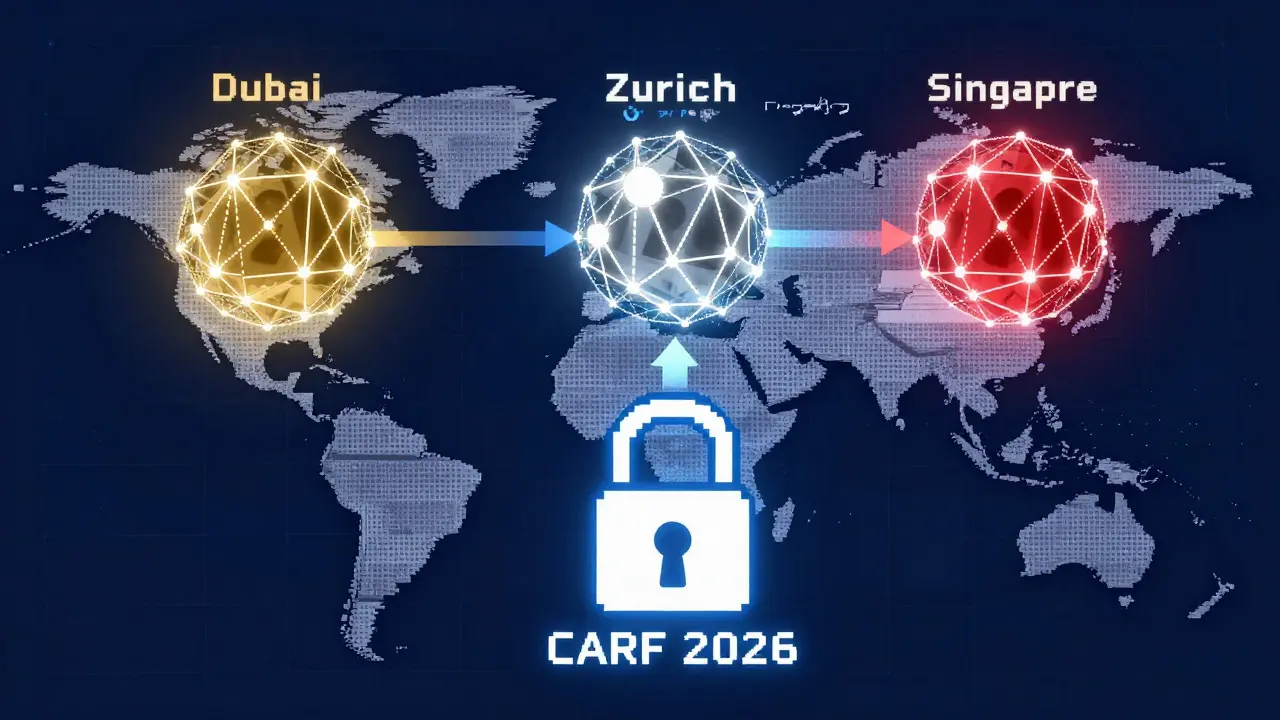
- OECD’s CARF Implementation: Starting in 2026, the Crypto-Asset Reporting Framework (CARF) will begin harmonizing tax reporting across participating countries. This means the days of hiding assets in opaque jurisdictions are ending. If you choose a jurisdiction, ensure it has good information exchange agreements if you hold dual citizenship or other assets abroad.
- Energy Transition Metrics: The World Economic Forum’s April 2025 report highlighted that sustainable energy is becoming a prerequisite for institutional investment. Countries like Iceland, Norway, and Canada are gaining ground because their crypto operations are powered by renewable energy. If you’re running mining operations alongside trading, consider these green havens.
Additionally, the EU’s MiCA regulations, fully implemented in June 2024, have raised the bar for European neighbors. Switzerland and Liechtenstein have enhanced their frameworks to remain competitive, ensuring that traders in Europe still have viable options without leaving the continent.
How to Choose Your Jurisdiction
So, where should you go? It depends on your profile:
- The High-Frequency Trader: Go to Singapore or UAE. Zero capital gains tax and sophisticated infrastructure allow you to scale quickly. Just budget for the high setup costs and compliance officers.
- The Long-Term Holder: Switzerland or Panama works well. Personal holdings are often exempt from capital gains tax. Focus on jurisdictions with strong property rights and political stability.
- The Institutional Player: Switzerland (Zug) or UAE (ADGM). You need banking relationships that can handle large volumes. These jurisdictions offer the credibility required by institutional partners.
- The Budget-Conscious Nomad: Panama or Malaysia. Lower cost of living, simple registration, and favorable tax treatment make these accessible for smaller portfolios.
Avoid jurisdictions that rely solely on tax advantages without regulatory substance. Malta, once a top pick, has seen its appeal diminish due to high business income taxes on frequent trading (35%) and shifting political winds. As Deloitte’s 2025 Blockchain Survey warns, jurisdictions without regulatory depth face significant correction risks as global standards evolve.
Practical Steps to Relocate
Relocating for crypto isn’t just about picking a country; it’s a logistical project. Here’s a realistic timeline:
- Month 1-2: Consult with a local crypto-specialized lawyer. Don’t use generalists. You need someone who understands VARA, FINMA, or MAS nuances.
- Month 3-4: Apply for residency visas. UAE requires proof of $180,000 annual income for certain investor visas. Start gathering documents early.
- Month 5-6: Set up corporate entities and open bank accounts. Expect delays. Have multiple banks lined up.
- Month 6+: Full compliance setup. Implement KYC/KYB procedures if you’re running a business. The FATF Travel Rule now requires full identity verification for transactions over $1,000 in 92% of jurisdictions.
Don’t rush. A hasty move can lead to rejected visa applications or frozen bank accounts. Take your time to build relationships with local professionals.
Frequently Asked Questions
Is crypto trading legal in all these jurisdictions?
Yes, in the jurisdictions discussed (UAE, Switzerland, Singapore, Hong Kong, Panama, El Salvador), crypto trading is legal. However, legality varies by activity. Retail trading is generally permitted everywhere, but operating an exchange or providing custody services requires specific licenses (e.g., VARA in UAE, SFC in Hong Kong). Always check the specific license requirements for your business model.
Can I live in a crypto-friendly jurisdiction without being a citizen?
Absolutely. Most top jurisdictions offer residency-by-investment or freelance visa programs. The UAE has the Golden Visa for investors and freelancers. Switzerland offers settlement permits for entrepreneurs. Singapore has the EntrePass. These visas allow you to live and work legally while benefiting from the local tax regime, provided you meet income or investment thresholds.
What is the difference between capital gains tax and income tax for traders?
This is crucial. Capital gains tax applies to profits from selling assets held for investment. Income tax applies to profits from regular trading activities. In Switzerland, personal holdings are exempt from capital gains tax, but if you trade frequently, authorities may classify you as a professional trader, subjecting your profits to income tax (22-40%). In Singapore and UAE, there is no capital gains tax, and corporate income tax is low or zero, making them safer for active traders.
Why is banking access such a big issue?
Traditional banks are risk-averse. They fear regulatory fines for handling crypto-related funds. Even in friendly jurisdictions, banks conduct rigorous due diligence. If they perceive your trading strategy as high-risk (e.g., leverage, DeFi interactions), they may close your account. Specialized crypto banks (like Sygnum in Switzerland) are safer but often have higher fees and stricter eligibility criteria.
Is Portugal still a good option for crypto traders?
Not anymore. Portugal was once a top choice due to its 0% capital gains tax on crypto. However, in 2024, it introduced a 28% tax on crypto gains, dropping it out of the top 10 crypto-friendly jurisdictions. Unless you have other reasons to live in Portugal, it is no longer a tax-efficient hub for traders compared to UAE or Singapore.
How does the OECD’s CARF affect my privacy?
The Crypto-Asset Reporting Framework (CARF), launching in 2026, aims to standardize tax reporting for crypto assets across participating countries. It means that if you hold crypto in a CARF-participating jurisdiction, your tax authority may receive information about your holdings. Privacy is decreasing globally. Choose jurisdictions that are transparent and compliant to avoid future penalties, rather than trying to hide assets in opaque systems.
Next Steps and Troubleshooting
If you’re ready to move, start with a self-audit. How much capital do you have? What’s your trading frequency? Do you need a physical office or can you work remotely?
For High-Net-Worth Individuals: Engage a family office in Switzerland or UAE. They can structure your wealth to optimize tax and estate planning.
For Solo Traders: Consider the UAE’s freelance visa or Panama’s friendly nation visa. Keep your overhead low and focus on banking relationships.
Troubleshooting Banking Rejections: If a bank rejects you, ask for the specific reason. Is it source of funds? Trading volume? Often, providing audited statements or using a crypto-native bank as your primary partner can resolve this.
The world is opening up for crypto traders, but it rewards those who do their homework. Choose wisely, comply strictly, and protect your gains.