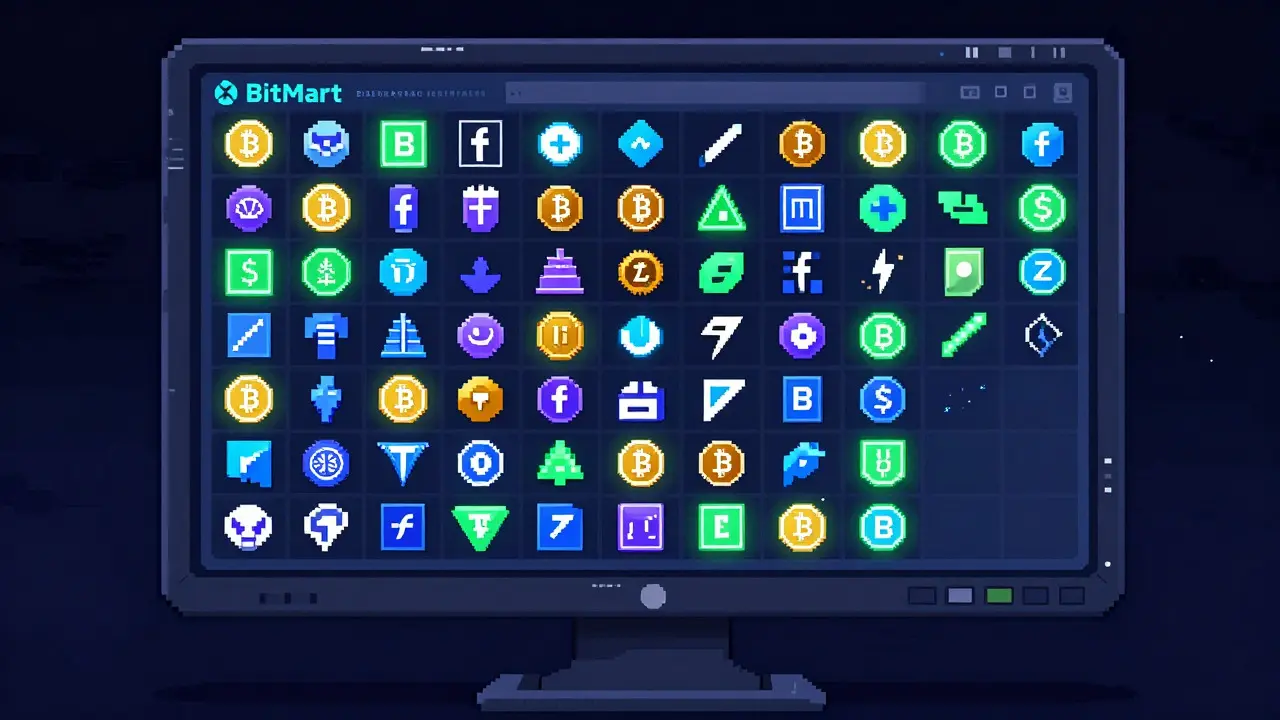
Buying cryptocurrency isn't just about Bitcoin anymore. If you are hunting for the next big meme coin or a niche altcoin that hasn't hit the mainstream yet, you need a platform that lists them early. That is where BitMart is a mid-tier centralized cryptocurrency exchange founded in 2017, known for listing over 1,400 digital assets including many small-cap and meme coins before larger competitors do. Headquartered in the Cayman Islands, it has grown to serve over 12 million users globally. But here is the catch: does listing obscure coins come at the cost of safety? Is your money safe there?
In this review, we cut through the marketing hype. We look at the real costs, the security track record, and whether BitMart is actually worth your trust in 2026. You will find out if this platform fits your trading style or if you should stick to the giants like Binance or Coinbase.
The Quick Takeaways
- Best For: Traders seeking access to new, low-cap altcoins and meme tokens not available on major exchanges.
- Fees: Competitive futures fees (0.02% maker) but spot fees can be higher than top-tier rivals.
- Security: Has an 'A' rating from some auditors but lacks public Proof of Reserves; had a hack in 2021.
- Availability: Available in 180+ countries, but banned in the US and UK.
- Verdict: Good for speculative traders who know the risks; avoid if you prioritize maximum regulatory safety.
What Exactly Is BitMart?
BitMart operates as a Centralized Exchange (CEX) is a platform that acts as an intermediary between buyers and sellers, holding custody of user funds and matching orders via its own engine. This is different from decentralized exchanges (DEXs) where you hold your own keys. With BitMart, they hold the assets for you. This makes trading faster and easier because you don't have to worry about gas fees on every transaction or managing complex wallet setups.
Founded by Sheldon Xia in 2017, the platform went live in March 2018. Since then, it has positioned itself as a bridge between traditional finance and the wild west of crypto. It processes between $500 million and $1.6 billion in daily volume. That puts it roughly in the top 15-20 exchanges globally by volume. It’s not a tiny startup, but it’s not a household name like Coinbase either.
The main draw? Selection. While big exchanges are cautious about what they list, BitMart casts a wide net. They support over 1,400 cryptocurrencies across 1,700+ trading pairs. If a new token launches with buzz, it’s likely on BitMart within days. This includes their dedicated NFT marketplace and Launchpad for new projects.
Fees: What Will It Cost You?
Trading fees eat into profits. Let's break down exactly what you pay on BitMart compared to the industry standard.
| Fee Type | BitMart | Binance (Standard) | Coinbase Advanced |
|---|---|---|---|
| Spot Trading (Maker/Taker) | 0.25% - 0.40% | 0.10% / 0.10% | 0.40% / 0.60% |
| Futures Trading (Maker/Taker) | 0.02% / 0.06% | 0.02% / 0.05% | N/A |
| Withdrawal Fees | Variable (Network Dependent) | Variable | Variable |
| Fiat Deposit (Card/PayPal) | ~3-5% + Fixed Fee | ~3-5% + Fixed Fee | ~3.99% |
Here is the nuance: BitMart’s spot trading fees (0.25% to 0.40%) are slightly higher than Binance’s base rate of 0.1%. However, they are competitive with Coinbase’s advanced trade tier. The real value proposition appears in derivatives. Their futures trading fees-0.02% for makers-are among the lowest in the industry. If you are a high-volume trader focusing on perpetual contracts with leverage up to 200x, BitMart becomes very attractive.
Remember, these are base rates. Like most exchanges, BitMart offers discounts if you hold their native token or maintain high trading volumes. Always check the current fee schedule before executing large trades.
Security: Is Your Money Safe?
This is the most critical section. In crypto, "not your keys, not your coins" is the golden rule. When you use a CEX like BitMart, you are trusting them with your assets. How well do they handle that trust?
On paper, the numbers look good. Independent evaluator Certified gives BitMart an 'A' security score, ranking it 23rd among the safest exchanges. They use cold storage for the majority of user funds and employ multi-signature wallets. These are standard, necessary practices for any reputable exchange.
However, history matters. In 2021, BitMart suffered a significant security exploit. While they compensated users, the incident raised eyebrows. More importantly, as of 2026, BitMart still lacks a comprehensive, regularly updated Proof of Reserves (PoR) is a cryptographic verification method where an exchange publishes data proving it holds sufficient assets to cover all user liabilities. Following the collapse of FTX in 2022, PoR became a baseline expectation for trust. Without it, you cannot independently verify that BitMart actually holds your Bitcoin or Ethereum.
Industry experts, including analysts at Coin Bureau, have pointed this out repeatedly. They recommend enabling every possible user-side security feature: two-factor authentication (2FA), withdrawal whitelists, and anti-phishing codes. If you keep large amounts on BitMart, you are taking on counterparty risk-the risk that the exchange fails or gets hacked again.
User Experience and Interface
Can you actually use the platform without getting a headache? Yes. BitMart’s interface is clean and intuitive. It avoids the cluttered, overwhelming dashboards that some professional-grade exchanges suffer from.
New users appreciate the simple buy/sell flow. You can connect a credit card, PayPal, or bank transfer to deposit fiat currency. The mobile app mirrors the desktop experience closely, allowing you to trade on the go. For advanced traders, the platform offers charting tools, order types (limit, market, stop-limit), and API access for bots.
One area that consistently draws criticism is customer support. Users report slow response times via chat and email. If you encounter a frozen withdrawal or a login issue during a volatile market spike, waiting hours for a reply is frustrating. This is a common pain point for mid-tier exchanges that lack the massive support infrastructure of Binance or Kraken.
Who Should Use BitMart? (And Who Shouldn't)
Not every exchange is for everyone. Here is how to decide if BitMart fits your profile.
You SHOULD use BitMart if:
- You hunt for gems: You want early access to new altcoins, meme coins, and NFT projects before they list on stricter exchanges.
- You trade futures: You are comfortable with leverage and want low maker fees on derivatives.
- You are outside the US/UK: BitMart is available in 180+ countries but is restricted in the United States and the United Kingdom due to regulatory hurdles.
- You understand the risks: You accept that mid-tier exchanges carry higher counterparty risk and may have slower support.
You SHOULD AVOID BitMart if:
- Safety is your #1 priority: You prefer fully regulated entities with transparent Proof of Reserves and insurance funds.
- You are in the US or UK: You literally cannot sign up easily, and trying to bypass geo-restrictions violates terms of service.
- You are a total beginner: The variety of risky, low-cap coins can lead to losses if you don't know how to research projects thoroughly.
- You need instant support: You require 24/7 responsive human assistance for complex issues.
Alternatives to Consider
If BitMart doesn't feel right, here are three strong alternatives based on different needs.
- Binance: The global leader. Best for liquidity, lowest fees overall, and vast coin selection. However, it faces ongoing regulatory scrutiny worldwide.
- Kraken: Known for superior security, transparency, and customer support. Ideal for users who value safety over having the absolute newest meme coins.
- Coinbase: The most regulated option in the West. Perfect for beginners and US-based traders, though fees are higher and coin selection is more conservative.
Final Thoughts
BitMart fills a specific niche. It is the playground for traders who want exposure to the broader, riskier corners of the crypto market. Its fees are fair, especially for futures traders, and its interface is user-friendly. But it demands caution. The lack of Proof of Reserves and its past security incident mean you should treat it as a hot wallet, not a long-term savings account. Keep only what you plan to trade actively on the platform, and move significant holdings to a hardware wallet like Ledger or Trezor.
In 2026, the crypto landscape is maturing. Regulatory pressure is increasing. BitMart must continue to improve its transparency to remain relevant. Until then, it remains a powerful tool for speculative traders who know exactly what they are doing.
Is BitMart available in the United States or UK?
No. BitMart currently restricts access for residents of the United States and the United Kingdom due to local regulatory requirements. Users in these regions typically need to use platforms like Coinbase, Kraken, or Binance.US.
Does BitMart offer Proof of Reserves?
As of 2026, BitMart does not provide a comprehensive, regularly updated Proof of Reserves dashboard like some top-tier exchanges. This means users cannot independently verify that the exchange holds 1:1 backing for all user deposits. This is a key consideration for risk management.
How much leverage does BitMart offer?
BitMart offers up to 200x leverage on its perpetual futures contracts. This allows traders to amplify their positions significantly, but it also increases the risk of liquidation. Beginners should start with lower leverage ratios.
Is BitMart safe after the 2021 hack?
BitMart has improved its security infrastructure since the 2021 exploit, earning an 'A' rating from security firm Certified. They use cold storage and multi-sig wallets. However, no exchange is immune to risk. Users should enable 2FA and consider BitMart suitable for active trading rather than long-term storage of large sums.
What are the trading fees on BitMart?
Spot trading fees range from 0.25% to 0.40% depending on the asset category. Futures trading is cheaper, with makers paying 0.02% and takers paying 0.06%. These rates are competitive for derivatives but slightly higher than the base rates of giants like Binance for spot trading.
Can I buy crypto with a credit card on BitMart?
Yes. BitMart supports fiat on-ramps via credit/debit cards and PayPal. Be aware that these purchases often incur higher processing fees (typically 3-5%) compared to bank transfers or P2P trading methods.