Imagine watching a financial revolution explode in your country, only to have it crushed by decree within twelve months. That is exactly what happened in Afghanistan, where the Taliban government implemented a comprehensive ban on all cryptocurrency activities in August 2022. Just a year prior, Afghans were rushing to adopt digital assets as their banking system collapsed under international sanctions. Then, with a single policy shift rooted in religious interpretation, the state declared these tools forbidden. This article breaks down why this ban happened, how it contrasts with global trends, and why people are still trading Bitcoin in secret despite the risk of arrest.
The Rise and Fall of Afghan Crypto Adoption
To understand the ban, you first need to grasp the adoption spike that triggered it. In 2021, following the Taliban's return to power, Afghanistan faced an economic freefall. Foreign reserves froze, banks ran out of cash, and the local currency plummeted. For ordinary citizens, traditional finance became inaccessible. Cryptocurrency stepped into the void. According to Chainalysis data from that period, Afghanistan jumped to rank 20th out of 154 countries in global crypto adoption indices. This wasn't speculative frenzy driven by wealth; it was survival. People used stablecoins like USDT to preserve value against inflation and Bitcoin for remittances when SWIFT transfers failed.
However, this rapid integration alarmed the new rulers. The Taliban viewed this decentralized financial layer as a threat to their authority and, more importantly, as incompatible with their strict interpretation of Islamic law. By August 2022, the honeymoon ended. Authorities issued an official directive halting all domestic Bitcoin trading. They didn't just regulate it; they prohibited it entirely, labeling such activities as "haram" or forbidden.
Religious Grounds and Legal Framework
The core argument for the prohibition rests on Sharia law principles regarding uncertainty and speculation. Taliban officials argued that cryptocurrencies lack backing by real-world assets, making them akin to gambling rather than legitimate commerce. In Islamic finance, transactions must involve tangible goods or clear services. Digital tokens, which exist purely as entries on a distributed ledger, were deemed too speculative.
| Aspect | Details |
|---|---|
| Legal Status | Complete Ban (Illegal) |
| Justification | Sharia Law (Haram due to speculation/lack of asset backing) |
| Enforcement Body | Taliban Ministry of Information and Culture / Da i Khanah |
| Primary Targets | Exchanges, Miners, Forex Traders |
| Penalties | Arrests, Fines, Confiscation of Assets |
This legal stance created a rigid framework. Unlike countries that tax crypto or require licenses, Afghanistan offers no middle ground. There is no legal recognition for any digital asset operation. If you hold Bitcoin, you hold it at your own risk. If you trade it, you are technically breaking the law. The enforcement structure includes indefinite suspension of exchanges and periodic crackdowns on miners. Yet, the decentralized nature of peer-to-peer networks makes total eradication nearly impossible.
Global Context: An Outlier Among Nations
It helps to look at who else bans crypto. As of 2026, Afghanistan remains one of only nine countries globally that prohibit Bitcoin usage outright. Most other nations have moved toward regulation or acceptance. Morocco lifted its ban in 2024, recognizing the potential for fintech growth. China maintains a strict ban but continues to develop its central bank digital currency. Iraq banned crypto in 2017 for financial security reasons, yet informal trading persists there too.
The trend is overwhelmingly toward accommodation. Governments increasingly see digital assets as part of the modern economy rather than a pariah. Afghanistan’s position places it firmly outside this mainstream. Experts suggest the likelihood of new global bans is low because isolation hurts economies. When a country bans crypto, it often drives activity underground, losing tax revenue and visibility while failing to stop the technology itself.

The Underground Market and Humanitarian Impact
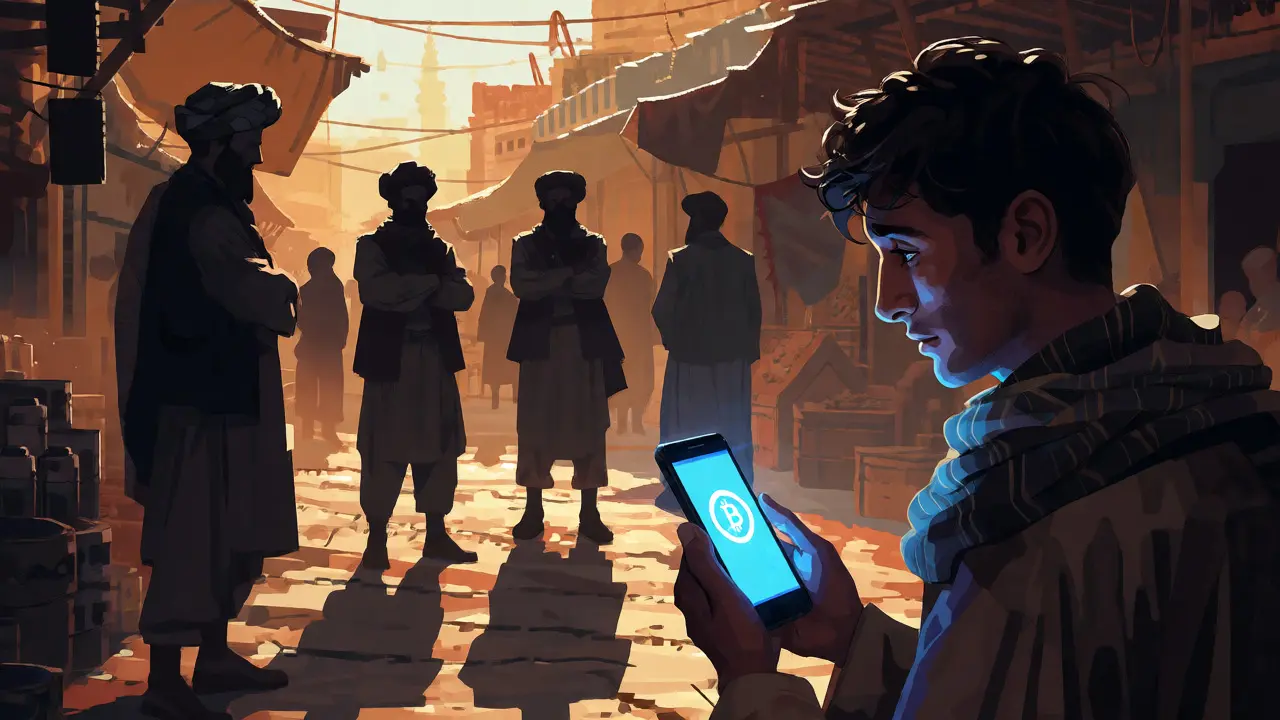
Banning crypto doesn't delete the blockchain. It just moves the market underground. After the August 2022 ban, transaction volumes officially plummeted. By November 2022, reported monthly values dropped to roughly $80,000, a fraction of previous levels. But these numbers likely underestimate reality. Peer-to-peer trades happen via WhatsApp groups and physical handovers, invisible to regulators.
This underground economy serves a critical humanitarian function. With 97% of Afghans falling below the poverty line in 2022 according to UN warnings, families rely on crypto to receive money from relatives abroad. Traditional banking channels remain broken or sanctioned. Stablecoins offer a lifeline, allowing people to buy food and medicine without relying on unstable local currency. The ban creates a paradox: the government forbids the tool that many poor citizens need most to survive.
Women, Freedom, and Digital Finance
One of the most profound impacts of the ban affects women. Under Taliban rule, women face severe restrictions on employment, education, and movement. Access to formal banking is difficult due to lack of identification documents and male guardianship requirements. For many Afghan women, cryptocurrency became a rare avenue for financial autonomy.
Roya Mahboob, founder of the Digital Citizen Fund, has highlighted how Bitcoin ownership gives women a sense of financial freedom. Organizations provide digital literacy training through online channels, teaching women how to manage private keys and execute transactions. Because crypto wallets don't require a bank branch visit or a male signature, they bypass some bureaucratic barriers. The prohibition threatens this fragile independence. When authorities crack down on traders, they often target visible hubs, but the knowledge remains. Women continue to use digital assets to save earnings from home-based businesses, even if doing so carries social and legal risks.

Challenges to Enforcement
Why hasn't the ban wiped out crypto completely? Two main factors: infrastructure limitations and human necessity. First, internet access in Afghanistan is limited. Only about 8.64 million people out of 40 million have reliable internet connectivity. Monitoring every transaction across such a fragmented network is logistically daunting for the Taliban, whose resources are stretched thin by broader governance challenges.
Second, the demand is inelastic. People don't trade crypto for fun; they do it because the alternative is financial exclusion. Even with the threat of arrest, the utility of moving value without a bank outweighs the risk for many. Recent developments show that while high-speed internet restrictions complicate mining and heavy trading, basic wallet transfers remain viable. The resilience of the underground market demonstrates that authoritarian control struggles against decentralized technology when economic desperation is high.
Future Outlook
Will the ban last? History suggests prohibitions are hard to maintain when the population finds workarounds. While the Taliban shows no signs of reversing the policy soon, the global pressure and internal economic needs create tension. If the banking sector fails to stabilize, the de facto acceptance of crypto may grow despite the de jure ban.
For now, Afghanistan stands as a stark case study in the clash between ideological governance and technological reality. The story isn't over. As long as Afghans need a way to store value and send money, they will find a way to use digital assets, regardless of what the law says.
Is cryptocurrency illegal in Afghanistan?
Yes, since August 2022, the Taliban government has banned all cryptocurrency activities, including trading, mining, and holding, citing Sharia law interpretations that classify digital assets as speculative and forbidden.
Can I still buy Bitcoin in Afghanistan?
Officially, no licensed exchanges operate. However, an active underground peer-to-peer market exists where individuals trade Bitcoin and stablecoins directly, often using mobile apps and local networks to bypass government oversight.
Why did the Taliban ban cryptocurrency?
The primary reason is religious. Taliban officials argue that cryptocurrencies lack real-world asset backing and involve excessive speculation (Gharar), making them 'haram' (forbidden) under their strict interpretation of Islamic finance principles.
How does the ban affect women in Afghanistan?
Before the ban, crypto offered women a degree of financial independence unavailable through traditional banks due to identity and mobility restrictions. The ban complicates this, though many women continue to use digital assets privately for savings and remittances.
Are there penalties for using crypto in Afghanistan?
Yes, penalties can include fines, confiscation of assets, and arrests. Enforcement varies, with periodic crackdowns on exchanges and miners, but individual users in peer-to-peer trades face lower visibility risks compared to commercial operators.