
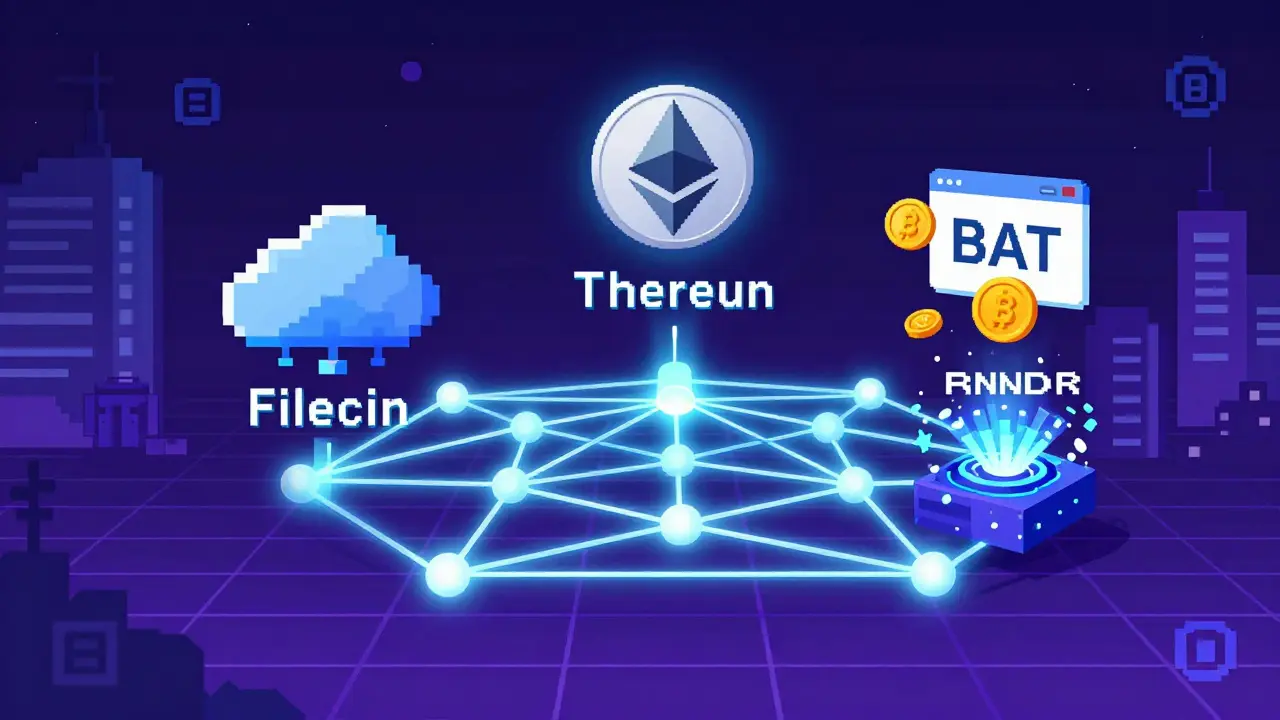
Utility tokens are not investments. They’re not stocks. And they’re definitely not money you can spend at the grocery store. But if you’re using a blockchain-based service - like decentralized storage, a gaming platform, or an ad-free browser - you’ve probably already used one. Utility tokens exist to give you access to something. Nothing more, nothing less.
What Exactly Is a Utility Token?
A utility token is a digital key. It doesn’t own part of a company. It doesn’t promise you dividends. It doesn’t even guarantee a return. All it does is unlock a feature, service, or resource inside a specific blockchain project. Think of it like a subway pass: you pay for it upfront, and it lets you ride the train. If the train stops running, the pass becomes worthless.
The most common utility tokens run on Ethereum using the ERC-20 standard for creating fungible tokens on the Ethereum blockchain. Over 73% of all utility tokens use this format, according to Etherscan data from October 2023. That means if you’re buying a token for a decentralized app, chances are it’s built on Ethereum.
Here’s how it works in practice: you buy a token during an initial coin offering (ICO) or on a crypto exchange. Later, you use that token to pay for storage on a decentralized network, to vote on platform upgrades, or to access premium features in a game. The value comes from how much you need it - not from speculation.
How Utility Tokens Are Different From Other Tokens
Not all crypto tokens are the same. Confusing them leads to bad decisions. Here’s how utility tokens stack up against other types:
| Token Type | What It Does | Ownership? | Regulatory Risk |
|---|---|---|---|
| Utility Token | Accesses services within a platform | No | Medium |
| Security Token | Represents shares, profits, or equity | Yes | High |
| Governance Token | Allows voting on protocol changes | No (but influence) | Medium-High |
| Native Cryptocurrency | Used to pay network fees (e.g., ETH) | No | Low |
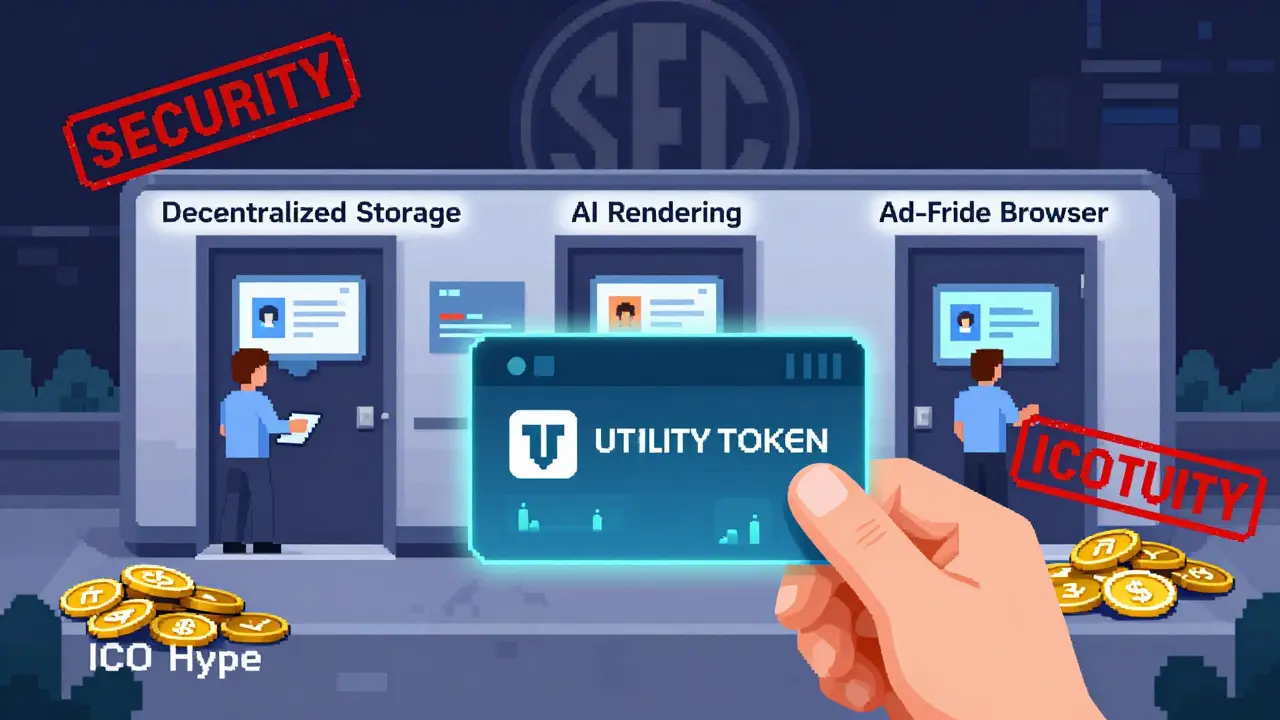
Security tokens are the big red flag. If a token promises profit based on someone else’s effort - like a company using your money to build a product - the SEC United States Securities and Exchange Commission, the primary financial regulator for securities in the U.S. says it’s a security. And unregistered securities are illegal. That’s why the SEC has sued over 17 utility token projects since 2023, including major names like Ripple and Telegram’s Gram token.
Governance tokens are trickier. Some, like MKR MakerDAO’s governance token used to vote on protocol changes and stability fees, let you vote on how a system runs. But they also often give you access to services - so they’re hybrids. True utility tokens don’t give you control. They just give you access.
Real-World Examples of Utility Tokens
Not all utility tokens are hype. Some actually solve real problems. Here are three that work as intended:
- Filecoin (FIL): This token lets you rent unused hard drive space on a global network. If you need to store data without relying on Amazon or Google, you pay in FIL. The more people use the network, the more FIL is worth - not because investors are buying it, but because the service is in demand. Protocol Labs reports a 94% correlation between FIL usage and storage demand.
- Basic Attention Token (BAT): Used in the Brave browser, BAT rewards users for viewing privacy-focused ads. You earn tokens, then spend them on tips or premium content. Brave’s own survey found 87% of users actively use BAT - not just hold it. That’s utility, not speculation.
- Render Network (RNDR): Artists and game developers use RNDR to rent GPU power for 3D rendering. Instead of paying $500/hour for cloud rendering, you pay in RNDR tokens. The token’s value rises as more creators use the network. It’s like renting a supercomputer with crypto.
These aren’t theories. They’re live networks with real users paying real value for real services.
Why Most Utility Tokens Fail
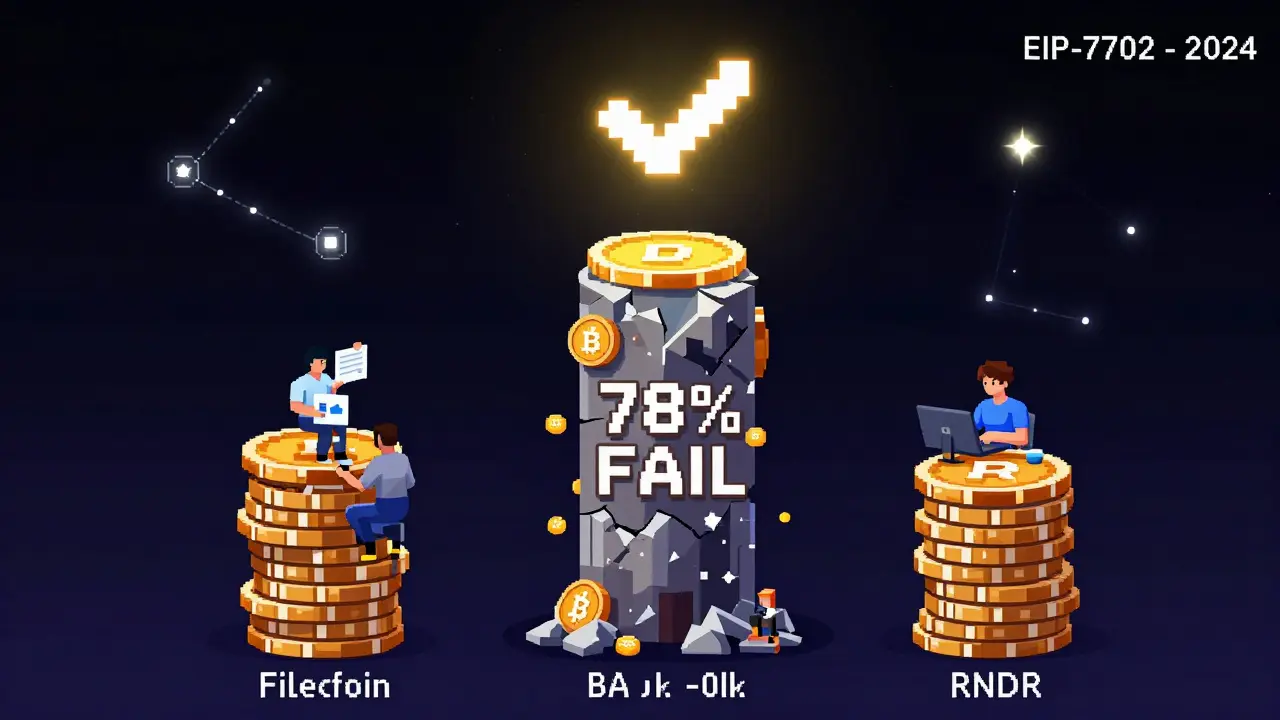
Here’s the dark side: over 78% of utility tokens lose their value when their platform doesn’t grow. Why? Because they were never meant to be used.
Take the 10,000+ utility tokens out there. CoinMarketCap found that 92.7% of them have zero use outside their own ecosystem. That means if the project dies, your token becomes a digital paperweight. And 58% of Reddit users in crypto communities say they’ve been burned by tokens that promised access but delivered nothing.
Common failures:
- Artificial scarcity: The team creates a token, limits supply, then says it’s "rare." But if no one needs it to use the service, it’s just a meme.
- Forced usage: You’re told you need the token to pay for a feature - but the same feature is available in fiat. Why pay in crypto if you can just use a credit card?
- No clear utility: The whitepaper says "utility," but doesn’t explain what you can actually do with it. That’s a red flag.
Vitalik Buterin, Ethereum’s creator, called out this trend in October 2023: "Many utility tokens create artificial scarcity without genuine utility - they’re just Ponzi schemes with blockchain branding."
Regulation: The Biggest Risk
The SEC doesn’t care if you call it a "utility" token. If it looks like an investment, they’ll treat it like one. The Howey Test - a legal standard from 1946 - asks: Did you invest money in a common enterprise expecting profit from others’ efforts?
That’s the problem. Most utility token sales are done through ICOs, where people buy tokens hoping the price will rise. That’s investment behavior. The SEC has made it clear: calling it "utility" doesn’t make it legal.
Switzerland and Singapore have clearer rules. If your token only gives access to a service - and you don’t promise returns - you’re usually fine. In the U.S.? You’re walking a tightrope. Over 68% of projects delay their launch because they’re scared of SEC action.
And it’s getting worse. The SEC’s proposed "Digital Asset Securities Act" in late 2023 could force all utility tokens to register as securities - or be shut down.
Who Uses Utility Tokens Today?
Despite the risks, utility tokens are growing - but only where they’re needed.
Here’s the data:
- 42% year-over-year growth in utility token usage across decentralized apps (DappRadar, Q3 2023)
- 63% of new tokens in late 2023 were for gaming, metaverse, or AI services
- $148.7 billion in total market cap as of November 2023 - 18.3% of the entire crypto market
- Only 8% of Fortune 500 companies have launched utility tokens - but 37% are exploring them
Real adoption is happening in niche areas:
- Decentralized storage: Filecoin, Arweave
- AI compute: Render Network, Bittensor
- Ad networks: BAT
- Real-world asset tokenization: Centrifuge’s Tinlake protocol has moved $427 million in loans using utility tokens as access keys
These aren’t speculative bubbles. They’re functional tools. The difference? They’re built around actual demand - not marketing.
Should You Buy Utility Tokens?
If you’re thinking of investing, ask yourself:
- Do I need this token to use the service? Or is it just an optional payment method?
- Is the service already working? Or is it still in beta with no users?
- Can I get the same thing without the token? (e.g., pay with PayPal or credit card)
- Is the team transparent about how the token is used - or do they only talk about price?
If you answered "no" to the first question, walk away. Utility tokens aren’t for speculation. They’re for users. If you’re not planning to use the service, you’re not buying a utility token - you’re gambling.
And if you’re a developer? Don’t create a token unless you have a real, necessary use case. Most tokens fail because they’re unnecessary. A credit card, PayPal, or even a simple subscription system often works better than a blockchain token.
The Future of Utility Tokens
The future isn’t about creating 10,000 new tokens. It’s about building fewer, better ones.
By late 2023, 72% of new utility token projects focused on one clear use case - up from 48% in 2022. That’s a good sign. Projects like EIP-7702 (coming in Q2 2024) will make tokens easier to use inside wallets and apps. That could help real utility thrive.
But the biggest hurdle remains regulation. Without clear rules, developers won’t build. Investors won’t trust. And users won’t adopt.
The winners? The ones that solve real problems - not those that just add a token to a website.
Are utility tokens legal?
It depends. In the U.S., the SEC doesn’t care what you call it - if your token acts like an investment, it’s a security and must be registered. In Switzerland, Singapore, and the UAE, clear rules exist: if the token only gives access to a service and no profit is promised, it’s legal. Always check local laws before buying or issuing.
Can utility tokens make money?
Yes - but not the way most people think. Utility tokens don’t pay dividends or interest. Their value rises only if the service they unlock becomes popular. If thousands of people use Filecoin to store data, FIL’s price goes up because demand increases. If no one uses it, the token crashes. It’s not speculation - it’s supply and demand for a real service.
How do I tell if a utility token is legit?
Look for three things: 1) A working product with real users (not just a whitepaper), 2) Clear documentation on how the token is used (e.g., "You pay 5 tokens to render a video"), and 3) No promises of price growth or returns. If the team talks more about "investment potential" than "service access," it’s likely a scam.
Do I need a wallet to use utility tokens?
Yes - but not always manually. Most platforms now integrate wallets directly into their apps. For example, Brave Browser handles BAT automatically. You don’t need to manage private keys unless you’re buying or trading the token yourself. But if you want to move it, you’ll need a wallet like MetaMask.
What happens if the project shuts down?
Your token becomes worthless. Unlike Bitcoin or Ethereum, utility tokens have no value outside their own ecosystem. If the company disappears, the service stops, and the token has no use. That’s why real utility tokens are tied to projects with long-term plans - not hype-driven launches.
Olivia Parsons
March 5, 2026 AT 16:06Utility tokens aren’t about speculation. If you’re not using the service, you’re just holding digital confetti. Filecoin, BAT, RNDR - they work because people actually need them. No hype, no fluff.
Bryanna Barnett
March 5, 2026 AT 16:23lol at people calling utility tokens 'real use cases'... most of these projects are just VC-funded scams with a whitepaper and a discord server. I've seen 30+ tokens that 'solve problems'... none of them actually do.
Denise Folituu
March 6, 2026 AT 23:04You think this is about utility? Please. Every single one of these 'utility' tokens was sold as an investment. The SEC isn't stupid. They know what's happening. They just haven't caught up yet. And when they do? Boom. 90% of these projects vanish overnight. I'm not saying they're all bad - I'm saying they're all *fraudulent* by design. They're not tokens. They're pyramid schemes with blockchain glitter.
And don't even get me started on 'governance tokens.' You think voting on a DAO means anything? The top 0.1% of holders control 80% of the votes. It's corporate boardrooms with more emojis.
Filecoin? Yeah, cool. But how many people actually use it? 2% of the market. The rest? Bought it because they thought it'd moon. Same with BAT. Brave browser has 50 million users. Only 3 million even *touch* BAT. The rest? HODLing. Waiting. Hoping. Just like every other crypto bro.
And don't give me that 'real demand' nonsense. If you need to pay in token to access a feature that's also available in USD? That's not utility. That's coercion. That's a tax. And the devs? They're laughing all the way to the bank.
Vitalik called it out? Good for him. Too bad he's too busy sipping champagne at Consensus to actually fix this. The whole system is rigged. And we're all just the chumps who keep feeding it.
Nancy Jewer
March 7, 2026 AT 09:34I appreciate the breakdown, but I think we're missing the nuance. Utility tokens aren't binary - they exist on a spectrum. Some are indeed just speculative instruments masquerading as access keys. But others? Like Render Network - they’re enabling real creative workflows. Artists who used to pay $300/hour for cloud rendering now do it for $15 in RNDR. That’s not hype. That’s efficiency. And it’s measurable.
The regulatory risk is real, yes. But the innovation is too. We shouldn’t throw the baby out with the bathwater. The key is transparency: if the token’s utility is documented, verifiable, and *necessary* - then it’s legitimate. The problem isn’t the model. It’s the bad actors exploiting it.
Also, the ERC-20 dominance isn’t just coincidence. It’s because Ethereum’s infrastructure makes it *possible* to build these use cases. That’s worth preserving.
Bill Pommier
March 8, 2026 AT 05:36Let’s be clear: calling a token a 'utility' token is a legal evasion tactic. The Howey Test doesn’t care about your marketing brochure. If investors are buying it with the expectation of profit - regardless of whether it 'works' - it’s a security. Period. The SEC has been consistent since 2017. The fact that 78% of these tokens fail isn’t proof of utility - it’s proof of market inefficiency. And the regulators are watching.
Furthermore, the notion that 'real usage' validates the token is dangerously naive. You don’t validate a financial instrument by counting users - you validate it by legal structure. If the token can be traded on centralized exchanges, it’s a security. Full stop.
And don’t cite Filecoin. Their token sale raised $257 million. That’s not a utility. That’s a venture capital round with a blockchain veneer. The fact that they now have 200,000 active users doesn’t retroactively make their ICO legal.
Rachel Rowland
March 8, 2026 AT 17:25So many people get this wrong. Utility tokens aren’t meant to make you rich. They’re meant to make the service work. If you’re buying it because you think it’ll double next month - you’re already doing it wrong.
I’ve used RNDR to render a 3D animation. Paid 8 tokens. Got my video in 4 hours. That’s cheaper than AWS. That’s utility.
Don’t overcomplicate it. If you use it? Cool. If you don’t? Don’t buy it. Simple.
Melissa Ritz
March 10, 2026 AT 04:44It’s funny how people romanticize utility tokens like they’re some kind of decentralized utopia. The reality? Most of these projects are built by 22-year-olds with no product experience, funded by VCs who’ve never used a blockchain app. They throw together a token, write a whitepaper full of buzzwords, and call it 'decentralized storage' or 'AI compute.'
And then they panic when the SEC comes knocking - because they never intended to build anything real. They just wanted to cash out before the rug pull.
Filecoin? Sure, it’s 'working.' But it’s still 1/100th the scale of centralized alternatives. And guess what? Most users don’t even know they’re using a token. They just see 'cheaper storage.' That’s not utility - that’s invisible infrastructure.
And the 'real adoption' stats? 42% growth? From a base of 0.0001% of the global tech market. That’s not growth. That’s noise.
Stop pretending this is a revolution. It’s a failed business model with better branding.
Issack Vaid
March 11, 2026 AT 21:50Oh, so now we’re pretending utility tokens aren’t securities? How quaint.
Let me translate: 'Utility token' = 'We’re too lazy to file a Form D.' You don’t get to bypass federal securities law because you added a 'use case' to your tokenomics slide. That’s like saying, 'I didn’t rob the bank - I just used the money to buy a sandwich.'
The SEC doesn’t care if your token 'works.' They care if you sold it as an investment. And you did. Every single one of these ICOs had Discord servers full of people asking, 'When’s it going to 10x?' That’s not utility. That’s fraud.
And don’t even mention Switzerland. Their rules are clear because they’re not the U.S. They don’t have 300 years of securities law. We do. And we’re not backing down.
Brian T
March 12, 2026 AT 00:20Who even uses these tokens anymore? I checked Filecoin’s on-chain data. Most transactions are between wallets that hold >100k FIL. That’s not users. That’s whales dumping. The 'real demand' is a mirage.
And BAT? Brave browser users get paid to watch ads. So they’re still being tracked - just with crypto instead of Google. That’s not privacy. That’s rebranding.
It’s all theater. The blockchain is just a fancy ledger for the same old scams. We’re not building a new economy. We’re just repackaging the old one with more buzzwords.
Julie Potter
March 13, 2026 AT 11:06Y’all are missing the point. Utility tokens aren’t about whether they work - they’re about who controls them. If a company can freeze your tokens, change the rules, or shut down the service? Then it’s not decentralized. It’s just a subscription with a wallet.
Filecoin? Their team can upgrade the protocol anytime. RNDR? They can de-list your token. BAT? Brave can change the reward algorithm tomorrow. So what’s 'utility' if the company holds all the power?
Real utility would mean the users own the network. Not the devs. Not the investors. The users.
But that’s not what’s happening. This isn’t innovation. It’s corporate capture with a blockchain label.
Bonnie Jenkins-Hodges
March 14, 2026 AT 01:35USA is the only country that matters here. If you’re building a token and not following SEC rules? You’re breaking the law. Period. Stop pretending Switzerland or Singapore are 'better.' They’re just letting you run scams until the U.S. catches up.
And don’t act like you’re some kind of rebel. You’re just a criminal with a GitHub repo.
🇺🇸
Steven Lefebvre
March 14, 2026 AT 09:46It’s not about whether utility tokens are good or bad - it’s about whether they’re necessary. Most apps don’t need a token. A credit card works fine. But for global, permissionless services? Like decentralized rendering or storage? Tokens remove gatekeepers.
Think of it like this: if you could rent GPU power from anyone in the world - without a middleman - wouldn’t you? That’s what RNDR does. That’s utility.
Don’t hate the tool. Hate the misuse.
Jane Darrah
March 15, 2026 AT 23:46Let’s be real - the entire utility token narrative is a distraction. The real innovation isn’t the token. It’s the underlying protocol. Filecoin’s IPFS, Brave’s ad model, Render’s GPU mesh - those are the breakthroughs. The token is just the payment layer. And payment layers? They’re replaceable.
What happens when a company decides to accept USD instead of FIL? The token crashes. But the service keeps running. So why do we care about the token at all?
It’s like arguing that PayPal is the innovation behind e-commerce. No - PayPal is the checkout button. The innovation is the website.
Most people are confusing the medium with the message. The token is not the utility. The service is.
And that’s why 92.7% of utility tokens are dead weight. They’re trying to monetize infrastructure that doesn’t need monetizing.
Build the service. Then decide if a token adds value. Not the other way around.
Most projects do it backward. And that’s why they fail.
Nick Greening
March 17, 2026 AT 18:39So you’re telling me a token that lets you pay for rendering is 'utility' - but a subscription to Adobe is 'normal'? What’s the difference? One’s in crypto, one’s in a corporation. Both lock you in. Both charge you. Both can change terms.
It’s not decentralized. It’s just branded differently.
And don’t say 'no middleman' - RNDR’s team takes 15% cut. That’s a middleman with a DAO logo.
This isn’t progress. It’s rebranding.
Austin King
March 18, 2026 AT 14:20One sentence: if you’re not using the service, don’t buy the token. Simple.
Josh Moorcroft-Jones
March 19, 2026 AT 16:33Okay, let’s unpack this. You’ve got a 5,000-word post that claims utility tokens are fundamentally different from securities - but then cites SEC lawsuits, the Howey Test, and regulatory risk as if they’re irrelevant footnotes. That’s not analysis. That’s cognitive dissonance.
And the examples? Filecoin raised $257 million in an ICO. That’s not a utility. That’s a venture round. BAT? It’s a loyalty program with a blockchain sticker. RNDR? It’s a cloud service that happens to use crypto as a payment method - which, by the way, is what PayPal does.
So what’s the difference? Nothing. The only thing separating these from traditional services is the fact that they’re built on a blockchain - which adds complexity, cost, and regulatory risk - with zero functional benefit to the end user.
And yet, you’re celebrating this as 'innovation'? It’s not. It’s a solution in search of a problem. The problem is: 'How do we make a simple payment system more expensive, slower, and legally dangerous?'
The answer? We don’t. We use credit cards. Or PayPal. Or Venmo. Or cash.
Utility tokens are a solution to a problem that doesn’t exist - created by people who don’t understand either finance or technology.
And the fact that people are still buying into this? That’s the real tragedy.
Eva Gupta
March 21, 2026 AT 02:24As someone from India, I’ve seen how utility tokens can empower people without banks. A small artist in Mumbai used RNDR to render her animation - paid in tokens, got paid back in tokens, then cashed out via local crypto exchange. No bank approval. No paperwork. No waiting.
That’s not hype. That’s access.
Yes, some projects are scams. But the tool? It’s powerful. Don’t throw it away because some people misuse it.
Just like the internet - not every website is good. But the network? Life-changing.
Jane Darrah
March 21, 2026 AT 07:04Replying to @2016 - you’re right about one thing: the token isn’t the innovation. But you’re wrong to dismiss it. The payment layer matters. Because if you can’t pay in token, you can’t participate in a permissionless network. A credit card requires identity. A wallet doesn’t. That’s the difference.
It’s not about replacing PayPal. It’s about giving people who can’t use PayPal - in Venezuela, Nigeria, Ukraine - a way to access global services.
Utility tokens aren’t perfect. But they’re the only tool we have that lets someone without a bank account rent a supercomputer.
So yes - most are garbage. But the ones that work? They’re changing lives. And that’s worth fighting for.