Have you ever seen a crypto token that sounds like it belongs in the future but trades for less than a penny? That’s exactly where TOP AI Network (TOP) sits right now. It’s not one of the household names like Bitcoin or Ethereum, and it’s definitely not leading the current AI crypto hype cycle alongside giants like Bittensor or Render. Instead, TOP is a quiet, high-tech experiment trying to bridge two massive industries: blockchain scalability and artificial intelligence.
If you’re wondering what this coin actually does, why it exists, and whether it’s worth your attention in late 2026, you’ve come to the right place. We’ll break down the tech, the money, and the reality on the ground without the usual fluff.
The Quick Takeaways
- What it is: A fourth-generation public blockchain originally built for communications, now rebranded as infrastructure for AI agents.
- The Tech: Uses a unique three-layer ledger and parallel pBFT-PoS consensus to handle high-frequency transactions.
- The Price: A true micro-cap asset trading around $0.00007-$0.00009 with a market cap under $1.4 million.
- The Risk: Extremely low liquidity and high volatility make it speculative; it lacks the developer traction of larger AI coins.
- The Goal: To provide cheap, fast on-chain interactions for autonomous AI models and agents.
From Chat Apps to AI Agents: What is TOP AI Network?
To understand TOP AI Network is a decentralized open communication network evolved into an AI model-as-a-service platform, you have to look at its roots. The project didn’t start out trying to build the next big AI tool. It began as TOP Network, a blockchain designed specifically for cloud communications. Think encrypted messaging, VoIP calls, and VPNs running directly on the chain. The problem they were solving was simple: traditional blockchains are too slow and expensive for sending thousands of tiny messages every second.
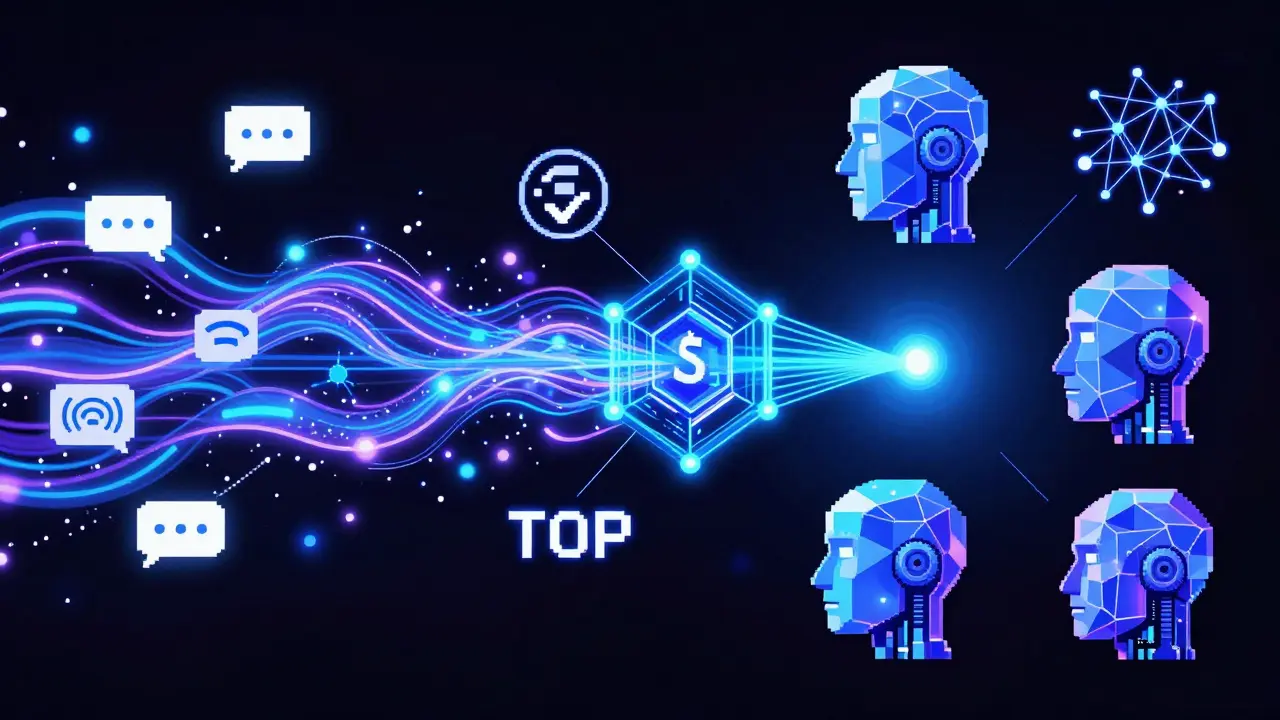
Fast forward to 2026, and the narrative has shifted. The core technology-the high-speed chain-remains the same, but the use case has pivoted. The team now markets TOP as the backbone for AI agents. Why? Because autonomous AI agents need to make decisions, pay for data, and interact with each other constantly. These actions generate millions of micro-transactions. If an AI agent tries to do this on Ethereum, the gas fees would eat its budget alive. On TOP Chain, those same transactions cost fractions of a cent.
So, while the ticker symbol is still TOP, the story has changed from “decentralized WhatsApp” to “infrastructure for robot brains.” It’s a smart pivot, given how hot the AI sector is, but it also means the project is competing in a much more crowded field.
How Does TOP Chain Actually Work?
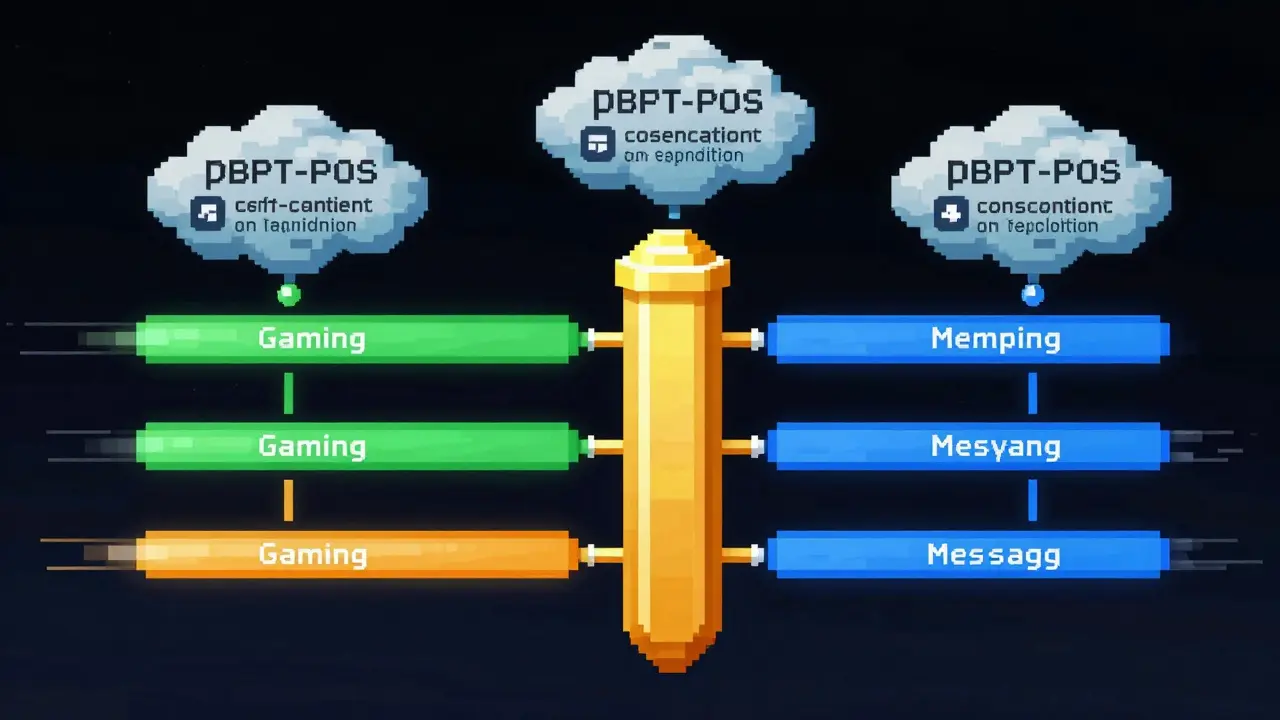
You can’t talk about TOP without mentioning its architecture, because that’s its main selling point. Most blockchains are linear-they process blocks one after another. TOP Chain uses a three-layer ledger architecture combined with a two-layer lattice Directed Acyclic Graph (DAG). Let’s translate that into plain English.
- Main Chain: This handles security and final settlement. It’s the source of truth.
- Service Chains: These are specialized lanes for specific apps (like gaming or messaging). They run in parallel, so they don’t clog up the main road.
- Off-Chain Ledgers: For super-high-frequency data that doesn’t need permanent storage immediately, this layer keeps things moving fast.
On top of this structure sits the consensus mechanism: parallel pBFT-PoS. This mixes Practical Byzantine Fault Tolerance (pBFT), which gives instant finality (your transaction is done, period), with Proof-of-Stake (PoS), which secures the network economically. By running these consensus rounds in parallel across different service chains, TOP aims to achieve thousands of transactions per second (TPS).
For an AI agent that needs to query a database, pay for a GPU render, and send a message all within seconds, this speed is critical. However, there’s a trade-off. Complex architectures like DAGs and sharded service chains are harder to maintain and secure than simple linear chains. You’re betting on their engineering team’s ability to keep this complex machine running smoothly.
Price, Supply, and Market Reality
Let’s get straight to the numbers, because in crypto, the math tells you who’s paying attention. As of early 2026, TOP is firmly in the micro-cap category. Here is the snapshot based on data from aggregators like CoinMarketCap, Bybit, and Dropstab:
| Metric | Value |
|---|---|
| Current Price Range | $0.000069 - $0.000093 USD |
| Market Cap Rank | #2600 - #2700 |
| Total Supply | 20 Billion TOP |
| Circulating Supply | ~15 Billion TOP |
| Daily Volume | $285,000 - $380,000 USD |
| Active Markets | ~10 Exchanges |
A few things stand out here. First, the price is incredibly low. You’re buying thousands of tokens for a single dollar. Second, the daily volume is thin. With only about $300k-$400k in daily trading volume, the liquidity is shallow. This means if you try to sell a large position quickly, you could crash the price yourself-a phenomenon known as slippage.
Also, note the supply. There are 20 billion tokens total. Even if the price doubled tomorrow, the market cap would still be tiny compared to major projects. This makes TOP a high-risk, high-reward play. It’s not an investment for stability; it’s a bet on whether the project can grow from rank #2600 into the top 500.
TOP vs. The Big AI Crypto Players
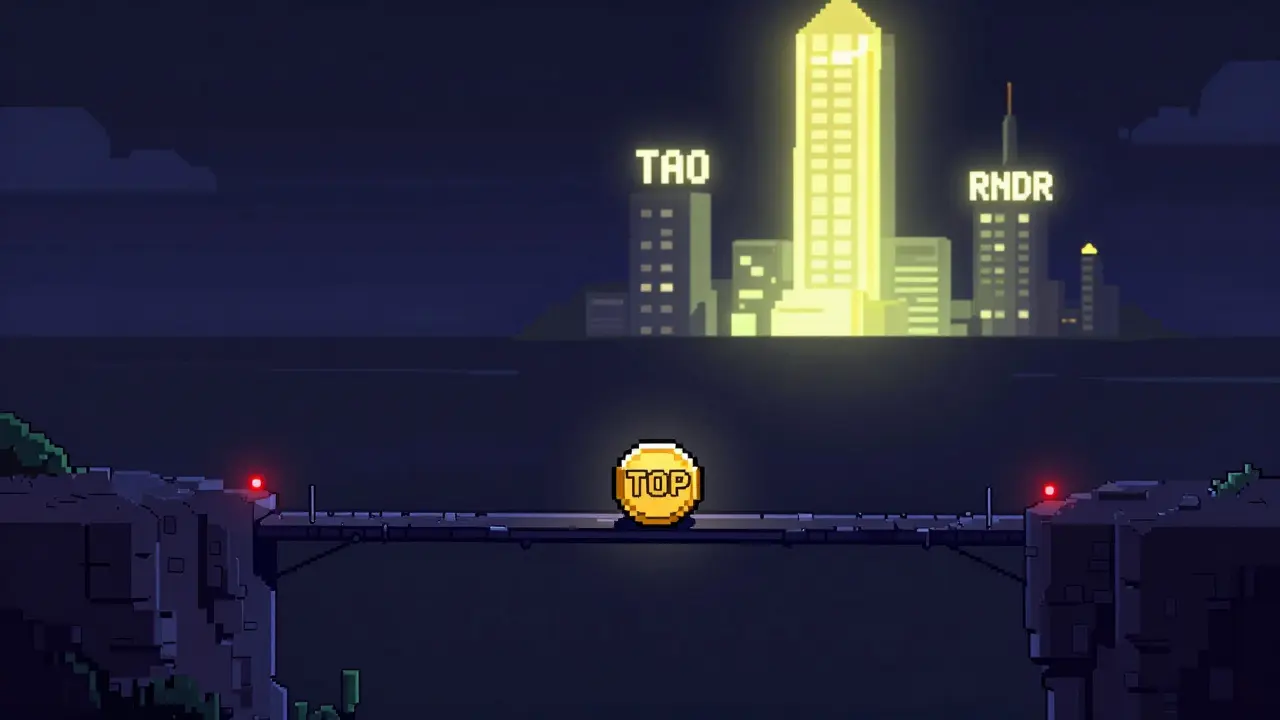
You might be thinking, “Isn’t everyone doing AI crypto right now?” Yes, they are. But TOP isn’t playing in the same league as the leaders. When analysts talk about the top AI coins in 2026, they mention Bittensor (TAO), Render (RNDR), and Fetch.ai (FET). These projects have hundreds of millions or billions in market cap, huge developer communities, and real-world enterprise partnerships.
Where does TOP fit in? It’s trying to be the plumbing underneath the fancy apps. Bittensor focuses on decentralized machine intelligence networks. Render provides GPU power for graphics and AI rendering. Fetch.ai builds frameworks for autonomous agents. TOP positions itself as the chain these agents run on.
Here is the harsh reality: developers usually build on established platforms like Ethereum, Solana, or even Polygon because that’s where the users are. For TOP to succeed, it needs to convince developers to port their AI agents to its specific architecture. So far, there is little evidence of widespread adoption. The social sentiment is positive (Coinbase reports a score of 94/100 among its small user base), but the number of people talking about it is modest-around 160 unique individuals in a 24-hour window. Compare that to tens of thousands for TAO or RNDR, and you see the gap.
Is TOP AI Network Safe? Risks and Limitations
Before you buy any micro-cap token, you need to understand what can go wrong. TOP carries several significant risks that you should weigh carefully.
- Liquidity Risk: With only ~10 active markets and low daily volume, getting in and out can be difficult. Large orders will move the price drastically.
- Adoption Uncertainty: The shift from “communication chain” to “AI infrastructure” is a bold marketing move, but it requires actual usage. Without major DApps or AI companies building on TOP, the tech remains theoretical.
- Technical Complexity: The hybrid DAG and parallel consensus model is innovative but unproven at scale compared to simpler PoS chains. Bugs or exploits in such complex systems can be costly.
- Competition: Established L1s like Solana and Avalanche are already positioning themselves as high-speed chains for AI. Why would a developer choose TOP over them?
Security-wise, the pBFT component offers strong finality, which is good. But BFT systems often rely on a smaller set of validators to maintain speed. If that validator set becomes centralized or compromised, the network’s integrity suffers. Always check the latest validator distribution if you plan to hold long-term.
Who Should Care About TOP?
This coin isn’t for everyone. If you’re looking for a stable store of value, skip it. If you want exposure to the AI boom, there are safer, larger bets available. However, TOP might interest you if:
- You are a developer interested in testing high-throughput, low-cost environments for AI agent simulations.
- You enjoy hunting for undervalued micro-caps with solid technical foundations before they hit the mainstream radar.
- You believe that specialized chains for AI will outperform general-purpose blockchains in the long run.
For the average investor, TOP serves as a reminder that the crypto world is vast. Beyond the blue chips, there are hundreds of niche experiments trying to solve specific problems. TOP’s problem is speed and cost for AI interactions. Whether it solves it well enough to survive the competition remains to be seen.
What is the difference between TOP Network and TOP AI Network?
They are the same underlying blockchain project. Originally launched as TOP Network for decentralized communications (messaging, VoIP), the team rebranded to TOP AI Network to reflect its new focus on providing infrastructure for AI agents and Model-as-a-Service platforms. The technology (TOP Chain) remains the same, but the target use cases have expanded.
Is TOP AI Network EVM compatible?
As of early 2026, official documentation emphasizes its custom three-layer ledger and parallel pBFT-PoS consensus rather than standard Ethereum Virtual Machine (EVM) compatibility. Developers typically interact with TOP Chain via specific APIs and SDKs designed for its high-frequency transaction environment. You should check the latest developer docs for any recent EVM bridge updates.
Can I buy TOP coin on Coinbase?
Yes, TOP is listed on Coinbase and several other exchanges like Bybit. However, due to its low market cap and limited liquidity, you may experience higher spreads or slippage when trading. It is traded on approximately 10 active markets globally.
Why is the price of TOP so low?
The low price reflects its status as a micro-cap asset with a very high total supply (20 billion tokens) and relatively low market demand compared to larger cryptocurrencies. Its market cap is under $1.4 million, placing it outside the top 2,000 cryptocurrencies by value. Low price per unit does not necessarily mean it is "cheap" in terms of total value.
How does TOP compare to Bittensor (TAO)?
Bittensor is a leading AI-focused cryptocurrency with a much larger market cap, community, and ecosystem focused on decentralized machine intelligence. TOP AI Network is a smaller, infrastructure-level play focusing on the blockchain layer for AI agents. TAO is a mature, high-profile project, while TOP is a speculative micro-cap with less adoption and higher risk.