
Medifakt Investment Risk Calculator
Investment Risk Assessment
Results
Why This Is Risky
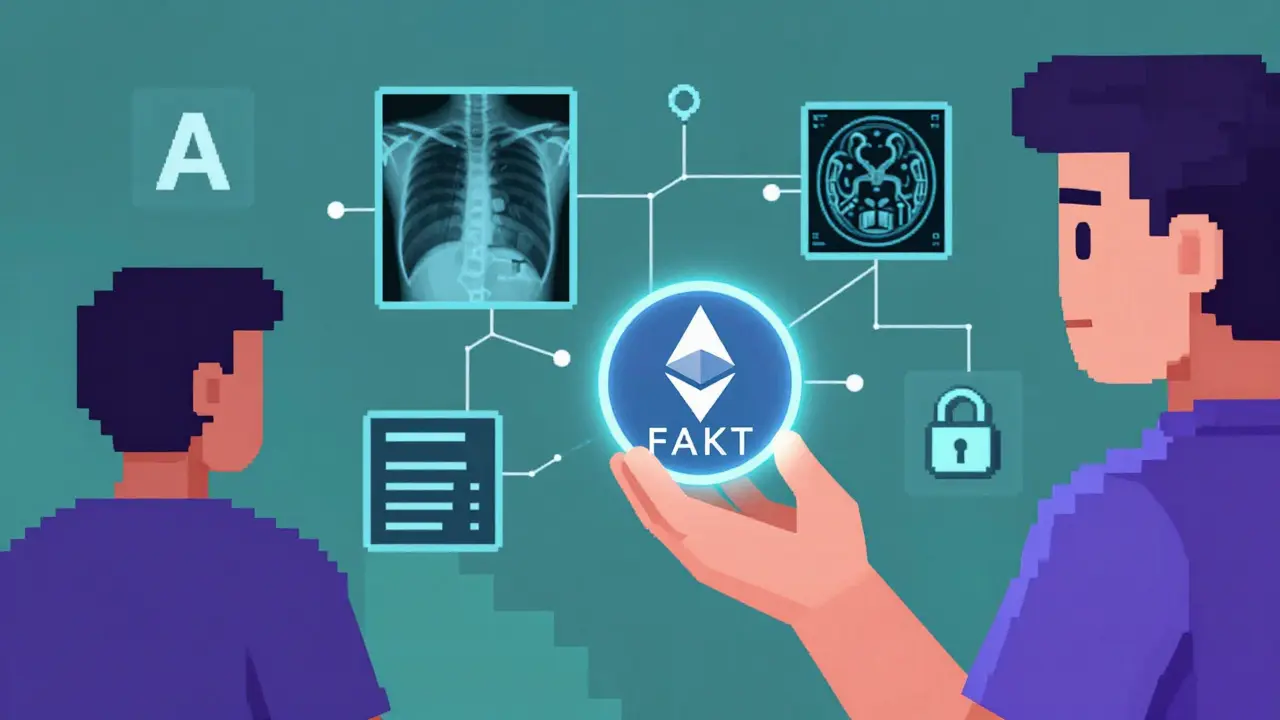
Medifakt (FAKT) is a cryptocurrency built on the Ethereum blockchain, designed to fix broken systems in healthcare data sharing. It’s not just another altcoin - it was created to let patients, doctors, and AI companies securely store and exchange medical images like X-rays and MRIs without relying on central hospitals or insurance databases. But despite its ambitious goal, the token has struggled to gain real traction. As of December 2025, its price sits at around $0.000297, down nearly 99% from its all-time high of $0.04451 in April 2022. That’s not a market correction - it’s a collapse.
How Medifakt (FAKT) is supposed to work
Medifakt’s idea is simple: use blockchain to make medical records safer and easier to share. Right now, if you want your MRI results sent from one clinic to another, you often have to wait days, pay fees, or even get physical CDs. Medifakt wants to change that. It uses Internet of Medical Things (IoMT) devices - like smart wearables or remote diagnostic tools - to collect data, then stores it on a decentralized network. Only people with permission can access it, and every access is logged on the blockchain.
The platform has three main users: patients who own their data, doctors who need quick access to records, and AI companies that train algorithms using real medical images. For example, an AI firm might pay FAKT tokens to access anonymized lung scans to improve cancer detection models. In return, patients get compensated with tokens for letting their data be used. That’s the theory, anyway.
The system runs on smart contracts - self-executing code on Ethereum - with the contract address 0x0262e9374e95b9667b78136c3897cb4e4ef7f0c2. It’s an ERC-20 token, meaning it works with any Ethereum wallet like MetaMask. Medifakt Ltd., based in Estonia, launched it in November 2021. They claimed 22.5% of their initial funding went to building AI tools that analyze medical images without human input. That’s a key part of their pitch: automation that reduces errors and speeds up diagnoses.
Why Medifakt’s numbers don’t add up
Here’s where things get messy. CoinMarketCap says Medifakt has a maximum supply of 999.99 million FAKT tokens. But it also says the circulating supply is zero. How can a token trade with a 24-hour volume of over $1,600 if no tokens are in circulation? That’s not a glitch - it’s a red flag. Other platforms like CoinGecko show trading volume too, but their numbers don’t match. One report says volume jumped 885% overnight. That kind of wild swing usually means low liquidity, fake trading, or bots manipulating the numbers.
Market cap? Listed as $0 by CoinMarketCap, even though the fully diluted valuation (FDV) is around $447,590. FDV is just a guess - it assumes all tokens are in circulation. But if no one holds them, that number means nothing. There are only 759 wallet addresses holding FAKT. For comparison, a tiny but active crypto project might have 10,000 holders. This isn’t a niche coin - it’s practically abandoned.
It’s traded on just four exchanges. No major platforms like Binance, Coinbase, or Kraken list it. That means very few people can even buy it easily. And even if you could, there’s no real reason to. No hospitals, clinics, or insurance companies have publicly announced using Medifakt. No case studies. No pilot programs. No press releases. Just a website and a token contract.

How Medifakt compares to real healthcare blockchain projects
Medifakt isn’t alone in trying to bring blockchain to healthcare. But it’s nowhere near the leaders. Medicalchain, Solve.Care, and BurstIQ are all projects with actual partnerships - hospitals, insurers, even government agencies. Medicalchain has worked with the UK’s NHS. Solve.Care has contracts with U.S. Medicaid providers. These projects aren’t just tokens - they’re platforms with legal compliance, audits, and real users.
Medifakt doesn’t mention HIPAA or GDPR compliance anywhere on its site. That’s a huge problem. In the U.S., healthcare data is protected by strict laws. In Europe, GDPR requires consent, encryption, and data portability. If Medifakt isn’t certified to handle this data, it’s legally risky - and no serious provider would touch it. Without that, the whole project is just tech without trust.
Even the technology stack is confusing. Some sources say Medifakt runs on Polkadot. The official site says Ethereum. Which is it? If you can’t even get your own documentation straight, why would anyone believe your claims about secure data sharing?

Is Medifakt (FAKT) worth investing in?
Let’s be clear: Medifakt is not a good investment. The price has fallen 99% since its peak. Trading volume is microscopic. The community is silent - no Reddit threads, no Twitter buzz, no Telegram groups with active members. There’s zero evidence it’s being used in the real world. The only people holding FAKT are likely speculators who bought at the top and are now stuck.
Even if you believe in the idea of blockchain for healthcare, Medifakt isn’t the way to bet on it. The team hasn’t released a roadmap since 2022. No new features. No partnerships. Just a security update in December 2025 - a last-minute patch to fix vulnerabilities that should’ve been caught years ago. That’s not innovation. That’s damage control.
And here’s the harsh truth: if a project has been around since 2021 and still has only 759 holders, it’s not failing - it’s already dead. The market has spoken. No one wants it.
What’s the future of Medifakt?
The future looks bleak. Without partnerships with actual healthcare providers, no regulatory compliance, and almost no trading activity, Medifakt has no path to recovery. Even if the price bounced back tomorrow, no hospital or insurer would adopt it. No AI company would train models on its data. No patient would trust it with their medical records.
It’s a cautionary tale. Building a blockchain for healthcare isn’t just about writing code. It’s about trust, regulation, and real-world use. Medifakt checked the tech box - but missed every other box that matters.
If you’re interested in healthcare blockchain, look at projects with live deployments, audited contracts, and clear compliance. Don’t chase a token that’s been abandoned by the market. Medifakt (FAKT) is a ghost in the crypto graveyard - technically alive, but functionally gone.





Shruti Sinha
December 15, 2025 AT 21:54Medifakt’s whitepaper reads like a tech bro’s fever dream wrapped in HIPAA buzzwords. Zero circulating supply but $1.6k volume? That’s not a market - it’s a casino run by bots with Excel sheets. The fact that they claim Ethereum but some sources say Polkadot? Either they don’t know what they’re building, or they’re deliberately confusing people to buy time. No audits. No partnerships. Just a contract address and a prayer.
Sammy Tam
December 16, 2025 AT 17:24Man, I remember when blockchain for healthcare was actually exciting. Medicalchain had real pilots. Solve.Care had Medicaid contracts. Medifakt? It’s like someone took a crypto template, slapped ‘medical’ on it, and called it a day. The 99% drop isn’t bad luck - it’s karma. You don’t build trust in healthcare by deploying smart contracts and hoping no one checks your compliance page. People’s lives are on the line here, not just portfolio numbers.
Sue Bumgarner
December 18, 2025 AT 10:43Let’s be real - this is just another pump-and-dump by some offshore LLC with a fancy website. The fact that it’s traded on only four sketchy exchanges and has 759 wallets? That’s not ‘niche,’ that’s abandoned. And don’t even get me started on the ‘AI training’ angle. If they’re using real patient data without HIPAA compliance, they’re not innovating - they’re laundering medical records. The FDA should shut this down yesterday.
Greg Knapp
December 19, 2025 AT 22:25you think this is bad wait till you see what they did with the wallet keys i heard they lost em in a cloud backup glitch and now the whole supply is locked in a server in estonia that no one can access lol also the ceo is a reddit mod from 2017 who also ran a bitcoin mining rig outta his basement
Sally Valdez
December 20, 2025 AT 02:13AMERICA MADE HEALTHCARE BROKE SO NOW SOME EESTONIAN STARTUP THINKS THEY CAN FIX IT WITH A TOKEN? LOL. YOU THINK BLOCKCHAIN IS THE ANSWER? TRY FIXING THE INSURANCE SYSTEM FIRST. THIS IS JUST TECH-BRO CULTURE AT ITS WORST - SOLVING PROBLEMS THAT DON’T EXIST WHILE THE REAL ONES BURN.
Kayla Murphy
December 20, 2025 AT 22:10Even if Medifakt is dead, the *idea* isn’t. Imagine if patients could truly own their scans, sell anonymized data to researchers, and get paid for it. That’s powerful. The execution failed - but the vision? Still valid. Maybe someone will build this right one day. Don’t bury the dream because of bad actors.
Dionne Wilkinson
December 21, 2025 AT 12:02I wonder if the people behind this ever thought about how scary it is to have your medical data on a public ledger. Even if it’s encrypted, the metadata alone - when you got an MRI, what clinic, what diagnosis - that’s all traceable. Maybe the problem isn’t the hospitals… maybe it’s the idea that everything should be tracked, logged, and monetized. Is this progress, or just more surveillance in a white coat?
Florence Maail
December 22, 2025 AT 04:26THEY'RE USING YOUR DATA TO TRAIN AI FOR THE DEEP STATE. THAT CONTRACT ADDRESS? IT'S A BACKDOOR. EVERY MRI YOU UPLOAD IS BEING SENT TO A DODGE CITY SERVER WHERE THEY BUILD PREDICTIVE HEALTH MODELS FOR GOVERNMENT CONTROL. THEY'RE NOT TRYING TO HELP - THEY'RE PREPARING FOR THE NEXT PANDEMIC. YOU THINK THE 99% DROP IS MARKET FAILURE? NO. IT'S BECAUSE THE ELITES DON'T WANT YOU TO KNOW HOW MUCH THEY'RE MAKING OFF YOUR CANCER SCANS.
Chevy Guy
December 22, 2025 AT 23:32so the ceo posted on linkedin last week saying ‘we’re pivoting to quantum blockchain’ lol. also the ‘ai tools’ they funded? turns out they paid a guy $2k on fiverr to make a chatbot that says ‘your xray shows no abnormalities’ in 5 languages. the whole thing is a glorified meme coin with a stethoscope emoji
SeTSUnA Kevin
December 23, 2025 AT 07:17The FDV is a mathematical fiction. The 759 wallets indicate terminal liquidity collapse. No regulatory framework. No institutional adoption. Zero utility beyond speculative arbitrage. This is not a project - it is a semantic artifact of crypto’s post-2021 entropy.
Madhavi Shyam
December 23, 2025 AT 12:54Medifakt’s architecture violates the principle of least privilege in decentralized identity systems. The ERC-20 implementation lacks zero-knowledge proofs for access control, making it non-compliant with ISO 13485 for medical device data integrity. The smart contract audit was never published - red flag for any HIPAA-adjacent application.
Mark Cook
December 25, 2025 AT 08:00wait wait wait - if the supply is zero but it’s trading, does that mean it’s a ghost coin? like a crypto poltergeist? 👻
Jesse Messiah
December 25, 2025 AT 13:50Look, I get why people are skeptical - but I’ve seen smaller projects come back from way worse. Maybe the team just went quiet to rebuild. The idea of patient-owned medical data is too important to give up on. I’m not saying Medifakt is the answer, but don’t write off the whole space because of one shaky token. There’s real potential here.
Jack Daniels
December 26, 2025 AT 16:36i bought 10 million FAKT at the peak. i still have them. i check the price every night. i cry. i sleep. i wake up. i check again. i do this every day. i’m not selling. i’m waiting for the miracle. i know it’s coming. it has to.
Heather Turnbow
December 27, 2025 AT 08:26The ethical implications of monetizing medical data - even with consent - require far more nuanced governance than a blockchain token can provide. Without institutional oversight, legal accountability, and transparent data-use policies, the entire model risks exploiting vulnerable populations under the guise of innovation. This is not merely a technical failure - it is a moral one.