Stablecoins are supposed to be the boring part of crypto. They sit at $1. You buy them. You hold them. You sell them for $1. But in 2026, that simplicity is under heavy fire from two massive regulatory forces: the European Union’s MiCA and the emerging federal framework in the United States.
You might have heard whispers about a "GENIUS Act" in the news. It’s important to clear up a confusion right away: there is no official US law called the GENIUS Act. That term often pops up in speculative discussions or misreports. What actually exists is a pending federal framework, heavily influenced by bills like the Clarity for Payment Stablecoins Act and executive orders from the Biden administration. For the sake of this comparison, we’ll refer to this as the "US Federal Framework." Understanding the difference between these two approaches is critical if you’re issuing tokens, trading them, or just trying to keep your savings safe.
The Core Philosophy: Safety vs. Dominance
The European Union and the United States are playing different games with money. The EU, through MiCA (Markets in Crypto-Assets Regulation), wants to protect its citizens and its monetary sovereignty. They are terrified of stablecoins becoming a shadow banking system that could crash the eurozone economy. Their goal is consumer protection above all else.
The US approach is more aggressive. As noted in the European Central Bank’s July 2025 analysis, the US framework aims to strengthen the global dominance of the dollar. By forcing stablecoin issuers to back their tokens primarily with US Treasuries, the government creates a massive new demand for US debt. This lowers borrowing costs for the US while keeping the dollar king of the hill. It’s less about protecting the average user from scams and more about maintaining geopolitical financial power.
How MiCA Classifies Your Stablecoin
MiCA doesn’t treat all stablecoins equally. It splits them into two main buckets, and where your token falls determines how hard it is to launch.
- E-Money Tokens (EMTs): These peg to a single currency, like the Euro or the US Dollar. To issue an EMT, you must already be an authorized credit institution or an electronic money institution. You need minimum capital of €350,000. You must publish a white paper and allow users to redeem tokens at par value instantly. Think of this as turning a stablecoin into a digital bank account.
- Asset-Referenced Tokens (ARTs): These track multiple assets or currencies. If you want to issue an ART, you must be an EU-based legal entity. You need to maintain liquid reserves at a strict 1:1 ratio. The rules here are tighter because these tokens are seen as riskier.
There is one major red line in Europe: algorithmic stablecoins are banned. If your stability comes from code and incentives rather than real-world assets sitting in a bank account, MiCA says no. This killed off several projects overnight when the rules fully kicked in late 2024.
The US Federal Framework Approach
The US path is different. Instead of banning models outright, it focuses heavily on what sits in the reserve vault. The emerging legislation requires that at least 80% of stablecoin reserves be held in US Treasuries or central bank reserves. Circle’s CEO Jeremy Allaire confirmed this direction in congressional testimony.
This means if you want to play in the big leagues in the US, you aren’t just backing your token with cash; you are effectively buying US government debt. This creates a direct link between the crypto market and the US Treasury market. Unlike MiCA, the US framework does not explicitly ban algorithmic stablecoins, provided they can meet these strict reserve composition requirements. However, meeting those requirements is incredibly difficult for pure algorithmic models, so the practical effect is similar to a ban for many smaller players.

Key Differences: A Side-by-Side Look
| Feature | EU MiCA | US Federal Framework |
|---|---|---|
| Status | Active (Phased implementation complete) | Pending Final Enactment (As of mid-2025) |
| Reserve Requirements | 100% liquid assets (cash, short-term debt) | 80%+ US Treasuries or central bank reserves |
| Algorithmic Stablecoins | Banned | Permitted if reserve rules met |
| Issuer Location | Must be EU-based for ARTs | No specific geographic restriction mentioned |
| Primary Goal | Consumer protection & financial stability | Dollar dominance & Treasury demand |
| Systemic Risk Thresholds | Yes (EBA defines 'significant' tokens) | No equivalent thresholds yet |
The Cost of Compliance
Regulations don’t just change rules; they change costs. Getting compliant with MiCA is expensive. The European Banking Authority reported in February 2025 that issuers spent an average of €2.7 million to achieve full compliance. This includes setting up new legal entities, auditing reserves, and building reporting infrastructure. Many companies had to establish EU subsidiaries just to operate. Paxos, for example, set up Paxos Europe in Dublin at a cost of €4.3 million.
In the US, the hurdle is different. Issuers preparing for the federal framework face an average setup cost of $1.9 million, largely due to the need to build infrastructure to access the Fed’s Treasury repo facilities. While cheaper upfront than MiCA, the ongoing requirement to hold massive amounts of Treasuries ties up capital that could otherwise be used for growth.
Market Impact: Who Won?
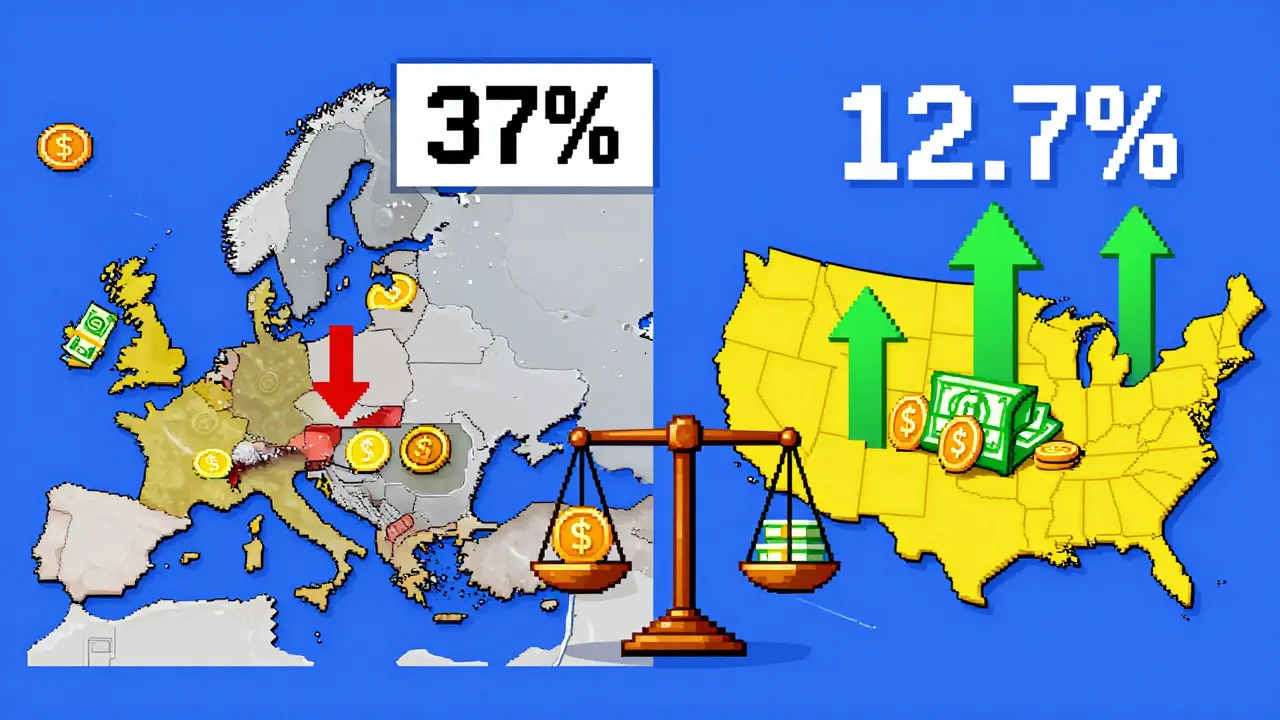
The results so far are stark. In the EU, the stablecoin market shrank by 37% between June 2024 and June 2025, dropping from $58.3 billion to $36.7 billion. Why? Because non-compliant tokens were delisted. Exchanges like Binance had to process millions of notifications to kick out risky assets. Today, USDC and EURC dominate the compliant space, holding nearly 90% of the market.
In the US, the market grew by 32.7% in the same period, reaching $192.7 billion. Tether (USDT) remains the giant, holding 58.4% of the share despite the regulatory uncertainty. The US framework’s focus on Treasuries has actually boosted the market, as large issuers now hold over $187 billion in US government debt. This makes the US stablecoin sector a key pillar of the national debt market.
What This Means for You
If you are a user in Europe, your choices are fewer, but safer. You won’t find high-yield algorithmic tokens anymore. But when you redeem your USDC or EURC, it works. Data shows MiCA-compliant stablecoins had 99.98% redemption reliability during market stress. You lose variety, but you gain sleep.
If you are in the US, you still have more options, but you are exposed to different risks. The concentration of reserves in Treasuries means that if interest rates spike or the Treasury market wobbles, your stablecoin feels it immediately. The IMF warned in April 2025 that this concentration creates systemic vulnerabilities.
Future Outlook: Convergence or Conflict?
We are heading toward a clash of systems. The EU is building a fortress around its financial data and stability. The US is building a pipeline to drain global liquidity into US Treasuries. The International Organization of Securities Commissions is trying to bridge the gap, proposing global standards that blend both approaches. But for now, businesses must choose: do you want the safety of the EU’s rigid structure, or the scale of the US’s Treasury-backed model?
Watch for the European Banking Authority’s list of "significant" stablecoins expected by September 2025. Those tokens will face even stricter rules, including 120% reserve backing. Meanwhile, watch the Senate Banking Committee’s progress on federal charters for US issuers. The winner of this race won’t just be the biggest stablecoin; it will be the jurisdiction that best balances innovation with survival.
Is the GENIUS Act real?
No, there is no official US legislation named the "GENIUS Act." This term is likely a confusion or misreporting. The actual US framework is based on pending bills like the Clarity for Payment Stablecoins Act and previous executive orders. When experts discuss US stablecoin regulation, they refer to the emerging federal framework, not a GENIUS Act.
Can I still use algorithmic stablecoins in Europe?
Under MiCA, algorithmic stablecoins are explicitly banned because they lack explicit reserves tied to traditional assets. If you are in the EU, you cannot legally issue or trade non-compliant algorithmic stablecoins on regulated platforms. Major exchanges have already delisted them to comply with ESMA restrictions.
Why does the US require US Treasuries as reserves?
The US framework mandates that at least 80% of reserves be held in US Treasuries to strengthen the dollar's global dominance. By creating a massive, steady demand for US government debt, the policy helps lower borrowing costs for the US government while ensuring stablecoins remain tightly linked to the US financial system.
Which regulation is better for consumers?
It depends on your priority. MiCA offers higher consumer protection with strict redemption guarantees and bans on risky models, resulting in fewer but safer options. The US framework offers more variety and potential yield but exposes users to systemic risks related to Treasury market volatility. Studies show MiCA-compliant tokens had near-perfect redemption rates during crises.
When did MiCA fully apply to stablecoins?
MiCA entered into force in June 2023, but its provisions applied in phases. Stablecoin-specific rules took effect on June 30, 2024. Requirements for Crypto-Asset Service Providers (CASPs) followed at the end of December 2024. By early 2025, most non-compliant tokens were restricted or delisted in the EU.