You hear the promise constantly: earn passive income by providing liquidity. The numbers look tempting. Annual percentage yields that dwarf traditional savings accounts are just a click away on decentralized exchanges. But behind those glowing green yield percentages lies a complex web of technical and market risks that can wipe out your capital faster than you can say 'blockchain.'
Providing liquidity isn't just parking money in a high-interest account. It’s an active role in the financial infrastructure of the internet. If you don’t understand how liquidity pools work and where they can fail, you aren’t investing-you’re gambling with a loaded dice.
The Core Mechanism: How Liquidity Pools Work
To understand the risks, you first need to grasp the machine you’re feeding. A liquidity pool is a smart contract holding two or more tokens that traders swap against. Unlike traditional stock markets that rely on order books and human market makers, decentralized exchanges (DEXs) use Automated Market Makers (AMMs).
When you deposit funds into a pool, you receive liquidity provider (LP) tokens representing your share of the pool. Every time someone trades within that pool, they pay a fee. That fee is distributed among all LPs proportional to their contribution. This system ensures trading happens 24/7 without intermediaries. However, this efficiency comes at a cost to the provider, primarily through price manipulation mechanics inherent in the AMM formula.
Impermanent Loss: The Silent Profit Killer
If there is one concept every potential liquidity provider must master, it is impermanent loss. This is not a bug; it is a feature of how AMMs function. Impermanent loss occurs when the price ratio of the two tokens in your pool changes significantly compared to when you deposited them.
Imagine you provide $1,000 worth of Ethereum (ETH) and $1,000 worth of USDC to a pool. The AMM maintains a constant product formula ($x \times y = k$). If ETH doubles in price, arbitrage bots will buy cheap ETH from your pool and sell it elsewhere for profit. This removes ETH from your pool and adds USDC. You end up holding less ETH and more USDC than you started with.
When you withdraw, you compare your position to simply holding the original assets. In our example, holding would have yielded $3,000 ($2,000 in ETH + $1,000 in USDC). Your pool might only be worth $2,828. That $172 difference is impermanent loss. It becomes permanent the moment you withdraw during a divergence. Volatility is the enemy here. The wider the price swing between the paired assets, the greater the loss.
Smart Contract Vulnerabilities: Code Is Law, Until It Isn't
In centralized finance, if a bank fails, insurance often covers deposits. In DeFi, there is no FDIC. Your funds sit in code. If that code has a flaw, your funds are gone. Smart contract risk is arguably the most dangerous category because it involves total loss rather than reduced returns.
Smart contracts are self-executing programs on the blockchain. They control billions of dollars but are written by humans who make mistakes. Common vulnerabilities include reentrancy attacks, where hackers exploit the timing of transactions to drain funds before balances update, and logic errors that allow unauthorized access to admin functions.
Even audited contracts aren't immune. Audits check for known issues, not future exploits. High-profile hacks have seen protocols lose hundreds of millions in minutes. When you provide liquidity, you trust the developer team’s competence and integrity. If the protocol is unaudited or uses untested code, you are exposing yourself to existential risk.
Rug Pulls and Governance Risks
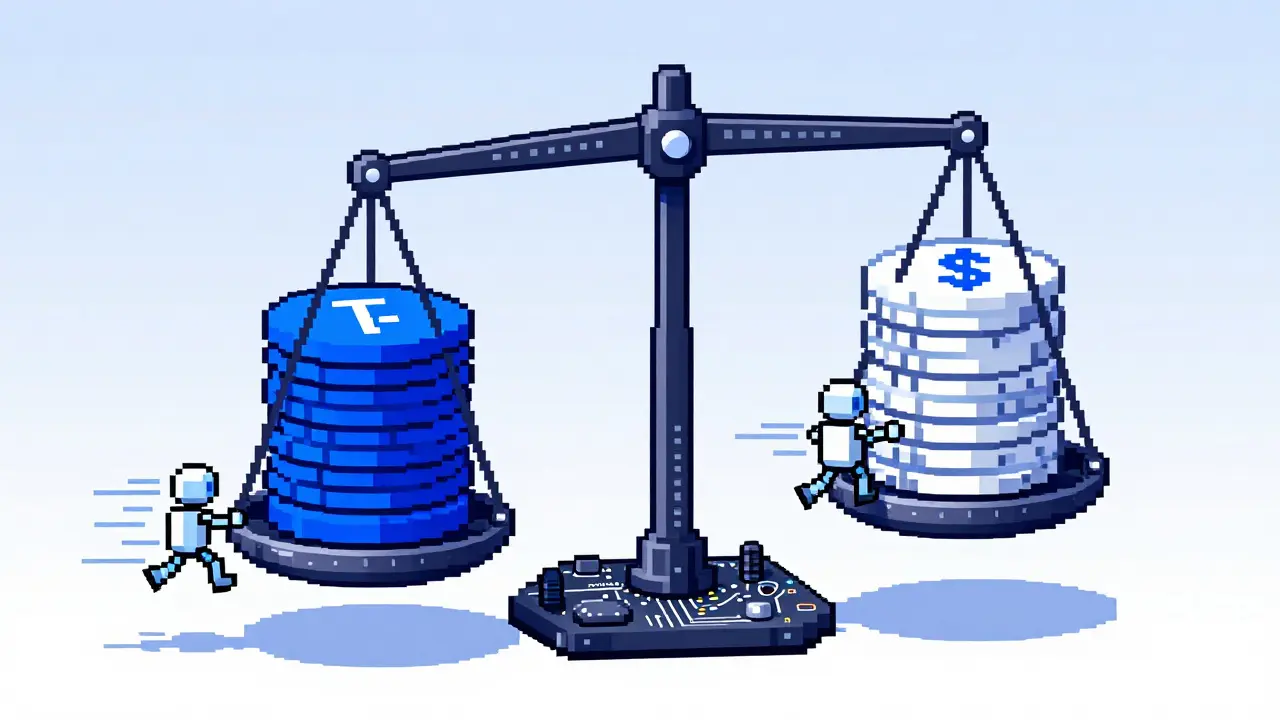
Not all losses come from bad code or market moves. Sometimes, the loss is intentional theft. A rug pull is a malicious act where developers abandon a project and take the liquidity with them.
Scammers create a token, pair it with ETH or USDT, and hype the project on social media. Once enough users provide liquidity, the developer sells their entire stash of the native token into the pool, crashing its value to zero, and withdraws all the valuable paired tokens. You are left holding worthless bags.
Governance risks are subtler but equally damaging. Many protocols use governance tokens to vote on changes. If a small group controls most voting power, they can pass proposals that benefit themselves at your expense. For example, they might change fee structures to favor themselves or approve malicious upgrades to the smart contract. Always check if liquidity is locked and who holds the keys to the vault.
Concentrated Liquidity and Out-of-Range Risk
Newer versions of DEXs, like Uniswap V3, introduced concentrated liquidity. This allows providers to allocate capital to specific price ranges, increasing capital efficiency and fees. However, it introduces out-of-range risk.
If the market price moves outside your chosen range, your position stops earning fees entirely. You are essentially holding a static amount of one asset while missing out on trading activity. To fix this, you must rebalance-withdraw and redeposit into a new range. This requires gas fees and active management. During volatile periods, you might spend more on transaction costs than you earn in fees, turning a profitable strategy into a losing one.
| Risk Type | Cause | Severity | Mitigation Strategy |
|---|---|---|---|
| Impermanent Loss | Price divergence between tokens | Medium to High | Use stablecoin pairs; monitor volatility |
| Smart Contract Bug | Code vulnerabilities/hacks | Critical (Total Loss) | Audited protocols only; diversify exposure |
| Rug Pull | Malicious developer action | Critical (Total Loss) | Check locked liquidity; verify team identity |
| Out-of-Range | Price moves outside set bounds | Low to Medium | Active rebalancing; wider ranges |

Mitigating Risks: A Practical Checklist
You cannot eliminate risk in DeFi, but you can manage it. Here is how experienced providers protect their capital.
- Stick to Stable Pairs: Providing liquidity for pairs like USDC/USDT minimizes impermanent loss because the prices remain pegged to each other. The returns are lower, but the risk is significantly reduced.
- Verify Audits: Never touch a pool that hasn’t been audited by reputable firms like CertiK, OpenZeppelin, or Trail of Bits. Check the audit report for critical findings.
- Check Liquidity Locks: Use tools like Unicrypt or Team Finance to see if the project’s liquidity is locked. Locked liquidity means developers cannot rug pull for a set period.
- Diversify Protocols: Don’t put all your eggs in one basket. Spread your liquidity across different chains and protocols to mitigate single-point-of-failure risks.
- Monitor Gas Fees: On networks like Ethereum, high gas fees can eat into profits, especially for frequent rebalancing. Consider Layer 2 solutions like Arbitrum or Optimized for lower costs.
The Psychological Trap of Yield
Finally, consider the psychological aspect. High yields attract attention, but they also signal higher risk. A 50% APY usually implies extreme volatility or unsustainable token emissions. If a protocol pays out rewards from its own token supply, that token’s price may dilute rapidly, making your earnings worthless in fiat terms.
Treat liquidity provision as active portfolio management, not passive income. You must monitor positions, understand the underlying assets, and be ready to exit when conditions change. The blockchain doesn’t care about your intent; it only executes code. Protect yourself by knowing what that code does before you sign the transaction.
What is impermanent loss in simple terms?
Impermanent loss is the difference between the value of your tokens if you had held them versus the value of your tokens in a liquidity pool. It happens when the price of one token changes significantly relative to the other. The more volatile the prices, the higher the impermanent loss.
Can I lose all my money in a liquidity pool?
Yes. If a smart contract is hacked or a developer performs a rug pull, you can lose 100% of your deposited funds. Impermanent loss rarely causes total loss, but security breaches do.
How do I know if a liquidity pool is safe?
Look for three things: professional smart contract audits, locked liquidity (meaning developers can't withdraw), and a transparent, active development team. Avoid pools with anonymous teams or unlocked liquidity.
Is providing liquidity better than staking?
Staking generally carries less risk because you lock a single asset. Liquidity providing offers higher potential rewards but introduces impermanent loss and counterparty risks. Staking is safer; liquidity providing is more complex and risky.
What is a rug pull?
A rug pull is a scam where developers create a fake project, attract liquidity, and then remove all the funds, leaving investors with worthless tokens. It is a form of fraud common in new, unaudited DeFi projects.