

Most people think of money as a simple tool, but the systems we use to track value are deeply flawed. Whether you prefer the traditional stability of a government-issued bank account or the futuristic promise of a digital wallet, you're dealing with a set of compromises. One system is prone to political whims and slow bureaucracy, while the other can swing wildly in value based on a single tweet. The real question isn't which one is "better," but which set of risks you're willing to live with.
To understand the trade-off, we first need to look at Fiat Currency is government-issued currency that is not backed by a physical commodity like gold or silver. It relies entirely on the trust and stability of the issuing government. While it's the global standard, that very trust is where the biggest problems begin.
The Hidden Costs of Centralized Money
The biggest flaw in the fiat system is that it's controlled by a few people in a room. When central banks decide to print more money to stimulate an economy, they aren't creating new wealth; they're diluting the value of every dollar or pound already in your pocket. This is the engine of inflation. If the supply of money grows faster than the production of goods, prices go up, and your purchasing power vanishes.
We've seen this go horribly wrong in the real world. Take the Zimbabwean dollar, for example. In 2022, it lost a staggering 76% of its value. When a government loses control of its monetary policy, the currency can become practically worthless overnight. This isn't just a theoretical risk; it's a systemic vulnerability that affects everyone holding traditional cash.
Beyond inflation, there's the sheer inefficiency of the plumbing. Sending money across borders using the traditional banking system is often a nightmare. You're looking at a window of 2 to 99 business days for a transaction to actually settle. Along the way, banks slap on commissions and fees that eat into the total amount. For a global economy in 2026, this level of friction is an embarrassment.
The Chaos of Digital Assets
On the flip side, Cryptocurrency is a digital or virtual currency secured by cryptography and operating on a decentralized network. While it solves the "central point of failure" problem, it introduces a level of instability that would make a traditional banker faint.
Price volatility is the elephant in the room. In the fiat world, a 2% change in currency value is a huge deal. In the crypto world, a 20% crash in a single day is just Tuesday. Remember when the FTX exchange collapsed? Bitcoin plummeted 22% in less than 24 hours. If you were using crypto as your primary means of payment, your rent money could literally disappear while you were sleeping.
Then there's the usability gap. Despite the hype, you still can't walk into most shops and pay with a digital token. While El Salvador made headlines by adopting Bitcoin as legal tender back in 2021, the vast majority of the world still requires fiat for daily life. If you can't buy a coffee with it, is it really money, or is it just a high-risk speculative asset?
| Feature | Fiat Currency Risks | Cryptocurrency Risks |
|---|---|---|
| Value Stability | Slow erosion via inflation | Extreme daily volatility |
| Control | Centralized (Government/Bank) | Decentralized (User responsibility) |
| Speed | Slow (especially cross-border) | Variable (Network congestion) |
| Security | Bank failures/Government collapse | Hacking/Loss of private keys |

The Technical and Environmental Wall
Many proponents of digital money claim it's faster and cheaper, but that's not always the case in practice. When a network gets crowded, transaction times can stretch from minutes to hours. If you're trying to pay for something at a checkout counter, a 10-minute wait for a Blockchain confirmation is unacceptable.
Cost is another issue. Users of the Ethereum network have frequently dealt with "gas fees"-transaction costs that skyrocket during peak usage. It's not uncommon for a small transfer to cost more in fees than the actual value being sent, which completely defeats the purpose of a low-cost payment system.
We also can't ignore the planet. The process of Mining-specifically for proof-of-work systems-requires a massive amount of computational power. This leads to a heavy carbon footprint, making it a hard sell for environmentally conscious users or governments trying to meet climate goals.
Security in a Lawless Land
In the fiat system, if your credit card is stolen, you call the bank and cancel it. In the world of Digital Wallets, there is no "forgot password" button for your seed phrase. If a hacker phishes your private keys or you simply lose your backup, your funds are gone forever. There is no central authority to appeal to.
This "wild west" environment is further complicated by regulatory uncertainty. Governments are still figuring out how to tax and monitor crypto. Depending on where you live, your digital assets could be legal, restricted, or viewed as a security, which creates a legal minefield for anyone trying to integrate crypto into a legitimate business model.
The Middle Ground: Stablecoins and Hybrids
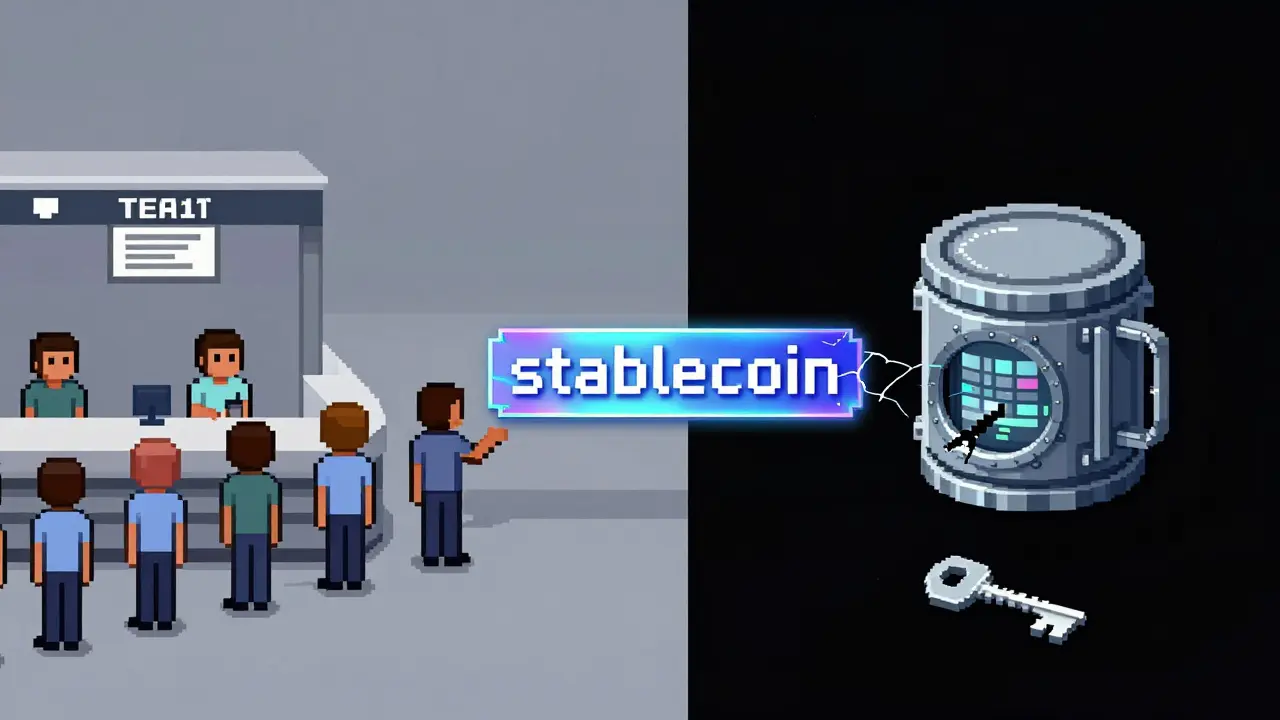
Because both systems have such glaring holes, the industry has tried to create a hybrid. Stablecoins are digital assets pegged to a fiat currency, like the US Dollar. The goal is to combine the speed and borderless nature of blockchain with the price stability of traditional money.
However, stablecoins aren't a magic bullet. They often rely on centralized reserves, meaning you're back to trusting a company to actually hold the money they claim to have. It's essentially a digital version of the old banking system, just wrapped in new technology. If the reserve is insufficient, the stablecoin can "de-peg," leading to the same kind of collapse seen in unregulated crypto projects.
Which Risk is More Manageable?
If you're looking at short-term needs-paying rent, buying groceries, and receiving a salary-fiat is still the only practical choice. The risk is a slow, steady loss of value over decades, which is a problem, but one you can manage by investing in assets. The stability of the Global Economy relies on this predictability.
Cryptocurrency, on the other hand, is a tool for those who distrust central authorities and are willing to accept extreme risk for the potential of high returns or absolute privacy. It's a hedge against the total collapse of a government, but it's a terrible tool for a weekly budget. Neither system is a perfect store of value; they just fail in different ways.
Can cryptocurrency ever fully replace fiat money?
It is unlikely to happen completely. Fiat currency provides the stability and universal acceptance required for daily economic functions. For cryptocurrency to replace it, it would need to solve the volatility problem without re-introducing the centralized control it was designed to avoid.
Why is inflation considered a disadvantage of fiat?
Inflation happens when governments print more money, which increases the supply and lowers the value of each unit. This means your money buys fewer goods and services over time, effectively acting as a hidden tax on your savings.
What is the biggest risk for a cryptocurrency holder?
The most immediate risks are extreme price volatility and the loss of private keys. Unlike a bank account, if you lose the access keys to your digital wallet, there is no one to help you recover your funds.
Are stablecoins safer than other cryptocurrencies?
They are safer in terms of price stability because they are pegged to a currency like the Dollar. However, they carry "counterparty risk," meaning you must trust the issuer to actually possess the reserves they claim to have.
Why are crypto transactions sometimes slow?
Blockchain networks have limited capacity. When many people try to send transactions at once, the network becomes congested. Users must either wait for a block confirmation or pay higher fees (like gas fees) to have their transaction prioritized.




Eric Raines
April 21, 2026 AT 01:25Everyone acts like this is some deep revelation but it's just basic economics. Fiat is designed to fail slowly and crypto is designed to fail fast. If you actually understood liquidity pools and the way algorithmic stablecoins function, you'd realize that the 'middle ground' mentioned here is basically just a fancy way of saying 'waiting for the next crash.' It is honestly exhausting how many people still think Bitcoin is a currency when it is clearly just a digital gold substitute for people who are afraid of the government.
Benjamin Forg
April 22, 2026 AT 01:10central banks are just fronts for the globalist agenda anyway. they print money to keep us in debt and compliant while the elites move their wealth into assets we can't touch. crypto was supposed to be the way out but look at the exchange collapses. its all a simulation to keep us guessing while they switch the rails of the financial system to something they can monitor even better than a bank account. stay awake people
jill huyo-a
April 22, 2026 AT 13:45I think it's really interesting how we're balancing these two worlds. Maybe we can find a way to implement the security of traditional banking with the transparency of the blockchain without losing the human touch that helps people when they make mistakes.
Mary Tawfall
April 22, 2026 AT 22:06Such a thoughtful perspective on the risks involved!
Keith Garcia
April 23, 2026 AT 05:13Imagine thinking a 'seed phrase' is a viable security measure for the masses 🙄. It's absolutely laughable that we've devolved into a state where 'trustless' systems actually require more faith in one's own ability to not lose a piece of paper than trusting a regulated entity. The sheer audacity of the crypto-evangelists to call this 'innovation' when it's basically just a glorified casino for people who failed high school algebra 🤡.
Matthew Morse
April 24, 2026 AT 23:02too long didnt read but basically banks suck and crypto is a gamble
Yvette P
April 26, 2026 AT 02:19Oh honey, let me just drop some actual knowledge on this since we're pretending to understand macroeconomics here. The 'environmental wall' is such a quaint talking point when you consider the sheer amount of energy wasted by the legacy banking infrastructure's redundant data centers and physical branches that are essentially fossils. If we're talking about the carbon footprint, let's talk about the systemic inefficiency of the SWIFT network which is basically the internet equivalent of sending a letter via carrier pigeon. It's adorable that you think 'gas fees' are the peak of inefficiency when the entire fiat system is literally built on the premise of stealing your purchasing power through inflation while you sleep. The arbitrage opportunities in the current volatile market are practically a gift for those of us who actually understand how to hedge our positions using derivative contracts and synthetic assets, but please, continue worrying about a few GPUs running in a warehouse somewhere. Honestly, the cognitive dissonance required to prefer a system that lets a central committee decide the value of your labor is just breathtaking.
Candace Sherrard
April 26, 2026 AT 23:08It makes me wonder if the concept of a 'currency' itself is just a collective hallucination we've all agreed to participate in to avoid the chaos of true bartering. We spend our whole lives chasing these numbers, whether they are stored in a marble building or on a distributed ledger, but in the end, the value is only as real as the society that supports it. It's a strange loop where we try to escape the fragility of the state only to find ourselves at the mercy of a mathematical algorithm that doesn't care if we can afford our rent or not.
Jennifer Taylor
April 27, 2026 AT 12:01The seed phrases are just a way for them to track who is actually independent. If you lose your keys you are just being purged from the system by the people who really run the coins.Dont trust the wallets!
Hannah Rubia
April 29, 2026 AT 07:01I would suggest that for those concerned about the volatility of digital assets, diversifying into a broad range of low-cost index funds may provide a more stable alternative to holding pure fiat or speculative tokens.
Miranda Jamieson
April 30, 2026 AT 16:46People who still hold massive amounts of cash in savings accounts are just asking to be poor. It's a lack of basic financial literacy that is honestly pathetic at this point.
Jagdish Sutar
May 2, 2026 AT 08:13It's quite helpful to see both sides laid out like this. In my experience, many people in India are using digital payments for everything now, even the smallest street vendors, which shows that the gap in usability is closing faster than we think.
Charlie Queen
May 2, 2026 AT 20:26I love the energy of this debate! 🚀 Maybe one day we'll just have a system that works for everyone without all the stress! 🌈✨
Sara Ellis
May 3, 2026 AT 09:28who cares if its a coin or a paper as long as i can buy stuff
Doc Coyle
May 3, 2026 AT 12:51The problem is that people want the benefits of decentralization without taking any of the responsibility. You can't complain about the 'wild west' when you're the one who chose to move into the frontier.
Ellie Drews
May 5, 2026 AT 06:40Let's all remember to be kind to each other while we figure this out. We're all just trying to protect our families' futures.
Findlay Duncan Lyon
May 6, 2026 AT 08:35Fair point on the cross-border fees. Absolute robbery.
Paige Raulerson
May 7, 2026 AT 21:02The comparison table is a bit simplistic, but I suppose it serves a purpose for those who can't grasp the nuances of monetary policy.
Larry Yang
May 8, 2026 AT 08:53stables are basically just another way for companies to lie about how much cash they actually have in the vault. trust me, they are all just Ponzi schemes with better marketing
Guy Bianco
May 9, 2026 AT 10:51I find the discussion on private key management quite pertinent. It is a significant barrier to entry for the average person. :)
Tara Aman
May 9, 2026 AT 16:08Let's keep pushing for better alternatives! The fact that we're even talking about this means change is coming!
debashish sahu
May 10, 2026 AT 21:22In my country, we have seen how these systems can be manipulated by those in power, so the debate between centralized and decentralized is very relevant to our daily lives.
Jennifer L
May 11, 2026 AT 08:49Oh my goodness, the thought of losing everything because of a lost password is simply terrifyng!! I could never do it!!