
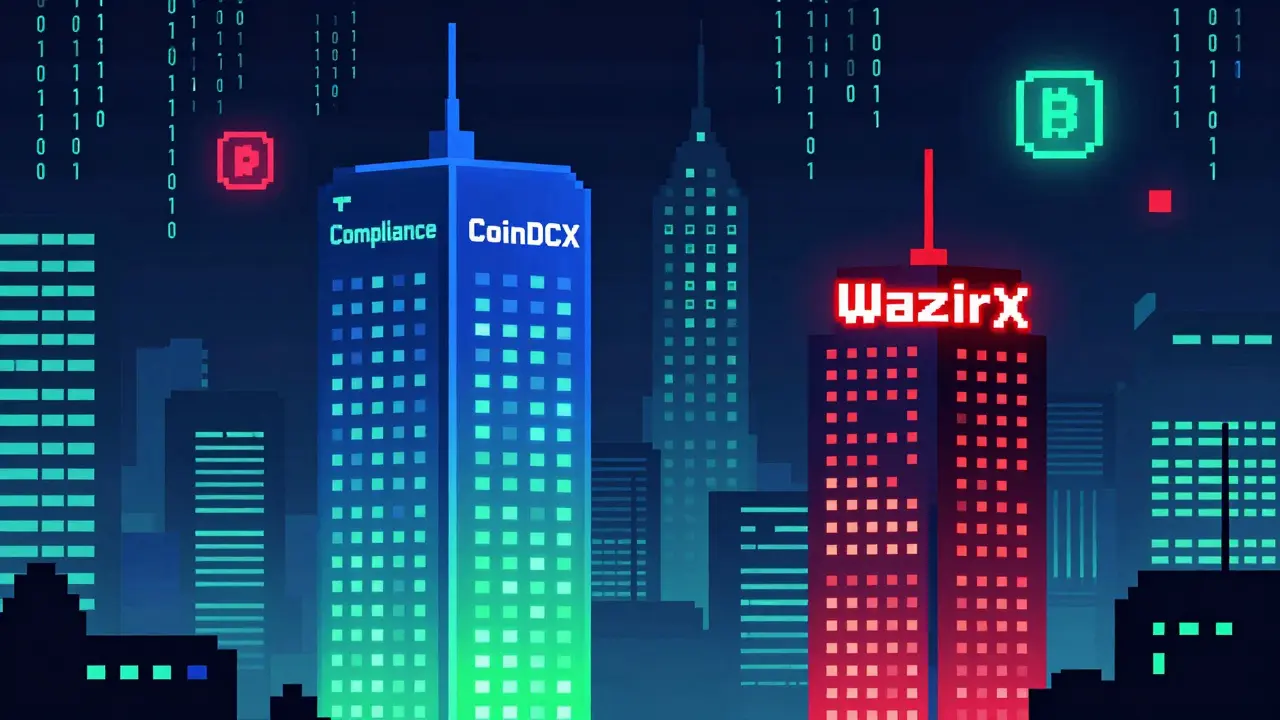
India’s cryptocurrency landscape has undergone a massive transformation over the last few years. If you are trading digital assets in India, you have likely noticed that things are no longer as wild as they were in 2021. The days of unregulated platforms operating with zero oversight are effectively gone. Today, the focus is squarely on compliance, security, and strict adherence to government mandates. Two names dominate this conversation: CoinDCX is a leading Indian cryptocurrency exchange that emphasizes regulatory compliance and institutional-grade security features. and WazirX is one of India's pioneering crypto exchanges that faced significant challenges following a major security breach in 2024.
Both platforms operate under the intense scrutiny of the Financial Intelligence Unit of India (FIU-IND) is the national financial intelligence unit responsible for combating money laundering and financing of terrorism.. This agency enforces rules derived from the Prevention of Money Laundering Act (PMLA) is an Indian law enacted to prevent money laundering and to provide for confiscation of property derived from or involved in money laundering.. For traders, this means higher barriers to entry but theoretically safer environments. However, safety is not guaranteed, as recent events have shown.
The Regulatory Framework: From KYC to Cybersecurity Audits
To understand where CoinDCX and WazirX stand, we need to look at the rules they must follow. Since March 2023, all Virtual Digital Asset (VDA) service providers have been required to register with FIU-IND. This brought crypto exchanges under banking-level Know Your Customer (KYC) and Anti-Money Laundering (AML) regulations. It was a seismic shift. Suddenly, crypto platforms had to treat user data and transaction monitoring with the same seriousness as traditional banks.
But the rules didn't stop there. In September 2025, FIU-IND introduced a new mandate: mandatory cybersecurity audits conducted by firms approved by CERT-In is the National Response Coordinator for cybersecurity incidents in India.. This move positioned cybersecurity not just as a best practice, but as a strategic investment requirement. Every platform operating in India must now undergo third-party security assessments. This creates significant operational pressure, especially for smaller startups that lack the resources of larger players like CoinDCX.
| Requirement | Governing Body | Implementation Date | Impact |
|---|---|---|---|
| Registration as VDA Service Provider | FIU-IND | March 2023 | Mandatory KYC/AML compliance |
| FATF Travel Rule Compliance | Reserve Bank of India / FIU-IND | Ongoing | No minimum threshold for sender-receiver info |
| Cybersecurity Audits | FIU-IND / CERT-In | September 2025 | Mandatory third-party security assessments |
| Suspicious Transaction Reporting | FIU-IND | Continuous | Real-time monitoring and reporting |
Security Breaches: Lessons from WazirX and CoinDCX
Regulations are often tightened after disasters. The Indian crypto sector has seen its share of them. WazirX, once a pioneer in the space, suffered a catastrophic security breach in 2024. Hackers stole approximately $230 million. This incident exposed critical vulnerabilities in the sector's infrastructure and became a catalyst for even stricter regulatory oversight. Users were left frustrated, contrasting WazirX's slower recovery against international exchanges like BingX, which resumed operations within 24 hours after their own breach.
CoinDCX, recognized as India's first digital asset unicorn, also faced challenges. In July 2025, the platform experienced a major security breach. While the exact financial impact differs from WazirX's loss, it reinforced regulators' concerns about cybersecurity preparedness across domestic exchanges. These incidents serve as stark reminders that even compliant platforms are not immune to threats. They highlight why the September 2025 cybersecurity audit mandate was so crucial. It forces exchanges to invest heavily in protection before a breach occurs, rather than scrambling afterward.
The FATF Travel Rule: One of the Strictest Regimes Globally
One of the most significant aspects of India's regulatory framework is its implementation of the Financial Action Task Force (FATF) Travel Rule. Unlike many other jurisdictions that set a minimum threshold for reporting, India requires detailed sender-receiver information for all cryptocurrency transfers. There is no minimum amount exempted. This makes India one of the strictest compliance regimes globally.
For users, this means more friction when sending funds. You cannot simply send crypto to an anonymous wallet without providing personal details. For exchanges, it means building robust systems to collect, store, and transmit this data securely. This aligns with India's broader strategy to combat rising cyber threats and maintain control over the rapidly growing cryptocurrency sector. The country ranks high in global blockchain analysis reports for crypto adoption, making it a prime target for illicit finance activities if left unchecked.
International Players vs. Domestic Exchanges
The regulatory crackdown isn't limited to domestic players like CoinDCX and WazirX. Major international exchanges have also had to adapt. Coinbase successfully registered with India's FIU, enabling compliant cryptocurrency trading services. Binance registered after paying a $2.2 million penalty for previous non-compliance. KuCoin followed suit, registering after a $41,000 penalty. These penalties signal that the Indian government will not tolerate shortcuts.
However, the situation is more complex for offshore platforms. Indian authorities issued notices to 25 offshore cryptocurrency exchanges, including Huione, CEX.IO, and BingX. These platforms were accused of money laundering risks and failure to comply with domestic registration requirements. They face potential bans if they fail to provide adequate explanations within 45-day notice periods. This could disrupt access for millions of Indian users who rely on these platforms for lower fees and broader asset access.
| Exchange | Type | Compliance Status | Notable Events |
|---|---|---|---|
| CoinDCX | Domestic | FIU Registered | July 2025 security breach |
| WazirX | Domestic | FIU Registered | $230M hack in 2024 |
| Coinbase | International | FIU Registered | Smooth registration process |
| Binance | International | FIU Registered | Paid $2.2M penalty |
| KuCoin | International | FIU Registered | Paid $41,000 penalty |
| Huione | Offshore | Notice Issued | 45-day compliance window |

Market Sentiment and User Choices
The immediate market implications are clear: user frustration. Traders express their concerns across social media platforms, highlighting the contrast between offshore platforms offering convenience and domestic exchanges offering security. Offshore platforms often have lower fees and access to a wider range of altcoins. However, their regulatory lapses expose users to sudden liquidation risks. If a platform gets banned overnight, accessing your funds can become a nightmare.
Industry experts note that India's approach reflects broader global trends toward tighter crypto oversight. Finance Minister Nirmala Sitharaman previously emphasized a balanced regulatory approach in 2022, warning against rushed regulations that might hinder technological progress. Yet, the government appears committed to prioritizing compliance over convenience given surging crypto adoption. The message is clear: platforms ignoring regulations will not be permitted to operate with impunity.
This environment creates opportunities for specialized firms. Cybersecurity companies like Pi42 and Mudrex leverage the compliance mandate by offering specialized solutions and educational services. They enhance overall sector trust while creating new business opportunities. Smaller exchanges face disproportionate compliance challenges compared to larger firms like CoinDCX, which benefit from competitive advantages through better resources to meet regulatory requirements.
Future Outlook: Consolidation and Innovation
The outcome of current enforcement actions will determine market concentration. We may see a consolidation between registered domestic players and international platforms that choose to comply. This could accelerate innovation among compliant entities while risking suppression in a sector experiencing explosive growth. Singapore-based Liminal Custody has emerged as an example of this trend, becoming an FIU-registered entity providing compliant digital asset custody services for Indian institutions. It demonstrates pathways for international firms to operate legally within India's regulatory framework.
Current market sentiment reflects a growing division. Some users seek convenience through offshore platforms, accepting the risks. Others prioritize security through compliant domestic exchanges. Many traders are diversifying across multiple platforms to mitigate regulatory risks. The 45-day compliance window for offshore exchanges represents a critical juncture. It will shape India's crypto ecosystem and influence how other emerging markets balance innovation with regulatory oversight.
Strategic responses from targeted platforms include exploring partnerships with local entities to navigate regulations and potential legal challenges to the regulatory notices. India's regulatory approach prioritizes investor protection and financial system integrity over market convenience. Future developments will likely focus on balancing technological innovation with risk mitigation, ensuring comprehensive oversight of both domestic and international service providers.
Is CoinDCX safe to use in 2026?
CoinDCX is considered one of the safer options for Indian traders because it is fully registered with the FIU-IND and complies with PMLA regulations. However, it did experience a security breach in July 2025. Like any exchange, it carries inherent risks. Users should always enable two-factor authentication and consider using hardware wallets for long-term storage.
What happened to WazirX after the $230 million hack?
After the $230 million hack in 2024, WazirX faced significant regulatory scrutiny and user distrust. The incident accelerated regulatory tightening in India, particularly regarding cybersecurity audits. WazirX has since worked to restore operations and regain user confidence, but the event remains a cautionary tale about the importance of robust security measures.
Do I need to provide my identity to send crypto in India?
Yes. Under India's implementation of the FATF Travel Rule, there is no minimum threshold for transactions. All cryptocurrency transfers require detailed sender-receiver information. This means you must complete full KYC verification on any compliant exchange to send or receive funds.
Will offshore exchanges like Binance still work in India?
Will offshore exchanges like Binance still work in India?
Binance has registered with FIU-IND after paying a penalty, so it currently operates legally. However, other offshore exchanges like Huione and CEX.IO have received notices and face potential bans if they do not comply within 45 days. The landscape is shifting rapidly, and users should monitor official announcements from FIU-IND.
Why are cybersecurity audits mandatory now?
Following major breaches at platforms like WazirX and CoinDCX, the Indian government mandated cybersecurity audits in September 2025. These audits, conducted by CERT-In-approved firms, ensure that exchanges have robust security infrastructure to protect user funds and data. It is a proactive measure to prevent future hacks.





Jerry CUNNINGHAM SR
May 15, 2026 AT 17:57It is genuinely fascinating to observe how the regulatory landscape in India has shifted from a wild west environment to one of strict compliance. The integration of KYC and AML protocols under the FIU-IND framework demonstrates a necessary evolution for institutional trust. While some may argue that these measures stifle innovation, they are essential for protecting investors from the very real threats of money laundering and fraud. The mandatory cybersecurity audits introduced by CERT-In are particularly noteworthy as they force exchanges to prioritize security infrastructure over rapid expansion. This level of scrutiny ensures that platforms like CoinDCX and WazirX operate with transparency and accountability. It is important for users to understand that these regulations are not merely bureaucratic hurdles but safeguards designed to protect their assets. The comparison between domestic and international exchanges highlights the complexity of global crypto regulation. International players like Binance have had to adapt quickly to avoid penalties, showing that no entity is above the law. This creates a more level playing field for all participants in the market. Ultimately, this regulatory maturity will likely lead to greater stability and confidence in the Indian cryptocurrency ecosystem.
Tobias Gjerlufsen
May 16, 2026 AT 22:04you people really think this makes you safe lol
the whole premise of crypto is decentralization and anonymity yet here we are bowing down to government mandates like scared children
india is just killing its own tech sector with this red tape
wazirx got hacked because they were incompetent not because they lacked paperwork
coin dcx also got breached so what does that tell you about these audits
nothing
its just a way for the state to track your every move and tax your gains
stop pretending this is about security
its about control
Shelby Cantu
May 17, 2026 AT 07:58I see where you are coming from Tobias but I think safety matters more than absolute anonymity.
People lost millions on wazirx.
That is real pain.
We need rules to prevent that.
Compliance helps everyone in the long run.
Tobias Gjerlufsen
May 19, 2026 AT 06:37safety is an illusion shelby
if you leave your keys on an exchange you already lost
these audits are just theater
hackers do not care about your certificates
they care about weak code
and centralized databases are always weak
the only true security is self custody
hardware wallets
paper wallets
anything else is gambling
you are confusing regulation with security
they are opposites
Ruben Michel
May 19, 2026 AT 16:27The notion that decentralized systems offer superior security is a profound misunderstanding of modern cyber warfare. Centralized entities with robust resources can implement multi-layered defense strategies that individual actors simply cannot replicate. The recent breaches at major exchanges serve as evidence that even sophisticated internal controls can fail, yet they remain the most viable option for mass adoption. Regulatory oversight ensures that these entities maintain high standards through continuous auditing and external validation. To suggest otherwise is to ignore the complexities of financial crime prevention. The FATF Travel Rule implementation in India sets a global precedent for transparency. It forces illicit actors to operate in the open or face immediate detection. This is not about stifling freedom but about establishing order in a chaotic market. Those who cling to the myth of anonymous transactions often overlook the fact that blockchain analysis tools have rendered such privacy largely obsolete. True sophistication lies in navigating the regulatory framework efficiently rather than attempting to bypass it entirely.
Samara McCallum
May 21, 2026 AT 16:11i feel like we are missing the point here
why do we need to know who sent us money?
it feels so invasive
like being watched all the time
but maybe thats just me being dramatic
i guess if it keeps my coins safe then fine
but i miss the old days
when it was just us and the code
now its us and the code and the government
sigh
Jan Gilmore
May 21, 2026 AT 21:27Let me break this down for those who are confused about the FATF Travel Rule. It is not just an Indian thing. It is a global standard that most developed nations are adopting. The reason there is no minimum threshold in India is because they want to catch small scale money laundering too. This puts immense pressure on exchanges to build better tracking systems. Coinbase and Binance have already adapted to this. They have the infrastructure to handle it. Smaller offshore exchanges might struggle. That is why you see notices being issued to places like Huione. If they cannot comply they will be banned. Users should move their funds to compliant platforms before it is too late. Do not wait until your account is frozen. The trend is clear. Regulation is here to stay and it is getting stricter every year. Adapt or get left behind.
Caique Muniz
May 22, 2026 AT 10:15lol jan thinks he knows everything
fatf travel rule is just a headache
who cares about money laundering when fees are low
i use offshore exchanges cause they dont ask questions
if they ban them ill just find another one
cat and mouse game
government is slow
crypto is fast
they will never catch up
relax guys
its not that serious
Jan Gilmore
May 23, 2026 AT 23:47You are dangerously mistaken Caique. Offshore exchanges are not immune to bans. Look at what happened with Binance in various jurisdictions. They pay fines and comply or they disappear. Your 'cat and mouse' strategy works until your entire portfolio gets locked out overnight. Then you realize that convenience is not worth the risk. I am telling you this as someone who has seen multiple exchanges collapse. Do not gamble with your life savings based on hope that the government is slow. They are faster than you think. Move to a registered platform now.
Gavin Wonnacott
May 24, 2026 AT 23:18This entire discussion is pathetic. You lot are squabbling over which leash is tighter while the dogs bark at each other. The reality is that CoinDCX and WazirX are both compromised entities. One failed due to incompetence, the other due to sheer negligence. The audits are a farce conducted by firms that are likely on the payroll of the very exchanges they are supposed to regulate. I have insider knowledge that suggests the CERT-In approved auditors are rubber stamping basic checks. Do not be fooled by the marketing speak. Your funds are not safe. They are never safe on any centralized platform. The only logical move is to exit immediately and take your losses if necessary. Stay away from these digital piggy banks.
Sheldon Friesen
May 26, 2026 AT 14:43Wow Gavin! What a delightful display of paranoia!
Did you wake up and decide to hate the world today?
I mean seriously, calling audits a farce without proof is quite the leap.
But sure, keep living in your bunker.
Meanwhile, the rest of us are making trades and paying taxes and feeling pretty secure.
Maybe try engaging with the actual content instead of just screaming into the void.
It might be refreshing.
Or maybe not.
Your call.
Gavin Wonnacott
May 27, 2026 AT 10:03Spare me your saccharine tone Sheldon. You are clearly a lapdog for the establishment. Enjoy your regulated scraps while I watch the house burn down. Ignorance is bliss for people like you. Keep your heads in the sand.
Tricia Alach
May 27, 2026 AT 18:40i think its interesting how everyone has such strong opinions
some say its safe some say its a scam
maybe the truth is somewhere in the middle
we just have to be careful
use hardware wallets for big amounts
keep small amounts on exchanges for trading
that seems like a good balance to me
also typos happen sorry about that
robert Whitehead
May 28, 2026 AT 12:16Tricia you are naive. There is no middle ground. Either you adhere to the highest standards of security or you are vulnerable. The moral obligation of an exchange is to protect user funds above all else. When they fail, as WazirX did, they betray the trust placed in them. This is not a matter of opinion. It is a matter of fact. The regulatory response is justified and necessary. Those who complain about KYC are often the same people who would benefit from hiding illicit activities. We must support strict enforcement to cleanse the industry. Anything less is complicity in the degradation of financial integrity. Stand firm against lax security practices.
H F
May 28, 2026 AT 22:59Look, I get the frustration. Crypto was supposed to be free and easy. But look at the mess it became. Scams everywhere. Hacks daily. India taking a hard line is actually brave. It shows they are serious about building a sustainable economy. CoinDCX doing audits is smart. It builds trust. Sure, it costs money, but trust is worth more. I’m staying on compliant platforms. Sleeps better at night. Don’t let the haters fool you. Security is sexy.