You’ve likely seen an ad for Bitzon crypto exchange. Maybe it was on social media, perhaps in an email promising high returns. The site looks professional. The promises sound tempting. But here is the hard truth: there is no credible evidence that Bitzon is a legitimate, regulated cryptocurrency exchange. In fact, the complete absence of this platform from every major industry tracker suggests it is either a defunct project or, more likely, a dangerous scam.
If you are reading this, you probably want to know if your money is safe. The short answer is no. Not unless you can prove otherwise through rigorous checks that most scammers fail. This review isn’t about listing features because there are none to list. It is about protecting your capital by understanding why a missing footprint in the crypto world is a massive red flag.
The Silence of Major Data Aggregators
In the crypto industry, visibility equals legitimacy. Legitimate exchanges, even small ones, appear on data aggregators like CoinGecko and CoinMarketCap. These platforms track trading volume, liquidity, and trust scores for hundreds of venues. As of mid-2026, Bitzon does not exist on these lists.
Why does this matter? Because data providers like Kaiko and CCData monitor market structure closely. They track exchanges with daily volumes as low as $100,000. If Bitzon were processing real trades, it would show up here. The fact that it doesn’t means one of two things: either the platform has zero trading activity, or it is operating completely off-grid. Both scenarios are terrible for a trader. Zero activity means you can’t withdraw your funds. Off-grid operation means no oversight and no recourse if things go wrong.
| Feature | Verified Exchanges (e.g., Kraken, Coinbase) | Bitzon (Unverified) |
|---|---|---|
| Listed on CoinGecko/CoinMarketCap | Yes | No |
| Regulatory Licensing (FCA/FinCEN) | Publicly Verifiable | None Found |
| User Reviews (Trustpilot/G2) | Hundreds/Thousands | Zero |
| Proof of Reserves | Audited Regularly | Non-existent |
| Developer Presence (GitHub/API) | Active Repositories | None |
Historical Context: Was Bitzon Ever Real?
The name "Bitzon" isn’t entirely new. During the ICO boom of 2017-2018, a project called Bitzon appeared on trackers like ICOBench. However, that project was described as a decentralized e-commerce marketplace, not a centralized exchange for trading Bitcoin or Ethereum. Most of these early projects failed to launch or pivoted away from their original goals.
If the current "Bitzon exchange" is trying to revive this old brand, it is doing so without any continuity of trust. There is no bridge between a 2018 marketplace token sale and a 2026 trading platform. This disconnect is common among fraudulent sites that borrow names from forgotten projects to lend themselves false credibility. Always check the timeline. A sudden reappearance of a dead brand is a classic scam tactic.
The Regulatory Void
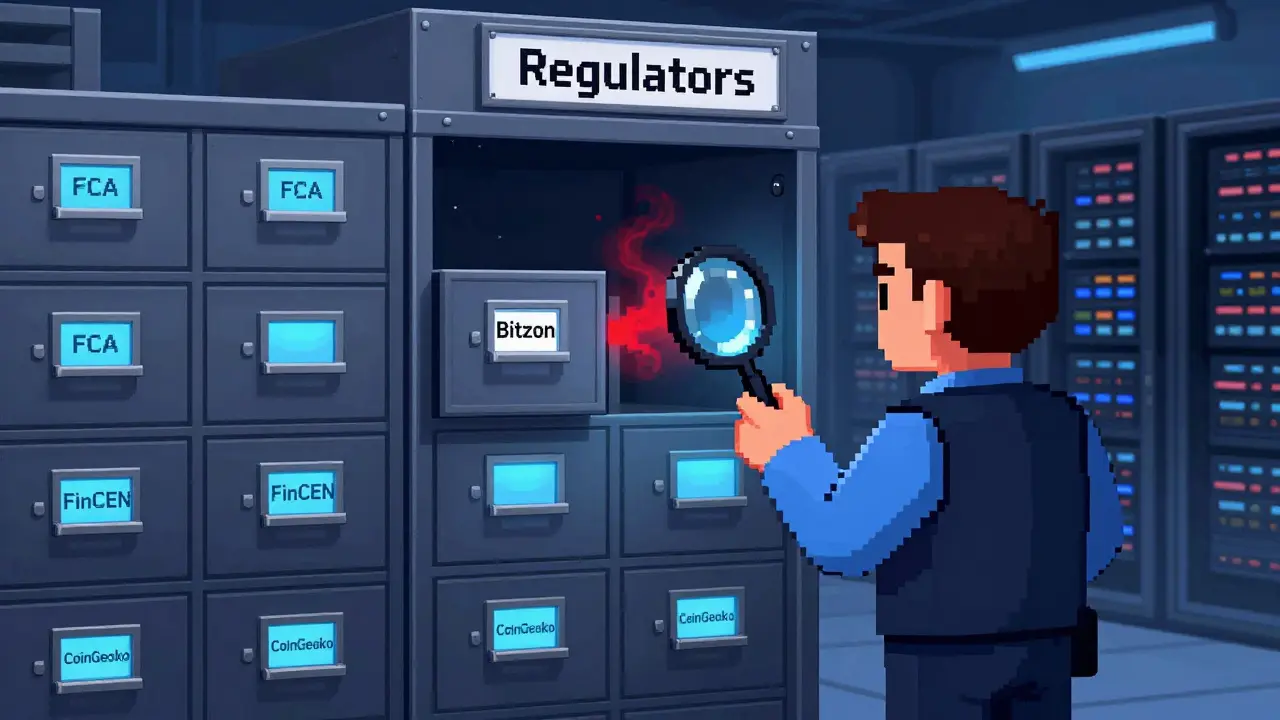
Legitimate financial institutions must register with authorities. In the UK, the Financial Conduct Authority (FCA) maintains a public register of authorized firms. In the US, the Financial Crimes Enforcement Network (FinCEN) tracks Money Services Businesses. Other jurisdictions like Singapore (MAS) and Cyprus (CySEC) also maintain strict lists.
I have searched these registries. Bitzon is not there. This is not a minor oversight; it is a critical failure. Operating a crypto exchange without licensing in major markets is illegal. More importantly, it means you have no legal protection. If Bitzon disappears with your deposit, you cannot file a complaint with a regulator who recognizes them. You are on your own. Compare this to established players like Kraken or Binance, which navigate complex regulatory environments globally to ensure compliance. Their presence in these registers is a badge of safety.
Social Proof and Community Sentiment
Crypto communities are vocal. Platforms like Reddit (r/CryptoCurrency), Twitter/X, and Bitcointalk.org are filled with discussions about fees, outages, and scams. Even niche exchanges get reviewed, criticized, or praised. Search for "Bitzon exchange" on these platforms. What do you find? Nothing.
This silence is deafening. If thousands of people were trading on Bitzon, someone would be complaining about slow withdrawals. Someone would be asking how to verify their account. Someone would be sharing success stories. The absence of organic chatter suggests that no real users exist. Scammers often use bots to generate fake reviews on their own sites, but they cannot buy genuine discussion on independent forums. If a platform has no community, it has no customers.
Technical Due Diligence: Checking the Code
Real exchanges are built by developers. They publish APIs for traders to build bots. They host code on GitHub. They undergo security audits by firms like CertiK or Hacken. Look for Bitzon’s technical documentation. There is none. No API keys, no Swagger files, no GitHub repository.
Without public code or audit reports, you have no way to verify how your funds are stored. Are they in cold storage? Is there multi-signature authentication? Or is your balance just a number in a database controlled by one person? Established exchanges publish Proof of Reserves (PoR) attestations to prove they hold user assets. Bitzon offers no such transparency. Trading on a black box is gambling, not investing.

How to Spot Similar Scams
If Bitzon raises red flags, how do you avoid others? Here is a checklist based on advice from the FTC and FCA:
- Check the Domain Age: Use WHOIS lookup tools. Many scam sites are registered only weeks before they start advertising. Legitimate businesses have older domains.
- Verify HTTPS and SSL: Ensure the site uses a valid certificate from a trusted authority like DigiCert or Let’s Encrypt. Self-signed certificates are a warning sign.
- Search for Negative Keywords: Type "Bitzon scam" or "Bitzon review" into Google. If the only results are from the company itself or paid ads, be suspicious.
- Look for Physical Addresses: Legitimate companies list real office addresses. Scammers often use virtual offices or PO boxes in offshore jurisdictions.
- Contact Support: Try to reach customer service via live chat or phone. If responses are generic, delayed, or non-existent, walk away.
Better Alternatives for 2026
You don’t need to risk your savings on unverified platforms. The crypto market is mature enough that you have plenty of safe, regulated options. Consider these alternatives based on your needs:
- Kraken: Known for strong security and transparent proof-of-reserves. Ideal for serious traders who value privacy and low fees.
- Coinbase: Publicly traded and highly regulated in the US. Best for beginners who want ease of use and insurance coverage.
- Bybit: Popular for derivatives and futures trading with deep liquidity. Good for experienced traders looking for advanced tools.
- Crypto.com: Offers a wide range of services including staking and debit cards. Suitable for users wanting an all-in-one ecosystem.
These platforms compete fiercely on price and features because they rely on real user trust. They have nothing to hide. Bitzon has everything to hide.
Conclusion: Protect Your Capital
The crypto industry has evolved past the Wild West era. While risks remain, they are now associated with negligence rather than necessity. Using an unlisted, unregulated, and undocumented exchange like Bitzon is unnecessary risk. The potential reward-access to some obscure trading pair-is never worth the certainty of losing your principal.
Stick to platforms that are visible, verifiable, and accountable. If an exchange isn’t on CoinGecko, isn’t licensed by a known regulator, and isn’t discussed on Reddit, it doesn’t exist for you. Save your time and your money. Choose safety over speculation.
Is Bitzon a legitimate crypto exchange?
No. There is no evidence that Bitzon is a legitimate, regulated exchange. It is absent from major data aggregators, regulatory registries, and user review platforms, which strongly suggests it is a scam or a defunct project.
Can I withdraw my money from Bitzon?
It is highly unlikely. Scam exchanges often allow small initial withdrawals to build trust before blocking larger amounts or disappearing entirely. Without regulatory oversight, you have no legal recourse to recover lost funds.
Why isn't Bitzon listed on CoinGecko or CoinMarketCap?
CoinGecko and CoinMarketCap require exchanges to meet strict criteria regarding liquidity, security, and transparency. Bitzon fails to meet these standards, indicating it lacks real trading volume and operational integrity.
What should I do if I already deposited funds into Bitzon?
Attempt to withdraw your funds immediately. If successful, close the account and delete any associated apps. If you cannot withdraw, report the incident to your local financial regulator and consider filing a police report for fraud.
Are there any safe alternatives to Bitzon?
Yes. Reputable exchanges like Kraken, Coinbase, Bybit, and Crypto.com offer secure, regulated environments with transparent fee structures and proven track records. Always choose platforms that are publicly verified.