Off‑Chain Transactions: The Practical Guide
When working with Off‑Chain Transactions, transactions that happen outside the main blockchain ledger to cut fees and speed up processing. Also known as off‑chain transfers, they let users move value without every single move being recorded on‑chain. This approach off-chain transactions encompass Layer 2 Scaling, solutions that bundle many small actions into a single on‑chain proof, and they often rely on Payment Channels, two‑party pathways that settle the net result on the blockchain after many off‑chain moves. By moving the heavy lifting off the base layer, users avoid congestion, reduce gas costs, and keep transaction times in seconds rather than minutes.
Why Off‑Chain Matters for Modern Crypto
Beyond the basic layer‑2 and channel ideas, Sidechains, independent blockchains linked to a main chain that can handle their own consensus and fees add another dimension. Assets can hop onto a sidechain, enjoy fast, cheap moves, and later return to the main chain with a single bridge transaction. Rollup Technology, a type of layer‑2 that posts compressed transaction data and a validity proof back to the main chain pushes this idea further: hundreds of off‑chain actions are rolled up into one on‑chain entry, giving near‑instant finality while preserving security. The synergy of sidechains, rollups, and payment channels means that today’s DeFi platforms, NFT marketplaces, and crypto exchanges can offer near‑real‑time experiences without overloading the base protocol.
What does this mean for you as a trader or developer? Exchange reviews like the Coincall or Betconix deep dives highlight how platforms integrate off‑chain order books or layer‑2 settlement to cut fees for high‑volume users. Airdrop guides, such as the FEAR token or OneRare harvest drops, often require participants to claim rewards through off‑chain mechanisms before the final on‑chain distribution, keeping the process smooth and cheap. Articles on rollup tech or hash‑rate security illustrate the broader ecosystem: while rollups boost throughput, a strong hash rate keeps the underlying chain safe for the aggregated data. Whether you’re eyeing a token utility project, scouting a sidechain for NFTs, or just trying to lower your trading costs, understanding off‑chain transactions gives you the toolbox to pick the right solution. Below you’ll find a curated set of articles that dive deeper into each of these concepts and show real‑world implementations.
State Channels: Boosting Blockchain Scalability
By Robert Stukes On 18 Feb, 2025 Comments (22)
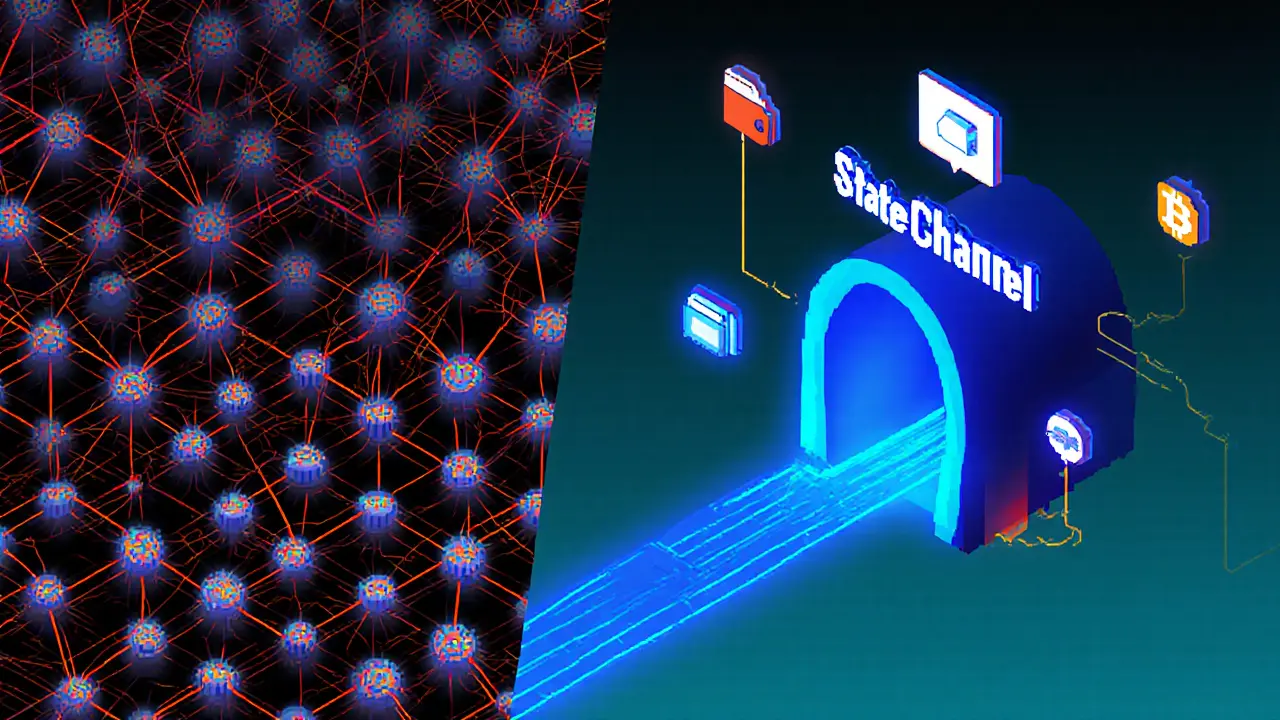
Learn how state channels boost blockchain scalability with faster, cheaper, private transactions. Explore how they work, real‑world use cases, pros, cons, and implementation tips.
View More