KEY Token: Everything You Need to Know
When working with KEY token, a blockchain‑based asset that grants holders specific rights such as staking rewards, governance voting, or access to platform services. Also known as KEY, it bridges the gap between pure cryptocurrency and functional token utility, acting as a digital key that opens doors to DeFi lending, NFT verification, and tokenized equity.
Understanding token utility, the set of functions a token can perform within its ecosystem is crucial because the value of a KEY token largely depends on how its utility is designed. A token that powers a DeFi lending protocol can generate interest income, while a token used for NFT‑based product authenticity creates tamper‑proof passports. The relationship can be expressed as a semantic triple: “KEY token encompasses token utility,” and another: “Token utility influences KEY token value.” This means that when developers add new features—like staking pools or fee discounts—the token’s market appeal grows in step.
Many projects also layer DAO governance tokens, cryptographic voting assets that let community members decide on protocol upgrades and fund allocations on top of the core utility. This creates the triple: “DAO governance token impacts KEY token governance rights.” By holding a KEY token, users may earn voting power in a decentralized autonomous organization, receive a share of transaction fees, or qualify for early access to token airdrops. The combination of utility and governance makes the token more than a speculative asset; it becomes a participatory tool for network growth.
Another emerging connection is with tokenized stock, security‑backed digital representations of real‑world equity that can be traded on blockchain platforms. Projects like the McDonald’s tokenized stock (MCDon) illustrate how a KEY token can inherit features from both security and utility tokens, expanding its appeal to investors seeking diversified exposure. This yields the semantic triple: “Tokenized stock expands KEY token use cases.” When a KEY token is linked to a tokenized equity, holders may receive dividend‑like payouts, enjoy regulatory compliance, and still participate in DeFi activities, blending traditional finance with decentralized innovation.
All these entities—utility, governance, tokenized equity—share a common backbone: robust tokenomics, the economic model that defines supply, distribution, incentives and inflationary or deflationary mechanisms. A well‑crafted tokenomics plan ensures that a KEY token can sustain long‑term growth, reward contributors fairly, and adapt to market shifts. The triple “KEY token requires tokenomics design” captures this need. Whether you are a developer planning a new feature, an investor weighing risk, or a trader hunting the next airdrop, grasping these relationships gives you a clearer roadmap.
Below you’ll find a curated collection of articles that dive deeper into each of these angles—interest‑rate models for DeFi lending, detailed exchange reviews, NFT applications for authenticity, airdrop mechanics, DAO governance structures, and the latest on tokenized stocks. Use the insights here as a launchpad to explore the specific guides and analyses that follow.
MoMo KEY (KEY) Airdrop Details 2025 - What You Need to Know
By Robert Stukes On 9 Oct, 2025 Comments (25)
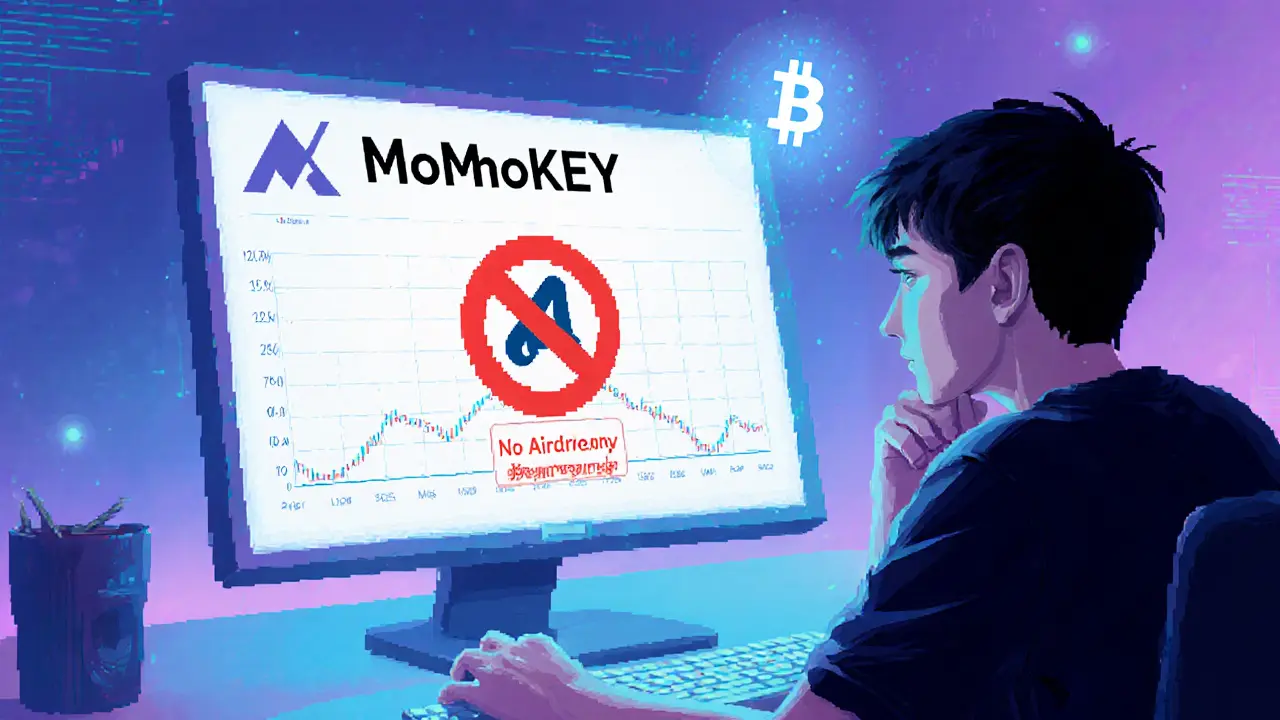
Explore whether a MoMo KEY (KEY) airdrop exists, how to verify legitimacy, claim steps, and compare it with other Momo projects. Get risks, liquidity info, and FAQs.
View More