BUNI Token – All the Essentials You Need
When diving into BUNI token, a community-driven utility token built on the Binance Smart Chain that aims to reward active participants and fund ecosystem growth. Also known as BUNI, it combines staking rewards, governance rights, and a regular airdrop schedule to keep holders engaged.
Understanding the tokenomics, the economic model that defines supply, distribution, and utility is the first step. BUNI caps at 1 billion tokens, with 40% allocated to community incentives, 20% to liquidity provisioning, 15% to a development fund, and the remainder split between the founding team and strategic partners. This structure creates a predictable inflation rate, allowing investors to estimate long‑term returns. The token’s utility includes transaction fee discounts on partner platforms, voting power in protocol upgrades, and eligibility for monthly airdrops that redistribute a portion of the treasury to active wallets.
Why BUNI Matters in the Crypto Landscape
Beyond its internal mechanics, BUNI interacts with several key entities in the broader market. The token is listed on multiple crypto exchanges, platforms where users can trade, stake, or provide liquidity for digital assets such as Coincall, Betconix, and ZilSwap. These venues offer different fee structures and security models, which directly affect BUNI’s price volatility and liquidity depth. For example, a review of Coincall highlighted its institutional‑grade custody, making it a safe harbor for large BUNI holders, while Betconix’s hybrid exchange‑casino model may attract speculative traders seeking higher risk‑reward profiles.
Governance is another pillar. Token holders can propose and vote on protocol changes, from fee adjustments to new feature rollouts. This democratic process mirrors DAO governance models, where the governance token, a digital asset granting voting rights within a decentralized organization acts as the decision‑making engine. In BUNI’s case, each token equals one vote, ensuring that the community’s voice directly shapes the roadmap. Such a structure not only aligns incentives but also reduces the risk of centralization—a common criticism of many newer tokens.
Finally, BUNI’s regular airdrop, a distribution event that sends free tokens to eligible wallets keeps the ecosystem vibrant. The airdrop formula considers wallet activity, staking duration, and participation in governance votes, rewarding users who contribute meaningfully. This approach contrasts with one‑off airdrops that often result in short‑term price spikes followed by sell‑offs. By tying rewards to ongoing engagement, BUNI fosters a stable holder base and encourages long‑term project support.
All these pieces—well‑structured tokenomics, exchange accessibility, robust governance, and recurring airdrops—create a cohesive ecosystem that’s both attractive to newcomers and sustainable for seasoned investors. Below you’ll find a hand‑picked selection of articles that break down BUNI’s airdrop steps, dive into its tokenomics, compare exchange options, and explore how its governance model stacks up against other DAO tokens. Dive in to get the practical insights you need to evaluate BUNI for your portfolio.
BUNiCORN (BUNI) Community Airdrop: Full Details, Eligibility & How to Claim
By Robert Stukes On 7 Jul, 2025 Comments (20)
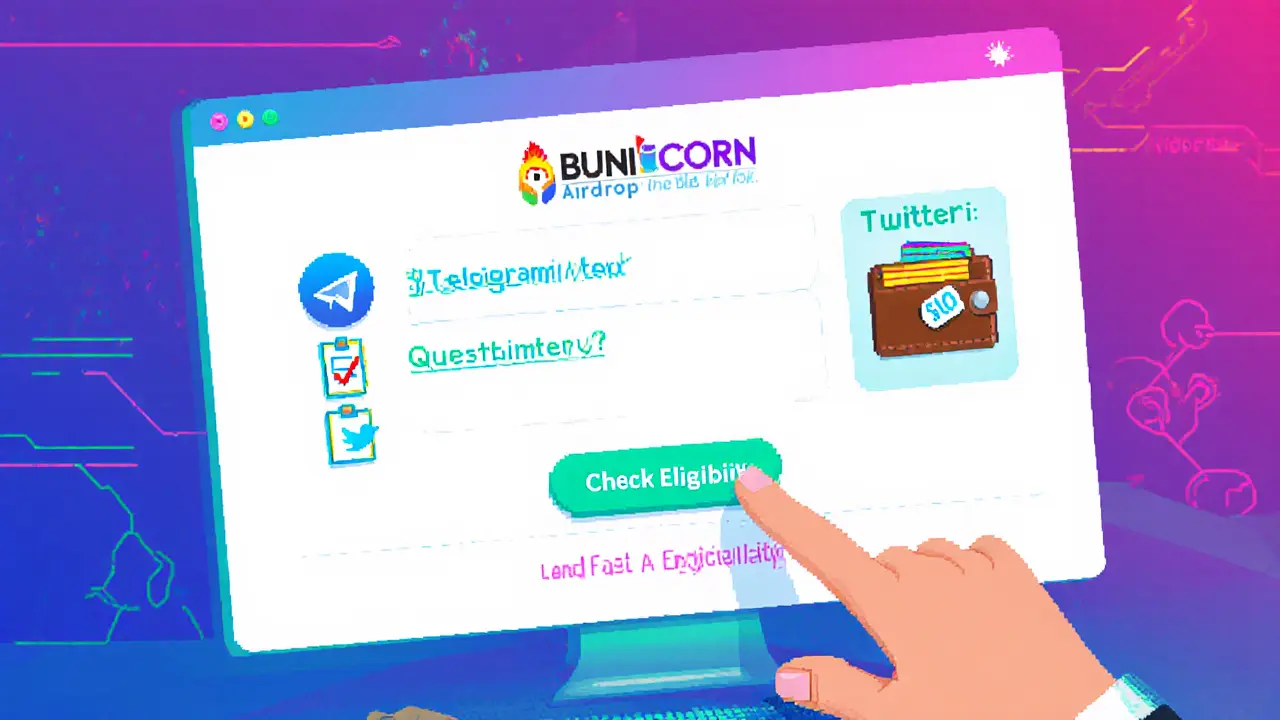
Discover everything you need to know about the Bunicorn (BUNI) community airdrop: eligibility, claim steps, token price, risks, and how it compares to other crypto airdrops.
View More