

Imagine opening a bank account in Bristol and being asked for your passport, proof of address, and utility bill. You hand them over. A week later, you want to open a brokerage account. They ask for the same documents. Then a crypto exchange. Same again. It’s frustrating, slow, and honestly, a bit insecure. KYC verification is the process behind these checks-Know Your Customer-but the traditional way is broken. That’s where blockchain steps in.
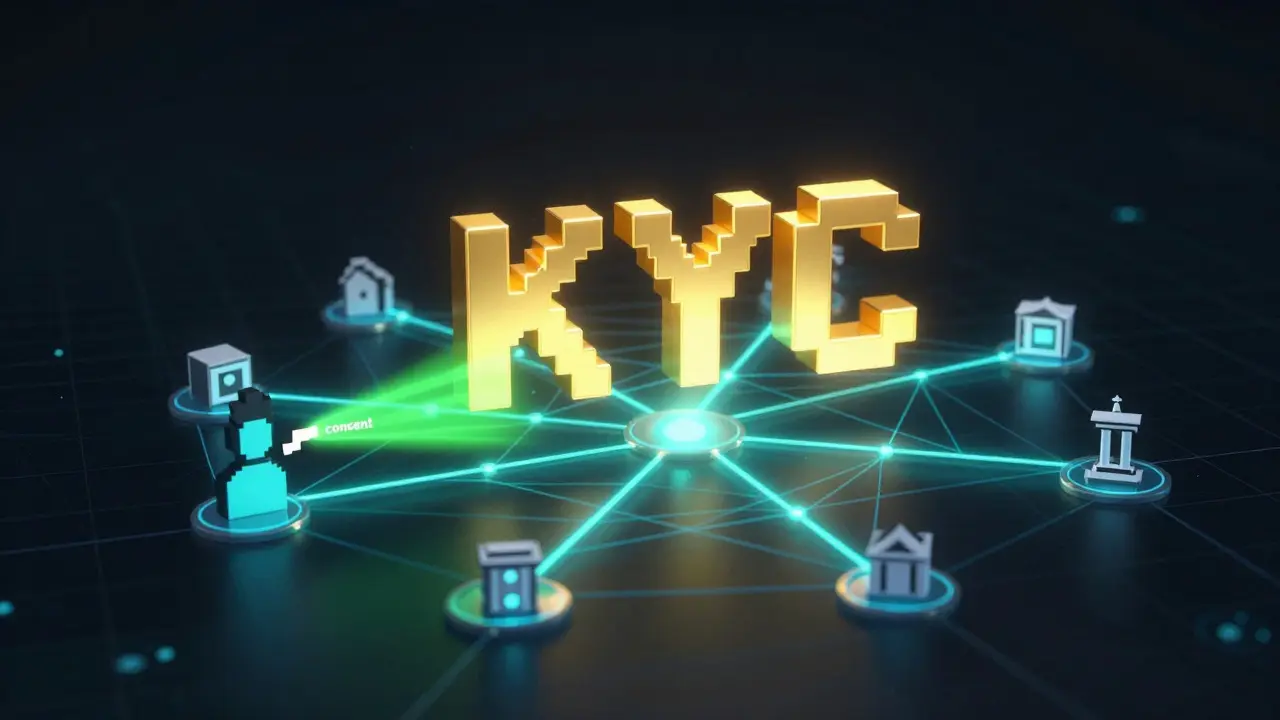
Blockchain doesn’t just store data; it creates a shared, immutable record that multiple institutions can trust without needing to see the raw documents every time. Instead of you submitting files to five different companies, you verify once, and those companies check a cryptographic hash on a distributed ledger. This shift from centralized silos to decentralized consensus is changing how financial services handle identity. Here’s how it actually works, why it matters, and what you need to know if you’re considering this technology.
The Core Problem with Traditional KYC
In the current system, every financial institution operates like an island. Bank A has no direct, secure line to Bank B’s customer database. So, when you move between providers, you start from scratch. This redundancy isn’t just annoying; it’s expensive. Compliance teams spend millions manually verifying documents that have already been checked elsewhere. Worse, storing physical or digital copies of sensitive IDs across multiple servers increases the attack surface for data breaches. If one bank gets hacked, your data is exposed. If two get hacked, it’s worse.
Traditional systems also lack standardization. One lender might require a specific format for a utility bill, while another accepts a different document entirely. This inconsistency slows down onboarding and creates friction for customers who just want access to financial tools. The result is a high drop-off rate during sign-up processes, costing businesses potential revenue.
How Blockchain Transforms Identity Verification
Blockchain-based KYC is a distributed ledger technology approach that enables reusable digital identities through cryptographic hashing and smart contracts. The core idea is simple: separate the verification status from the raw data. You don’t share your passport scan with every company. Instead, you prove that your passport was verified by a trusted authority, using a mathematical fingerprint called a hash.
Here’s the workflow in practice:
- One-Time Setup: You submit your ID documents to a trusted verifier (like a government agency or a major bank). This happens once.
- Hash Generation: The verifier processes your data and generates a unique cryptographic hash. This hash is uploaded to a permissioned blockchain network, such as Hyperledger Fabric, which is widely used in enterprise settings for its privacy features.
- Consent-Based Access: When you apply to a new service provider, they request access to your KYC status. You grant permission via a smart contract.
- Instant Verification: The new provider checks the blockchain. If the hash matches the one recorded during your initial verification, your identity is confirmed. No document re-upload needed.
If your data changes-for example, if you update your address-the old hash becomes invalid, and a new one is generated. This ensures the record is always current without exposing your full history to everyone.
Key Technical Components
Understanding the tech stack helps clarify why this method is more secure than traditional databases. Three main elements drive the system:
- Cryptographic Hash Functions: These act as digital fingerprints. Even a tiny change in input data results in a completely different hash output. This makes tampering obvious because any alteration would break the match on the ledger.
- Smart Contracts: These are self-executing code segments stored on the blockchain. In KYC contexts, they automate compliance rules. For instance, a smart contract might automatically approve a loan application only if the user’s KYC status is "verified" and their age is above 18. This removes manual review bottlenecks.
- Permissioned Networks: Unlike public blockchains like Bitcoin, KYC systems typically use private or permissioned ledgers. Only approved nodes (banks, regulators, auditors) participate. This balances decentralization with the privacy requirements of financial regulations like GDPR.
Researchers like Bhaskaran et al. have proposed consent-driven models where users control exactly who sees what. Hanbar et al. further optimized this by using off-chain storage (via IPFS) for large files and keeping only the links and hashes on the blockchain, improving speed and scalability.
Comparing Traditional vs. Blockchain KYC
The differences aren’t subtle. Let’s look at the practical implications side-by-side.
| Feature | Traditional Centralized KYC | Blockchain-Based KYC |
|---|---|---|
| Data Storage | Siloed in individual company servers | Distributed across a permissioned ledger |
| Verification Process | Repeated document submission per institution | Single verification, reusable via hash checks |
| Security Model | Vulnerable to single-point-of-failure breaches | Immutable records with comprehensive access logs |
| Customer Control | Limited; data often retained indefinitely | High; users grant/revoke access via consent |
| Compliance Cost | High due to manual audits and redundant checks | Lower due to automated smart contract execution |
| Interoperability | Poor; requires manual data exchange | High; standardized protocols allow cross-institution sharing |
This table highlights why financial institutions are starting to pilot these systems. The cost savings come not just from fewer staff hours spent checking IDs, but from reduced fraud losses and faster customer acquisition.
Implementation Challenges and Real-World Constraints
It sounds ideal, right? But implementing blockchain KYC isn’t plug-and-play. There are hurdles that organizations must navigate carefully.
Technical Complexity: Building a robust system requires expertise in distributed ledger technology, cryptographic security, and smart contract development. Teams need to understand platforms like Hyperledger Fabric deeply, including how to manage node consensus and data privacy channels. The learning curve is steep for legacy IT departments.
Scalability Concerns: While academic studies show feasibility, real-world throughput varies. High-volume environments, like major retail banks processing thousands of sign-ups daily, need to ensure the blockchain network can handle the transaction load without latency spikes. Optimizations like off-chain storage help, but architecture design is critical.
Regulatory Fragmentation: Data privacy laws differ across jurisdictions. GDPR in Europe, for example, grants users the "right to be forgotten." Blockchain’s immutability seems contradictory to this. However, solutions exist: store only hashes on-chain and keep raw data off-chain, allowing deletion of the source data while retaining the verification trail. Aligning these technical approaches with legal requirements is a complex task that requires close coordination between legal and tech teams.
Network Effects: The value of blockchain KYC grows as more institutions join the network. If only three banks participate, the benefit is limited. Achieving widespread adoption requires industry-wide cooperation, which is difficult when competitors are involved. Consortiums are forming to address this, but progress is gradual.

User Experience and Privacy Benefits
For the end-user, the benefits are tangible. A 2023 Statista survey found that 88% of US adults express concern about data privacy when interacting with brands digitally. Blockchain KYC addresses this fear directly. Since you only share what’s necessary-and only with whom you consent to-you retain more control over your personal information.
Think about the last time you switched mobile carriers or opened a credit card. You probably had to upload photos of your ID again. With a mature blockchain KYC ecosystem, that step disappears. You log in, authorize the check, and you’re done in seconds. This reduction in friction improves customer satisfaction and reduces abandonment rates during onboarding.
Moreover, the audit trail provided by the blockchain means that if a dispute arises-say, a bank claims you provided false info-the immutable record proves exactly what was verified and when. This transparency builds trust between consumers and institutions.
Future Outlook and Adoption Trends
The trajectory for blockchain KYC points toward broader integration into mainstream financial services. As regulatory technology (RegTech) matures, we expect to see standardized protocols that make cross-border identity verification seamless. Imagine verifying your identity in London and instantly using that verification to open an account in Singapore. This level of interoperability is currently rare but technically feasible with blockchain.
Industry analysts predict significant cost savings in identity verification as these systems scale. The focus is shifting from experimental pilots to production-grade deployments. Major fintech companies are investing in partnerships with blockchain developers to build these infrastructures. The long-term viability is strong, driven by increasing stringency in data protection laws and rising customer expectations for streamlined experiences.
While not every business will adopt blockchain KYC immediately, the trend is clear. The combination of security, efficiency, and user control makes it a compelling alternative to outdated, paper-heavy processes. For anyone involved in financial services or tech infrastructure, understanding this shift is no longer optional-it’s essential.
Does blockchain KYC replace all existing identity documents?
No, it complements them. You still need valid government-issued IDs for the initial verification. Blockchain simply stores the proof that those IDs were checked, eliminating the need to resubmit the physical or digital copies repeatedly.
Is my personal data stored on the blockchain?
Usually, no. Most implementations store only cryptographic hashes and metadata on the chain. The actual sensitive data (like your photo ID) remains off-chain in encrypted storage, linked to the hash. This preserves privacy while maintaining verifiability.
Which blockchain platforms are best for KYC?
Hyperledger Fabric is the most common choice for enterprise KYC due to its permissioned nature, modular architecture, and support for private data collections. Other options include Corda and Quorum, depending on specific institutional needs.
How does blockchain KYC handle GDPR compliance?
By separating raw data from the ledger. Since only hashes are stored on-chain, deleting the off-chain data satisfies the "right to be forgotten" without altering the immutable chain. The hash remains as a historical record of verification, not as personal data itself.
Can I revoke access to my KYC data once granted?
Yes. Smart contracts typically include mechanisms for users to revoke permissions. Once revoked, the service provider loses access to your verification status, though they may retain a copy of the data according to their own retention policies unless specified otherwise in the contract.




Patrick Pat
August 16, 2026 AT 13:29So we are just trading one big database for a bunch of smaller ones that pretend to be friends? Because from where I stand, if I have to show my ID to the bank, then the broker, then the crypto guys, it feels like I'm auditioning for a job at the CIA every time I want to buy a coffee. The 'immutable record' part sounds great until you realize your typo in your address in 2019 is now carved in stone forever. Nice.
Claudio Perrone
August 17, 2026 AT 19:15this is going to change everything bro. finally something real. i think they are hiding the fact that this will let them track us even more but who cares right? the money is in the details and the details are missing here. just trust the process. also typos happen when you type fast so dont judge me.
Aaron Morrissey
August 19, 2026 AT 04:13One must consider the profound implications of such a shift. It is not merely a technological upgrade; it is a fundamental reimagining of how trust is constructed within our society. We are moving from a paradigm of suspicion to one of verified consensus. This is a beautiful, albeit complex, evolution. Let us hope it serves humanity well.
Patrick Quairoli
August 19, 2026 AT 13:06typical. another way for the banks to collude. you think they really care about your privacy? nah. its so they can share data on who is broke and who is rich without asking permission. the 'permissioned network' is just a polite word for a cartel. wake up people. they are watching you. always have been. this just makes it easier for them to see through the walls.
Zothana Pachuau
August 20, 2026 AT 12:27Great read! Just a small note though: in India, we have Aadhaar which does something similar but centralized. It works surprisingly well for what it is, though the security debates never end. Maybe decentralization is the next logical step globally? Or maybe we just need better encryption on the current systems. Curious to hear thoughts from others on hybrid models.
Linda Leeuwesteijn
August 20, 2026 AT 22:40This is so important! 🌟 I’ve been struggling with this exact issue lately. Having to upload my passport five times for different apps was driving me crazy. If this actually works as described, it would be a game-changer for user experience. I’m cautiously optimistic! 💻✨
Shawn Schaerer
August 22, 2026 AT 06:04The argument presented here is compelling, yet it rests upon a fragile foundation of assumption. You posit that distributed ledgers solve the problem of redundancy, yet you ignore the latency costs inherent in consensus mechanisms. Is speed truly sacrificed for security? In the high-frequency trading world, milliseconds matter. Do we accept a slower verification process for the sake of theoretical purity? One must weigh the trade-offs carefully before declaring victory.
Hicham Mounir
August 23, 2026 AT 05:56I get why people are skeptical, honestly. It’s a lot of new tech to wrap your head around. But thinking about how much stress goes into financial onboarding... imagine just logging in and being done. That peace of mind is worth a lot. I think we’re ready for this, aren’t we?
Sarah Campbell
August 24, 2026 AT 11:14Finally some sense! 🇺🇸 Why do we let Europe dictate our privacy standards anyway? GDPR is a nightmare for business. This blockchain stuff sounds like it’ll help American companies move faster without all that bureaucratic red tape. Let’s get it done! 🚀
Phelan Deihl
August 25, 2026 AT 18:13cool idea but how does it work if you move countries? seems like a headache to manage across borders. im probably overthinking it but curious.
michelle aguilar
August 27, 2026 AT 08:07Oh, how delightful, isn't it? To reduce the human element of identity to a mere hash function? How very modern. One wonders if we shall soon be identified by our digital footprints rather than our souls, or perhaps our social credit scores? The implications are, shall we say, *profoundly* unsettling, wouldn't you agree? Or am I just being too dramatic? Probably. But still, fascinating.
Lance Konig
August 29, 2026 AT 03:51You're missing the point entirely. It's not about replacing the soul, it's about efficiency. The article clearly states that raw data stays off-chain. Read it again. The hash is just a pointer. It's elegant engineering. Stop looking for metaphors and start looking at the architecture.
Dina Lazarova
August 30, 2026 AT 13:34It appears to be a solution in search of a problem, though a well-dressed one. The prose is competent, if somewhat dry. One notes the reliance on Hyperledger, which suggests this is not yet a consumer-facing revolution but an enterprise pilot. Until the UX is flawless, it remains a curiosity for the technologists. Let us await further developments with bated breath.
Walker Perry
September 1, 2026 AT 05:59They are coming for your data. Did you know that every time you verify your ID, they are scanning your retina? Not really but who knows? This blockchain thing is just a front. They want to put a chip in your brain. The 'smart contracts' are just code for control. Wake up. The matrix is closing in. Don't let them hash your freedom!
Alexander Scheel
September 1, 2026 AT 19:29How quaint. We used to have honor systems. Now we need cryptographic proofs. And for what? So a bank can tell you your loan was denied because your hash didn't match their algorithm? The moral hazard of removing human judgment from these processes is staggering. Who is responsible when the machine is wrong? The code? The coder? Or the customer? A question left unanswered, naturally.
Evelyn Kula
September 3, 2026 AT 16:05Ugh, another tech bro dream. Think about the energy consumption! Even if it's permissioned, it's still servers running 24/7. And don't get me started on the 'interoperability'. Who decides which protocol wins? The US? Of course it does. The rest of the world can catch up later. 🇺🇸💪
manish jha
September 4, 2026 AT 06:58In the grand scheme of dharma, technology is neutral. It is the intent that matters. If this system serves to protect the vulnerable from fraud, it is good. If it serves only the greedy, it is bad. Judge the fruit, not the tree. However, ensure the tree is rooted in truth.
Ashley Snyder
September 5, 2026 AT 23:50I actually think this could be pretty cool for expats. Moving between countries is such a pain administratively. If I could keep my identity verified once and just carry it with me, that would save so much time. I'm hopeful it'll work out eventually, even if the tech is still maturing.
Melissa G
September 7, 2026 AT 19:17There is a philosophical tension here that often goes unnoticed. We speak of 'trust' as if it were a commodity to be stored on a ledger. Yet, trust is inherently relational and contextual. By reducing identity to a static hash, do we not strip away the nuance of human interaction? Perhaps we are building a system that is secure, yes, but also sterile. It reminds me of the old adage: the map is not the territory. The blockchain is the map. Where is the territory? In the hearts of the people involved, surely. We must ensure that our technology serves the human spirit, not merely the efficiency metrics of corporations. Otherwise, we risk creating a world that is perfectly ordered, yet profoundly lonely. Let us proceed with caution and wisdom, keeping our eyes open for the unintended consequences of such powerful tools.
Patrick Pat
September 8, 2026 AT 13:16Lonely? Yeah, that tracks. At least now we can all be lonely together on the same distributed ledger. Cheers to that.