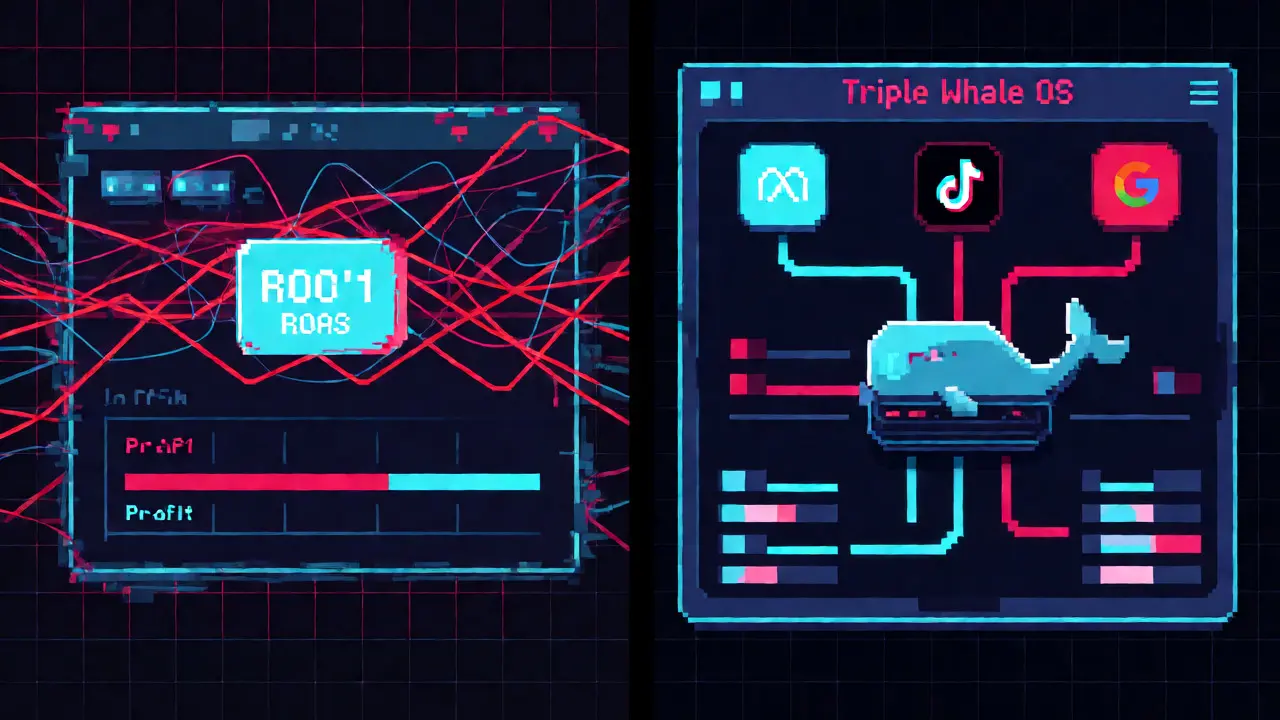
Imagine you are running a direct-to-consumer brand. You spend $50,000 on ads across Meta, TikTok, and Google. At the end of the month, your dashboard shows a Return on Ad Spend (ROAS) of 4.0. But when you check your bank account, the profit margins look thin. Why? Because traditional analytics tools often lie about where that money actually came from. They overvalue the last click and ignore the complex journey a customer took before buying. This is the "data bottleneck" problem, and it’s exactly what Triple Whale aims to solve.
As we move through 2026, the future of e-commerce analytics isn't just about seeing more charts. It's about having an intelligence layer that thinks for you. Triple Whale has evolved from a simple dashboard into what they call an "eCommerce operating system." If you're a Shopify merchant or a DTC founder, understanding this shift is critical for staying profitable in an era of privacy changes and rising ad costs. Here is how the platform is changing the game and what you need to know before you commit your budget.
The Shift From Dashboards To Contextual Intelligence
Most analytics platforms give you raw data. They tell you that 1,000 people clicked your ad. But they don't tell you why those people bought a $5 candle instead of a $500 handbag. That context matters. Triple Whale's core mission has shifted from simple data consolidation to delivering contextual intelligence. This means the platform doesn't just aggregate numbers; it interprets them based on the specific nuances of commerce behavior.
Consider the difference between generic AI and specialized AI. A tool like ChatGPT can summarize a report, but it doesn't understand the lifecycle value of a subscription box versus a one-time purchase. Triple Whale’s proprietary AI, known as Moby, is trained exclusively on 12.7 billion commerce events from over 8,500 Shopify stores. This specialization allows Moby to make recommendations that are 3.2 times more actionable than general-purpose AI models. For example, it might identify that abandoned cart sequences perform better when triggered at specific times of day for customers in certain time zones, boosting recovery rates by up to 28%.
This evolution addresses a major pain point for founders. According to internal surveys, 78% of users reduced their time spent on reporting by at least 65%. Instead of spending six hours every week manually pulling data from five different sources, merchants now spend less than an hour reviewing insights generated by the system. The goal is no longer just to see what happened, but to know what to do next.
How The Technical Architecture Works
To deliver this level of insight, Triple Whale relies on a four-layer technical stack. Understanding these layers helps you appreciate why the platform commands a premium price compared to free alternatives like basic Shopify reports.
- The Triple Pixel: This is the first-party data collection engine. In environments disrupted by iOS privacy updates, standard tracking methods fail. The Triple Pixel achieves 98.7% accuracy in multi-touch attribution, compared to just 62.3% for Google Analytics in similar conditions. It bypasses cookie restrictions by leveraging server-side tracking and modeled conversions.
- The Founders Dashboard: This interface integrates 37 different data sources, including Shopify, Meta Ads, Google Ads, TikTok, Klaviyo, and Recharge. With API response times averaging 1.2 seconds, it provides a unified view of your business without the lag typical of older BI tools.
- The Semantic Layer: One of the biggest headaches in analytics is metric discrepancy. Does "ROAS" mean the same thing on Facebook as it does on Google? Often, no. The Semantic Layer standardizes 147 key performance indicators (KPIs) across all platforms, ensuring that when you compare channels, you are comparing apples to apples.
- The AI Layer: Powered by Moby, this layer processes the standardized data to generate predictive insights and automated actions. It moves beyond descriptive analytics (what happened) to prescriptive analytics (what should happen).
Security is also baked into the architecture. The platform holds SOC 2 Type II certification, meaning its security controls have been audited by third parties. Data is encrypted with AES-256 at rest and TLS 1.3 in transit, processing within AWS us-east-1 regions with a 99.95% uptime SLA. For brands handling sensitive customer data, this compliance is non-negotiable.

AI Agents And Automated Decision Making
The most significant leap in the future of Triple Whale is the introduction of agentic AI. We aren't just talking about chatbots that answer questions. We are talking about autonomous agents that perform tasks. Scheduled Moby Agents run weekly revenue optimization analyses automatically, reducing manual reporting time by 76%. These agents monitor anomalies, such as a sudden drop in ROAS on a specific TikTok campaign, and alert you immediately.
During Black Friday 2024, one user reported that anomaly detection caught a 47% ROAS drop on Monday morning. The issue was fixed within two hours, saving an estimated $18,000 in lost revenue. Without this automated vigilance, that loss might not have been noticed until the end-of-week report, by which time the damage was done.
Looking ahead, the roadmap includes features like Automated Budget Allocation, scheduled for release in mid-2025. This feature promises to dynamically shift ad spend across platforms with 92% accuracy in early testing. Imagine your budget automatically moving from underperforming Instagram campaigns to high-performing TikTok creatives in real-time. This reduces the cognitive load on media buyers and allows them to focus on creative strategy rather than spreadsheet management.
| Feature | Triple Whale | Polar Analytics | Northbeam |
|---|---|---|---|
| Attribution Accuracy | High (98.7% pixel accuracy) | Moderate (72% native) | Superior for organic traffic |
| Ease of Implementation | 4.8/5 (Very Easy) | 3.9/5 (Moderate) | 4.0/5 (Moderate) |
| AI Functionality | 4.9/5 (Agentic & Predictive) | 4.3/5 (Descriptive) | 4.1/5 (Statistical) |
| Entry Price Point | $299/mo (Min $5k ad spend) | $199/mo (No min) | Custom Pricing |
| Best For | Multi-channel DTC Brands | Data-savvy Teams | Organic-heavy Brands |
Competitive Landscape And Market Position
In the Shopify analytics ecosystem, Triple Whale currently holds the #2 position behind Littledata, according to G2’s Spring 2025 report. However, its growth trajectory suggests it may soon take the top spot, particularly among larger brands. Analysts predict Triple Whale will capture 28% of the Shopify analytics market by late 2025, up from 21% the previous year.
Why choose Triple Whale over competitors? The primary advantage lies in ease of use combined with deep AI integration. While Polar Analytics offers more flexibility for data scientists who want to customize every query, Triple Whale prioritizes out-of-the-box usability. For a small team of three managing millions in revenue, speed and clarity often outweigh customization options. Additionally, Triple Whale leads in TikTok integration, scoring 4.7/5 compared to competitors' lower ratings, making it essential for brands heavily invested in short-form video advertising.
However, it is not perfect. The pricing structure is a common complaint. The starter plan requires a minimum monthly ad spend of $5,000 to unlock full features. For smaller brands with sub-$10k ad budgets, this can result in poor ROI. One Reddit user noted paying $299/month for months with little value until their Black Friday sale spike. Furthermore, some experts criticize the attribution model for potentially overvaluing last-click channels by 15-18% compared to strict incrementality tests. If you rely solely on Triple Whale’s ROAS figures without validating against holdout groups, you might be scaling unprofitable channels.

Implementation Challenges And Realities
Setting up Triple Whale typically takes 7-14 days for a full rollout. The initial installation of the Triple Pixel takes about two hours for technically proficient users, or 45 minutes with developer assistance. However, the learning curve shouldn't be underestimated. Users report needing 8-12 hours of training to master the core functionality, although the Moby Chat interface simplifies basic queries significantly.
Common pitfalls include historical data discrepancies. When you switch analytics providers, the numbers rarely match perfectly due to differences in tracking methodologies. Triple Whale offers a 30-day data reconciliation window to help bridge this gap, but expect some variance in your historical reports. Another challenge arises during major Shopify platform updates, where API sync issues can temporarily disrupt data flow. The company maintains a dedicated Shopify API team with a 97% resolution rate within 24 hours, but downtime still happens.
Support quality varies by tier. Enterprise clients enjoy dedicated account managers with high satisfaction rates. Startup tier users, however, often face average email response times of 18 hours. For urgent issues during peak sales seasons, this delay can be costly. Engaging with the active Triple Whale community on Slack (over 12,500 members) can provide faster peer support and workarounds for common glitches.
The Future Outlook: From Analytics To Operations
The long-term vision for Triple Whale extends beyond analytics. The acquisition of AI startup DeepSight in April 2025 signals a push into visual analytics, helping brands optimize product imagery and ad creative performance automatically. This aligns with the broader industry trend toward "predictive operations," where software doesn't just report on the past but executes decisions in the present.
Features like Auto-Optimize, currently in beta with enterprise clients, hint at a future where the platform autonomously adjusts bids, pauses ads, and reallocates budgets. For many merchants, this represents the holy grail: freeing up human capital for strategy while machines handle the tactical execution. However, this creates a new dependency. With 83% of Triple Whale’s revenue derived from Shopify merchants, any significant change in Shopify’s platform policies could impact the ecosystem. Diversification remains a strategic priority for the company.
For brands considering adoption, the decision hinges on scale and complexity. If you are a Shopify Plus brand with over $1 million in annual revenue running multi-channel campaigns, the efficiency gains likely justify the cost. If you are a smaller brand relying primarily on organic traffic, simpler, cheaper tools may serve you better. The future of analytics is intelligent, automated, and deeply integrated-but only if your business volume supports the investment.
Is Triple Whale worth it for small businesses?
Generally, no. Triple Whale is optimized for brands with significant ad spend (typically $5,000+ per month). Small businesses with limited budgets may find the $299/month starting price hard to justify unless they are experiencing rapid growth or complex multi-channel attribution needs. Simpler tools or native Shopify reports may offer better ROI for early-stage startups.
How accurate is Triple Whale's attribution compared to Google Analytics?
Triple Whale claims 98.7% accuracy in multi-touch attribution using its Triple Pixel, whereas Google Analytics often struggles with iOS privacy changes, achieving around 62.3% accuracy in similar environments. Triple Whale uses server-side tracking and modeling to fill gaps left by browser-based cookies, providing a more complete picture of the customer journey.
What is Moby AI and how does it work?
Moby is Triple Whale's proprietary AI system trained on 12.7 billion commerce events. Unlike generic LLMs, it understands e-commerce specific contexts, such as product lifecycles and channel behaviors. It powers features like anomaly detection, predictive forecasting, and automated budget allocation, offering actionable insights rather than just raw data summaries.
Can I integrate Triple Whale with non-Shopify platforms?
While Triple Whale is deeply integrated with Shopify, it supports other platforms through its API and integrations. However, its strongest capabilities and seamless data flows are designed for Shopify merchants. Non-Shopify users may experience more setup friction and fewer native features compared to Shopify Plus or Standard users.
Does Triple Whale replace my ad platform dashboards?
Not entirely. Triple Whale provides a unified view and better attribution, but you still need to log into Meta, Google, or TikTok for creative adjustments and bid strategies. Think of Triple Whale as the command center that tells you *where* to spend, while the ad platforms remain the vehicles for executing those spends.